- Yes
- No
 Light Tank Mk. VII - Murmansk to Armenia
History
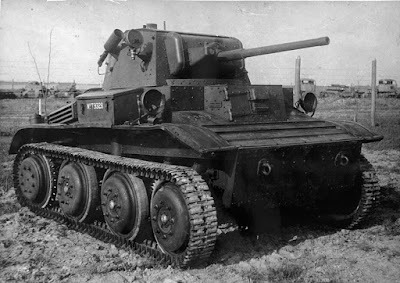
In late December of 1941, as part of the Allied effort to support the USSR against Germany, 20 Tetrarch tanks arrived by way of Persia (modern Iran). They reached the Iranian border town of Zanjan on December 27th, delivered through the southern supply route that bypassed the treacherous Arctic convoys. It was the first time these light British tanks came to Soviet hands, and it was also the last major shipment no further orders of Tetrarchs were sent due to doubts about their combat value.
The batch included early production vehicles some dating from late 1940 and a few built later in 1941. Many still carried British unit marks from their time with units like the 10th Royal Hussars, where they had been used for training before being sent east.
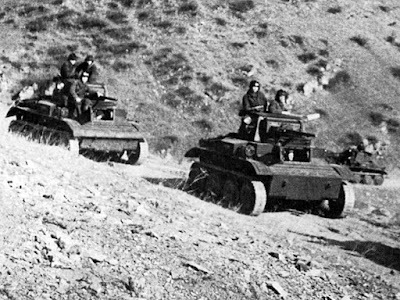
Tetrarchs assigned to the 21st Independent Training Tank Regiment, March 1942, in the Shaumian area.
Once in Persia, the tanks were moved north to Baku and then onward to Armenia. By March 1942, they had been assigned to the 21st Independent Training Tank Regiment near Yerevan, where crews learned to operate them and tested their capabilities in the mountainous terrain. This assignment included some patrol duties, but even early on the Tetrarch’s limitations especially in parts and logistics began to show.
The presence of these British tanks even caused a minor diplomatic episode in the spring of 1942. Soviet war photographers captured images of the Tetrarchs on maneuvers, which were sent back to Moscow and beyond. British officials worried that the photos being published could reveal sensitive information, prompting a request to suppress further publication of images of both Tetrarchs and other British tanks in Soviet service.
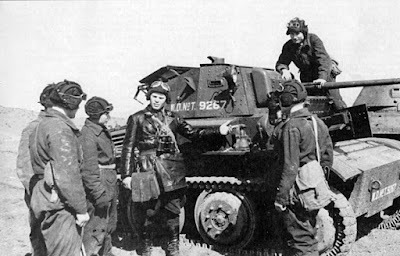
By mid-1942 the Tetrarchs had moved from training units into operational formations. In May of 1942, they were incorporated into the newly formed 151st Tank Brigade, serving alongside older Soviet T-26 light tanks. This brigade was part of the Transcaucasian and North Caucasus Fronts, responsible for guarding the southern approaches and supply routes.
Once deployed, Soviet crews quickly learned both the strengths and weaknesses of the Tetrarch. The engine was reliable, and the tank’s speed and mobility were appreciated, especially on firm ground. However, the cooling system was poorly suited for extended use in cold climates, and the thin armor barely thicker than many light machine shields offered scant protection. Components like wheel carriers, gears, and suspension parts were prone to breaking under regular use, and spare parts were hard to come by.
Despite these issues, the Tetrarchs did see combat. In early 1943, the 151st Brigade entered offensive operations, including assaults against fortified positions. Even though some crews distinguished themselves during these battles, the thin armor and mechanical problems meant the tanks suffered losses and limited success. By early February 1943 only a fraction of the original vehicles remained operational after heavy use and losses.
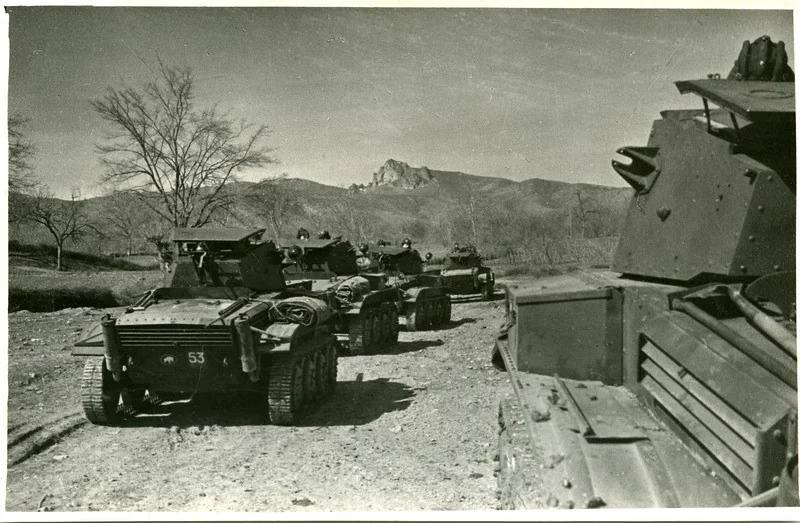
Soviet Tetrarch tanks, still carrying British markings
As the spring of 1943 progressed, surviving Tetrarchs were reallocated. Some went to the 563rd Independent Tank Brigade and participated in an amphibious operation at Novorossiysk, which ultimately failed. Many tanks that had broken down were retired from mobile service and used as static defenses anchored in fixed positions like roadblocks or pillboxes especially around the strategic Shapsugkiy bridge.
By late 1943 the “combat career” of the Tetrarch in Soviet service was effectively over. Spare parts were exhausted, maintenance resources were scarce, and the design simply could not keep pace with the demands of prolonged fighting on the Eastern Front. Some tanks lingered in repair depots or were written off by early 1944
"Based on information received from units about the deficiencies of the MK-7 British tanks, I report that:
-
- The engine works well, but the cooling system has a drawback that does not allow the water to be fully drained without removing the engine. In addition, the cross-section of the drain pipe is 4 mm, which is insufficient, quickly clogs, and freezes. Work in the winter even on the Transcaucasian Front requires antifreeze.
-
- Many parts and assemblies are not robust, and break down even with light use on good roads.
-
- The wheel carriers are not robust enough and tend to crack in the corners.
-
- The drive shaft gear wears out quickly.
-
- The armour has the following drawbacks:
-
- The turret roof is poorly held, the seven 4-5 mm thick brackets can be torn off with a crowbar.
-
- The hatch lock is loose.
-
- Openings are present in the turret and rear that could be easily avoided, strengthening the tank against bullets and incendiary fluid.
- The layout of certain components (gearbox, differential, brake drums) is poor, as they are located underneath the engine and require its removal for maintenance.
- Access to the idler wheel gear carrier is difficult.
- The track and track links do not have good traction with the ground and slip often on wet or snowy roads."
Battle for the Caucasus
On January 1, 1943, the 151st Tank Brigade, equipped with 25 T-26 tanks and 19 Mk. VII Tetrarchs, was redeployed from Leninakan to the Black Sea Group of the Transcaucasian Front. Alongside it were the 563rd Independent Tank Battalion, which fielded 21 M3 Light tanks and 9 M4A2 Shermans, and the 564th Independent Tank Battalion, equipped with 10 T-34s and 20 T-26s.
Upon arrival, the 151st Tank Brigade was placed under the command of the 47th Army, where it soon entered combat for the first time.
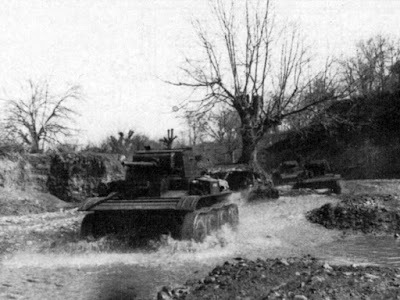
Specificaions
General Information
Origin: United Kingdom
USSR Received: 20
Crew: 3
Dimensions
Length: 4.11 meters (13 feet 6 inches)
Width: 2.31 meters (7 feet 7 inches)
Height: 2.11 meters (6 feet 11 inches)
Weight: 7.6 tons (approx. 16,800 lbs)
Armament
Main Gun: 40mm Ordnance QF 2 pounder
Ammunition Capacity: 50 rounds
Effective Range: Approx. 1,000 meters (1,094 yards)
Secondary Armament: 1 x 7.92mm Besa machine gun (coaxial)
Ammunition Capacity: Approx. 2,025 rounds
Armor
Hull Front: 16mm
Hull Sides: 14mm
Turret Front: 16mm
Mobility
Engine: Meadows 12 cylinder gasoline engine (165 hp)
Top Speed: 64 km/h (40 mph) on roads
Range: 225 km (140 miles)
Transmission: Wilson pre selector gearbox