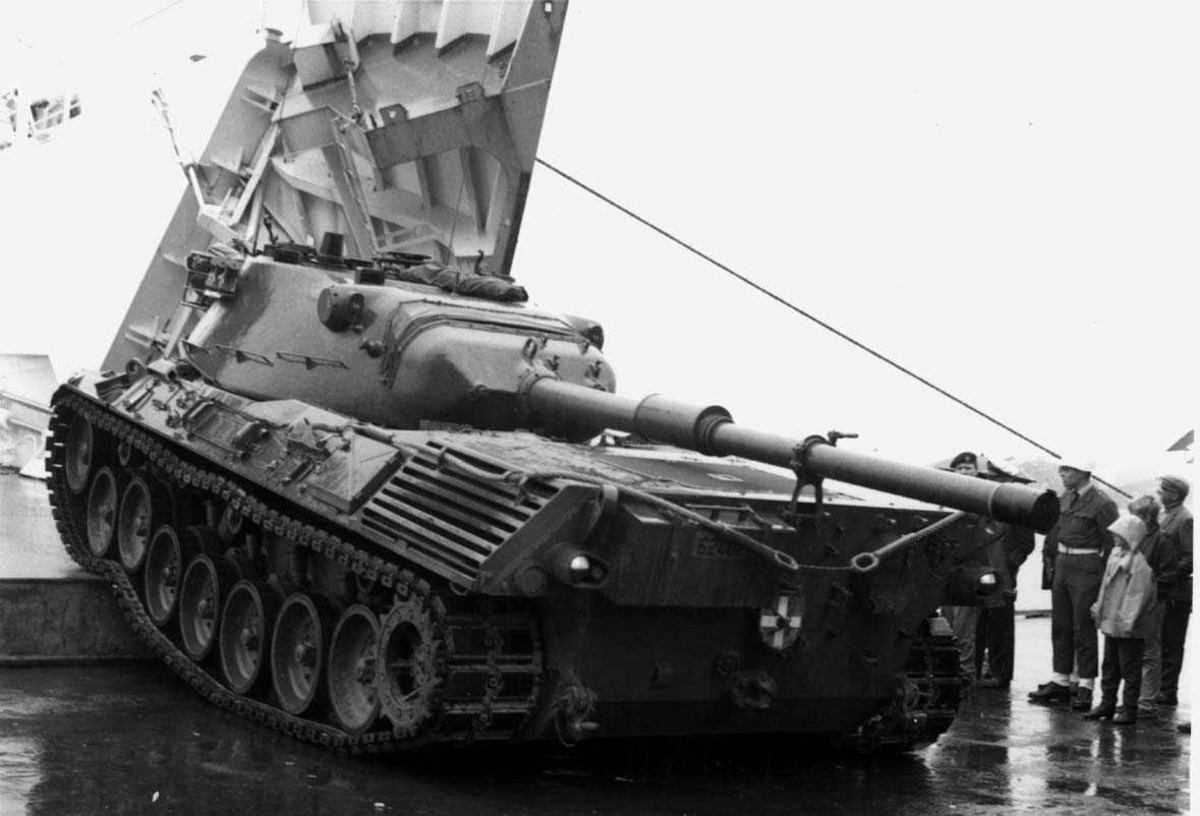
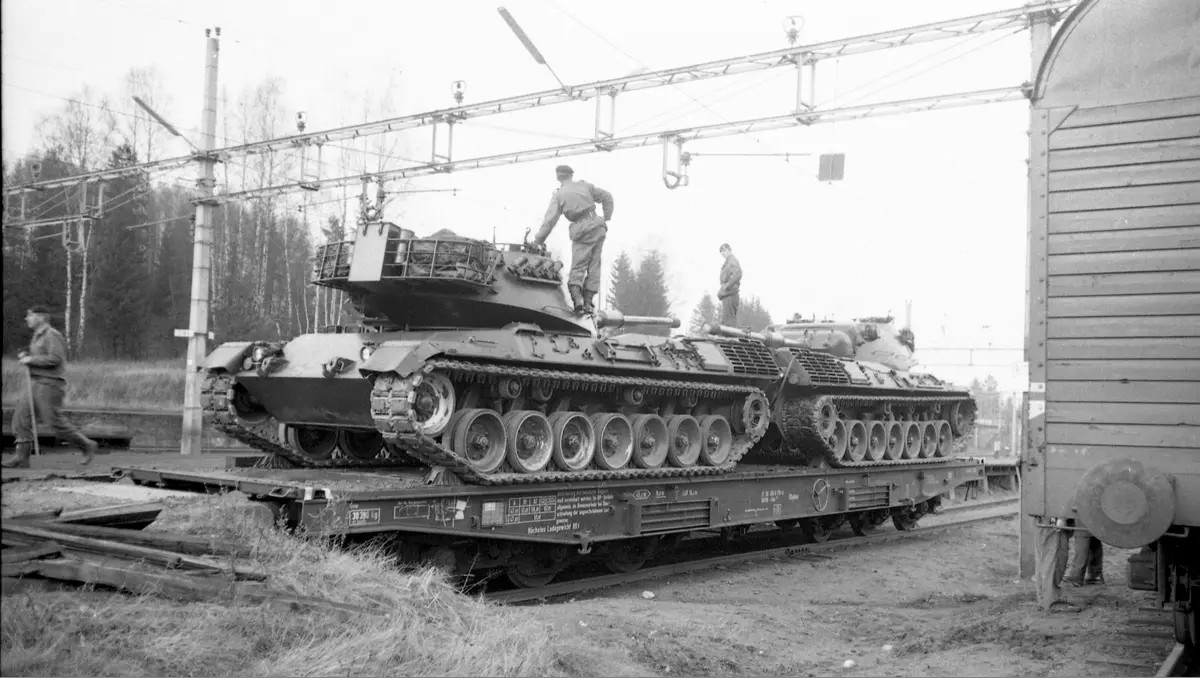
LEOPARD 1 EARLY PRODUCTION
INTRODUCTION
Back in the late 1960’s, Norway had been doing trials with two leopard 1 tanks for a couple years, and when they decided they wanted to order them, they wanted these to be delivered as quickly as possible. Germany then took an unprecedented step and decided to lend them as many as 34x Leopards from their own platoons! These were returned when all the 78 ordered leopards were delivered by 1971. This vary a little bit from the Leopard 1A1NO, and would in my opinion be a good addition even tough it’s copy paste, but as it was used for 2 years, it could either be added to the Swedish techtree as a part of an Norwegian subtree or in a Norwegian/Danish independent techtree, it’s differences differs in protection, design and firepower, and could be foldered together with the Leopard 1A1 Early with an battle rating of 8.0, or as a premium/squadron vehicle.
HISTORY
The Leopard main battle tank was developed on the basis of experiences from World War 2 and experiences gained in the post-war period. The wagon was developed in the late 1950s/early 60s, the first ones then entered German service in 1965 and have since been Germany’s standard tank. It has also undergone a number of upgrades over the years and has now come in yet another new and improved edition. Leopard 1 has been in use in a number of countries around the world, including Australia and Canada. Today, Leopard 1 is on its way out of the installations of quite a few countries, which has meant that a number of new user countries have also come up, there are countries such as Brazil and Chile.
Shortly before the arms aid ended in early 1968, the Norwegian Armed Forces set up a committee, or so-called Tank Commission, to look at, evaluate and compare which equipment the Norwegian Armed Forces should acquire. These were to be assessed based on their properties in Norwegian terrain and climate, as well as their possible delays and problems with acquisition. As a result of this commission’s work and handover, 2 German Leopard tanks were loaned from the Bunderwehr Panzerlehrbattaillon in the autumn of 1966. These tanks arrived in Trandum, Norway in November, and a 3-man instructor group, led by Lieutenant Colonel Scheb, Ben accompanied them. They also included 2 specialists from the manufacturer Krauss Maffei in Munich. Technical tests were carried out at Trandum, in addition to sharpshooting at the Hjerkinn shooting range, which also included mobility exercises. This continued until late 1967, when the German Leopard tanks were returned to the Bunderwehr Panzerlehrbattaillon. Normal activity at Trandum ran parallel to these tests, and was to some extent affected by this. In 1967 the Swedish Stridsvagn 103-0 was lended to be trialed as well, as an option to the Leopard 1, the reason for this was mostly it’s unique, innovative design. However, as the leopard’s mobility and adaptability were superb to this tank in the Norwegian terrain, and was thus choosen over the STRV 103. In the same year that the arms aid ended, the authorities decided to acquire Leopard tanks, but due to the situation both at home and abroad, delivering the tanks on time became difficult, and then the Bundeswehr made the unprecedented choice to take 34 tanks from its own stock to comply with the Norwegian request. This was a loan, and was to be returned when the tanks were delivered. I haven’t been able to find any images of these trials yet, as the information about these trials, for that matter everything that was done around this time.
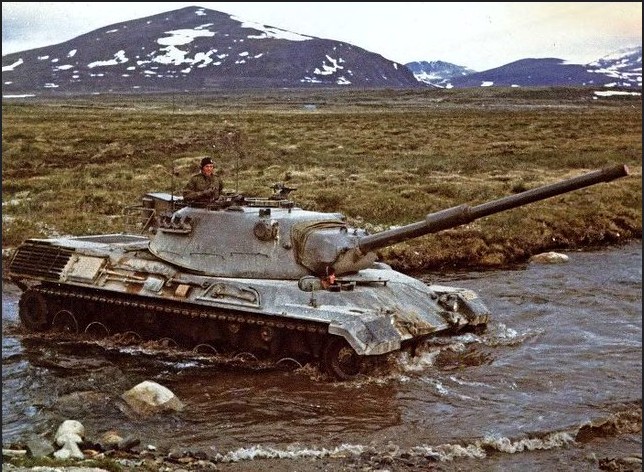
-Leopard 1 in 1967 during the trials
The total amount of tanks from the initial order ended up being 78 units and were fully delivered within the end of 1970. These tanks were of the Leopard 1A1 and were after Norwegian modifications, given the designation Leopard 1A1NO. Some of the modifications of this included a reinforced underbelly as the original couldn’t handle the rocky Norwegian terrain, and in some cases it had actually made holes in the floor, this is a common ting on all the Norwegian Leopard 1 tanks. As these tanks saw a 20 year service, and the Leopard 1 were relatively new, the tanks gradually underwent modifications and upgrades. The very first ones did not have gun stabilization, something that was released in 1971, and installed on tanks beginning in 1974-1975, so at some point Norway installed this on their leopards, i don’t know the exact date. They didn’t have night vision either, something that was added in the 1980’s. This is just two of many upgrades done throughout the years. And this is the reason i am suggesting a Early and Late variant (Right after delivery and at the end of it’s service before being upgraded to 1A5NO). In the beginning of the 1990’s, Norway was starting to phase out the aging NM116 and M48A5 tanks, and to compensate for this, they ordered 96x used Leopard 1A1A2 tanks from Germany. The Leopard 1A1A2 was an improved version, and featured the PZB 200 Low-Light Level Television (LLTV), Passive infrared aiming system and IRS 100 IR scanner, cannon stabilization to name a few, these also featured the additional armor on and around the turret. As the original Leopard 1A1NO had a little while before this purchase been upgraded to Leopard 1A5NO standard, with extensive Norwegian upgrades, a total of 33x of the leopard 1A1A2’s were upgraded to 1A5NO and given the designation Leopard 1A5NO2. These then differed from the 1A5NO’s with the additional turret armor.
The remaining 63x Leopard 1A1A2’s received cheaper and less extensive upgrades, this was likely due to costs, among the most noticeable modifications were the belly reinfocement, and that they took the Norwegian Model 128 Simrad LV3 Laser Rangefinder which had been used on the NM116 tanks and installed these on the 1A1A2’s, and integrated it, mounting it externally on top of the gun mantlet. The Vehicle was then given the designation Leopard 1A1A2NO. The Leopard 1A1A2NO was designated to the sourthern Norwegian armored brigades, and was phased out when the Norwegian army received the Leopard 2A4 tanks they had bought from the Netherlands in 2001.
DESCTIPTION AND DETAILS OF THE NORWEGIAN LEOPARD 1A1NO Early Service
Difference between Loaned German Leopard 1 Early Production and Leopard 1A1NO Early service
Loaned Leopard 1 Early Production
-Gun Stabilization None, the gun was unstabilized, limiting accurate fire while moving. The tank relied on stopping to aim and shoot effectively.
-Gun Barrel Thermal Management
No thermal sleeve; the barrel could warp or deviate due to heat from sustained firing, affecting accuracy.
-Side Protection No side skirts, the upper tracks and suspension were exposed, vulnerable to HEAT warheads, debris, and mud.
-Tracks Diehl D139E2 double-pin tracks with integral vulcanized rubber treads. These were prone to wear and less adaptable.
-Other Minor Improvements Basic optics and NBC (nuclear, biological, chemical) protection; no deep-wading vane initially.
Leopard 1A1NO Early Service
-Reinforced belly plate
-Diehl D640A double-pin combat tracks
-New road wheels with wider rims and tires to improve flotation and handling in soft or snowy ground
-Turret Hatch Locks Added locks on the turret hatches for enhanced security and weather sealing
TECHNICAL DATA
Spoiler
SPECIFICATIONS
Combat Weight: Approx. 46.73 tons
Length with gun: 9.54 m
Width: 3.37 m
Height: 2.70 m
Crew: 4
Engine: MTU MB 838 CaM 500, 10-cylinder, multi-fuel diesel engine 830 hp
Power/Weight Ratio: 19.6 PS/tonne
Operational Range: 600 km
Road Speed: 65 km/h
Suspension: Torsion bar
Armor: Steel (10-70 mm RHAe)
ARMAMENT
Spoiler
-
Main Armament:1x 105mm Royal Ordnance L7A3 L/52 rifled gun
-Ammunition: Capable of firing all standard NATO 105mm ammunition types, including APFSDS-T and HESH-T rounds.
-Ammunition capacity: A total of 55 rounds are carried (13 in the turret and 42 in the hull).
-Stabilization: The main gun is fully stabilized, allowing for engaging targets while moving.
-
Secondary Armament:2x 7.62x51mmmm MG3 machine guns.
One is mounted coaxially with the main gun, and the second is pintle-mounted at the commander’s or loader’s hatch for anti-aircraft defense. A total of 5,500 rounds of 7.62mm ammunition are carried.
-
8x Smoke Grenade Dischargers
-Placement: Two banks of four electrically operated smoke grenade dischargers are mounted on either side of the turret for cover and evasion
-
Ammunition
- DM13 APDS (Armour-Piercing Discarding Sabot): A kinetic energy penetrator that was the standard round initially used.
- DM12 HEAT-FS (High-Explosive Anti-Tank Fin-Stabilized): A chemical energy round effective against various targets, regardless of distance.
- DM512 HESH (High-Explosive Squash Head): An explosive round that caused internal spalling in armored targets.
SOURCES
Spoiler
Stridsvogner opplastet på tysk spesialvogn -Norsk Jernbanemuseum / DigitaltMuseum
Stridsvogner opplastet på tysk spesialvogn -Norsk Jernbanemuseum / DigitaltMuseum
Kavaleriet i Norge 1200-1994 : utvikling og innsats gjennom 800 år
Nasjonalbiblioteket
Norsk militært tidsskrift (trykt utg.). 1973 Vol. 143 Nr. 12
Nasjonalbiblioteket
The book “Motoriserte militærkjøretøy I norge 1905-2005” wich is released by our armed forces/defence museum (https) 3.000 books published
Den Sorte lue : medlemsblad for kameratforeningen Norske Dragoner hvori opptatt Hedmarks Dragonforening. - 2021 Vol. 18 Nr. 2
Nasjonalbiblioteket
Kavaleriet etter Annen verdenskrig : (en kort oversikt)
Nasjonalbiblioteket
Army Guide
Leopard 1 – Wikipedia
Leopard Tank | Alexander Nilssen | Flickr
Leopard | A norwegian Leopard tank | Alexander Nilssen | Flickr
POLL
Would you like to see this vehicle in game?
This post was made by
Til_Dovre_Faller