- Yes
- No
- (independent) BeNeLux tree
- France: BeNeLux subtree
- other
- no/negative
- 1 × 20 mm autocannon + 1 × 12.7 mm HMG
- 2 × single 12.7 mm HMG
- other (please comment)
- no/negative
TL;DR: Belgian Cold War patrol boat with multiple historical armament fits, offering light firepower and good maneuverability.

History
History of P904 Sambre
The post-war Belgian Navy (Force Navale) needed small but capable patrol craft to secure inland waterways and fulfill NATO duties along the Rhine. In 1952, Belgium ordered six Leie-class vedetten from Hitzler Werft in Regensburg, Germany. These compact craft displaced just 25 tons, measured 24.25 m in length, and could reach 19 knots thanks to twin diesel engines.
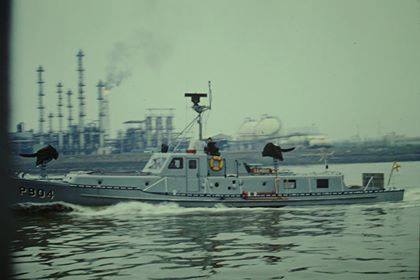
P904 Sambre was the third of the series. She was launched on 26 September 1953 and entered service days later on 30 September. Initially, she joined the Rijnsmaldeel (Rhine Flotilla), tasked with patrols, liaison duties, and inspections of river traffic in cooperation with allied navies. These missions were part of NATO’s defensive strategy, ensuring security along Europe’s key inland trade routes in case of Warsaw Pact hostilities.
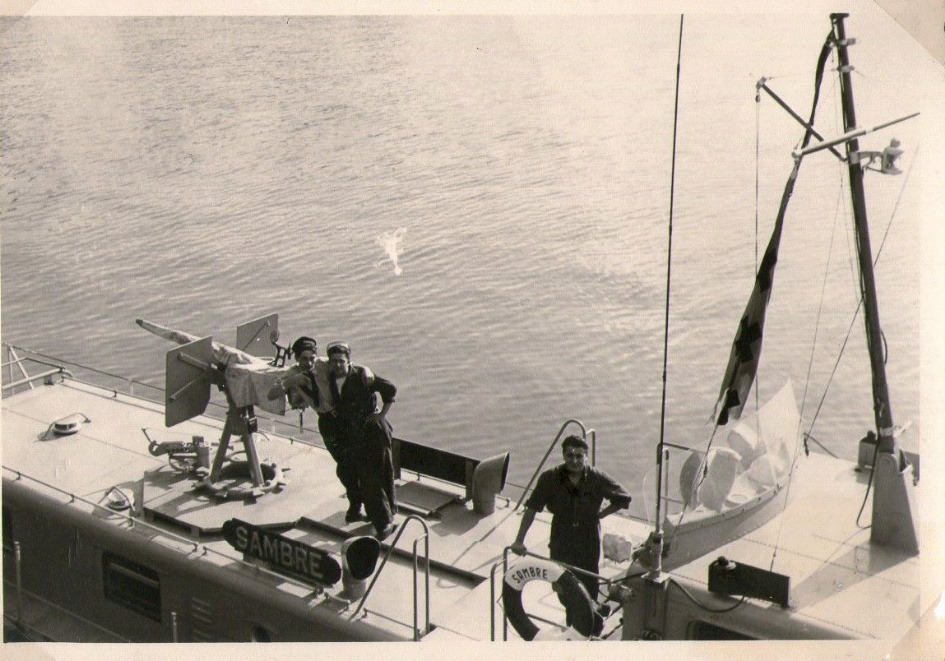
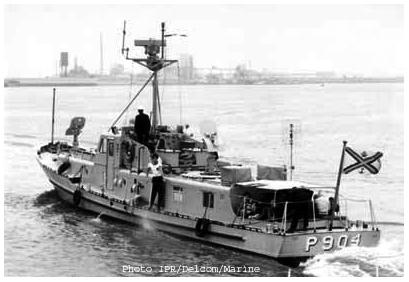
Her small crew — one petty officer and six sailors — handled navigation, gunnery, and patrol tasks. Armament varied during her career. Early records indicate the class could be fitted with a 20 mm autocannon supported by a 12.7 mm HMG, while other sources confirm configurations with two single 12.7 mm Brownings. This reflected both availability of weapons and the flexible nature of river patrol requirements.
By the mid-1960s, strategic emphasis shifted away from the Rhine flotilla, and the Sambre returned to Belgian coastal and inland waters. There she was re-tasked with harbor patrol, training missions, and even pollution control duties in ports such as Antwerp. She was upgraded over time with new radar sets: the DECCA 707 (1954–1979) and later the DECCA 1214 (1980–1984).
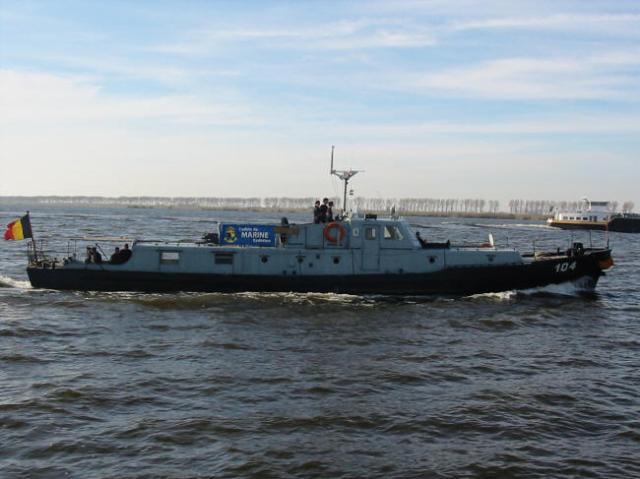
After more than 30 years of service, she was decommissioned on 23 November 1984. Unlike some of her sister ships, Sambre was not scrapped. Instead, she was sold on 21 February 1985 to Joseph Voet and Charles Severyns for 550,000 Belgian francs. That same day she was transferred to the Corps Royal des Cadets de la Marine (Liège section), renamed K104 Sambre, and repurposed as a bateau-école (school ship).
In this capacity she continued to operate, giving Belgian cadets practical seamanship training. This “second career” ensured the Sambre remained active into the late 20th century, remembered not only as a Cold War patrol craft but also as an important training ship.
Specifications
Displacement: 25 tons
Length overall: 24.25 m
Length between P/P: 23.0 m
Beam: 3.8 m
Draught: 0.9 m
Range: 2,300 nm at 10 knots
Speed: 19 knots
Propulsion: 2 × MWM diesel engines (220 hp each), 2 shafts, twin screws
Radar: DECCA 707 (1954–1979), DECCA 1214 (1980–1984)
Crew: 1 petty officer + 6 sailors
Radio call sign: ORIFArmament variants:
Variant Weapons Location Mixed autocannon + HMG 1 × 20 mm autocannon + 1 × 12.7 mm HMG Aft (20 mm), fore (HMG) Dual HMG (initial version) 2 × single 12.7 mm HMG Fore & aft
Place in War Thunder
In War Thunder, Sambre would make a versatile low-tier patrol craft for Belgium. Her different possible weapon fits provide balance options:
- The 20 mm + 12.7 mm layout gives modest anti-boat capability, suitable for mid rank I.
- The dual 12.7 mm HMG setup would fit at Early rank I, comparable to early motor torpedo boats.
This flexibility means she could be added either as one variant with armament choice, or as two separate vehicles — giving more depth to a potential Belgian or BeNeLux naval tree.
Pictures
Images of P904 Sambre
P904 Sambre with visible 20 mm armament mount
2 × single 12.7 mm HMG
2 × single 12.7 mm HMG
in the Rhine 1957
Sources
Sources
- Agentschap Onroerend Erfgoed — Inventaris Onroerend Erfgoed 2025: P904 Sambre [online], P904 Sambre | Inventaris Onroerend Erfgoed
- Coulier, F. (2008–2009). Het Belgisch maritiem Rijnsmaldeel I–IV, Neptunus
- Anrys H., De Decker de Brandeken J.-M., Eygenraam P. (1992). De Zeemacht
- S.N. (1980). 150 ans de marine militaire belge, Brussels
- Van Ginderen L. & Delgoffe C. Fotoboek Belgische Zeemacht 1946–1996
- Jane’s Fighting Ships (1959–1961 editions)