- Yes - In the Tech Tree.
- Yes - Event/BP.
- Yes - Premium.
- No - I would not like to see HMNZS Wellington in game.
HMNZS Wellington post 1998 refit.
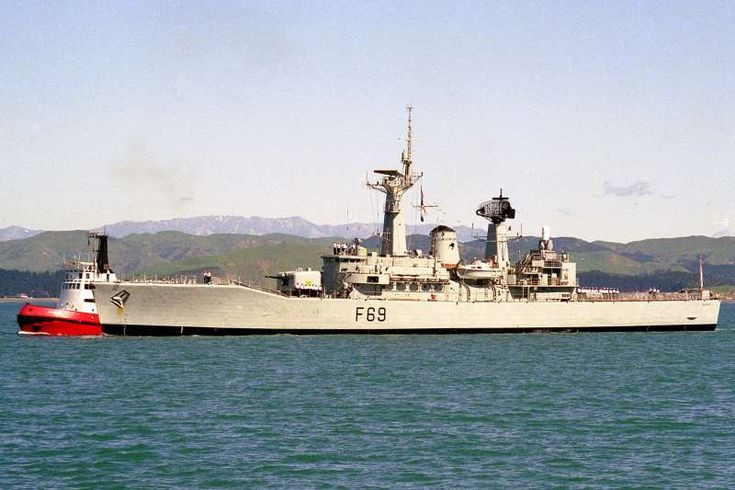
Description:
HMNZS Wellington was one of four Leander-class (Type 12I) Frigates operated by the Royal New Zealand Navy. She was ordered in the latter pair of vessels, both of which were not initially built for the RNZN, instead being ex Royal Navy ships sold to NZ. She would serve the RNZN through the late cold war into the early 2000s.
She would be acquired by the RNZN as to replace their two aging Otago-class (Type 12M) frigates, without breaking the bank with a new class. When the NZNB placed an inquiry for the purchase two gun-armed broad beam Leanders from the RN reserve, there were some problems.
Most of the ships offered to NZ by the RN were old and of limited hull life, they were seen as uneconomical and were rejected. Other vessels which had better hull life lacked helicopter facilities and were also rejected. Eventually the NZNB would settle on a package deal, with their ideal candidate HMS Bacchante, which suited their needs, and the Ikara armed HMS Dido, which was of worse condition and an un-ideal armament.
The HMS Bacchante and Dido would be purchased and renamed HMNZS Wellington and Southland respectively. However this would break the 1983 New Zealand Defense whitepaper, which stated that the RNZN should only acquire Gas-turbines powered vessels, with both the Wellington and Southland being powered by geared steam turbines.
This suggestion is for the HMNZS Wellington’s as she commissioned from her initiation refit in 1986.
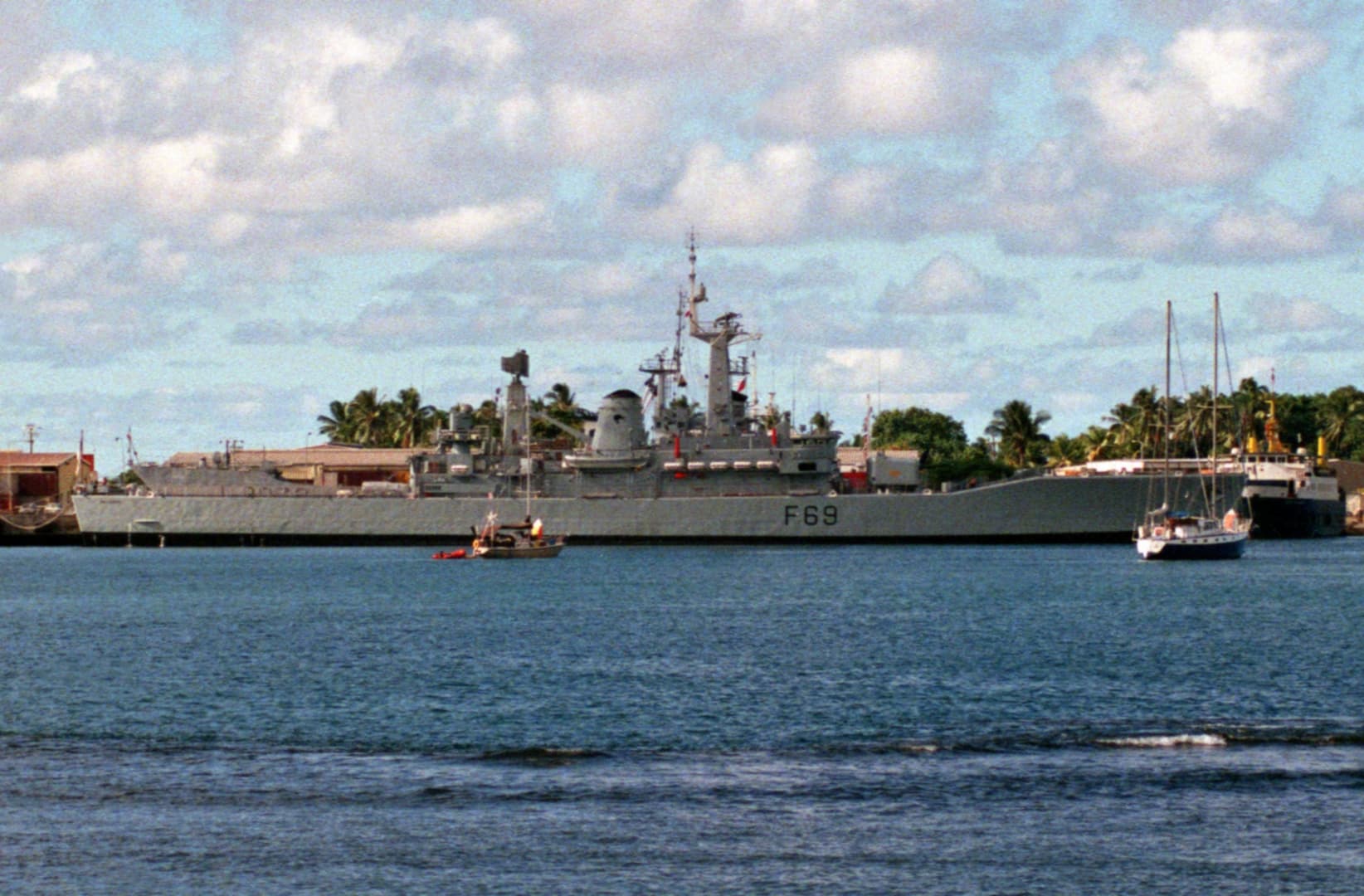
HMNZS Wellington in port, around 1991.
History:
Royal Navy Service:
Laid down as the HMS Bacchante on the 27th of October 1966 by Vickers-Armstrong on the Tyne, she would launch on the 29th of February 1969, finally commissioning into the Royal Navy on the 17th of October 1969.
Upon commissioning she would continue working up and trials until early 1970, when she would join the Standing Naval Force Atlantic (STANAVFORLANT), where she would visit friendly ports and exercise with NATO allies. She would continue in this until 1971, when she would transfer to the West Indies, where again she would continue exercising with allies in the area. In 1973 she would become the Guardship.
later that year she would transfer to the Fishery Protection Squadron out of Scotland, where she would participate in the second and third cod wars, from which she would survive undamaged. Back on the West Indies station at the end of that confrontation, she would then visit Wilmington Delaware, then New York to take part in the 4th of July celebrations for 1976.
In 1981 she would deploy to the Persian Gulf, as to conduct the Armilla Patrol, taking over from the HMS Minerva. During her deployment she would visit many ports in the area, including Mogadishu, and Muscat. By 1982 she would become the Gibraltar Guardship, joining the Birmingham group deploying to the South Atlantic as part of the Falklands war. After this war finished she would send some crew ashore as to assist the locals in disaster recovery.
This would include placing navigational markers in Stanley Sound, and failing to refloat the High Commissioner’s barge. During operations in placing these navigational markers she would accidentally sail through a minefield without any damage. After these operations she would decommission into reserve due to budget cuts.
She would be selected for sale along with her sister, HMS Dido to new Zealand. There were talks about buying the vessel in the earlier years through 1981 while she was still operational.
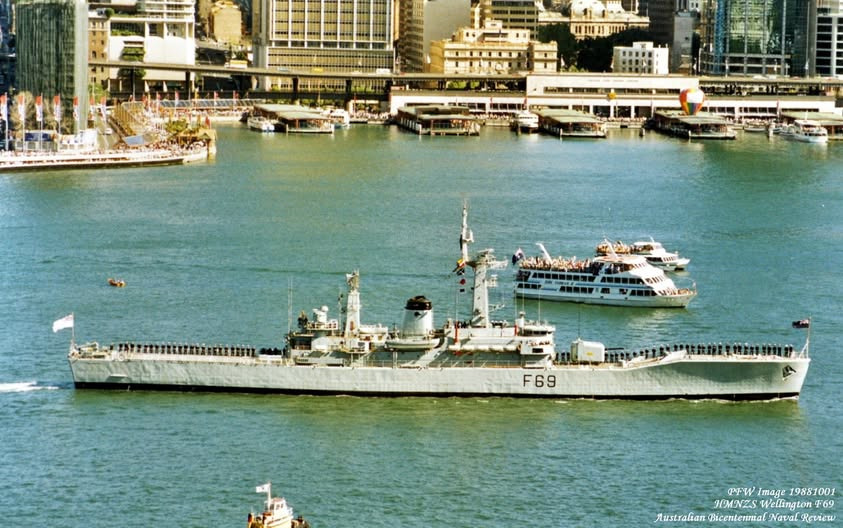
HMNZS Wellington visiting Sydney in 1988 for the Australian Naval Review.
New Zealand Navy Service:
Upon her purchase in 1982, the Bacchante would be renamed to Wellington, after the Wellington region of the North Island. She would commission into the RNZN for her journey to New Zealand, but upon arrival would immediately be decommissioned and placed into a large refit, as to make for both more suitable for New Zealand’s conditions, and give her a general modernisation of her systems.
This would include significant hull repairs and reinforcement, as to compensate for the hull stressed endured during the Falklands war, new fuel tanks giving her an extended range, a new RCA-76 gunnery control system, her Type 965 radar was replaced with another unit due to degradation, and new Type 1006 navigation radar was equipped among other sensor changes. Asbestos was removed, escape hatches enlarged, along with other changes learnt with the experience of the Royal Navy during the Falklands war.
By 1985 the cost of this refit was $263m. The rising cost and time taken for this refit to complete was expedited by the large scale energy projects being undertaken at Marsden Point, which was drawing away skilled labour away from the Dockyards. However in 1986 these works would complete and the HMNZS Wellington would recommission.
She would again commence in sea trials, before she would participate in exercises FAST FOWARD I & II, PUBLIC REVIEW, off Auckland and Gisborne by March 1987. In April that year she would visit Sydney with the HMNZS Southland for ANZAC Day. Her first major deployment would be to Fiji, during the first Fijian Coup, as to stand by to evacuate New Zealanders as part of Operation WELLS. She would return to Auckland in June.
In 1988, in company with the HMNZS Canterbury, Endeavour, and Waikato, the HMNZS Wellington would visit Australia for the celebrations of the Australian Bicentenary. During these celebrations she would participate in Operation BOOMERANG, and on the return voyage to NZ she would exercise with the Royal Netherlands Navy. In May 1989 she would be deployed on a deployment to SEA, during which she would partake in exercise STARFISH 89, finally returning to Auckland in August.
On the 1st of February 1990 she would embark Prince Edward for the 150th Waitangi celebrations, after which she would visit Western Samoa, and the Tokelau Islands as to supply aid after cyclone Ofa. By May 1990 she would again visit SEA, visiting Singapore and partaking in exercise STARFISH 1990.
She would partake in peace talks between Papua New Guinea and the Autonomous Region of Bougainville. She would provide the accommodation for the Government officials that met with the Bougainville delegation aboard HMNZS Endeavour. These would be complete by August, and she would return to Auckland.
In April 1991 she would again deploy to SEA, and took part in exercise STARFISH 91. She would return to Australia, exercising with the RAN along the way. Around this time she would undergo a RNZN standard Leander-class frigate mid-life refit, including a computer based command and control centre, LWO-8 radar, new data link, replacing her sea-cat with Phalanx, new IFF, and an expanded helicopter deck and hangar for the Seasprite helicopter. These would be completed in April 1993.
After this she would again deploy to Singapore, as to take part in exercise STARFISH 39, then was present for the launch of her replacement, the ANZAC-class HMNZS Te Kaha. By October 1995 she would deploy to the North Arabian Gulf as part as the UN Maritime Enforcement Force, she would return in February 1996. 1997-1998 was spent in operations around the NZ and Aus coast, In October she would visit Guam, South Korea, Japan, and the Philippines, returning to Auckland via Niue.
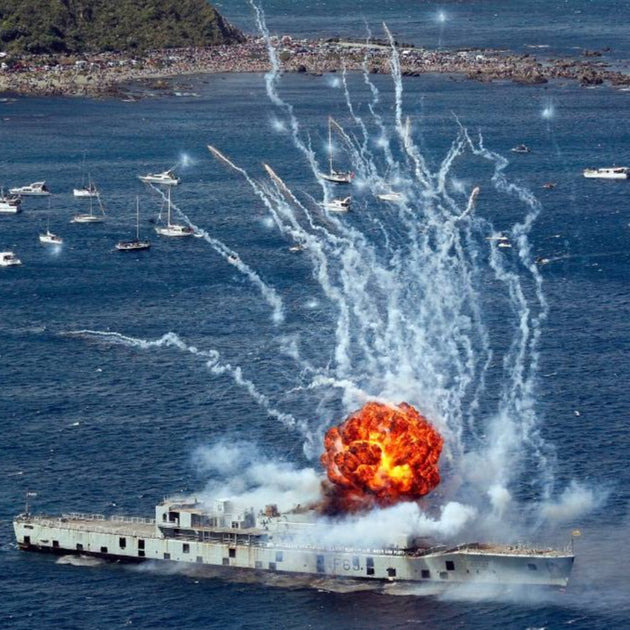
She would be decommissioned on the 5th of May 2000, as she was completely worn out and her replacements were ready. She would then be sold to the Sink F69 Trust in Wellington for $1. She was prepped for a controlled scuttling, eventually being sunk on the 14th of November 2005 in the Cook Straight as an artificial reef and dive site.
| General Characteristics: | |||||
|---|---|---|---|---|---|
| Name: HMNZS Wellington | |||||
| Country: New Zealand | |||||
| Type: Frigate | |||||
| Class name: Leander (Type 12I) | |||||
| Year of commission: 1982 | |||||
| Refit: 1986 | |||||
| ----------------------------------------------------------------------------------------------------------------------------------------- | |||||
| Dimensions: | |||||
| Length: 372ft 1in (113.4m) | |||||
| Beam: 43ft (13.1m) | |||||
| Draught: 19ft (5.8m) | |||||
| Displacement: 3,200t full, 2,450t standard | |||||
| ----------------------------------------------------------------------------------------------------------------------------------------- | |||||
| Propulsion: | |||||
| Powerplant: 2x oil fired double reduction geared steam turbines @ 30,000 hp (22,370kW) overall, 2 shafts | |||||
| Speed: 28kt | |||||
| Endurance: 4,600nmi @ 15kt | |||||
| ----------------------------------------------------------------------------------------------------------------------------------------- | |||||
| Armament & sensors: | |||||
| Compliment: 240 | |||||
| Primary armament: 1x2 QF 4.5-Inch/45 Mk.6 | |||||
| Secondary armament: 1x4 Sea-Cat GWS22 | |||||
| Tertiary armament: 2x1 20mm Oerlikon, 2x3 12.75" ASW torpedo tubes | |||||
| Radar: Type 965 search, Type 903 & 904 fire control, Type 1006 Nav | |||||
| Sonar: Type 184P search and attack | |||||
| Misc Systems: UAA-8/9 warning, Type 668 & 669 jammers, IFF, Decoys, RCA-76 gunnery control | |||||
| ----------------------------------------------------------------------------------------------------------------------------------------- | |||||
| Aircraft Specifications: | |||||
| Type: Westland Wasp HAS.1 | |||||
| Armament Carried: 2x Mk.44 12.75" ASW torpedoes, or 2x Depth Charges, 2x MGs. | |||||
| Engines: 1x RR Nimbus 103, providing 710shp (530kW) | |||||
| Crew: 2 | |||||
| Main Rotor Diametre: 32 ft 3 in (9.83 m) | |||||
| Length: 40 ft 4 in (12.29 m) | |||||
| Height: 8 ft 11 in (2.72 m) | |||||
| Range: 263nmi | |||||
| Max Speed: 96kt | |||||
| Empty Weight: 3,452lb (1,566kg) |
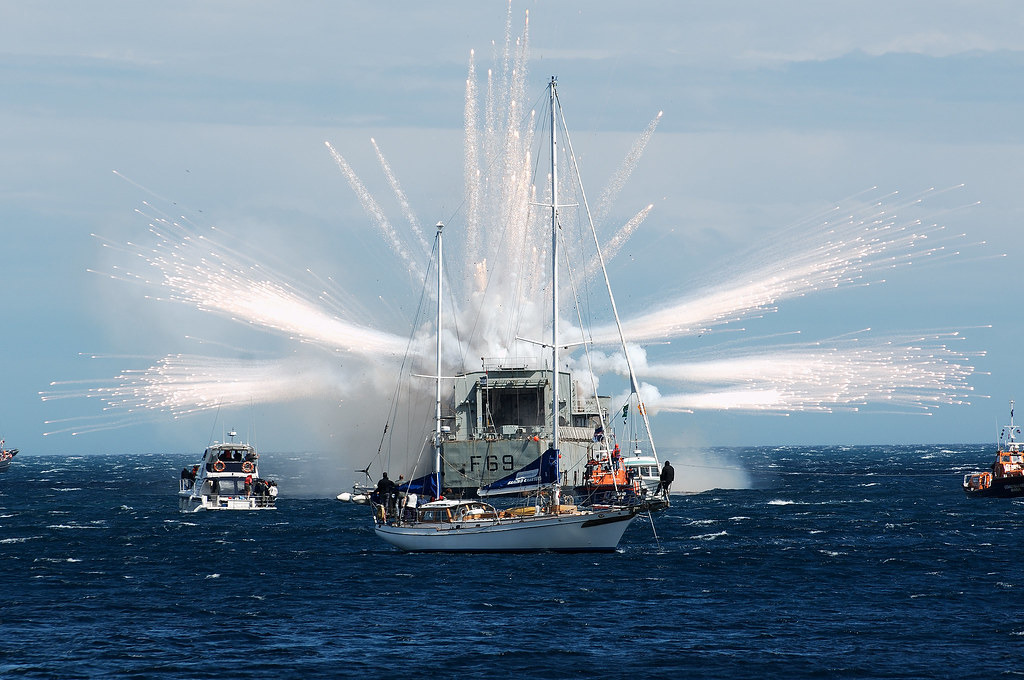
HMNZS Wellington during her scuttling in 2005
Extra Photos

Sources:
P.Greener (2009) TIMING IS EVERYTHING: The Politics and Processes of New Zealand Defense Acquisition Decision Making (pp.23-25)
HMNZS Wellington - Frigate — National Museum of the Royal New Zealand Navy
HMNZS Wellington (F69) - Wikipedia
Type 12I Leander class Frigate Royal New Zealand Navy RNZN
Wasp Helicopter — National Museum of the Royal New Zealand Navy