- Yes - In the Tech Tree.
- Yes - Event/BP.
- Yes - Premium.
- No - I would not like to see HMNZS Canterbury in game.
Description:
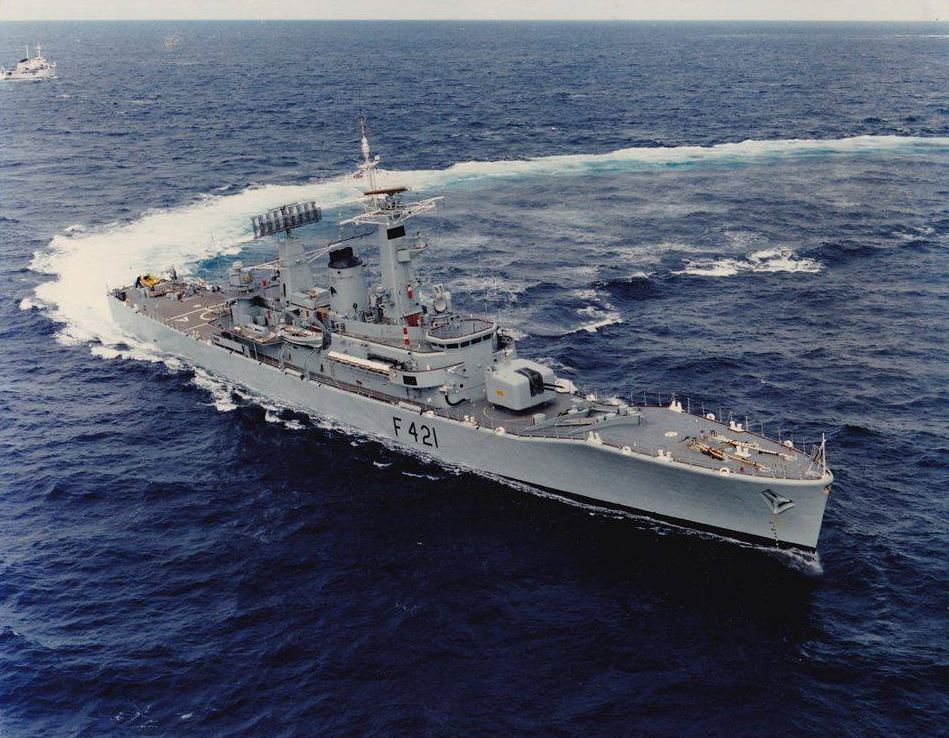
HMNZS Canterbury was the second Leander-class frigate to be operated by the Royal New Zealand Navy, and one of two built as RNZN Ships. She served the RNZN in the Cold War environment, serving through until the early 2000s.
This suggestion is for her 1997 fit, her final fit in the RNZN.
History:
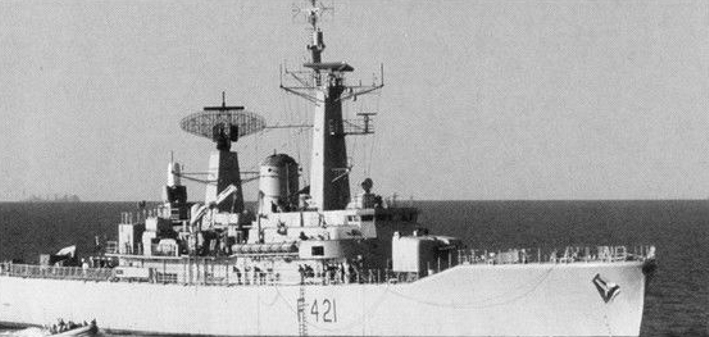
Laid down by Yarrow shipbuilders, at Scotstoun, Glasgow, on the 12th of April 1969. She was the last Leander-class frigate to be built, (the other RNZN Leander’s being former RN ships). She was launched into the River Clyde on the 6th of May 1970 by Princess Anne, commissioning on the 22nd October 1971.
She initially had the standard systems of a Leander-class frigate within the Royal Navy, including a wasp helicopter. She was, however, built with a surplus RN Type 177 sonar, as the UK refused to sell the US Edo sonars. Doppler 184M sonars were offered, but this was rejected on cost grounds.
Sailing from the UK to NZ via the Panama Canal, she sailed up the Potomac River to Washington, being the first foreign warship to do so since the War of 1812. During this voyage, a barbecue was held on her stern to promote NZ lamb. During which someone stated to a NZ Diplomat on her at the time, “What are these guys doing in this town? Last time they were here they burnt the place down.”
In 1973, she was sent to Moruroa Atoll to protest French nuclear testing. Her GP computer assessed the local radiation level, and her EW equipment detected a French P-2 scanning the area with its surface search radar, to detect unwanted civilian protest vessels and enemy submarines in the area. HMNZS Canterbury observed the ‘Melpomène’ test on the 28th of July 1973.
Lt CDR M.A.Harling (RAN) ascertained that the presence of a modern RNZN frigate in the area presented the French officials operational difficulties, and possibly led to the reduction of bombs tested to only five. The NZ Labour Government in power at the time admitted that both France and the UK opposed the use of HMNZS Canterbury for this, with the French later claiming that her presence was one of the “provocations that led to the attack by the French Intelligence service and Navy on the Rainbow Warrior in 1985”.
After observing the French nuclear tests, HMNZS Canterbury joined the US Pacific fleet’s Destroyer Squadron 5 off the US west coast for six months. This was the first time a RNZN frigate had been a key part of a US Navy Force.
In April 1977, HMNZS Canterbury and HMAS Brisbane escorted HMAS Melbourne during a trip to the UK for the Queen’s Silver Jubilee naval review. In 1980, the NZ Admiralty’s plans for a new frigate (Type 21 or Kortanear) and modernisations for the type 12M HMNZS Taranaki fell through, and instead Canterbury received a year-long refit. During which she gained new surveillance radar and some solid state systems.

Upon the outbreak of the Falklands War in 1982, the Prime Minister of the 2nd National Government, Robert Muldoon, offered both broad-beam Leanders in the RNZN, HMNZS Canterbury and Waikato to join the Royal Navy Task Force retaking the Islands. This offer was rejected, possibly due to the age of these vessels, but also the fact that they had very modernisation of their systems since completion, notably not having any Chaff launchers. Instead, it was offered that the RNZN Frigates replace and take over RN patrol duties in the Persian Gulf.
This was partially successful. However, it was limited, as the NZ Government did not allow the NZ Frigates to enter the Persian Gulf due to sensitive relations with Bahrain. For this, HMNZS Canterbury was awarded the Wilkinson Sword of Peace.
In 1987, she received a mid-life refit, which saw the full replacement of the systems array with new solid state ones, including the R76-C5 fire control system, ArgoSystems radar-detection, SRBOC Launchers, G750 sonar, LWO-8 Air surveillance radar, new Mark XII IFF, and replaced her type 993 surface surveillance radar with type 994. To control this, the NAutlS system was chosen. The crew area was also changed to represent lessons learnt from the RN during the Falklands War. Her wasp helicopters were also replaced by the SH-2F Seasprite. For this, the helicopter hangar was expanded.
Unlike her sister, HMNZS Wellington, Canterbury did not receive extra fuel tanks with this refit. A new LWO8 radar was fitted during this refit, and debate started on the removal of the Sea-cat system, whose usefulness was doubted during the Falklands war.
In May 1991, she visited Crete for the 50th anniversary of the battle for Crete in the Second World War. Later that year, her Sea-Cat launcher and associated equipment were removed, replaced by a single Phalanx CIWS.
She assisted with the enforcement of the embargo against Iraq in operation Delphic. After this period, she was deployed to East Timor as part of the INTERFET peacekeeping force, conducting four patrols between the 26th of September and 12th December 1999. During these patrols she achieved a 92% systems availability rate, a good achievement for a nearly thirty-year-old ship.
While she was off the Chatham Islands in 2003, her auxiliary switchboard lit ablaze. She was saved by the quick actions of two ratings, one receiving the New Zealand Order of Merit for their actions. The repairs for this cost NZD $1 million, and confirmed that her service life had been dangerously extended, as there were delays for her replacement with the Protector-class OPV Program. It was also hinted that she might be replaced by the HMS Grafton, a type 23 Frigate. This, however, did not go forward as the Grafton was sold to Chile.
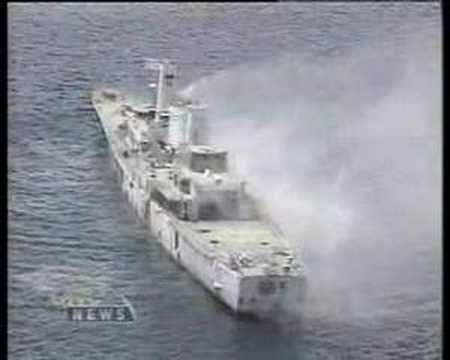
She was decommissioned in 2005, and stripped for parts. She was to be sunk as a artificial reef off the Bay of Islands, along with HMZNS Wellington. She was scuttled by 14kg of charges placed by Norman Greenall, a diver who had undertaken the responsibility of sinking other RNZN vessels. This earnt him a reputation as the person who had sunk more NZ Ships than the enemy did in the whole of the Second World War. Canterbury now lies in Deep Water Cove, where she sits to this day.
| General Characteristics: | |||||
|---|---|---|---|---|---|
| Name: HMNZS Canterbury | |||||
| Country: New Zealand | |||||
| Type: Frigate | |||||
| Class name: Leander (Type 12I) | |||||
| Year of commission: 1971 | |||||
| Refit: 1997 | |||||
| ----------------------------------------------------------------------------------------------------------------------------------------- | |||||
| Dimensions: | |||||
| Length: 372 ft (113.4m) | |||||
| Beam: 34 ft (13.1m) | |||||
| Draught:18 ft (5.5m) | |||||
| Displacement: 2,945t | |||||
| ----------------------------------------------------------------------------------------------------------------------------------------- | |||||
| Propulsion: | |||||
| Powerplant: 2x oil fired double reduction geared steam turbines @ 30,000 hp (22,370kW) overall | |||||
| Speed: 28kt | |||||
| Endurance: 3,000nmi @ 13kt | |||||
| ----------------------------------------------------------------------------------------------------------------------------------------- | |||||
| Armament & sensors: | |||||
| Compliment: 247 | |||||
| Primary armament: 1x2 QF 4.5-inch L45 on mount Mk.6 | |||||
| Secondary armament: 1x1 Phalanx CWIS, 2x 20mm Oerlikon, 2x .50 M2HB | |||||
| Tertiary armament: 2x3 12.75" Mk .46 Torpedoes , 2x Mark 36 SRBOC chaff launchers | |||||
| Systems: 2xMk.36 SRBOC Launchers,1x G750 Sonar, Argo-Systems radar detection, | |||||
| 1x LWO-8 Air search Radar, Type 994 Surface search Radar, R76-C5 Fire Control Radar | |||||
| Type 1006 nav radar, PST-1288 HVU intercept and Jammer, Mk XII IFF. | |||||
| ----------------------------------------------------------------------------------------------------------------------------------------- | |||||
| Aircraft Specifications: | |||||
| Type: SH-2F Seasprite | |||||
| Armament Carried: 2x Mk.46 ASW Torpedoes, 2x Large DC, 2x1 FN MAG 30.60 7.62mm, 2x AGM-65B/G | |||||
| ( Max Overload payload of 13,300 lb (6,000 kg) | |||||
| Engine: 2x GE T58 providing 1,350 shp ea | |||||
| Crew: 3 | |||||
| Main Rotor Diameter: 44 ft (13.41 m) | |||||
| Length: 38 ft 4 in (11.68 m) w/ Nose and blades folded | |||||
| Height: 13 ft 7 in (4.14 m) | |||||
| Max Speed: 165 mph, (265 km/h) | |||||
| Empty Weight: 7,040 lb (3,193 kg) |
Sources
HMNZS - Canterbury - Frigate — National Museum of the Royal New Zealand Navy
HMNZS Canterbury (F421) - Wikipedia
https://www.helis.com/database/unit/345-HMNZS-Canterbury
https://ndhadeliver.natlib.govt.nz/webarchive/20100331193327/http://hmnzscanterbury.bravehost.com/
https://www.usni.org/magazines/proceedings/1994/march/more-leander
Kaman SH-2 Seasprite - Wikipedia
McDougall, R. J. (1989). New Zealand Naval Vessels (pp. 49-48, 156)
Hensley, G. C. (2006). Final approaches : a memoir (p.161)
Lt CDR M.A.Harling (N.D) Gunboat diplomacy? : the RAN and RNZN at Moruroa (p.16)