- Yes
- No
 King Tiger - Stars & Stripes König
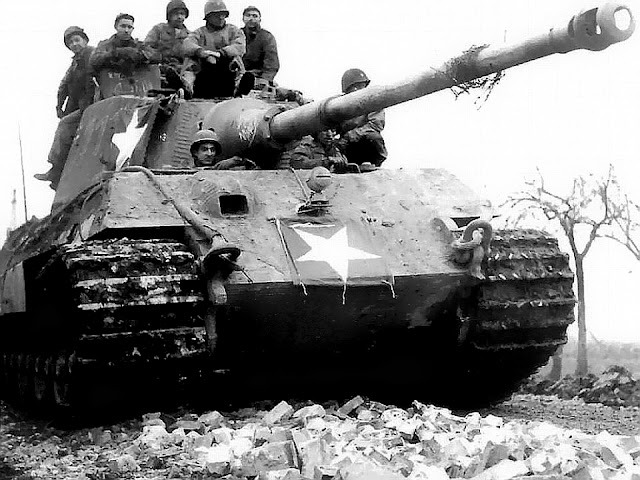
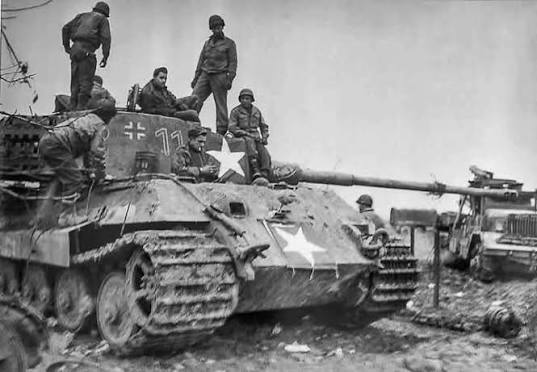
This Panzer VI Tiger II “Königstiger” (Turret No. 2-11), assigned to the 2nd Company of schwere Panzer Abteilung 506, was captured by American forces. It was later repaired and brought back into running condition by Company B, 129th Ordnance Battalion, 7th Armored Division in Gereonsweiler, Germany, on December 15, 1944.
History
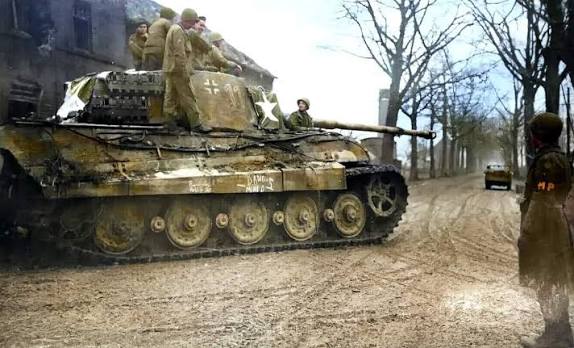
In early 1945, as American forces pushed deeper into western Germany, a Panzerkampfwagen Tiger Ausf. B, commonly known as the King Tiger or Tiger II, was captured near the town of Düren. The capture took place during operations conducted by the United States Army First Army as it advanced toward the Rhine River.
Düren had already suffered massive destruction from Allied bombing in late 1944. By the time ground forces reached the area in February 1945, the town was largely in ruins. German forces were retreating eastward while attempting to delay the American advance. Armored units in the region were often scattered remnants of heavy tank battalions mixed with infantry formations, operating with limited fuel and supplies.
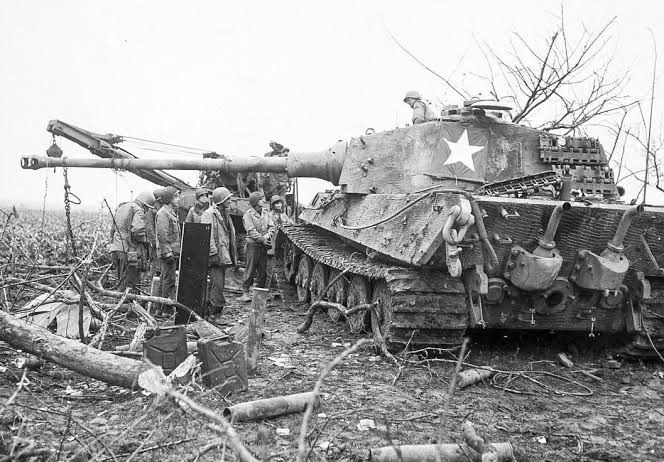
The King Tiger found near Düren appears to have been abandoned rather than destroyed in direct combat. Photographs taken after its capture show the tank largely intact, fitted with the Henschel turret and armed with the long-barreled 8.8 cm KwK 43 L/71 gun. There is no clear evidence of catastrophic battle damage. This strongly suggests that the vehicle was immobilized due to mechanical failure, lack of fuel, or possibly becoming stuck during the German withdrawal.
By early 1945, Germany was facing severe shortages of fuel, spare parts, and recovery vehicles. The King Tiger was an extremely powerful but mechanically complex and heavy vehicle. Breakdowns were common, especially during extended retreats over damaged roads and through devastated urban areas. When a Tiger II could not be repaired or towed in time, crews were often forced to abandon it.
After American forces secured the area, soldiers inspected and photographed the tank as a battlefield trophy. The thick frontal armor, reaching up to 150mm in places, and the high-velocity 88mm gun were of particular interest. Allied technical intelligence teams carefully examined captured heavy tanks to study German armor design, optics, and ammunition performance.
There is no record of the Düren King Tiger being placed into American combat service. Unlike some lighter captured vehicles that were briefly used for testing or limited operations, heavy tanks such as the Tiger II were typically evaluated and then scrapped. It is likely that this vehicle was eventually dismantled or used for ballistic testing before being disposed of.
Specifications
General Information
- Origin: Germany
- Captured By: The United States of America
- Crew: 5
Armament:
- Main Gun: 8.8 cm KwK 43 L/71
- Penetration: ~203mm at 100 m, ~182mm at 1000m (AP)
- High-Explosive: 105mm HE for infantry/soft targets
- Secondary: 2 × 7.92mm MG 34 machine guns
Armor:
- Front Hull: 150 mm (sloped)
- Side Hull: 80mm
- Rear Hull: 80mm
- Turret Front: 180mm
- Turret Sides: 80mm
- Turret Rear: 80mm
Mobility:
- Engine: Maybach HL 230 P30 V12, 700 hp
- Weight: ~69 tons
- Max Speed: 41.5 km/h (road), 20-25 km/h (off-road)
- Power-to-Weight Ratio: 10.1 hp/ton
- Operational Range: 120–150 km