History
Background
An artist’s impression of “Modified Spruance” destroyers of Iran, ordered from Litton Industries in 1974. The ships were never delivered to Iran and became Kidd-class destroyers of the US Navy (1975).
As the order and procurement of Spruance-class destroyers for the US Navy were underway, four additional destroyers based on this class’s hull design were designed and ordered for the Shah of Iran prior to 1979. Compared to the Spruance class, these destroyers were to have superior SAM capability with their two dual Mk 26 Guided Missile Launching Systems for 50+ RIM-66 Standard missiles, as they were intended for general-purpose operations rather than specialized anti-submarine warfare. These destroyers retained the former class’s anti-submarine capabilities by using RUR-5 anti-submarine missiles on the Mk 26 launchers, as well as two triple Mk 32 torpedo tubes in reserve. Because they would be operated in the Persian Gulf, these vessels featured advanced air-intake and filtration systems to handle dust and sand in that environment, as well as greater air-conditioning capacity. These vessels also incorporated combat systems for all their weapons systems. As a result, their displacement was expected to be greater than that of the Spruance-class vessels.
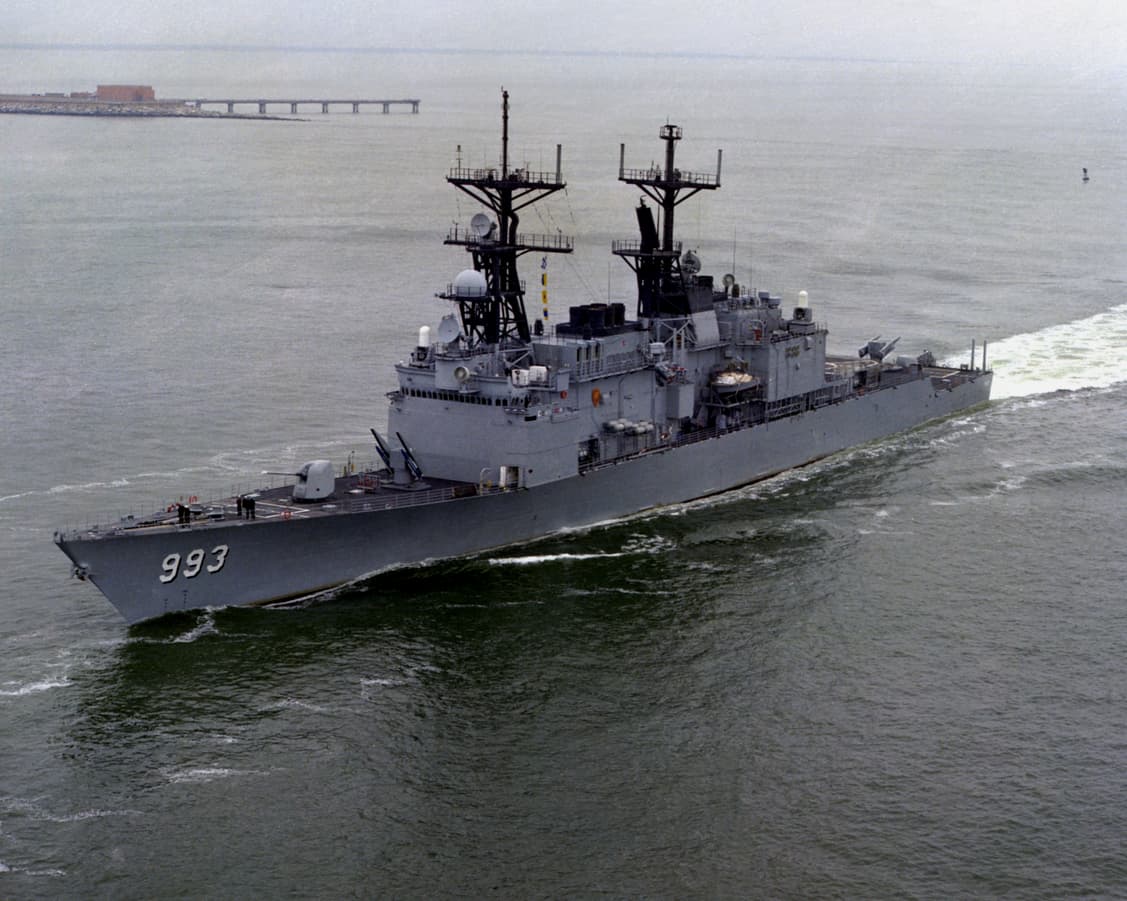
USS Kidd (DDG-993) during sea trials, 1981.
The first two destroyers were laid down on June 26, 1978, and October 23, 1978, respectively, with the third and fourth laid down in early 1979. They were to bear the names Kourosh, Dariush, Nader, and Anoshirvan, in that order. However, because the 1979 Iranian Revolution occurred, the succeeding Iranian government terminated the contract for the Kourosh-class guided-missile destroyers, officially canceling delivery. The outcome was the acquisition and integration of these four destroyers into the US Navy fleet in 1981-82, where they were officially commissioned as the Kidd class: USS Kidd (DDG-993), USS Callaghan (DDG-994), USS Scott (DDG-995), and USS Chandler (DDG-996), in that order.
Standard “as-built” configuration of the Kidd-class guided-missile destroyer.
Due to the hot climate-suited equipment found on board Kidd-class vessels, they were used in US Navy operations in the Middle East. In the mid-1980s, these vessels were retrofitted with LAMPS equipment, enabling their helicopters to conduct long-range airborne ASW operations.
NTU configuration of the Kidd-class guided-missile destroyer.
From 1988 to 1990, the Kidd-class vessels received the New Threat Upgrade as part of modernization efforts, upgrading their sensors to improve anti-air warfare performance against more advanced threats expected in the 21st century. Their Mk 26 launchers received improved, extended-range RIM-67B Standard missiles and the upgraded combat systems. The program also resulted in Kidd-class vessels receiving new superstructure sensors that enabled mainmast cooperative engagement with Aegis-equipped Ticonderoga-class cruisers, allowing the cruisers to control the Kidds’ SAMs in flight while the Kidd-class destroyers operated in a completely electronically silent mode.
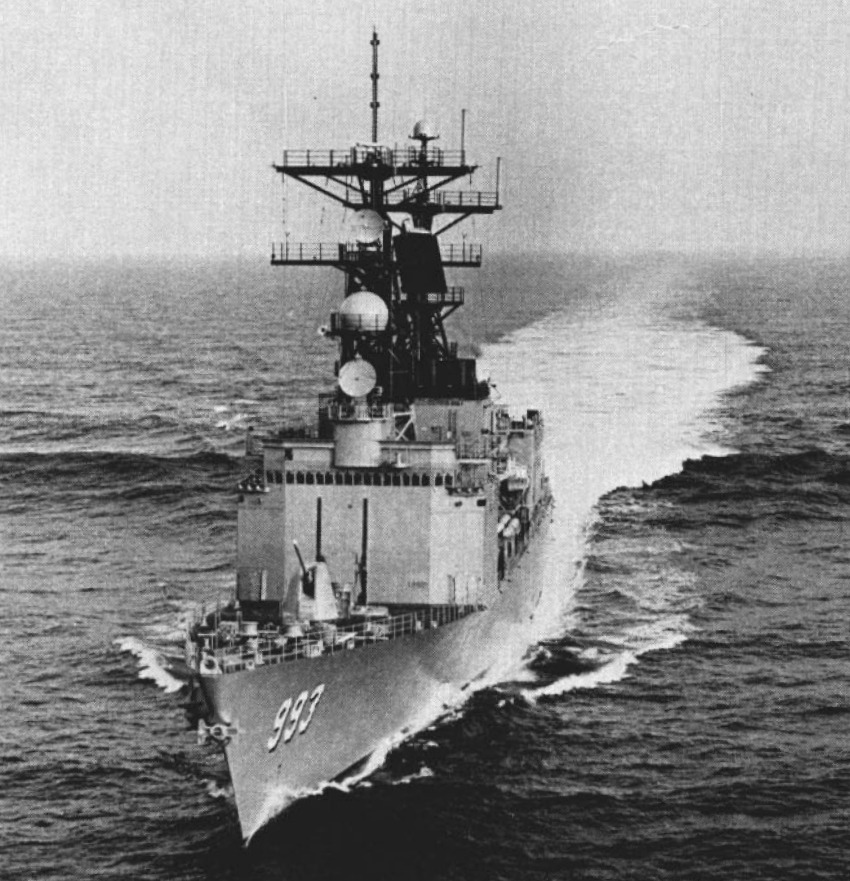
Dahlonega (YTB-770) escorting USS Kidd (DDG-993) in Hampton Roads, USA, 1990. Note that the AN/SPS-48 3D radar had been relocated behind the mast as a result of the NTU program.
However, the arrival of Aegis-equipped Arleigh Burke-class destroyers began to outclass the Kidd-class destroyers in terms of combat and sensor capabilities. With the Cold War ended, the Navy accelerated the retirement of both the Spruance and Kidd classes. All four Kidd-class ships were decommissioned from the US Navy in the late 1990s. They were initially offered for sale to Australia in 1997 but were rejected in 1999, and later offered to Greece, which also declined. In 2001, the US attempted again, offering all four ships to Taiwan; this was approved, and they were sold in 2004. All four were scheduled for transfer to the Republic of China Navy under the Kuang Hua VII program. The first two ships, ex-Scott and ex-Callaghan, arrived and were commissioned in Taiwan in December 2005, while the remaining two units, ex-Kidd and ex-Chandler, were delivered and commissioned in 2006. Altogether, they became the Kee Lung-class destroyers, serving a longer career with the Republic of China Navy.
Propulsion
The LM2500 engine is typically installed within a metal enclosure to isolate sound and thermal from personnel and adjacent machinery spaces.
As designed, the Kidd-class destroyer was powered by four gas-turbine General Electric LM2500 engines. These engines provided the ship with a total of 86,000 shp and a full speed of 33 knots. The LM2500 propulsion system was so reliable and successful that it remained in use on most subsequent US warships through iterations of the LM2500 family.
Sensors
Standard forward sensors of the Kidd-class destroyers before the NTU upgrade.
The Kidd-class destroyer was equipped with AN/SPS-48 radar, which was a three-dimensional, long-range air surveillance radar used to determine the range, azimuth, and altitude of airborne targets. With the New Threat Upgrade (NTU), it was upgraded to the SPS-48E, offering performance improvements in resistance to jamming and ECM, detection of smaller targets on the horizon, and the ability to accept and execute commands from shipboard combat systems like Aegis-equipped Ticonderoga-class cruisers. The SPS-48 series radar provided data to Standard missiles.
Standard forward sensors of the Kidd-class destroyers after the NTU upgrade.
In addition to the AN/SPS-48 radar, the vessels included the AN/SPS-49(V)5 radar, which was a two-dimensional, very long-range, all-solid-state radar. It replaced the forward, legacy AN/SPG-60 radar as a result of the NTU program. It supplied range and bearing data as a backup to a 3D radar, integrating its outputs into the ship’s overall weapons control system and providing enhanced ECCM processing and automatic target detection capability.
Above the SPG-60/SPS-49(V)5, there was an AN/SPS-55B, which was used as a surface surveillance radar to detect seaborne targets.
Standard sensors at the aft section of the Kidd-class destroyers after the NTU upgrade.
For ASW, an AN/SQS-53 sonar was mounted in the bow below the waterline, with both active and passive operating capabilities. It was a crucial sensor for ASW weapons guidance. With the introduction of the LAMPS upgrade, the ship could use the AN/SQR-19, a tactical towed-array sonar capable of passively detecting hostile submarines at very long range.
The AN/SLQ-32 electronic warfare suite was installed, offering improved capability in detecting and providing early warning of hostile emitters and targeting systems.
Armament
USS Spruance (DD 963) firing its 5” 54 gun during a three-day exercise in the Central Arabian Gulf, September 15, 2004.
The destroyers were armed with two 5-inch (127 mm)/54 caliber Mk 45 guns, one on the bow and one aft. The Mod 1 incorporated a major improvement in its ability to select and fire six different kinds of ammunition. The most common type was high-explosive, in either anti-aircraft or high-capacity projectiles. The gun’s rate of fire was 20 rounds per minute in automatic mode.
The Mk 45 guns were controlled by the Mk 86 Gun Fire Control System, a digital system providing naval gunfire control against surface, air, and shore targets, capable of tracking four surface targets, two shore targets, and one air target simultaneously. The Mod 3 of the Mk 83 installed aboard the DD-963 could direct the fire of two 5-inch guns against two tracked targets at once. The system included two track-while-scan radars: the AN/SPG-60 for air targets and the AN/SPQ-9A for surface and low-flying airborne targets.
Phalanx Block 1 test-firing aboard USS Carl Vinson (CVN-70), February 20, 2003.
Two 20 mm Phalanx CIWS Mk 15 guns were installed for close-range anti-aircraft and anti-missile defense. One was installed on top of the bridge and the other on top of the hangar. These were later upgraded to Block I, which improved radar, ammunition capacity, rate of fire, engagement envelope, and computing.
RIM-66 Standard missiles on a Mark 26 launcher aboard USS Ticonderoga (CG-47), March 13, 1983
The Kidd-class destroyers were fitted with two dual Mk 26 Guided Missile Launching Systems, one forward with a total of 24 missiles and one aft with a total of 44 missiles. The system supported the capability of firing RIM-66 Standard and RUR-5 ASROC. Through the NTU program, they could fire SM-2MR and SM-2ER missiles.
In conjunction with the Mk 26 launchers, the AN/SPG-51D was a key sensor for the Tartar Guided Missile Fire Control System, which tracked and locked onto targets and illuminated them before interception by missiles launched through the Tartar FCS. The NTU resulted in the Tartar system being upgraded to Mod 14 or 15 standard, enabling the use of SM-2MR/ER missiles and expanding interception capability by increasing the number of targets the system could engage simultaneously.
The incorporation of the Harpoon system was already in place, with eight Harpoon anti-ship missiles in canister launchers installed amidships for anti-ship offensive capability.
Crew loading Mk 46 torpedo into the Mk 32 torpedo tube launcher aboard Spruance-class USS Leftwich (DD-984), July 1, 1986.
Two triple Mk 32 torpedo tube launchers were installed amidships on either side, used to fire Mk 46 torpedoes against hostile submerged targets at close range.
Left: Kaman SH-2F Seasprite. Right: Sikorsky SH-60B Seahawk.
Initially in service, the Kidd-class destroyers were not equipped with the Light Airborne Multi-Purpose System (LAMPS) but were quickly retrofitted with LAMPS I, which included two SH-2F Seasprite ASW helicopters in an enclosed hangar to enhance ASW capability beyond the intended range. These helicopters were capable of deploying Mk 46 ASW torpedoes and passive/active sonobuoys to detect and datalink information on submerged targets to the vessel. Later in service, the Kidd-class vessels replaced the SH-2Fs with SH-60B Seahawks with LAMPS III equipment.
Trails left by the Mk 245 infra-red decoy round from Mk 36 chaff launchers aboard HMS Bulwark, 2007.
As for countermeasures systems, the vessels included Mk 36 chaff decoy launchers used to defend against anti-ship missiles by creating false signals with an array of chaff cartridges, confusing hostile missile guidance and fire control systems. The number and arrangement of Mk 36 launchers installed depended on the size of the ship, ranging from two launchers on a small combatant to as many as eight on an aircraft carrier, so it is believed that two to four Mk 36 launchers were mounted on ships of this class as standard. Each launcher had six 130 mm fixed tubes arranged in two parallel rows at angles of 45 and 60 degrees to provide a spread of launched decoy cartridges at a speed of 75 m/s.
AN/SQL-25 Torpedo Protection Concept.
The Torpedo Countermeasures Transmitting Set AN/SLQ-25, known as Nixie, was a common noisemaker tool used to confuse and defend against hostile acoustic- and wake-homing torpedoes. When a Nixie was towed by the vessel, it sent out a simulated ship noise signal to draw a torpedo away from its intended target.