- Yes
- No
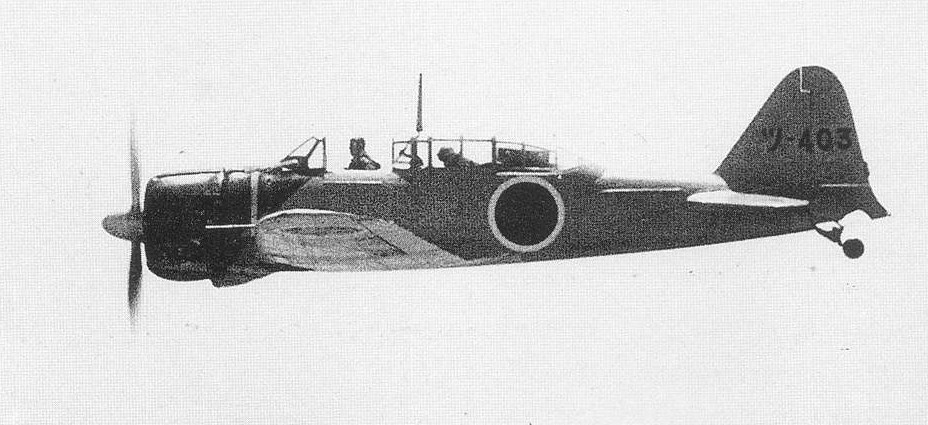
Kaigun A6M2-K (海軍第21航空廠 零式練習用戦闘機一一型)
The Kaigun A6M2-K is a trainer fighter developed by the 21st Naval Air Arsenal based on Mitsubishi’s A6M2. It made its maiden flight in November 1942, and 518 units were produced by the end of the war.
History
With the introduction of the Mitsubishi A6M, the Imperial Japanese Navy—which required training on more advanced aircraft that more closely resembled actual combat aircraft—adopted the A5M4-K, a two-seat variant of the A5M4, in 1942. Furthermore, in 1942, the Navy instructed the 21st Naval Air Arsenal in Omura to develop the Prototype 17-shi Training Fighter, which was based on the A6M2 itself.
The prototype made its maiden flight in November 1942 (though some sources cite 1943), but delays in bringing it into service meant that it was not officially adopted as the A6M2-K until March 1944.
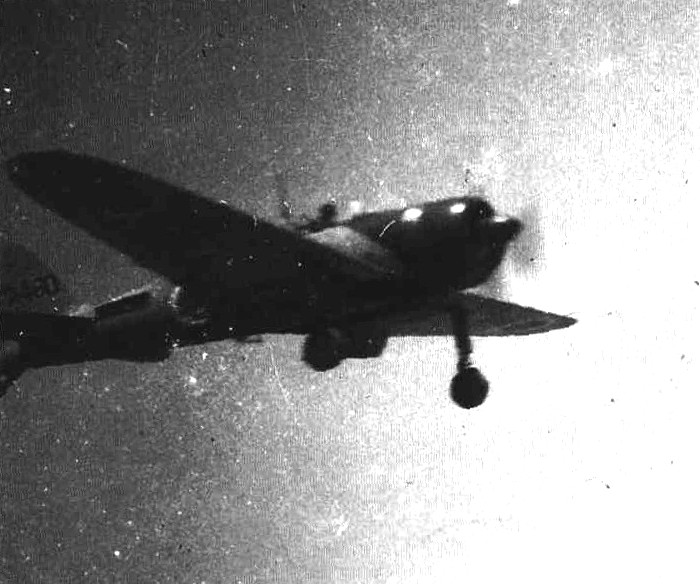
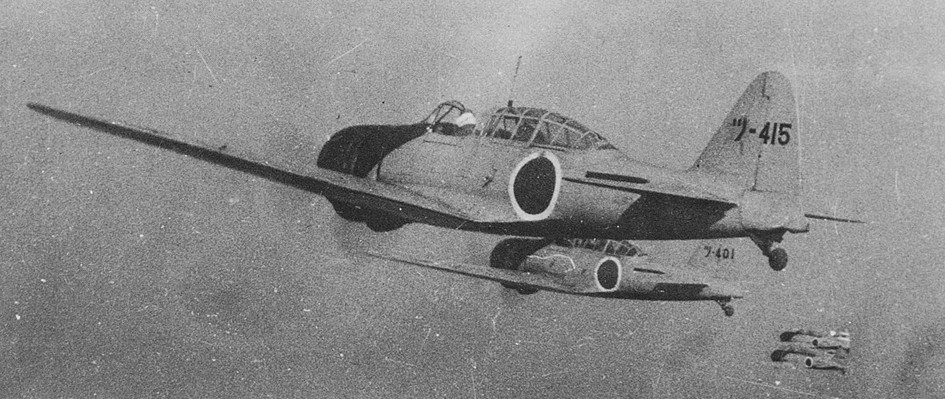
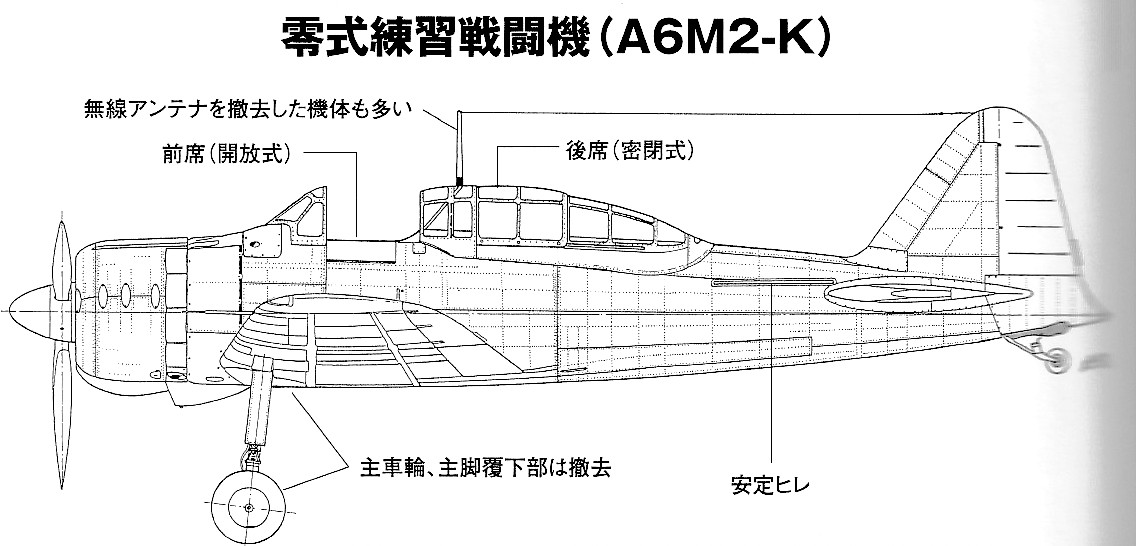
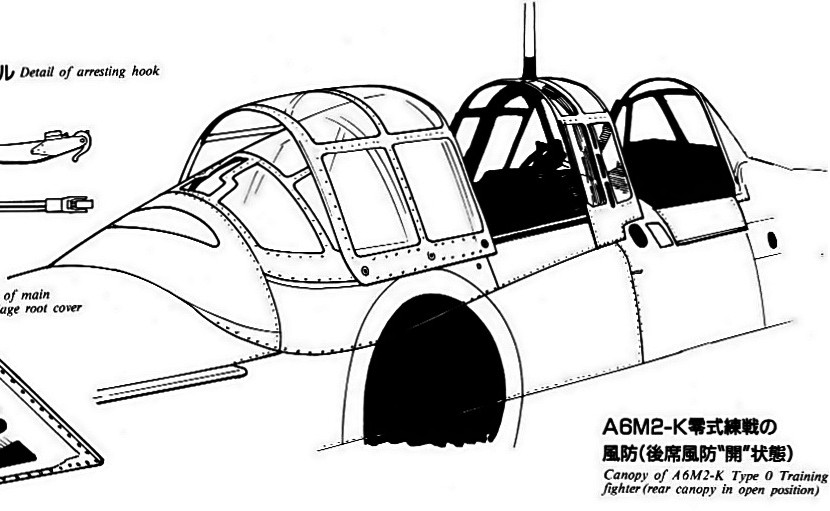
This aircraft was based on the A6M2, featuring an instructor’s seat behind the pilot’s seat to enable dual-control flight, and stabilizer fins on both sides of the fuselage. The front cockpit had an open windscreen, while the rear cockpit was enclosed; a rollover bar was installed between the two seats to protect the crew in the event of a rollover. The wing folding mechanism and arresting hook were eliminated, and the wheel sections of the main landing gear covers were omitted to simplify maintenance. The 20mm cannon was removed, but the 7.7mm machine gun in the nose was retained for firing practice. Additionally, the bomb racks under the wings were retained.
Mass production took place at the 21st Naval Air Arsenal and Hitachi Aircraft; production began at the former in January 1943, prior to the aircraft’s official adoption, and at the latter in May 1944. A total of more than 500 aircraft were produced and deployed to various training units.
Toward the end of the war, aircraft became scarce, and even training aircraft were used for kamikaze missions. The A6M2-K was no exception and was used in kamikaze attacks during the Battle of Okinawa.

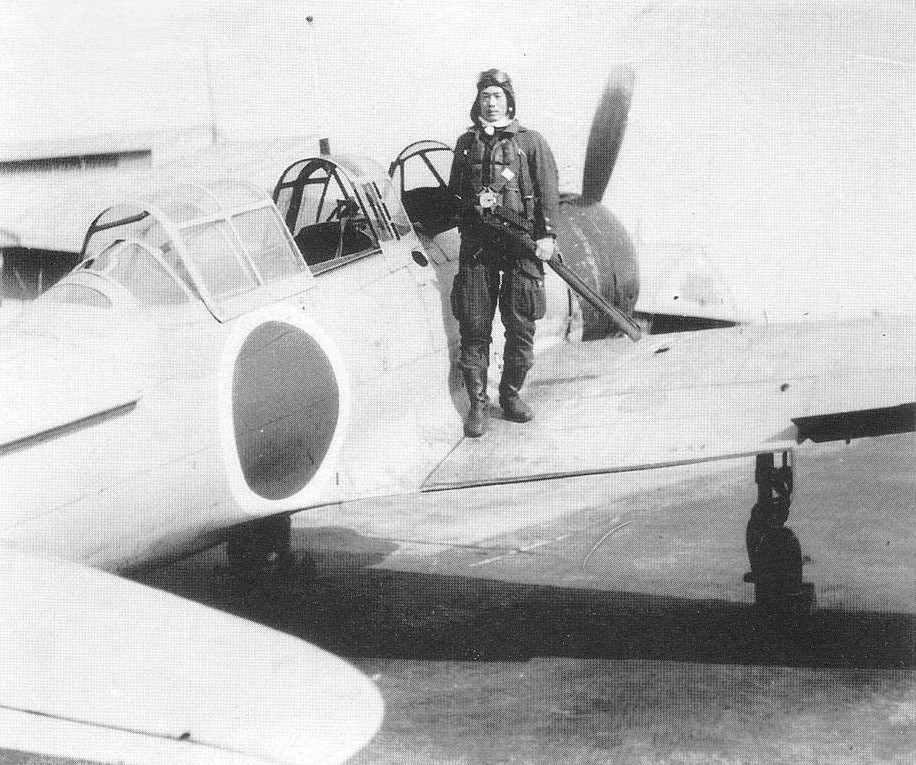
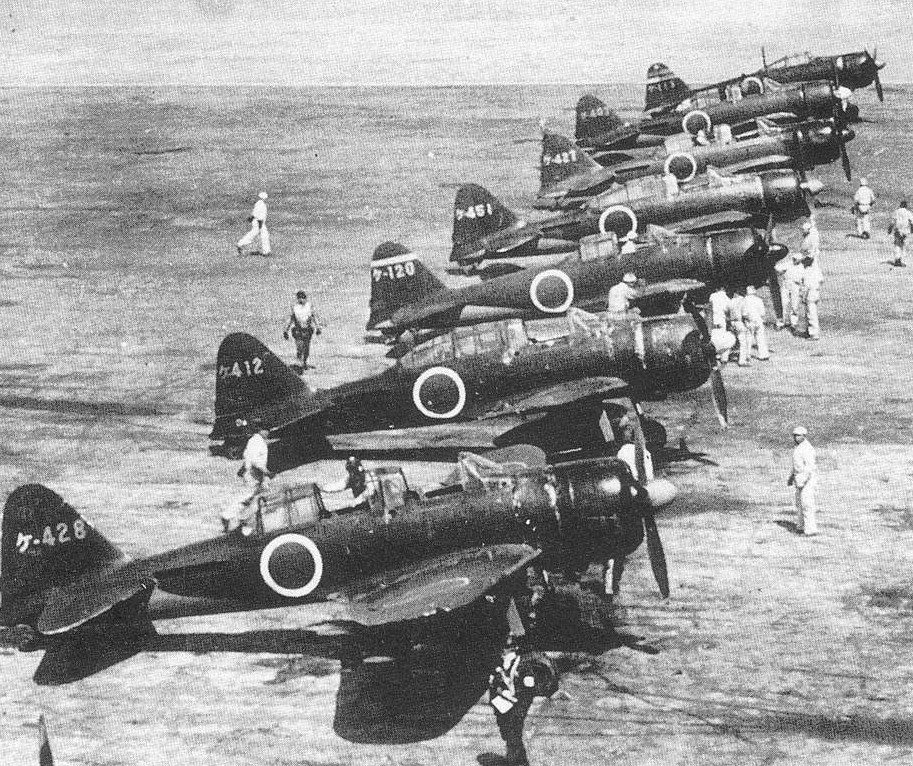
Art
There are two theories regarding the camouflage color of this aircraft: one suggests it was the same “gray” as that of standard A6M2s, while the other suggests it was the “orange” used on trainers and prototypes.
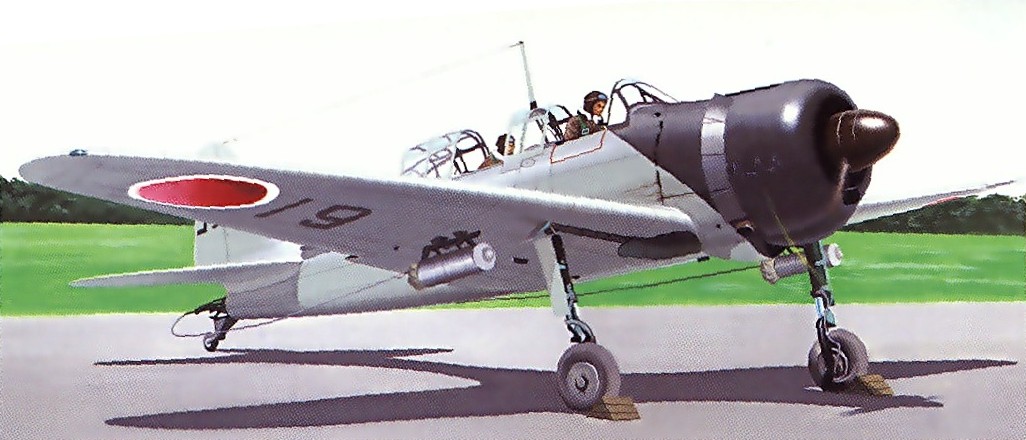
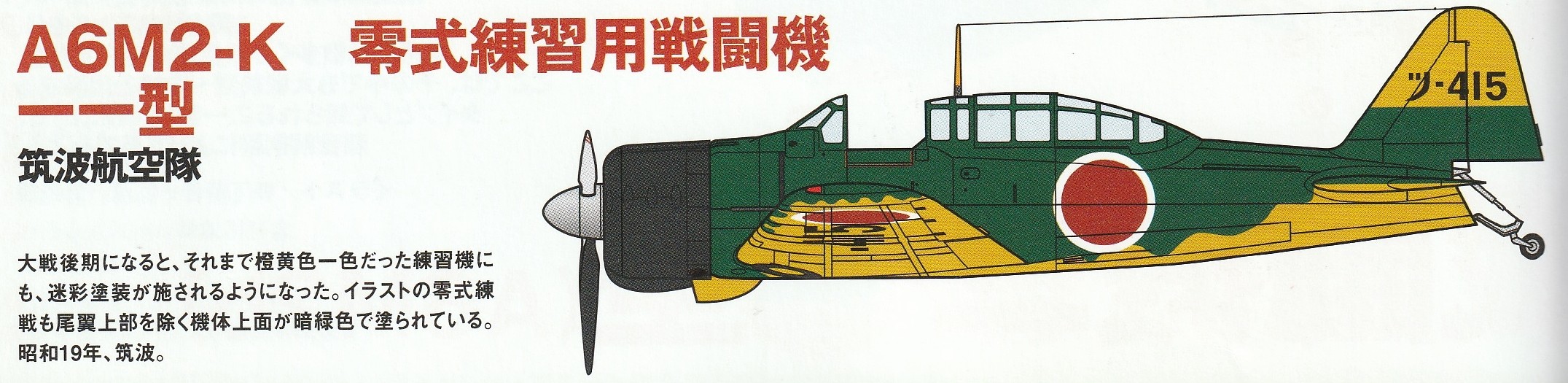
Construction description
Modifications compared to the A6M2:
- Addition of a rear cockpit. Dual-control configuration.
- Changes to the canopy design (open in the front seats, closed in the rear seats)
- Added stabilizer fins to both sides of the fuselage
- Removal of the 20mm Cannon
- Removal of the Main Landing Gear Wheel Cover
- The rear wheel is fixed and cannot be retracted.
- The rear tires were changed from solid tires to pneumatic tires, and their size was increased.
- Elimination of Shipboard Equipment (Wing-Tip Folding Mechanism, Arresting Hook)
- Added entry doors on the left and right sides of the front seats

General characteristics
- Crew: 1
- Length: 9.06 m
- Wingspan: 12.0 m
- Height: 3.53 m
- Wing area: 22.44 m²
- Empty weight: 1,819 kg
- Gross weight: 2,334 kg
- Max takeoff weight: ?
- Powerplant: 1 × Nakajima Sakae 12 (take-off power 940 hp)
- Propellers: 3-blade constant speed propeller (Hamilton Type) : diameter 2,900 mm
Performance
- Maximum speed: 476 km/h@4,000 m
- Cruising speed: ?
- Range: 1,379 km
- Service Ceiling: ?
- Time to Climb: 7 minutes 57 seconds to 6,000m
Armament
- Guns:
- 2 x 7.7mm Type 97 Fixed Machine Gun (in the nose)
- Bombs:
- 2 x 30 kg
- 2 x 60 kg
- 1 x 250 kg (Suicide Attack)
- Other
- 1 x Drop Tank (330L metal or 300L wood)
Armour
- None
Summary
The Kaigun A6M2-K will be a very interesting aircraft for the Japanese tree in War Thunder. If it were to be placed in the tech tree, it would be ideal for filling the gap between the A5M4 and the A6M2-N. It’s faster than both of those aircraft, and while its firepower is inferior to the A6M2-N, it has better maneuverability. Also, although it lacks armor, its survivability is slightly improved because it has two pilots. I hope you will share your knowledge in the comments section and participate in the discussion.
Finally, since my native language is not English, I used the DeepL translation. Please note that there is a possibility of translation errors and misrepresentations.
Book sources
世界の傑作機 No.55, 文林堂, 1997-11-5
零戦と一式戦「隼」完全ガイド, イカロス出版, 2019-3-5, ISBN978-4-8022-0664-8
モデルアート No.272 日本海軍機の塗装とマーキング 戦闘機編, モデルアート社, 1986-6-30
エアロ・ディテール 7, 大日本絵画, 1993-5, ISBN4-499-22608-2
日本軍用機写真集 3 (偵察機/飛行艇/輸送機/練習機), 文林堂, 1983-1