I would love to see the Ju 248 in game.
The Ju 248 is a German Jet Fighter and was supposed to be the successor of the Me 163. It never flew but it was completely build and fitted with the engine(HWK 109-509C) in September of 1944. The reason it never flew with it it’s engine is due to a lack of fuel. But between February 8th and 19th, 1945, Karl Wendt, together with the experienced Junkers chief pilot Hans-Joachim Pancherz, completed a total of 13 unpowered gliding flights with the prototype.
Here are some Key Datas
Crew 1
Length 7.89 m
Wingspan 9.55 m
Height 2.70 m
Wing Area 17.80 m²
Wing Loading Empty Weight: 123.6 kg/m²
Max. Takeoff Weight: 298.4 kg/m²
Landing Weight: 147.5 kg/m²
Wingspan 5.1
Empty weight 2200 kg
Maximum takeoff weight 5312 kg
Landing weight 2626 kg (after fuel consumption)
Maximum speed 950 km/h (at 6000 m)
Cruising speed 145 km/h (gliding)
Ascent time to 13,000 m: 3 min
Maximum flight altitude: 16,000 m
Range: 165 km (from 11 km gliding flight)
Engine: Walter HWK 109-509C-4 rocket engine with up to 2355 kp thrust
Armament: two 30 mm MK 108 cannons
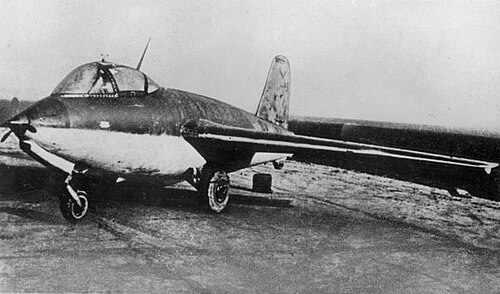
Since this jet is not a paper plane but an existing one, it should be added. But
The Me 263 V1 was the only prototype of the series to undergo extensive aerodynamic flight testing. For safety reasons during its initial unpowered glider flights, the aircraft’s newly designed tricycle landing gear was locked in a fixed, extended position. Although a functional twin-chamber Walter HWK 109-509C rocket engine was eventually mounted in the rear fuselage, early balance tests utilized a dummy weight to maintain the correct center of gravity. Technicians used this airframe for crucial aerodynamic research, which included taping wool tufts to the wings to observe airflow patterns in flight. The V1 carried no weapons or combat equipment.
The V2 prototype was completed shortly after the V1 and was specifically built to test the mechanical systems of the aircraft. Unlike the first prototype, the V2 featured a fully functional, hydraulically retractable tricycle landing gear intended for in-flight operation. It was also physically fitted with a real Walter rocket motor to ensure proper weight distribution and systems integration. However, due to mounting wartime delays and the chaotic collapse of the German testing infrastructure, the engineering team never managed to conduct comprehensive dynamic flight tests of the retraction mechanism before the project halted.
The V3 prototype was intended to serve as the definitive production pattern for the planned Me 263 A-1 series, but it remained incomplete in the final assembly shop at the end of the war. It was the only airframe designated to receive a full combat loadout, which featured a planned installation of two heavy 30mm MK 108 autocannons mounted directly into the wing roots. While both the operational rocket engine and the retractable landing gear systems were allocated for this airframe, the rapidly advancing Allied forces prevented technicians from finalizing or optimizing the aircraft for actual flight operations.
When American forces initially moved into the Dessau manufacturing facility, they encountered all three experimental airframes in various stages of abandonment. The Americans chose to destroy the V2 prototype on-site via demolition charges to prevent it from being salvaged. Shortly afterward, a boundary shift placed the factory into the Soviet occupation zone, allowing Soviet forces to capture the flight-tested V1 and the nearly completed V3, along with a full-scale wooden mock-up. Soviet aviation engineers immediately evacuated these captured assets to the USSR, using them as the direct design foundation for their own experimental rocket interceptor, the Mikoyan-Gurevich I-270.