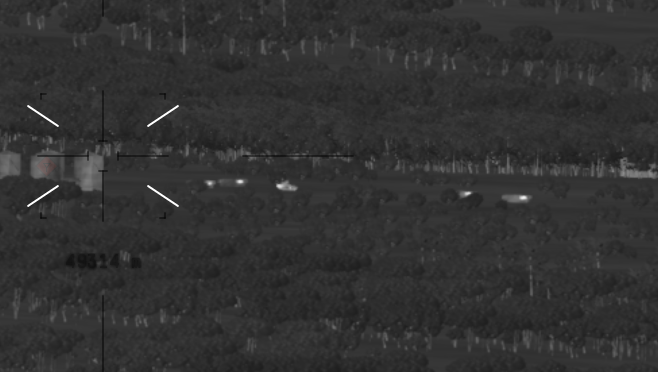
The existing aim-point/focus-of-interest sensors can mark/annotate up to 30 km at the pod’s maximum viewing range.
This article does not enumerate IRST/OEPS, reconnaissance pods, laser spot trackers, UAV electro-optical payloads, or helicopter targeting pods.
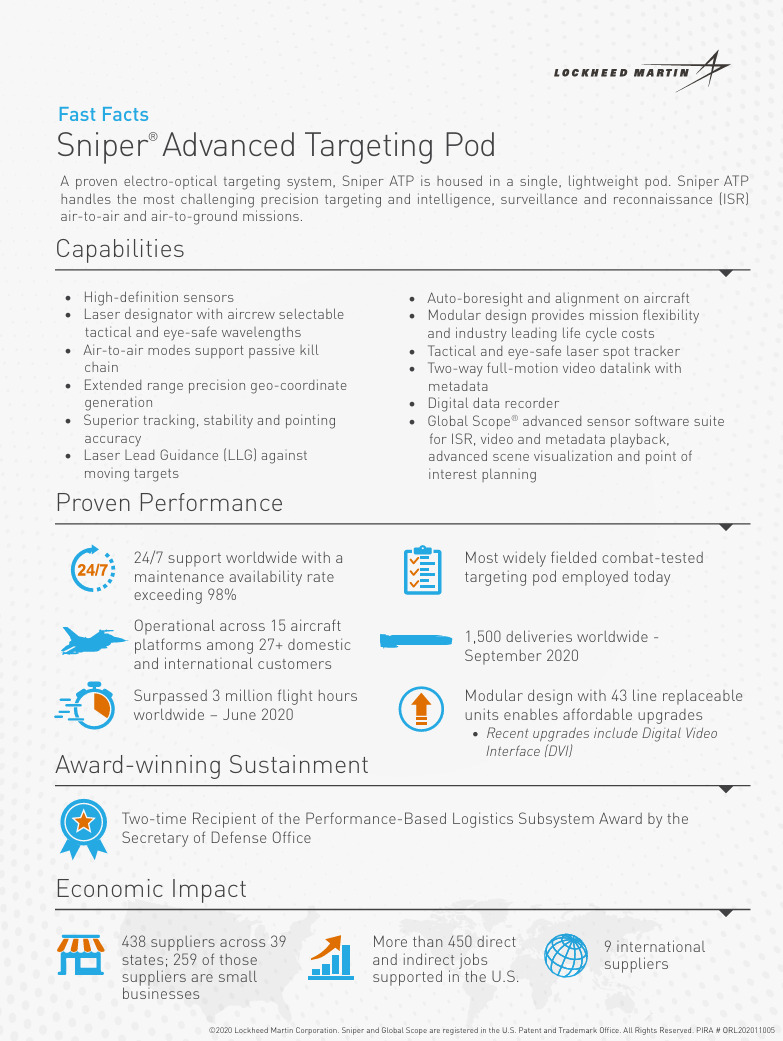
- AN/AAQ-33 “Sniper” series
Sub-variants:
— Sniper ATP (Advanced Targeting Pod, AN/AAQ-33)
— Sniper XR (Extended Range; export version designated PANTERA)
— Sniper ATP-SE (Sensor Enhanced; under the USAF NET-T contract, established a point-to-multipoint data link and extended-range beyond-line-of-sight image distribution capability)
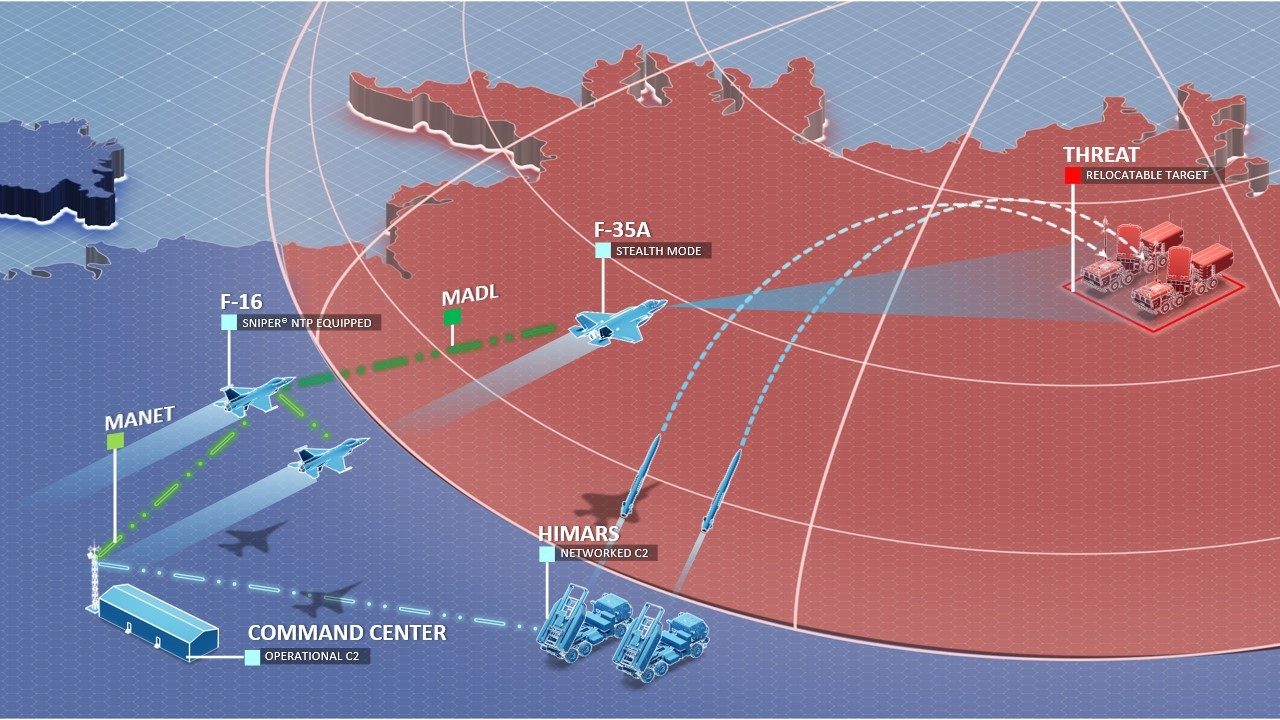
— Sniper NTP (Networked Targeting Pod; equipped with HybridBase Station, supports MADL, 5th-generation/4th-generation interoperability, pod-to-pod links, and edge computing)
Maximum range for points of interest and stable tracking: approximately 50 km.
Sniper Advanced Targeting Pod (ATP) | Lockheed Martin
Electronic Weapons: Saudis Buy A Better Vision
- AN/AAQ-14 LANTIRN targeting pod (including the ER extended-range variant)
It is paired with the AN/AAQ-13 navigation pod (including a Ku-band terrain-following radar) to form the LANTIRN system; the downgraded export variants are the AN/AAQ-20 (navigation, with the terrain-following radar removed) and the AN/AAQ-19 “Sharpshooter” (targeting, incompatible with the AGM-65).
Sub-variants:
— Sensors and improvements: The targeting pod consists of a narrow-field-of-view FLIR, an automatic target tracker, and a laser target designator/rangefinder.
— The ER variant upgrades the FLIR from 256×256 to a third-generation 640×512 medium-wave staring array, increasing target recognition and tracking range by approximately 25%; the laser is changed to a diode-pumped type with dual wavelengths of 1.06 µm (operational) and 1.57 µm (eye-safe training).
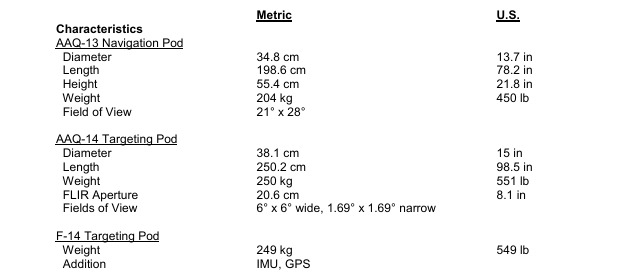
Maximum range for points of interest and stable tracking: approximately 25 to 28 km.
AN/ASQ-228 ATFLIR (Advanced Targeting Forward-Looking Infrared)
Sensor composition: infrared (IR) + low-light-level TV camera + laser rangefinder/target designator + laser spot tracker; since 2005, a Ku-band high-speed data link has been introduced, enabling real-time distribution of tracking/targeting video to ground equipment.
Maximum range for points of interest: day/night target location and designation at ranges beyond 40 nautical miles (approximately 74 km) and at altitudes above 50,000 ft.
Sub-variants:
— AN/AAS-38 “Nite Hawk” pod
Maximum range for points of interest / maximum stable tracking / laser designation range exceeds 40 nautical miles; the AN/AAR-50 navigation FLIR or the AAS-38 NITE Hawk navigation and infrared target designation FLIR pod can feed IR imagery directly to the head-up display (HUD).
ASQ-228/Advanced Targeting Forward-Looking Infrared (ATFLIR)
Aircraft Factsheets: McDonnell Douglas F/A-18
—AN/AVQ-26 “Pave Tack” pod
Thermal imaging + laser designation/rangefinding; can be cross-linked with radar or operate independently, providing the weapon systems officer with monochrome thermal imagery of the target (Class B).
Maximum range for points of interest / maximum stable tracking / laser designation range: approximately 18.5 km.
DESERT STORM - Precision Guided Munitions
F-111 Upgrade Options Parts I - IV
— AN/ASQ-153 / AN/AVQ-23 “Pave Spike” pod
Electro-optical (TV + laser) target designation pod; guides laser-guided bombs under daytime visual conditions (the early variant was a daytime TV designation type, not an all-weather thermal imaging type).
Maximum range for points of interest / maximum stable tracking: approximately 30 nautical miles; laser designation range: 10 nautical miles.
DESERT STORM - Precision Guided Munitions
- ITENING (LITENING) series
Rafael Advanced Defense Systems of Israel is responsible for the front sensor compartment section; Northrop Grumman of the United States is responsible for the rear electronics compartment section. Northrop Grumman is the prime contractor for LITENING AT, while Rafael markets Type III and its variants.
Sub-variants:
— Litening II: Has fully automatic stabilized target tracking capability and can operate at typical altitudes, speeds, and slant ranges for tactical weapon delivery.
Maximum point-of-interest detection range: approximately 55.6 km.
— Litening III: An upgrade of Type II; its typical operational scenario is described as observation at ranges beyond 50 km. It also has fully automatic stabilized tracking capability. Maximum point-of-interest detection range: approximately 55.6 km.
— Litening ER: “ER” stands for Extended Range; officially stated to increase surveillance and target detection range by more than 50% over the previous variant.
— Litening AT: Adopts a 1K×1K (1024×1024) high-resolution FLIR, with the primary goal of improving day/night detection and recognition range.
— Litening G4: The first to adopt an all-digital 1024×1024 (1K×1K) FLIR and a 1K×1K CCD, improving day/night target detection and recognition range; it has two-way data link and other networked capabilities.
— AT/5: Continuous technology upgrades; Litening 5 integrates electro-optical (EO) and infrared (IR) sensors and dual lasers, supports air-to-ground/air-to-air missions, and includes ground moving target indication (GMTI), multi-target tracking, and automatic target recognition (ATR).
LITENING Advanced Targeting Pod | Northrop Grumman
-
Thales Damoclès targeting pod (including the UAE “Shahab” variant)
Sensors and fields of view: third-generation medium-wave infrared (MWIR) FLIR with two fields of view, 4°×4° and 1°×0.75°; 1.06 µm and 1.5 µm dual-band laser rangefinder/designator; optional laser tracker and CCD camera; navigation FLIR MWIR 24°×18° (can be installed inside the pod or integrated into the stores management system).
Maximum range for points of interest: can recognize armored vehicle targets at 27 km; laser designation/rangefinding: laser designation range 16 km; the manufacturer claims sufficient power for use from an altitude of 13,700 m (45,000 ft) at a slant range of 45 km. -
Thales TALIOS (long-range identification electro-optical targeting pod)
A next-generation targeting and laser designation pod for the Rafale F3R/F4 standard; described as providing the Rafale with day/night laser surveillance, identification, and designation capability, with meter-level accuracy, interoperability with all laser-guided weapons, the ability to launch from standoff distances, and reconnaissance functions. Since 2024 it has integrated artificial intelligence to automatically analyze pod imagery and cue detected target information to the pilot (Jane’s IDR report, 2024); it can overlay real-time imagery on a 3D map (Vision Permanente) and interface with the helmet-mounted sight (F4 standard).
Maximum range for points of interest: 70 km; air-to-air tracking mode: 100 km.
Détecter et poursuivre
Thales on board the Dassault Aviation Rafale | Thales Group
Dassault Aviation Aims at New Rafale Market - GBP
-
TIALD (Thermal Imaging Airborne Laser Designator)
-
ASELPOD (ASELSAN Electro-Optical Targeting Pod)
Diameter 0.43 m, length 2.35 m, weight 240 kg; MIL-STD-1553B bus; 115 VAC 400 Hz and 28 VDC power; rear air intake for air cooling; four-axis stabilized electro-optical turret; includes day/night high-resolution cameras, dual-band laser rangefinder/designator, laser spot tracker, and 128 GB recording device; turret azimuth 360°, elevation +45° to −150°. TV channel: resolution 768×576; FOV 0.8°–4.0°. IR channel: 640×512 third-generation detector, 3–5 µm; three FOVs—ultra-wide 28°, wide 4.0°, narrow 0.8° (the narrow FOV is the FOV after 8× zoom).
Maximum range for points of interest: 55 km.
- 101KS-N Electro-Optical Targeting Pod
Russian third-generation airborne electro-optical targeting pod; uses single-aperture multi-channel optical targeting technology; 650×512 IR focal plane array; integrates night vision and laser targeting functions; rear ram-air intake exhausts waste heat from the laser.
- K/JDC01 Electro-Optical Targeting Pod
Sub-variants:
K/JDC01A adopts an infrared/TV dual-mode camera and can automatically track ground targets.
Maximum range for points of interest: 20 km (IR) / 22 km (TV).
- WMD-7 Electro-Optical Targeting Pod
Length 2.7 m, diameter 0.39 m, weight 280 kg; three channels: infrared + white-light TV + laser rangefinder/designator; neither the white-light nor the infrared channel has an ultra-wide field of view—wide FOV 4.3°×5.8°, narrow FOV 1.4°×1.9°.
Maximum range for points of interest: 25 km.
- YINGS-III (Falcon-III) Electro-Optical Targeting Pod
Design style similar to the US AN/AAQ-33 Sniper—clipped multi-planar fixed quartz window, modular design; equipped with a high-resolution CCD camera, an infrared imager, and a new-generation laser rangefinder.
Maximum range for points of interest: 70 km.
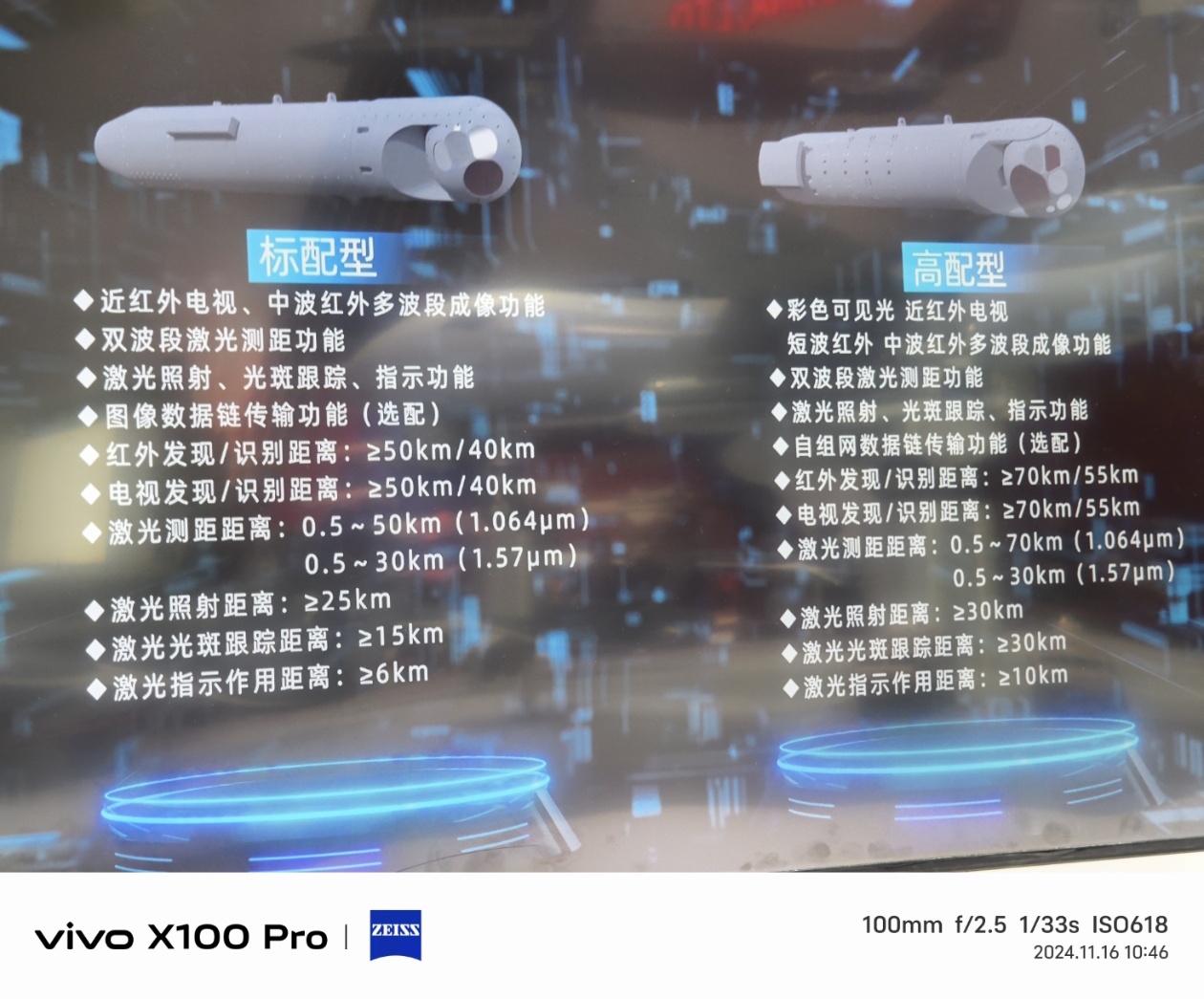
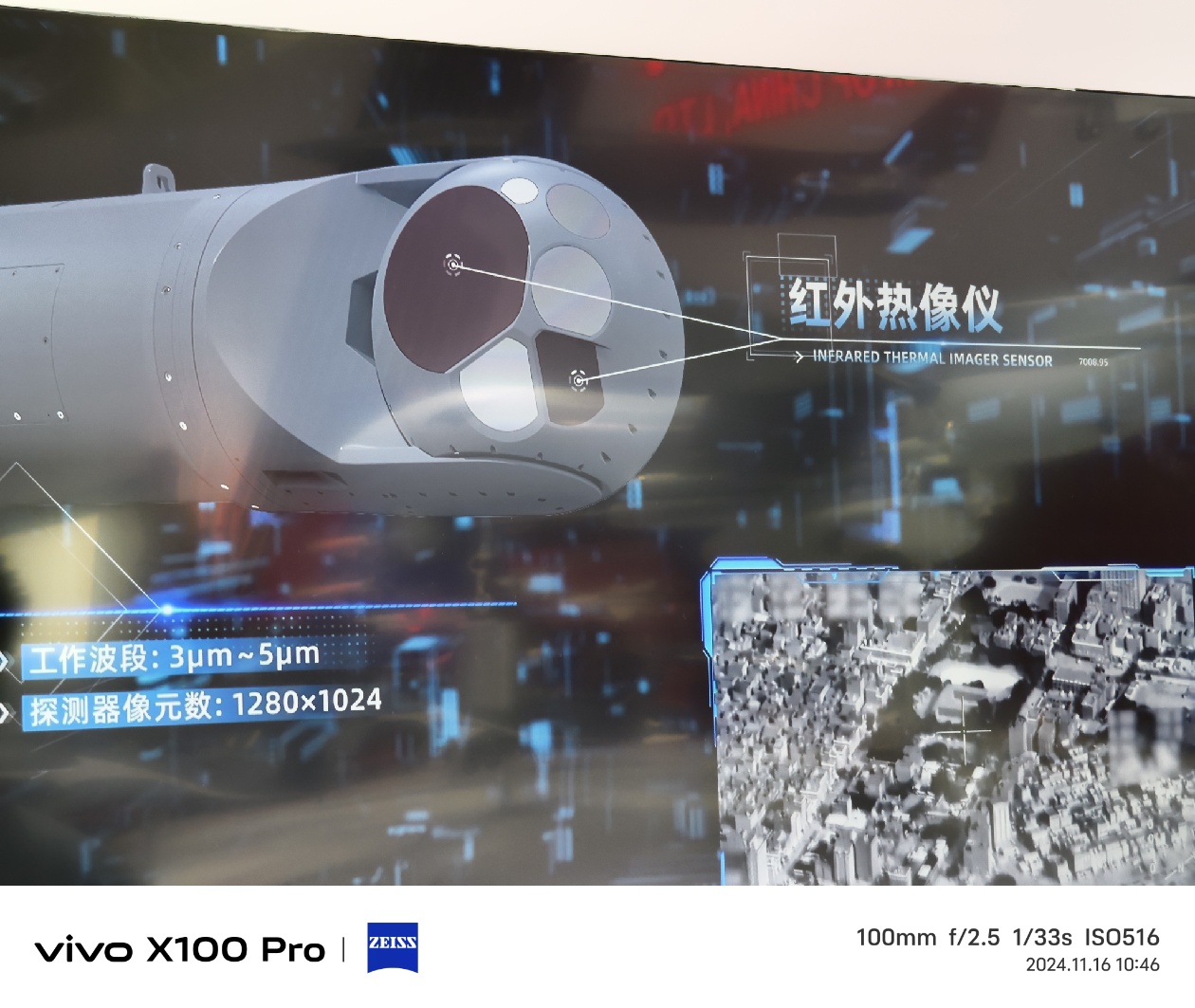
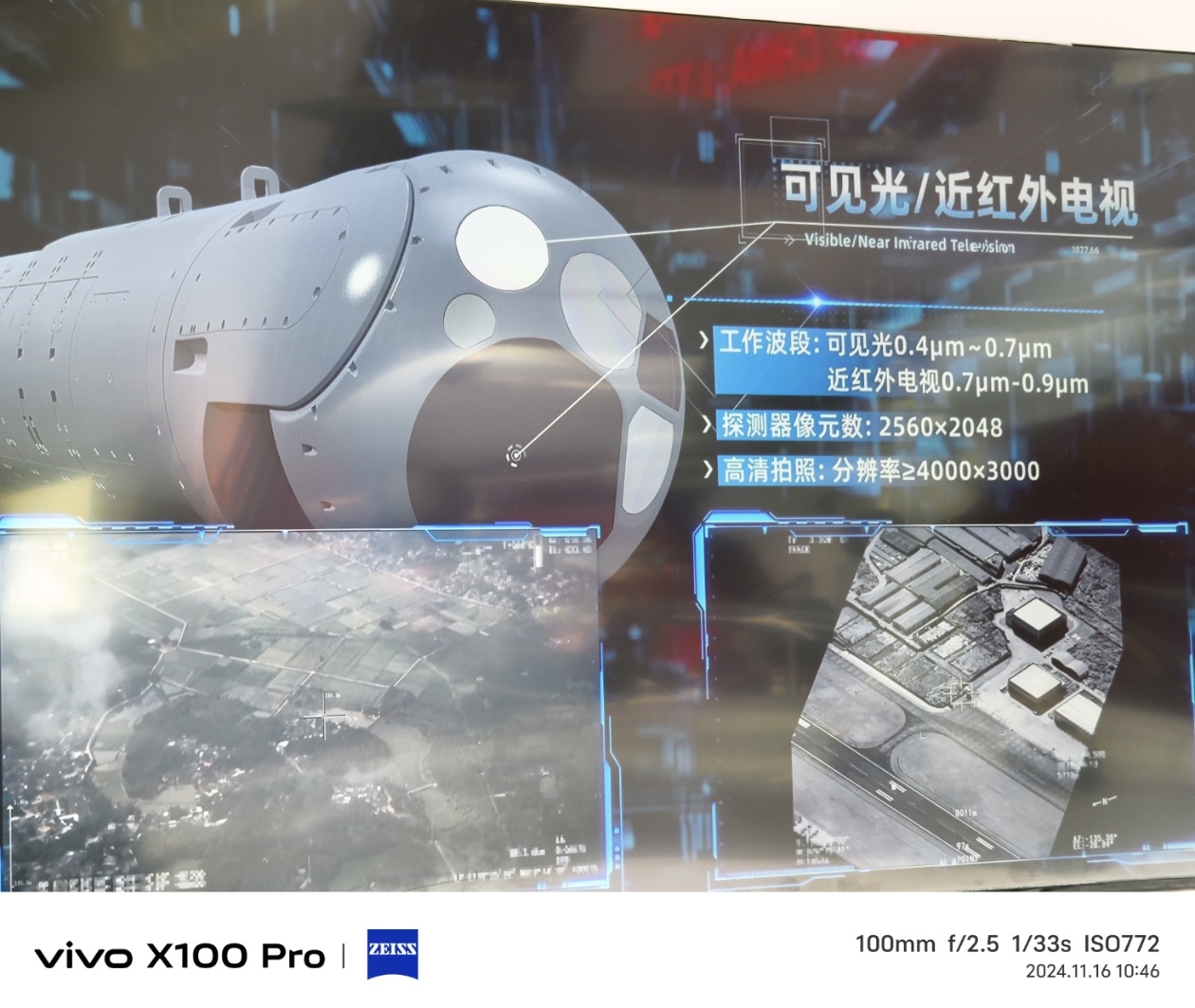
- OC-05 / OC-2
OC-2(Norinco / Harbin Jiancheng Group) is a laser/IR targeting pod employing a medium-wave infrared targeting system. In publicly available data, its IR detection range is20 km , and its laser maximum ranging range is15 km. Some reports also list its laser designator range as 15 km and mention that it is equipped with a zoom camera.
Public parameters for theOC-05are relatively limited. Available information indicates a detection range of 15 km and a laser designation range of 12 km , and that it is not equipped with an eye-safe 1.57 µm wavelength laser. Compared with the OC-2 in the same series, the OC-05 has shorter detection and designation ranges, and may be positioned as a lower-cost or lighter-weight solution
- Loong Eye series (AVIC EO/IR turrets/pods)