There will be a circle at the end of the line showing where the missile targets
not always
sometimes the missile decides that it knows where it is and that it is where it isnt so it has to arrive at a position where it was or something like that
anyways, it just doesnt put the target circle on anything and it just stays around the missile like in the picture
the whole radar stuff is just janky asf
It’s currently not implemented, it can only do TRK / IOG+DL / IOG. There is already a bug report that was accepted a while back about it.
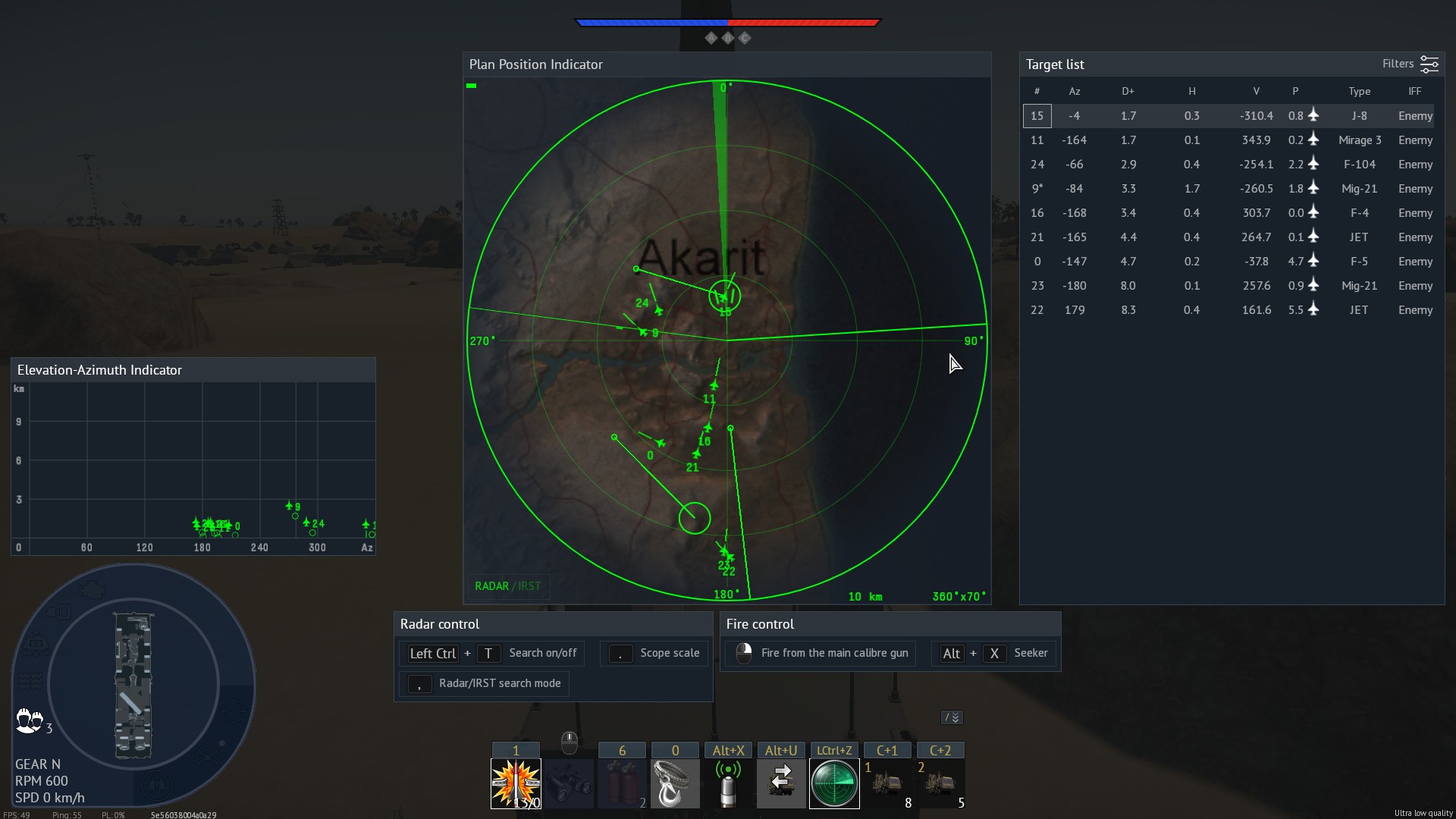
An arc would be more useful to display the area the missile is searching
Also as far as my research states, since IRIS-T’s seeker is not a true imaging IR focal plane array, in that it uses a smaller, linear, two-color, 128x2 staggered element array which is scanned by a sensor which indirectly receives the image from a scanning mirror which rapidly traverses the linear array.
What this means is that not only would Laser based countermeasures have less effective range against IRIS-T (since reflective losses due to the scanning mirror) but LDIRCM would also only affect the seeker in alternative frames of scanning since the angle of the mirror reflections would not allow for the laser to dazzle the scanner for a full second.
Since the seeker scans the image from the 128x2 array in such a way that it builds a 128x128 resolution image at 80 frames per second, the LDIRCM would really only be (at maximum) effective for 40 of those frames. Meaning the guidance update rate would effectively be, in the most efficient dazzling scenario, be halved.
All of this is ASSUMING that the LDIRCM can effectively dazzle ALL the seeker elements simultaneously for any single scanning frame.
PS.(not to mention the LDIRCCM methods of feature track and HOJ etc etc)
PPS i forgot to mention but, even Aim-9M (and missiles with IOG) would not really be countered by LDIRCM on helicopters sicne the moment it becomes dazzled, the onboard computer will recognise that there are countermeasures present and will shift guidance onto IOG. Same case with IOG in IRIS-T and Aim-9X.
7 Likes
Did they screw around with missile damage again or am i going insane?
Crit btw.
1 Like
Latest changelog:
- A direct hit on an aircraft’s fuel tank by the high-explosive warhead of an air-to-air missile (or equivalent munition) will now always cause the fuel tank to detonate.
You want to hear something more crazy which would be possible if a piezo-electric actuated mirror is used?
Including a sensor which measures the incoming energy of the infrared light. If the energy is above a certain threshold for one or more scanned lines (enough energy to damage the seeker) the mirror would direct these lines onto an absorber block instead of onto the sensor. Technically possible, unknown if implemented ^^
No point.
The speed of light is just too fast to slow the mirror to protect the seeker immediately… although i understand this would prevent extended exposure so it is a tactic worthy of employment.
You know that energy is “power over time”? Speed of light yes, but it has to be exposed long enough to transmit/be exposed to a certain amount of energy. If the piezo electric mirror switches between the following states there is no limitation because of the speed of light:
IR Power sensor ↔ IR sensor line (for each line as long as the incoming power is uncritical)
IR Power sensor ↔ Absorber block or line skip (if the incoming power exceeds the allowed limit for the line)
Between every line it switches to the power sensor to check if the incoming power exceeds the limit and only if it’s safe it directs the incoming IR radiation onto the IR sensor line, otherwise to either the absorber block or it skips to the next line and the cycle repeats. This would also equal a mechanical shutter effect (a shutter is necessary anyway for line-scan devices). Technically this is no witchcraft and the speed of light has nothing to do with it.
The only crititcal moment would be when the line gets redirected and in exactly that moment the LDIRCM hits the sensor, but then the exposure time would also just be just a few microseconds before the mirror switches to the power sensor again.
Yes i understand.
I incorrectly assumed that you meant the mirror could protect the sensor 100%.
Apologies for the misunderstanding
I apologize if I sounded more aggressive than I meant to be ^^
1 Like
No Problemo ^^
1 Like
Seems like iris t still unable to track targets when ordinance been dropped by them and issue with LDRCM still on going (came back from deleting the game and deleted today again lol)
i think that is an universal issue with alot of radars, not even only ground ones
Yeah, the radars with NCTI can discriminate between planes, missiles (rocket) and bombs (small) but there is no functionality to prioritze or ignore stuff. Automatic switching to another signature (plane to bombs) shouldn’t be a thing at all.
imo it is too easy to detect munitions especially missiles
i can get bombs and stuff but not small missiles
Well, the distances in this game are very low and the RCS of the ARH missiles ingame are around 0,04 m² while bombs are around 0,08 to 0,16 m². The missiles also generate a good doppler return because of their speed and at these short distances (up to 30 km) it would rather surprise me if they couldn’t see missiles. They don’t get detected beyond 30 km I think.