Like many players, I have often questioned the practical consistency of high-explosive interactions in the game—not the underlying theoretical mechanics, but why certain projectiles trigger lethal Overpressure while others with significantly higher explosive mass fail to do so. To investigate this, I conducted systematic empirical testing across various HE, Semi-AP/SAP, HESH shells, and rockets by targeting external modules (specifically gun barrels).By mapping the maximum detonation distance along the barrel from the turret/hull that still results in a kill, I uncovered several critical bugs and hardcoded inconsistencies that severely degrade gameplay and disrupt the damage model’s logic.
To be precise, these issues can be categorized into two distinct groups:
1. Rocket Damage Multipliers & Inconsistent Classification:
My testing reveals that specialized MLRS/Artillery rockets receive a heavily boosted Overpressure damage multiplier—likely designed to compensate for their low accuracy and high dispersion. The bug lies in the inconsistent application of this mechanic: certain rockets (particularly those mounted as secondary/auxiliary armament, such as on the RBT-5, Calliope, or Matilda Hedgehog) appear to lack this multiplier entirely. They revert to standard HE calculations, resulting in a severe performance disparity where primary MLRS rockets with minimal TNT mass outclassed massive secondary rockets and heavy HE shells. Below are several screenshots of rocket impacts, arranged in ascending order of their TNT equivalent. Each screenshot captures the maximum distance threshold down the gun barrel required to trigger a lethal Overpressure kill:
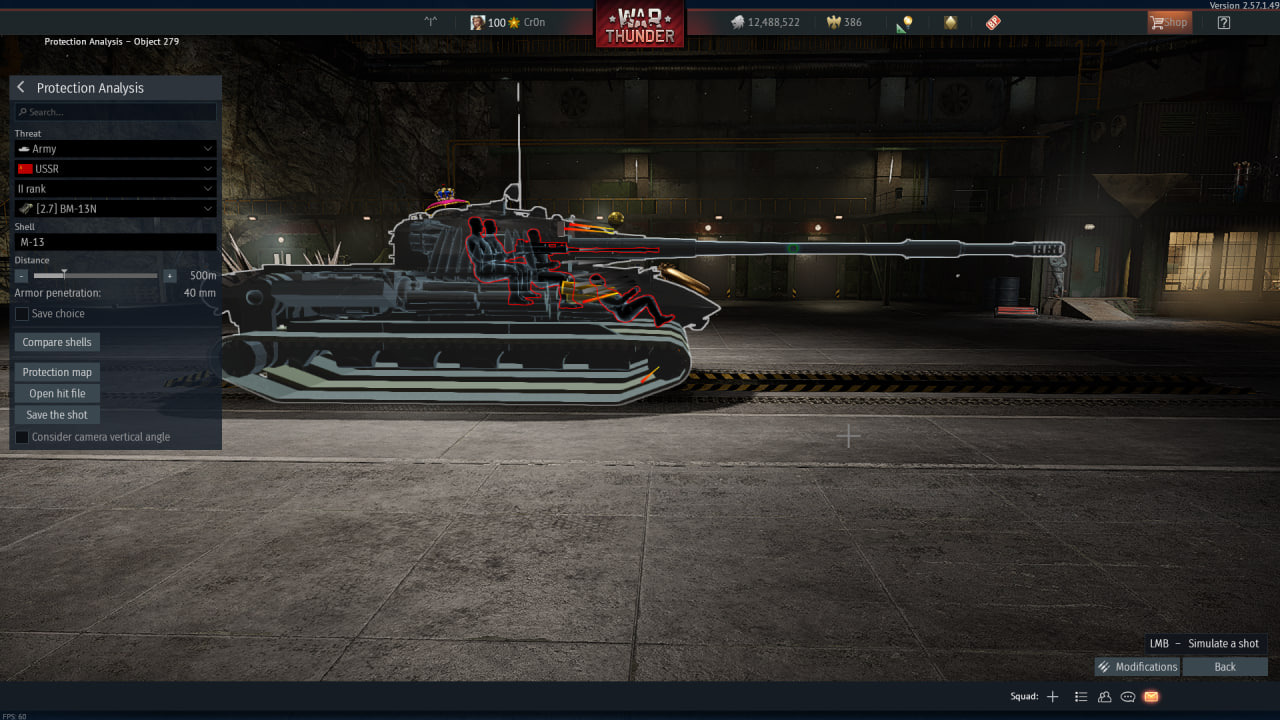
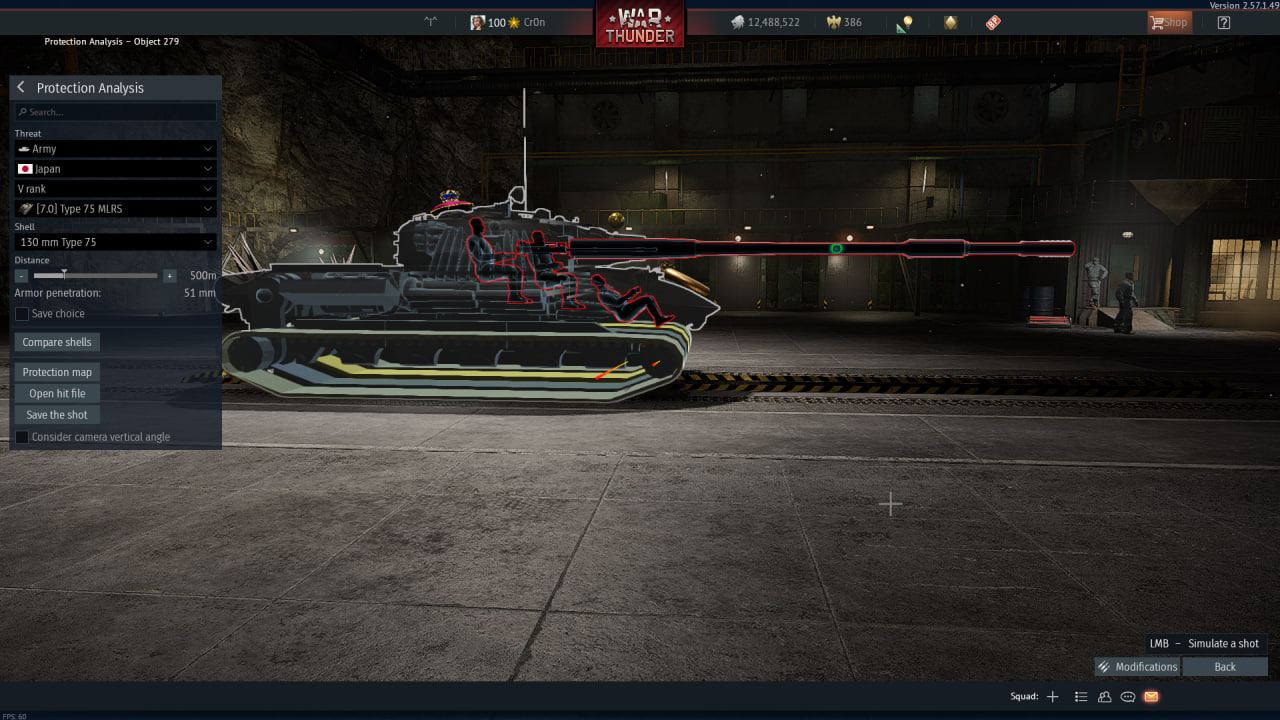
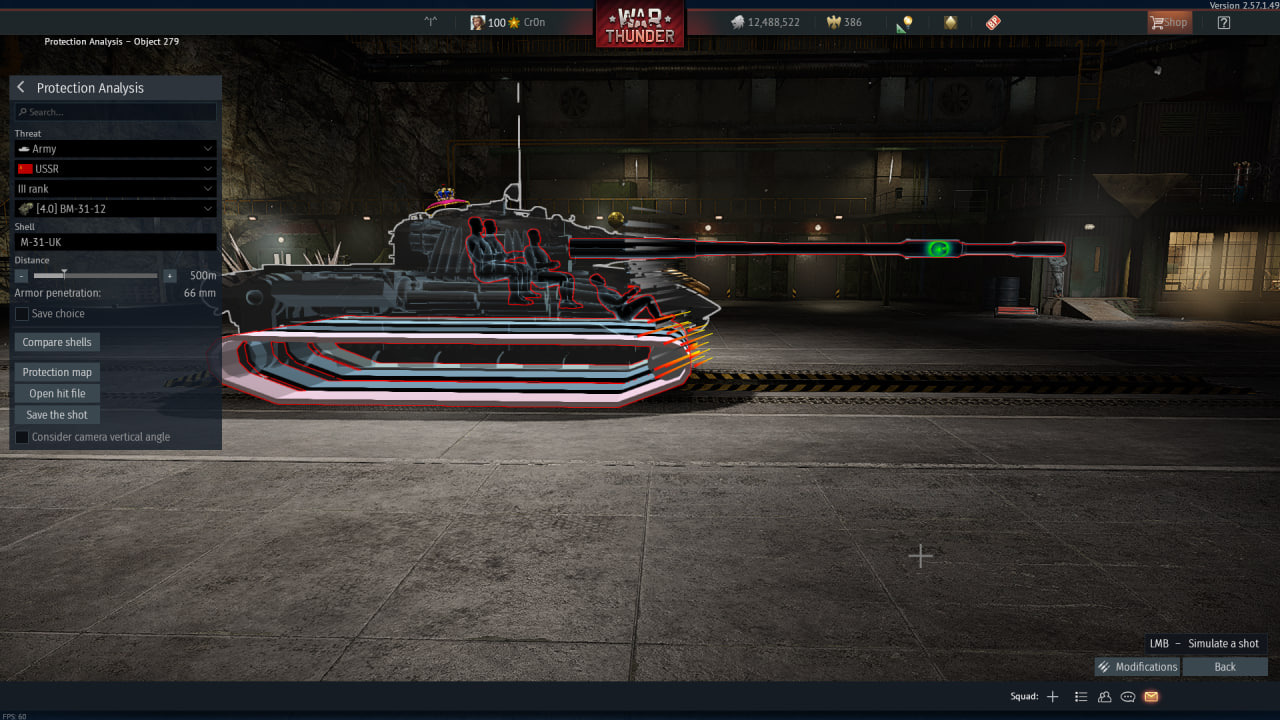
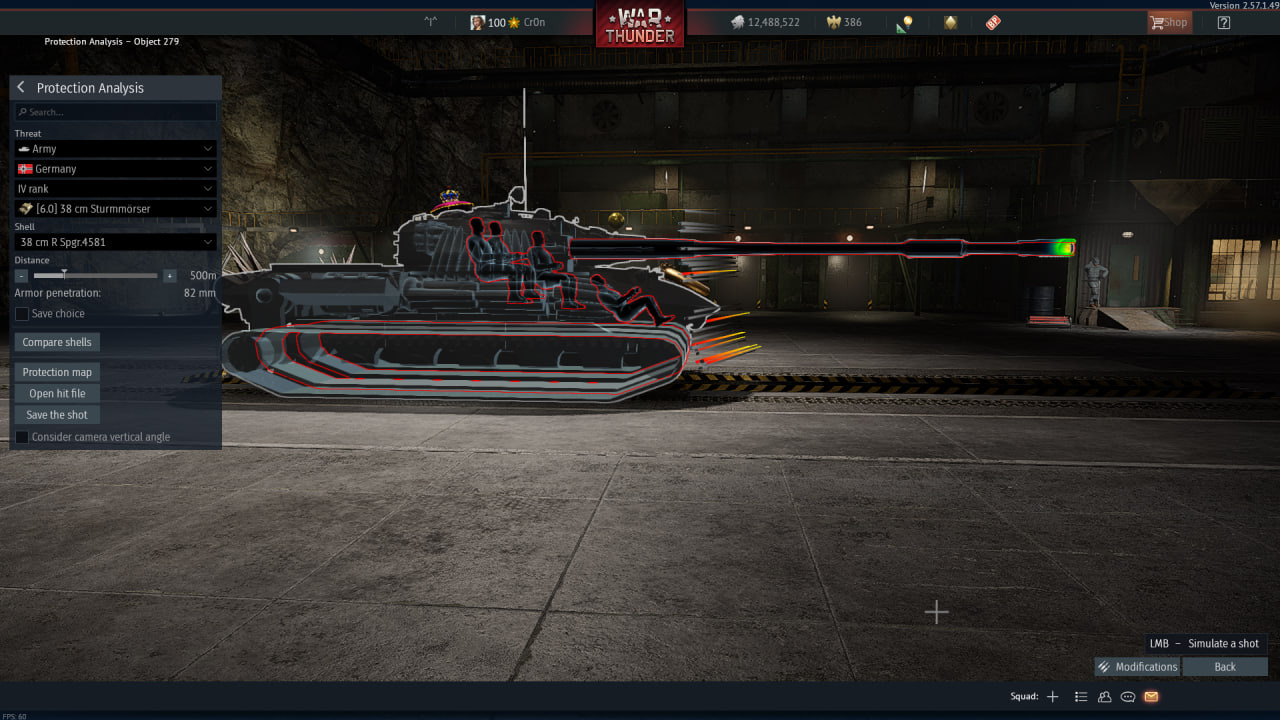
And here is how it works for rockets lacking this boosted damage multiplier. Note that these screenshots still demonstrate the maximum detonation distance from the turret/hull required to achieve a lethal Overpressure kill. To clarify, the gun barrel is used strictly as a standardized measuring scale to evaluate relative blast damage efficiency across different projectiles
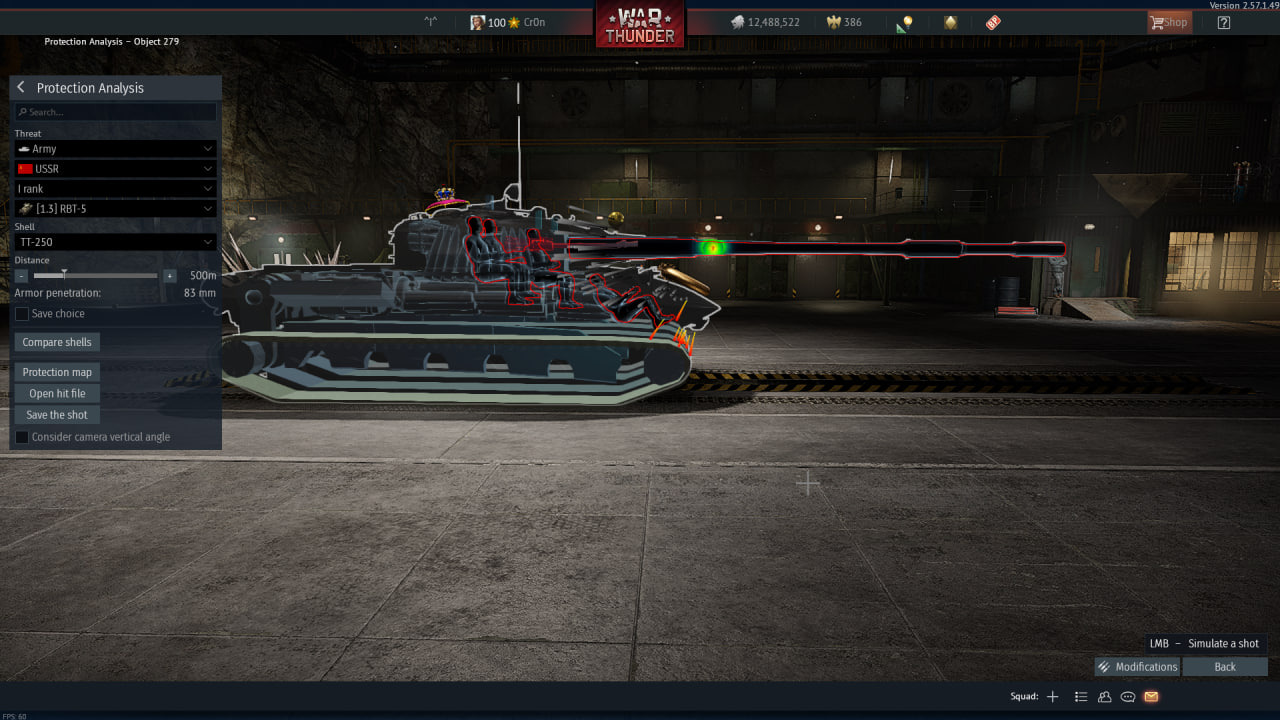
To put this disparity into perspective: a rocket with 130 kg of TNT equivalent performs twice as poorly as a rocket with merely 4.9 kg of TNT equivalent. Rockets on the Matilda Hedgehog and Churchill AVRE (Petard) show the exact same abnormally weak performance, scaling identically to standard HE shells. While I have not tested every single rocket in the game, the pattern is clear: one group of rockets clearly possesses an amplified damage multiplier that scales with explosive mass, whereas another group of rockets was simply overlooked by the developers and left with baseline HE calculations.
- Fragment Calculation & Overpressure Dispersion Errors.
This issue affects all tank-fired High-Explosive (HE), Semi-Armor-Piercing (SAP), and High-Explosive Squash Head (HESH) projectiles across the board. Systematic testing across numerous vehicles yielded completely predictable, broken results regardless of the target tank. To clearly illustrate this mechanics flaw, I will use the KV-2 (152mm) as a benchmark example:
The provided screenshots clearly demonstrate that the standard 5.82 kg TNT-equivalent HE shell is twice as weak (in terms of lethal Overpressure distance) compared to the 4.85 kg TNT-equivalent SAP shell.
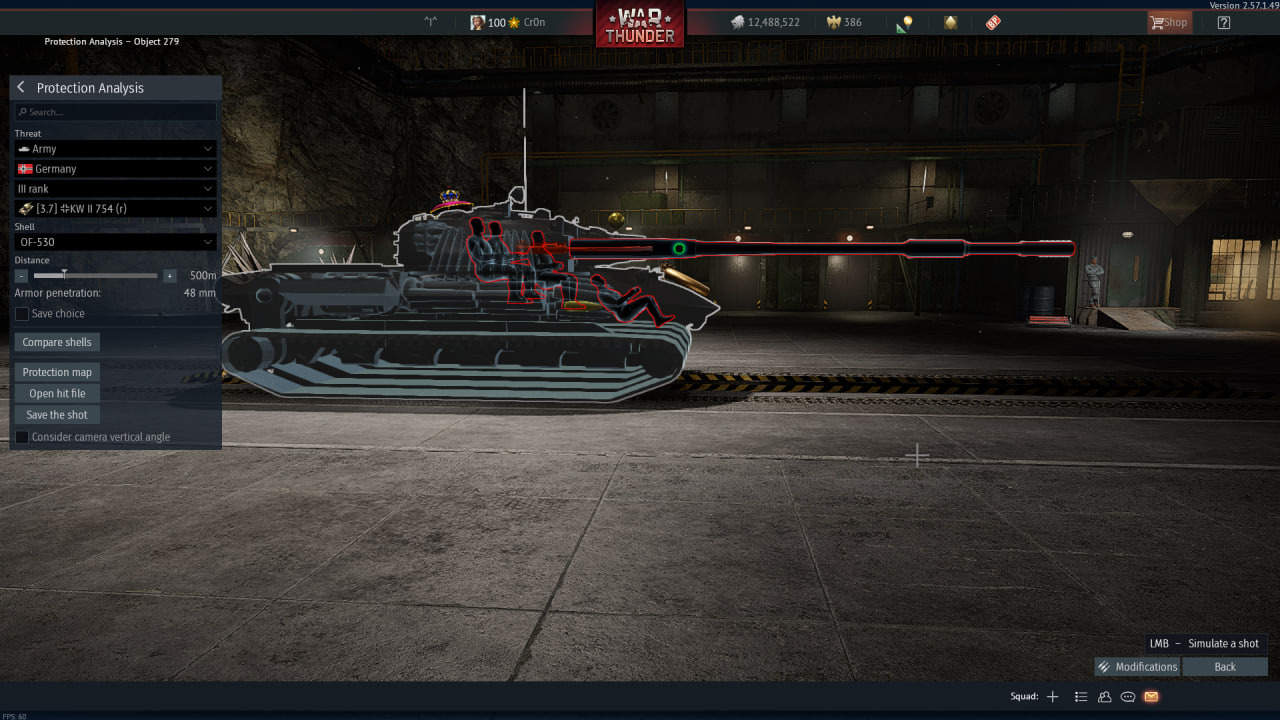
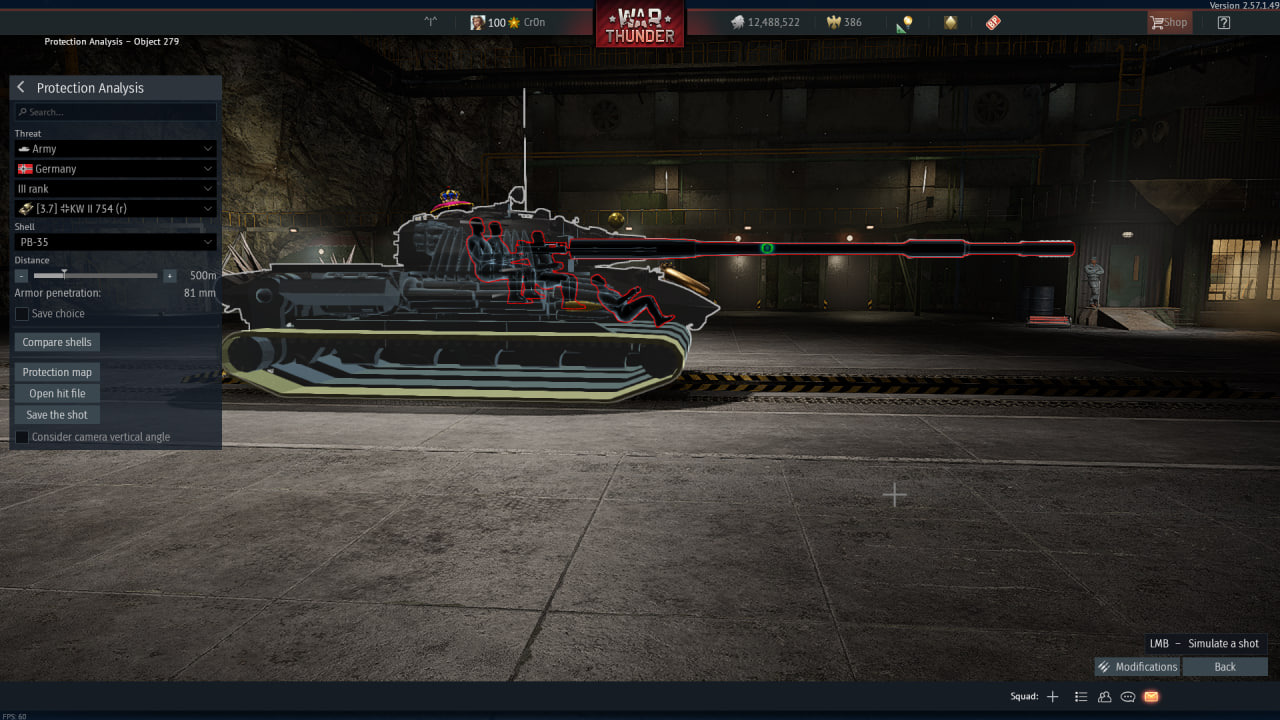
Using the KV-2 provides a perfectly controlled baseline: both projectiles are fired from the exact same gun, mounted on the exact same vehicle, and tested against the exact same target. Furthermore, this anomaly is not limited to gun barrel impacts—it applies universally to any impact point on the tank body itself, as well as near-miss detonations on the ground. A projectile containing less explosive mass should not consistently outclass a dedicated HE round with higher explosive content across all impact scenarios.
This behavior applies identically across all High-Explosive (HE), Semi-Armor-Piercing (SAP), and High-Explosive Squash Head (HESH) projectiles—essentially everything belonging to the broader ‘High-Explosive’ damage class.
The root cause of this behavior is an incorrect variable being used in the ALL HE damage calculation formula.
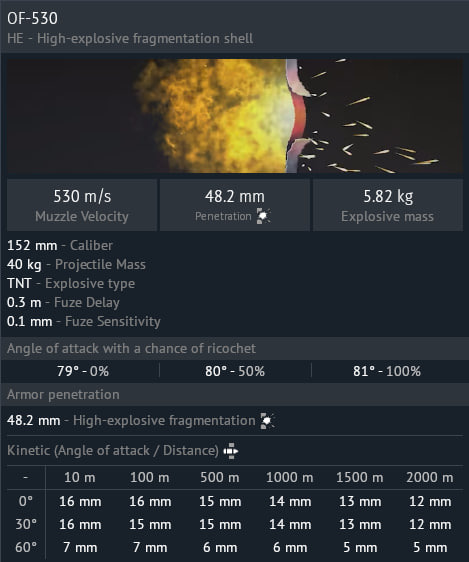
First, the game calculates whether there was a full kinetic penetration into the internal compartment at the impact point. For the provided KV-2 HE screenshot, this is armor up to 16mm. If there was no penetration (hit on the gun barrel, track, heavy armor, or ground), the high-explosive damage is calculated using high explosive fragmentation. On the screenshot, this value is 48.2mm.
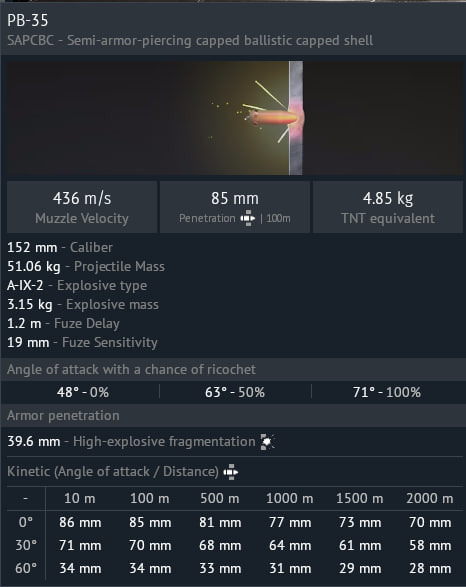
For SAP shells, the game similarly calculates whether a direct penetration occurred first (up to 86mm on the screenshot). Afterward, the high-explosive effect is calculated. HOWEVER, IT DOES NOT USE high explosive fragmentation! For the high-explosive effect of SAP shells, the formula instead uses their armor penetration figure, factoring in distance and impact angle. When fired point-blank, this SAP shell explodes like an HE round with a high explosive fragmentation value of 86mm. At a distance of 2000m and at an acute angle, it explodes like an HE round with a high explosive fragmentation value of 28mm.
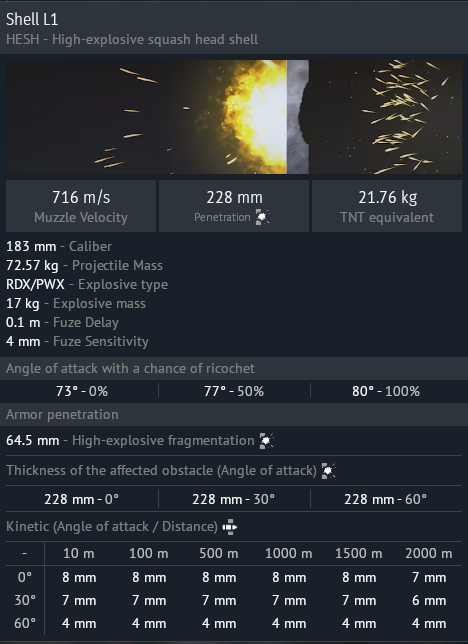
For HESH shells, “Thickness of the affected obstacle” is used instead of high explosive fragmentation.
I do not know the exact internal formulas, but taking into account adjustments for caliber, explosive mass, etc., the use of incorrect variables is evident and directly correlates with the test results. Anyone can verify this: the main requirement is to select a heavily armored tank with a long gun barrel, keep it completely stationary during testing to maintain a constant impact angle, and aim using the hanger background elements as reference points.
This error in the formula completely breaks the proper mechanics of these shells, making SAP and HESH rounds several times more powerful than standard HE rounds.