- Yes
- No
HUS-1 Seahorse - The Marines Forgotten Workhorse
Introduction
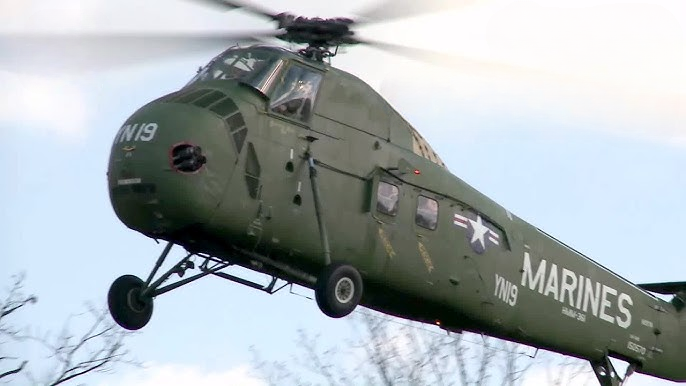
The HUS-1 Seahorse was one of the Marine Corps’ most dependable helicopters during the late 1950s and early years of the Vietnam War. It wasn’t flashy or high-tech, but it was a tough, reliable workhorse that Marines could count on in almost any situation. The HUS-1 carried troops into tight landing zones, hauled supplies across rough terrain, and pulled wounded Marines out of danger when every second mattered. Its big radial engine, sturdy frame, and straightforward design made it easy to keep flying even in harsh conditions.
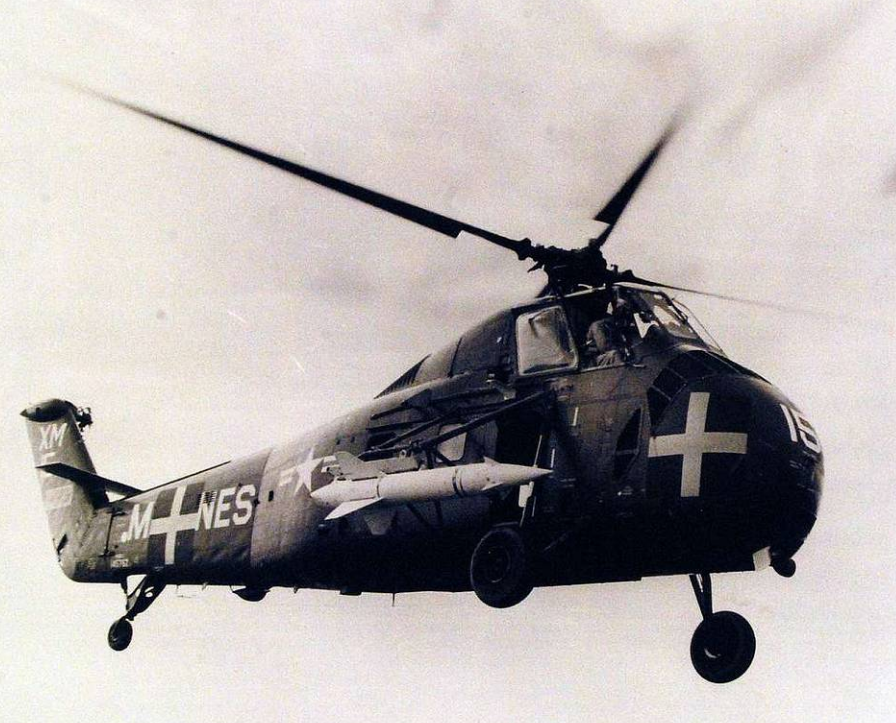
HUS-1 carrying a Bullpup ATGM.
History
The story of the H-34 really begins in the early 1950s, when Sikorsky was looking for a way to improve on its successful H-19 series. Helicopters were becoming a bigger part of military planning after the Korean War, and the services wanted something with more lift, better reliability, and a cabin that could handle real troop-carrying missions. In 1954, Sikorsky rolled out what would become the S-58, a helicopter that looked oddly distinctive with its long nose and radial engine mounted up front. That engine placement wasn’t just for looksit freed up space in the cabin, improved weight balance, and made the aircraft much easier to maintain in the field.
The U.S. Army was the first to jump on the design, adopting it as the H-34 Choctaw. The Navy wasn’t far behind, ordering its own version for anti-submarine warfare and general utility duties. The aircraft quickly proved itself: it was rugged, easy to fix, and had enough muscle to haul troops, stretchers, cargo, or even sling loads nobody had tried lifting with a helicopter before. It was the kind of machine that didn’t need to be babiedit just worked.
For the U.S. Marine Corps, the timing couldn’t have been better. The Marines had learned a lot about helicopter operations from the Korean War, and they were already thinking ahead to the next conflict. Amphibious assaults were changing. The old idea of storming a beach under heavy fire was fading, replaced by the concept of vertical envelopment hitting the enemy from unexpected angles using helicopters. But to make that work, the Marines needed a reliable aircraft that could take off from ships, haul a squad of troops, and operate in rough conditions without constant downtime.
That’s where the H-34 came in.
After testing the design, the Marine Corps adopted its own variant, designated HUS-1 (later renamed UH-34D in 1962). Marine squadrons immediately appreciated what they had. The HUS-1 was simple to work on, tough enough to handle saltwater operations from amphibious assault ships, and big enough to carry Marines and their gear into places vehicles could never reach. The big radial engine gave it a unique sound loud, throaty, and unmistakable and the nose-mounted layout meant mechanics could reach most critical parts without crawling through tight openings.
By the late 1950s, the Seahorse had become a familiar sight aboard Marine helicopter carriers. It took part in exercises across the Pacific, the Caribbean, and the Mediterranean, proving that helicopter-borne assaults were more than just theory. But its true test came in the early 1960s, when the United States began sending advisors and aviation units to Vietnam.
When Marine helicopter squadrons deployed to Vietnam in 1962, the HUS-1 was the backbone of their airlift capability. It became the aircraft that carried Marines into their first combat operations of the war. It hauled troops into landing zones cut out of jungle, evacuated wounded troops under fire, delivered ammo and water to remote outposts, and lifted damaged vehicles and downed aircraft out of impossible places. Later in the war, when enemy fire became heavier and more accurate, crews improvised by adding machine guns, armor plates, and protective gear that hadn’t been part of the original design.
The H-34 wasn’t perfect its piston engine struggled in hot, humid Vietnamese weather, and its performance suffered at high elevations but it earned a reputation for showing up and getting the job done anyway. Marines came to respect it not because it was fancy or powerful, but because it was dependable, familiar, and incredibly forgiving. Many pilots learning to fly helicopters in the 1950s and 60s trained on the H-34 before moving on to turbine-powered aircraft.
As newer helicopters like the UH-1E and CH-46 Sea Knight entered Marine service, the H-34 gradually stepped into a secondary role. By the late 1960s, it was finally phased out, but it had already left a huge mark on Marine aviation. It had helped pioneer modern helicopter assault tactics, served as the first Marine transport helicopter in Vietnam, and proven that helicopters could shape the battlefield in ways traditional vehicles never could.
Today, the H-34/HUS-1 is remembered with a kind of quiet respect. It wasn’t flashy, and it wasn’t cutting-edge for long, but it was a reliable workhorse that carried Marines through some of the toughest early years of helicopter combat. Many veterans still talk about the sound of that big radial engine or the way the aircraft shook and rumbled but somehow always brought them home.
Specification
- Powerplant: One Wright R-1820-84B/D radial piston engine (1,525 hp)
- Main rotor diameter: 56 feet (17.07 meters)
- Length overall: 65 ft, 10 in. (20.06 meters)
- Weight, empty: 7,750 lbs. (3,515 kg)
- Height: 14 ft., 3.5 in. (4.36 meters)
- Maximum allowable weight: 14,000 lbs. (6,350 kg)
- Maximum level speed at sea level, at 13,000 lbs.: 106 knots (122 mph; 196 km/h)
- Maximum rate of climb at sea level, at above AUW: 1,100 ft (33 meter)/minute
- Service ceiling, at above AUW: 9,500 ft (2,900 meters)
- Range with max fuel, 10% reserve, at above AUW: 214 nm (247 miles; 400 km)
- Accomodations: 18 troops or 8 stretchers
- Armament: transport aircraft (slicks) carried two single-crew operated swivel-mounted 7.62mm NATO M-60 machineguns; gunships (stingers) carried two 18-rocket pods of 2.75-inch rockets, two fixed-mounted 7.62 NATO M-60 machineguns, and three single-crew operated swivel-mounted 7.62 NATO M-60 machineguns or Bullpups.
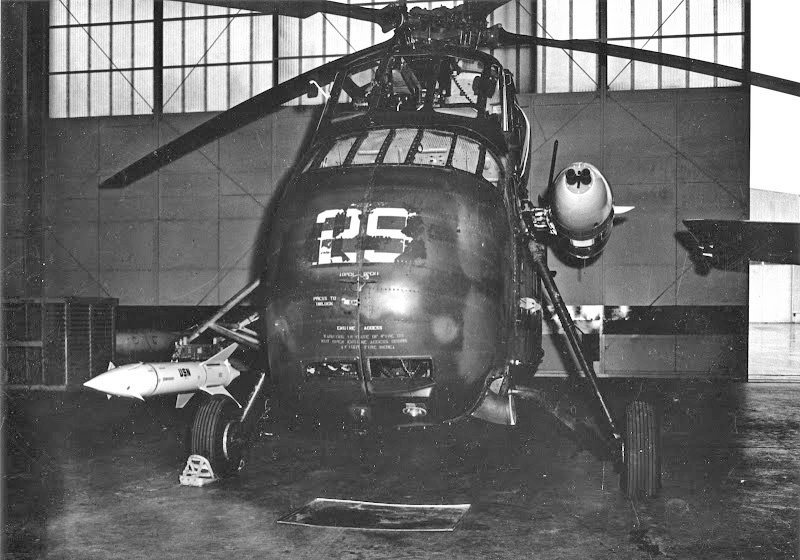
HUS-1 (UH-34D) with Bullpup and Mk 4 Gunpod
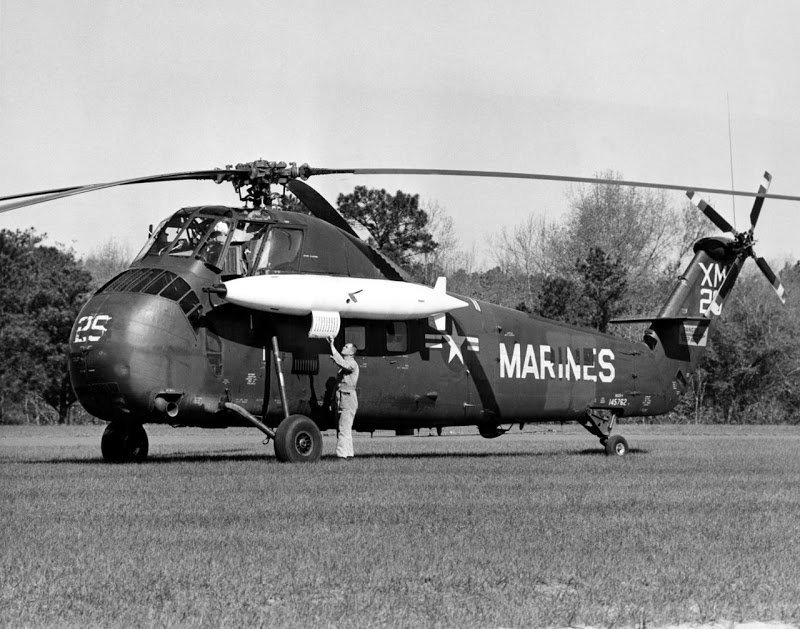
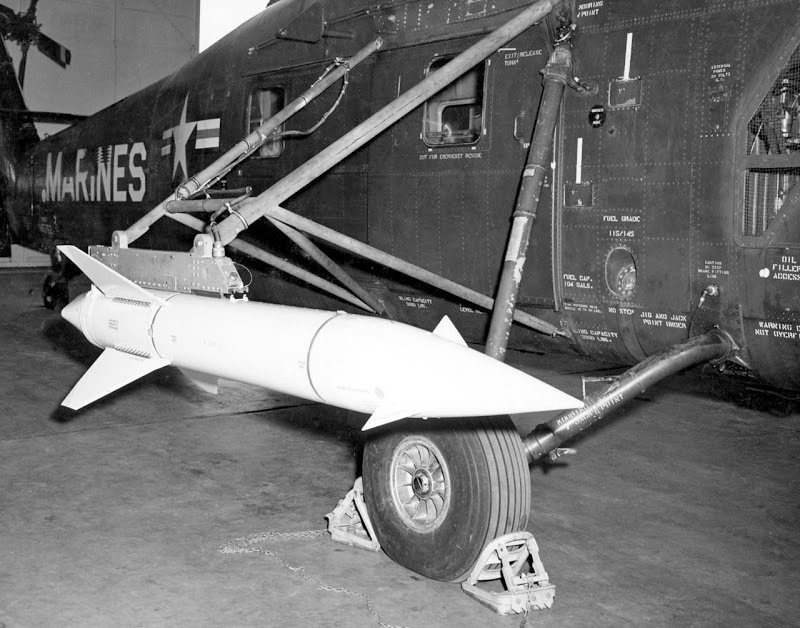
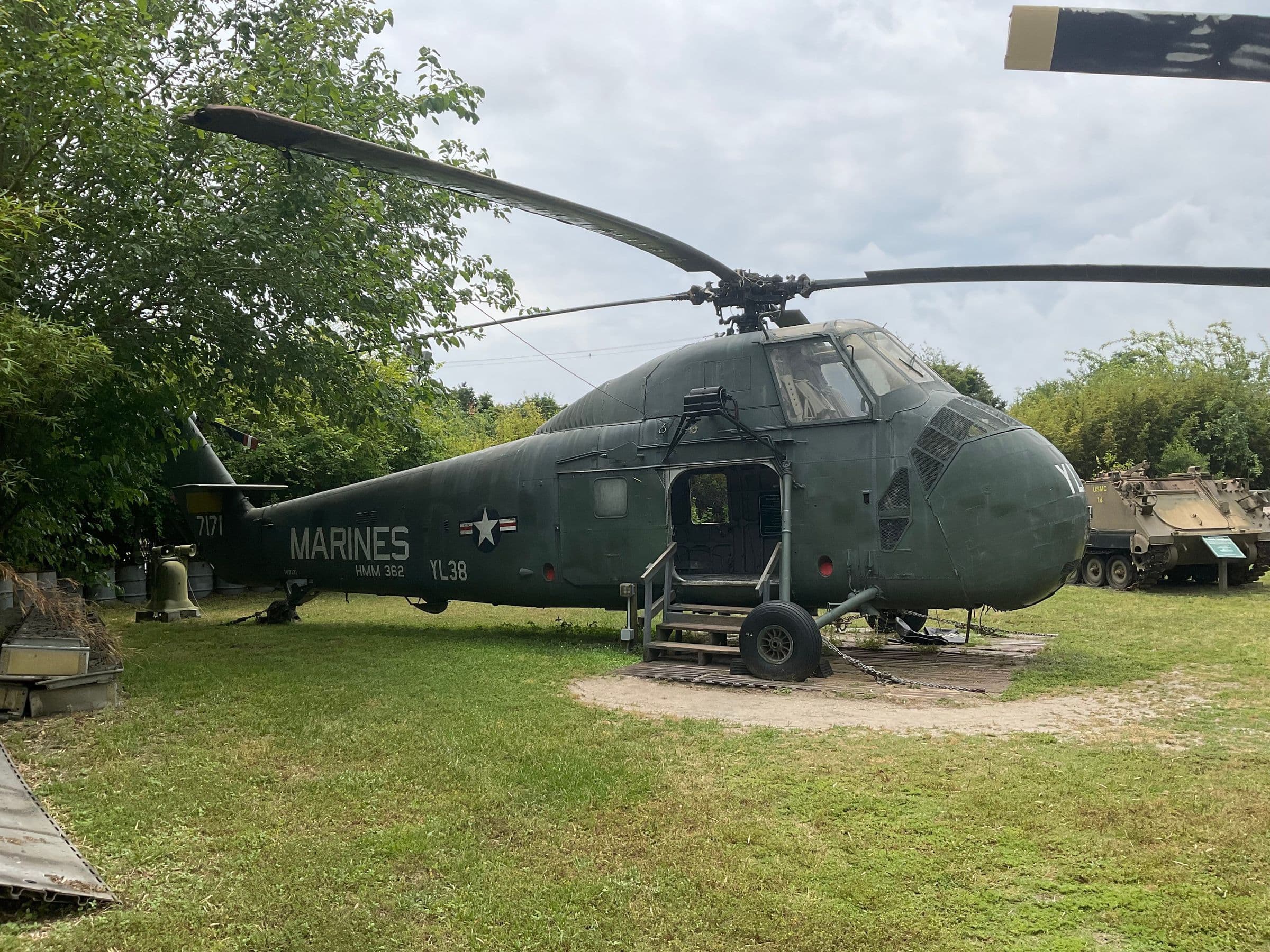
UH-34D at National Naval Aviation Museum
Extra
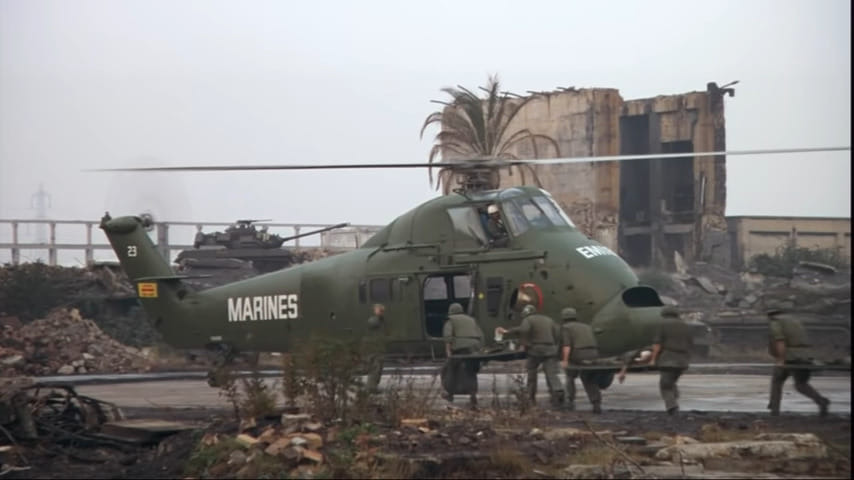
Westland Wessex painted in Marines livery for movie “Full Metal Jacket”
Sources
https://www.flyingleathernecks.org/aircraft-collection/hus-1-sea-horse
https://www.angelfire.com/de/HMM365Vietnam/acft.html
Sikorsky UH-34D - National Museum of the Marine Corps
Sikorsky UH-34J Seabat | Estrella Warbird Museum
Sikorsky H-34 - Wikipedia
https://x.com/Ninja998998/status/1419959162293964800
https://www.youtube.com/watch?v=FaIEie3vhsc