History
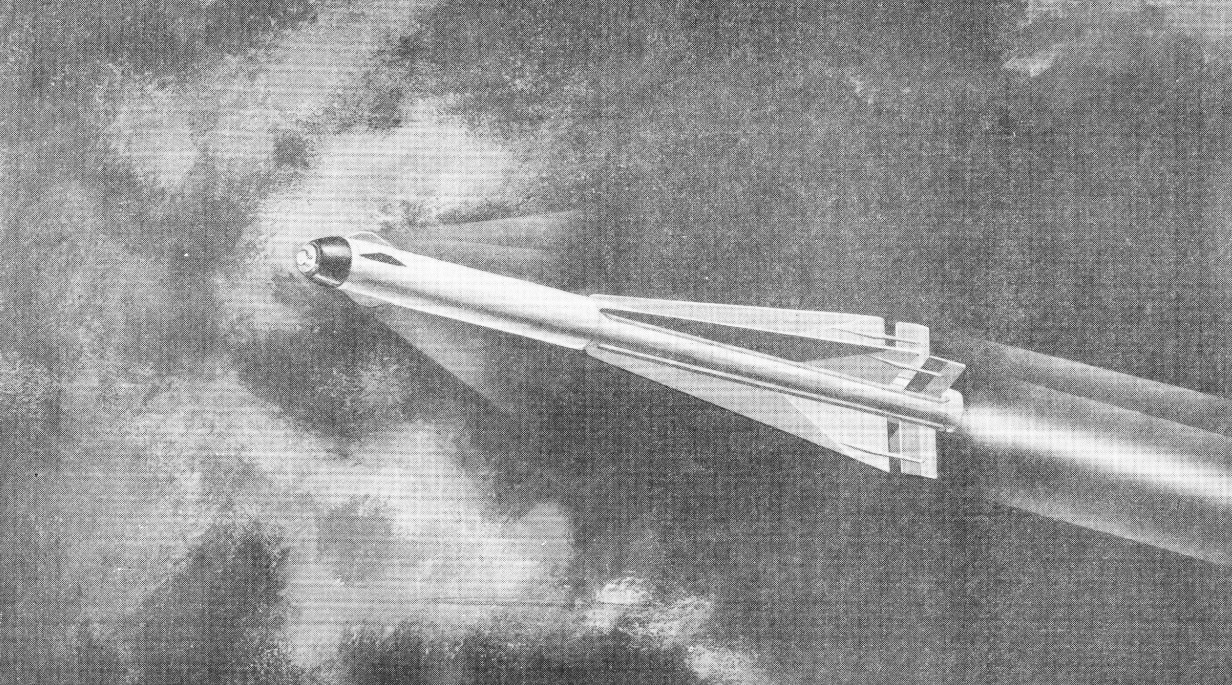
The AIM-4 Falcon missile series was the first operational guided air-to-air missile to enter US Air Force service. Its earliest presence was noted in 1946, when Hughes was awarded a contract to study a short-range air-to-air missile under project MX-798. It was originally envisioned to be launched from bombers’ tails for self-defense, but the project was cancelled in March 1947 and restarted as the MX-904. By 1950, the requirement had changed from a bomber-launched platform to a fighter/interceptor platform. Now named Falcon, it was to become a missile for use by fighter interceptors against Soviet bombers with contact fuse system in its warhead.
It was designated F-98 as the USAF began assigning aircraft-type designations to its guided missiles in 1950, with interceptor missiles designated as “Fighters.” The Falcon was also originally envisioned as two weapons at this stage: a missile suitable for subsonic fighters like the F-89 Scorpion, designated the XF-98, and a missile suitable for supersonic fighters like the F-102A Delta Dagger, designated the XF-98A. The subsonic variant was eventually dropped in favor of a supersonic-launch variant.
In 1955, the USAF stopped using aircraft designations for missiles, and the Falcon was redesignated. Subsequently, the XF-98A, YF-98A, and F-98A became the XGAR-1, YGAR-1, and GAR-1, respectively.
Beginning in 1951, GAR-1 test launches were conducted for developmental purposes. In the meantime, the Falcon missile was subjected to trial and error and would not be delivered to F-89H units until it reached IOC in March 1956.
The GAR-1D emerged as the first improved Falcon design over the GAR-1. In its definitive configuration, the GAR-1D could maneuver better and fly faster at higher altitudes because its control surfaces were separated from the delta wings and made larger. In addition, its dimensions remained unchanged from those of the GAR-1. The GAR-1D used a semi-active radar seeker and was mainly employed against Soviet subsonic bombers. The GAR-1D was the main production model of the original SARH Falcon, with about 12,000 missiles built.
Development of an infrared-guided counterpart to the GAR-1D began in July 1952. This missile variant was designated the GAR-2. It was 1.5 inches longer than the GAR-1D due to its IR seeker. The obvious advantage of the GAR-2 was its “fire-and-forget” capability. It was initially employed by the F-102A throughout development. The missile became operational in 1956. The GAR-2’s IR seeker encountered technical problems during testing. Hughes investigated the root cause and determined that the sensitive seeker was the culprit, as it was highly susceptible to external interference from environmental sources such as haze, clouds, and the sun. A low-altitude evaluation of the GAR-2 in 1959 showed that it was almost completely unusable.
Hughes spent two years resolving this problem by adding micron filters to the GAR-2’s IR seeker, although this did not fully resolve the seeker’s sensitivity problem. Hughes integrated GAR-2 capability into the F-89H and F-101B.
The 1962 United States Tri-Service aircraft designation system redesignated the GAR-1 Falcon missile as the AIM-4, making the GAR-2 the AIM-4B.
The AIM-4B was replaced by the AIM-4C and AIM-4D, which featured improved IR seekers and were introduced in September 1957 and April 1962, respectively. More than 26,000 AIM-4B/C missiles were built. The F-89H, F-101B, and F-102A were among the launching platforms that used this missile type.