History
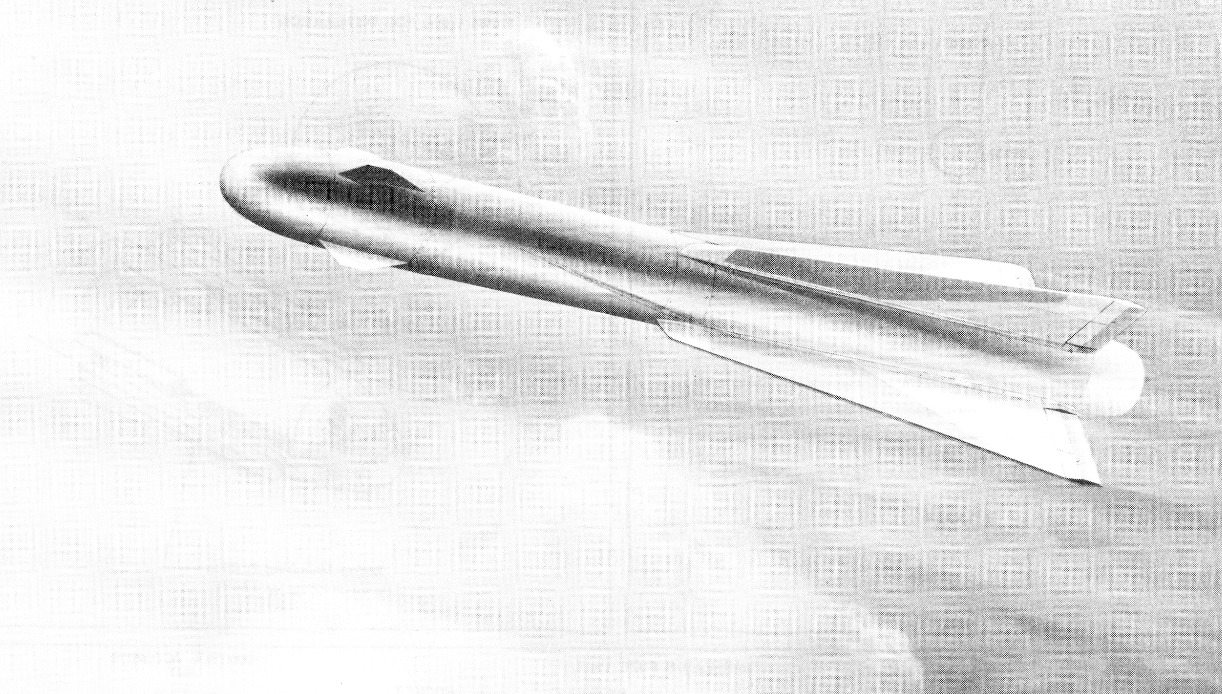
The AIM-4 Falcon missile series was the first operational guided air-to-air missile to enter US Air Force service. Its earliest presence was noted in 1946, when Hughes was awarded a contract to study a short-range air-to-air missile under project MX-798. It was originally envisioned to be launched from bombers’ tails for self-defense, but the project was cancelled in March 1947 and restarted as the MX-904. By 1950, the requirement had changed from a bomber-launched platform to a fighter/interceptor platform. Now named Falcon, it was to become a missile for use by fighter interceptors against Soviet bombers, with a contact-fuze system in its warhead.
It was designated F-98 as the USAF began assigning aircraft-type designations to its guided missiles in 1950, with interceptor missiles designated as “Fighters.” The Falcon was also originally envisioned as two weapons at this stage: a missile suitable for subsonic fighters like the F-89 Scorpion, designated the XF-98, and a missile suitable for supersonic fighters like the F-102A Delta Dagger, designated the XF-98A. The subsonic variant was eventually dropped in favor of a supersonic-launch variant.
In 1955, the USAF stopped using aircraft designations for missiles, and the Falcon was redesignated. Subsequently, the XF-98A, YF-98A, and F-98A became the XGAR-1, YGAR-1, and GAR-1, respectively.
Beginning in 1951 and continuing through 1954, YGAR-1 test launches were conducted for developmental purposes. In the meantime, the Falcon missile was subjected to trial and error until the production GAR-1 design was perfected and delivered to the USAF. In March 1954, the USAF had ordered 156 F-89H interceptors, which were to be equipped with six Falcon missiles as part of their armament suite, making the F-89H the first Falcon launch platform to enter service. On 27 January 1955, an F-89 destroyed a QB-17 with a GAR-1 containing a live warhead, marking the missile’s first successful intercept using a USAF interceptor.
Hughes had delivered the first production-standard missiles to the USAF in 1954, but issues with the F-89H’s wingtip missile pods and other problems prevented IOC from being reached for nearly two years. Finally, however, the GAR-1 reached IOC in March 1956, with the F-89H as its launch platform. This marked the first operational interceptor/radar-guided AAM combination in the USAF.
While the successful entry of the GAR-1 into operational service opened the way for more advanced Falcon variants in development and testing, the GAR-1’s service was short-lived, and it did not remain operational with the USAF for long. Production of the GAR-1 configuration ended in November 1956, with the missile withdrawn from use by 1960. In 1962, the GAR-1 was designated the AIM-4, without a suffix letter.