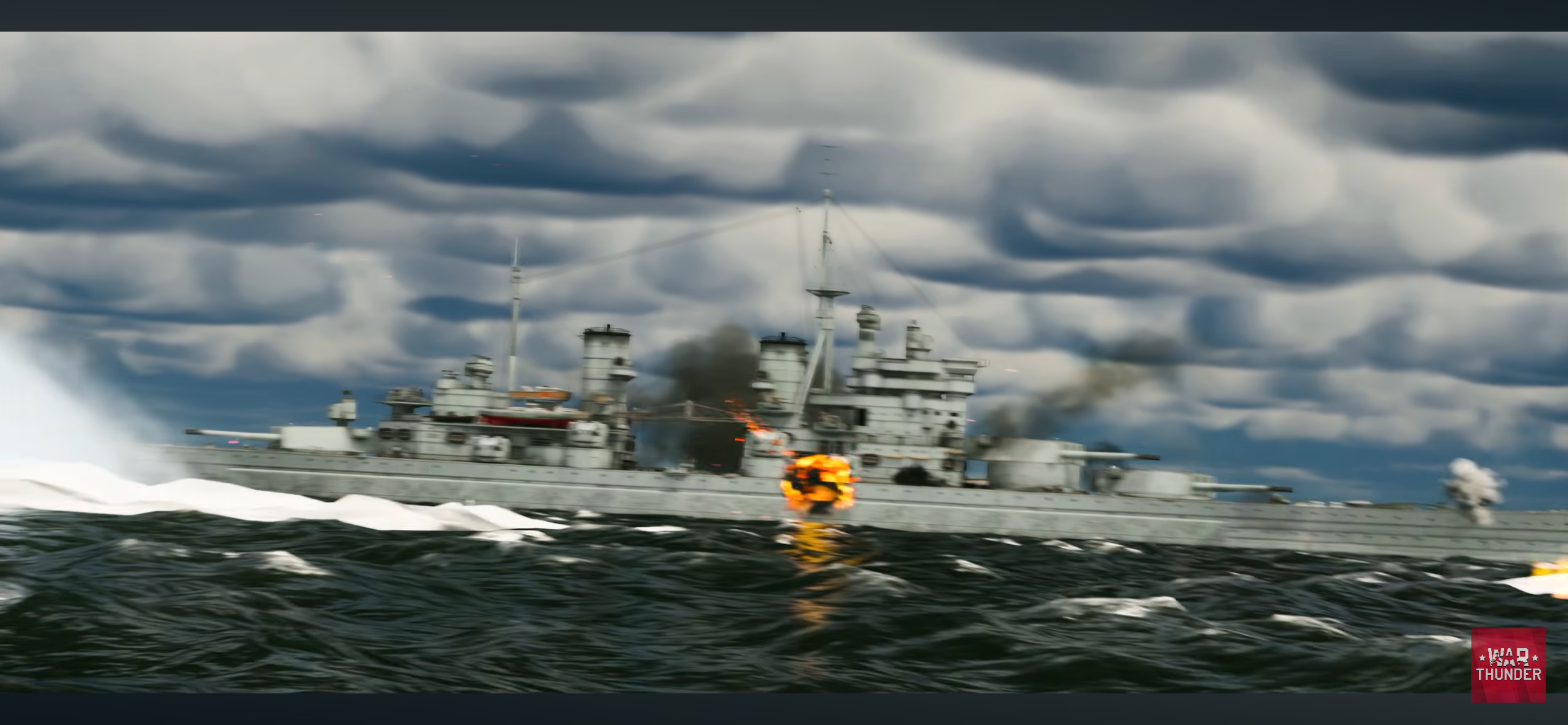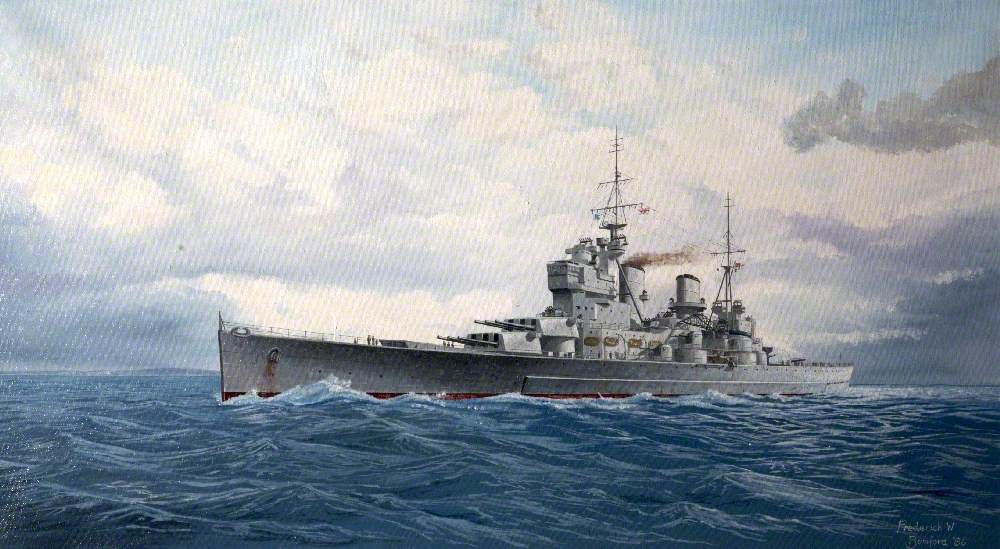
“HMS ‘Thunderer’ Lion Class, 1939” by Frederick W. Bumford.
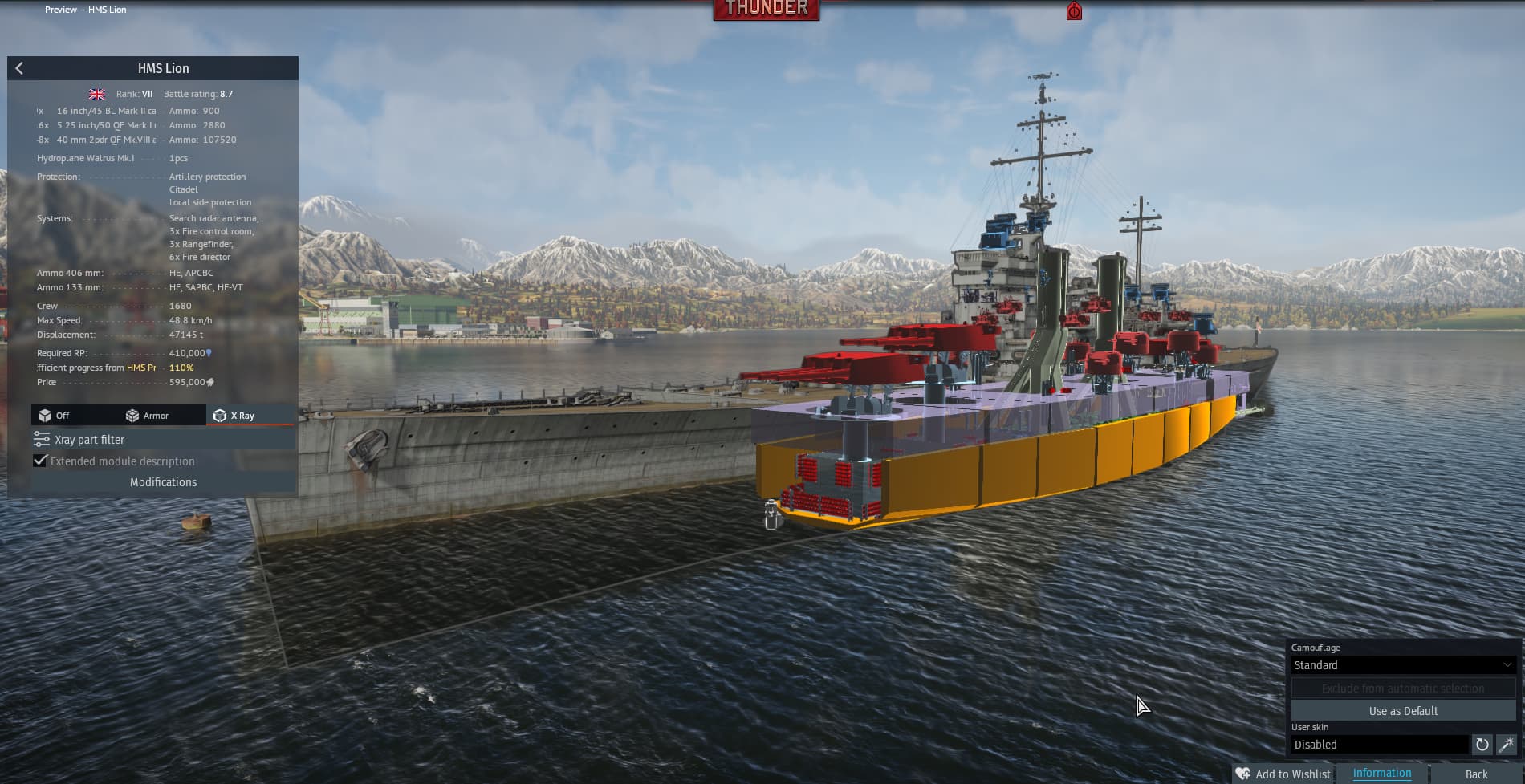
HMS Lion was a lead ship of its class Lion-class battleship designed in response to Imperial Japan not signing the Second London Naval Treaty of 1936, triggering the “Escalation Clause” which granted signatories allowance to build ships with main armament up to 16" (406mm) in calibre.
Lion-class battleships had been designed in response to Imperial Japan not signing the Second London Naval Treaty of 1936, triggering the ‘Escalation Clause’ which granted signatories allowance to build ships with main armament up to 16" (406mm) in calibre. Designing process started somewhere in 1937 based on the already existing KGV- class, with tonnage of 35,000 long tons (35,562 metric tons) in adherance to The Treaty. Designing such ship in this tonnage proved to be a futile task and Admiralty pushed for raising the limit to 40,000 long tons (40,642 metric tons). Due to political tensions with Japan and failing diplomacy with United States, which feared of being outclassed by Imperial Japanese Navy, refused to accept such limit. To keep US signatory, Admiralty settled on 45,000 long tons (45,722 metric). Designing process with a new displacement started somwhere in 1938. The final design was approved at the turn of 1939.
HMS Lion was a lead ship, and a part of the first wave of orders for new capital ships for Royal Navy, along with HMS Temeraire. Order for her was placed in 28th of February 1939 from Vickers-Armstrongs Limited and was laid down at Newcastle upon Tyne shipyard in 4th of July 1939.
Her construction was very chaotic and first cracks started showing up when her construction was suspended in October 1939 due to urgent resource reallocation for other projects—such as anti-submarine warfare and convoy escorts. Though construction halted, design works continued and project was constantly revised with adjustments drawn from the first weeks of war. Construction resumed in November 1939, but ceased again in May 1940.
In the meantime—with war raging in the background—multiple modifications were made to the original design, with each one becoming more ‘Vanguard-ish’; meaning the ship was becoming—in terms of looks at least—very similar to how HMS Vanguard looked upon completion.
Construction work ceased completely in 1943, and all remaining parts were scrapped shortly after, sealing the fate of the Lion.
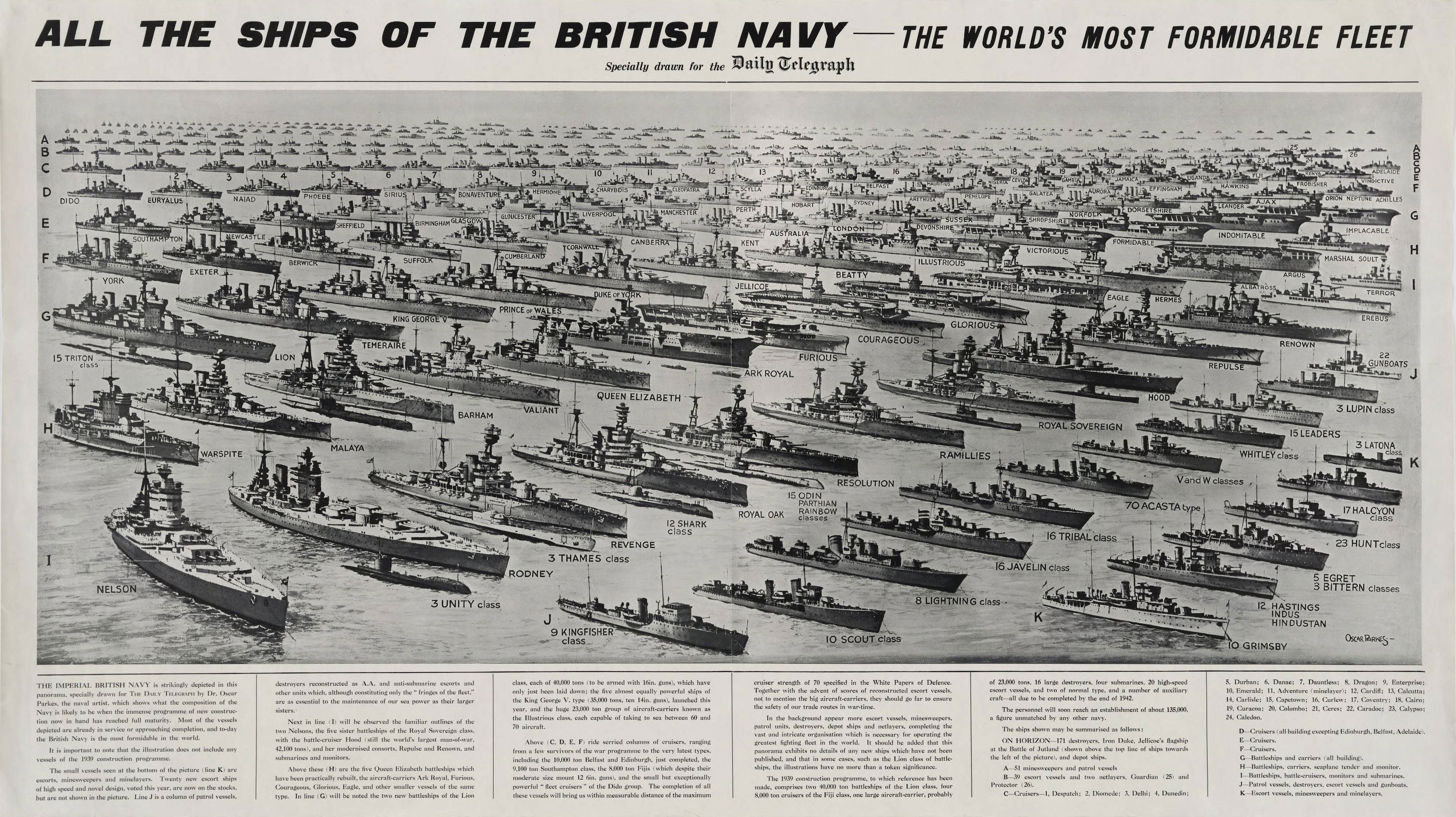
A propaganda poster ’ depicting the might of Royal Navy. Notice the HMS Lion and HMS Temeraire being present in the ‘G’ line at the right side.The Daily Telegraph, probably 1939.
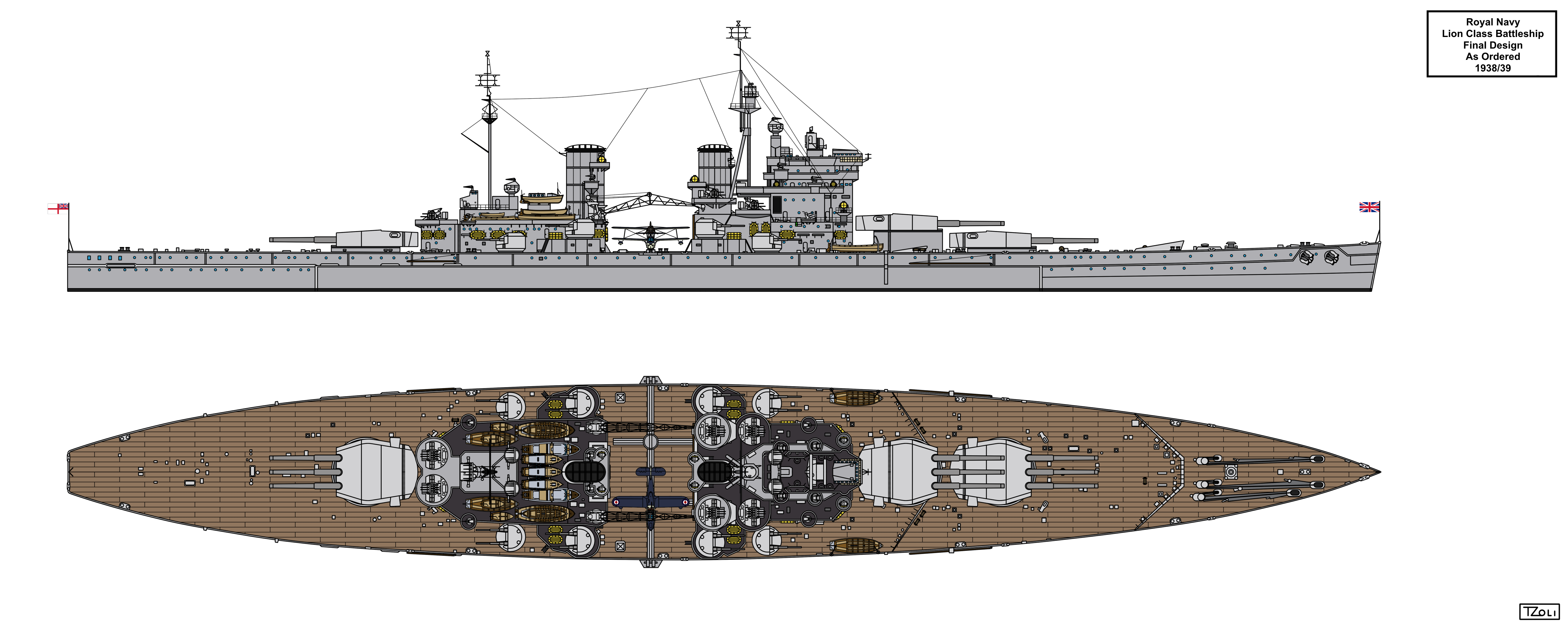
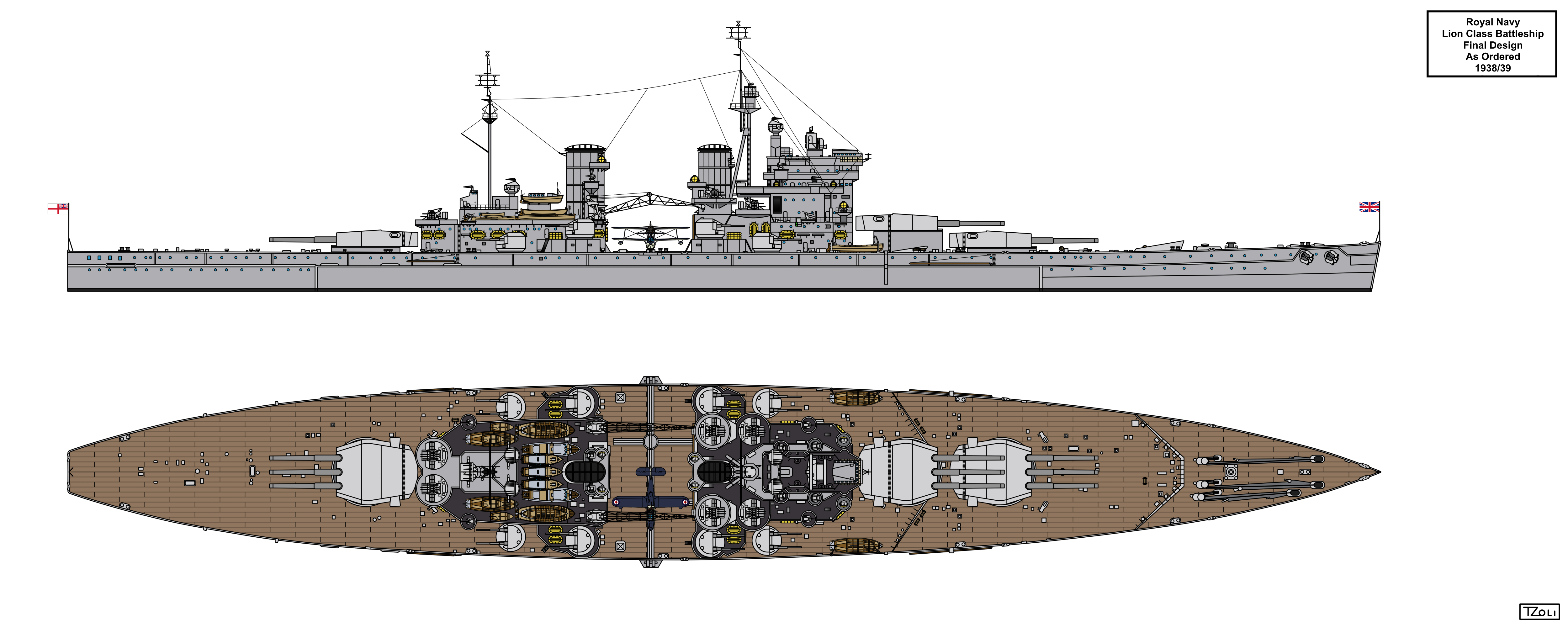
- 3x Triple-mounted BL 16-inch Mark II naval gun
- 8x Twin-mounted QF 5.25-inch Mark I dual-purpose
- 6x Octuple-mounted QF 2-pounder Mark VIII anti-air gun
- 4x Quadruple-mounted Vickers .50 Mark V
HMS Lion would have been the most powerful warship ever commissioned by the Royal Navy, incorporating all the existing principles of a modern and formidable capital ship—such as dual-purpose 5.25-inch secondaries and a 3x3 16-inch main armament layout. Upon completion, she was set to become the most powerful vessel to ever sail the Atlantic.
The new BL 16-inch, designed specifically for the Lion-class battleship, improved on the flaws of the previous BL 16-inch Mark I; designed for cancelled G3-class battlecruisers and—in the end—mounted on Nelson-class battleships.
| BL 16-inch | Mark I[1] | Mark II | Mark III | Mark IV |
|---|---|---|---|---|
| Projectile weight | 2,048lb (929kg) | 2,375lb (1,077.3kg) | 2,375lb (1,077.3kg) | 2 375lb (1,077.3kg) |
| Bursting charge [weight] | 51.2lb (23.7kg) | 59.5lb (27kg) | 59.5lb (27kg) | 59.5lb (27kg) |
| Bursting charge [type] | TNT | Shellite | Shellite | - |
| Propellant charge [weight] | 498lb (225.9kg) | 520lb (235.9kg) | 520lb (235.9kg) | - |
| Propellant charge [type] | SC250 | SC350 | SC350 | - |
| Velocity | 2,614fps (797m/s) | 2,450fps (747m/s) | 2,450fps (747m/s) | - |
| Rate of fire | 1.6 rpm | 2 rpm | 2 rpm | - |
| Units build | 29 | 3[2] | 2[2] | None |
^ [1] This data regards changes made after 1930 to improve Mark I's performance.
^ [2] Dependig on source numbers may be reversed.
The Mark II and Mark III corrected the post-WWI misconception that lighter, faster projectiles had superior ballistics. By adopting a heavier shell, the Royal Navy reduced kinetic energy loss en route to the target. Furthermore, the increased weight allowed for a larger bursting charge, which was further improved by replacing TNT with Shellite, which is 1.05 to 1.10 times more powerful than conventional TNT, vastly improving the shell’s lethality after penetration. Mark II and Mark III also improved reliability and reduced wear—partially due to velocity reduction—consequently extending barrel life.
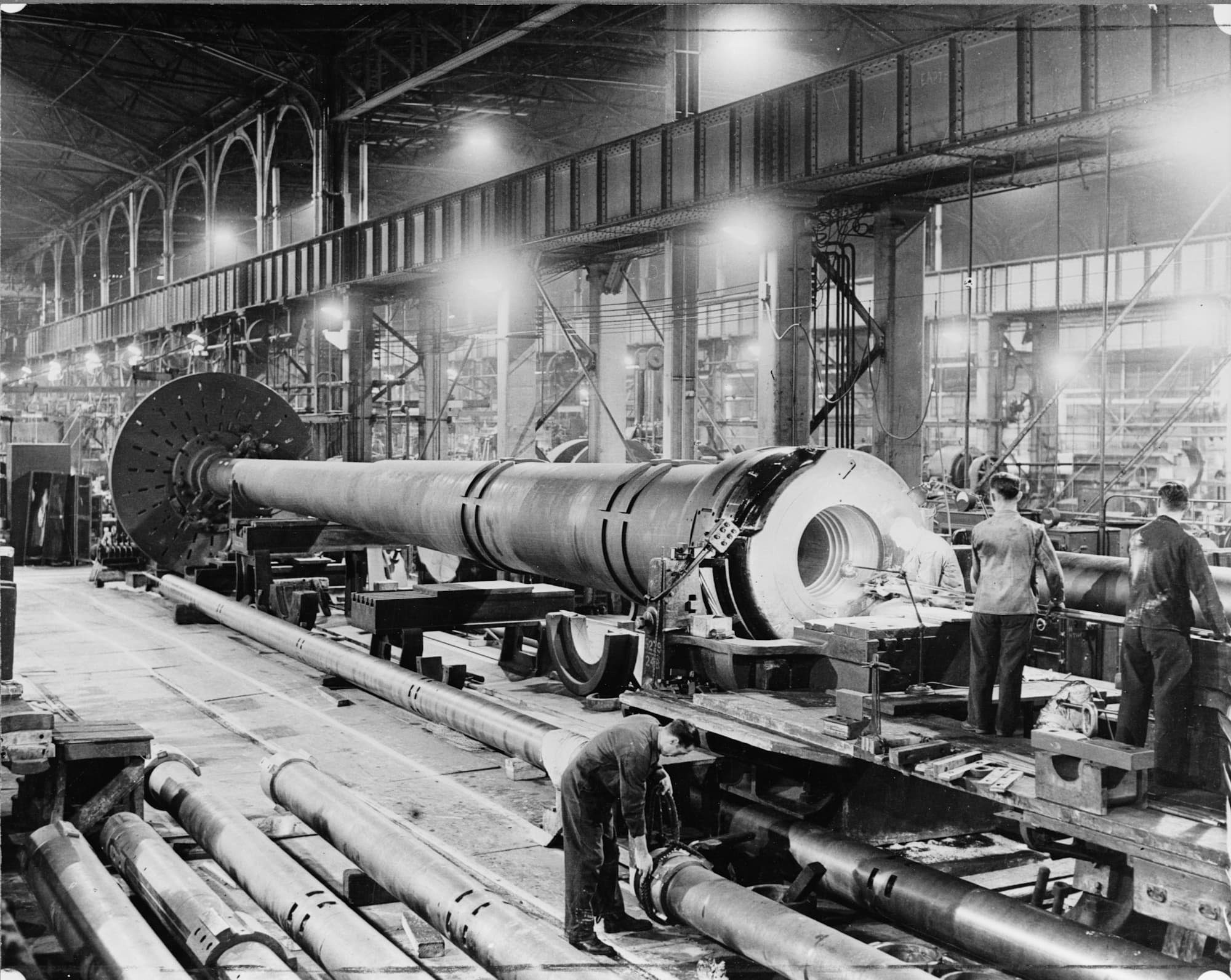
BL 16-inch Mark II during the gauging process.
There is a discrepancy regarding the actual origin of the image. Depending on the source, it may be either a BL 16-inch Mark I or Mark II. However, it is unlikely to be a Mark I, as most sources agree that this picture was taken after boring, which is a manufacturing process, not a maintenance one, and this picture was taken when Mark I’s weren’t produce anymore.
While marked as separate models, Mark II and Mark III were essentially the same and difference was purely structrural, yet they’re calssified as separate models.
While a total of five guns were manufactured, not a single turret was ever built.
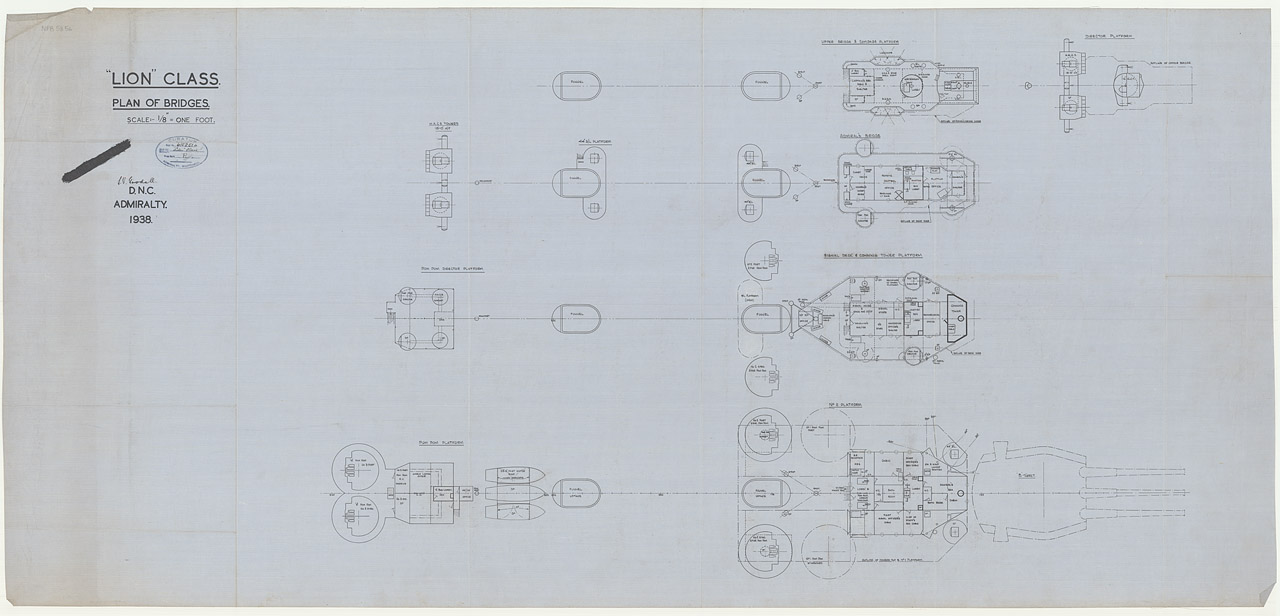
Bridge blueprint of the Lion class. You can clearly see its “Pom-Pom” nests and drawing of its main battery.Royal Museums Greenwich archive.
Main turrets:
- Faceplate - 15" (381mm)
- Sideplates - from 10" - 8" towards the back (from 254mm to 203.2mm)
- Roof - 6" (152.4mm)
Hull armour
- Conning tower - up to 5" (127mm)
- Belt - 15" (381mm)
- Deck - 6" over magazines and 5" machinery (152,4mm and 127mm)
- Barbette (above deck armour) - From 14"/15" on sides to 11"/12" (355.6mm / 381mm to 279.4mm / 304.8mm)
- Barbette (below deck armour) - 2" (50.8mm)
- Longitudinal bulkheads - from 1.75" - 1.5" right at the bottom (44.45mm to 38.1mm)
- Transverse bulkheads - from 12" - 10" towards the middle (304.8mm - 254mm)
- Magazines and elevators splinter protection - 1.5" (38.1mm)
HMS Lion was all about protection, and would have been the most armoured of any ship in the Royal Navy arsenal. Constructed from KCA (Krupp Cemented Armour), it was designed to withstand any conceivable type of attack. The horizontal plating was designed in such a way that the ship could sustain a direct hit from a 1,000lb (450kg) bomb dropped from an altitude of about 4km. Designers also took precautionary measures regarding magazine protection by heavily armoring the citadel inside the hull. The underwater protection would have consisted of a 13.25-foot (4m) wide, three-layer system of voids and liquid-filled compartments, capped with armoured longitudinal bulkheads. The combined side protection—consisting of the longitudinal bulkheads and the armoured belt—reached a total thickness of 16.75-inches (425.45mm). For comparison, the IJN Yamato’s combined waterline protection was approximately 16 inches (410 mm) thick.
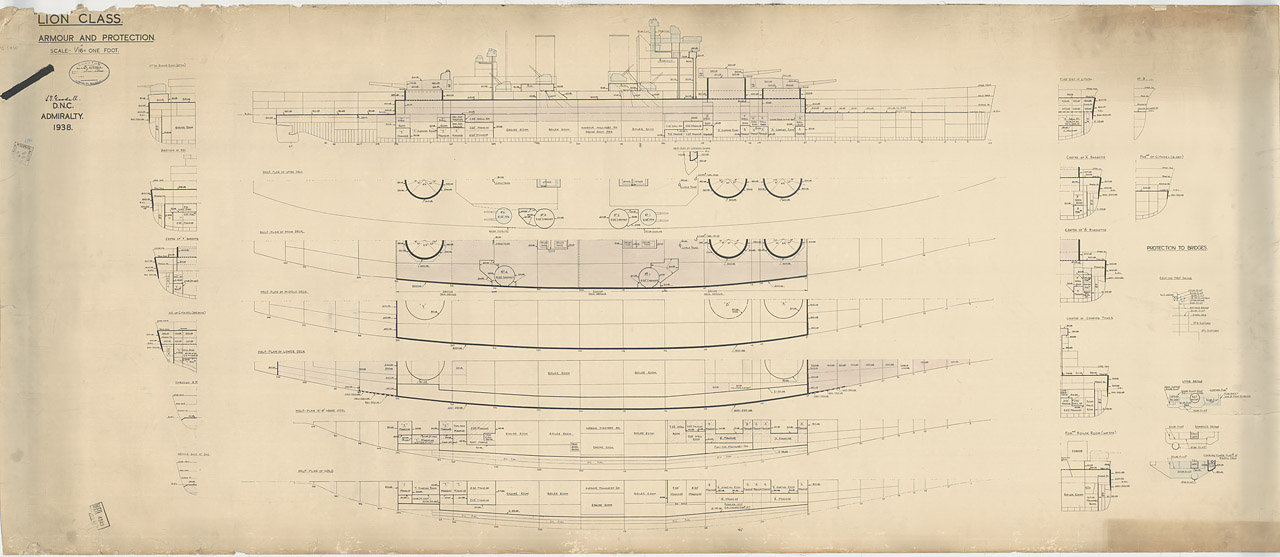
Original Lion class blueprint showing armour layout.Royal Museums Greenwich archive.
Overall design of propulsion stayed the same as in the KGV. Four sets of Parsons steam turbines—each driving one propeller shaft—in seperate compartments. The only real change is the generated power, increased from 110,000hp (82,000kW) to 130,000hp (97,000kW) during overload; making it possible to sail with a speed up to 30 knots (56km/h; 35mph). In case of emergency boilers and turbines could be cross-connected with each other. Additionally Lion was to be equiped with 330kW turbo-generators and two 330kW diesel generators for power supply.
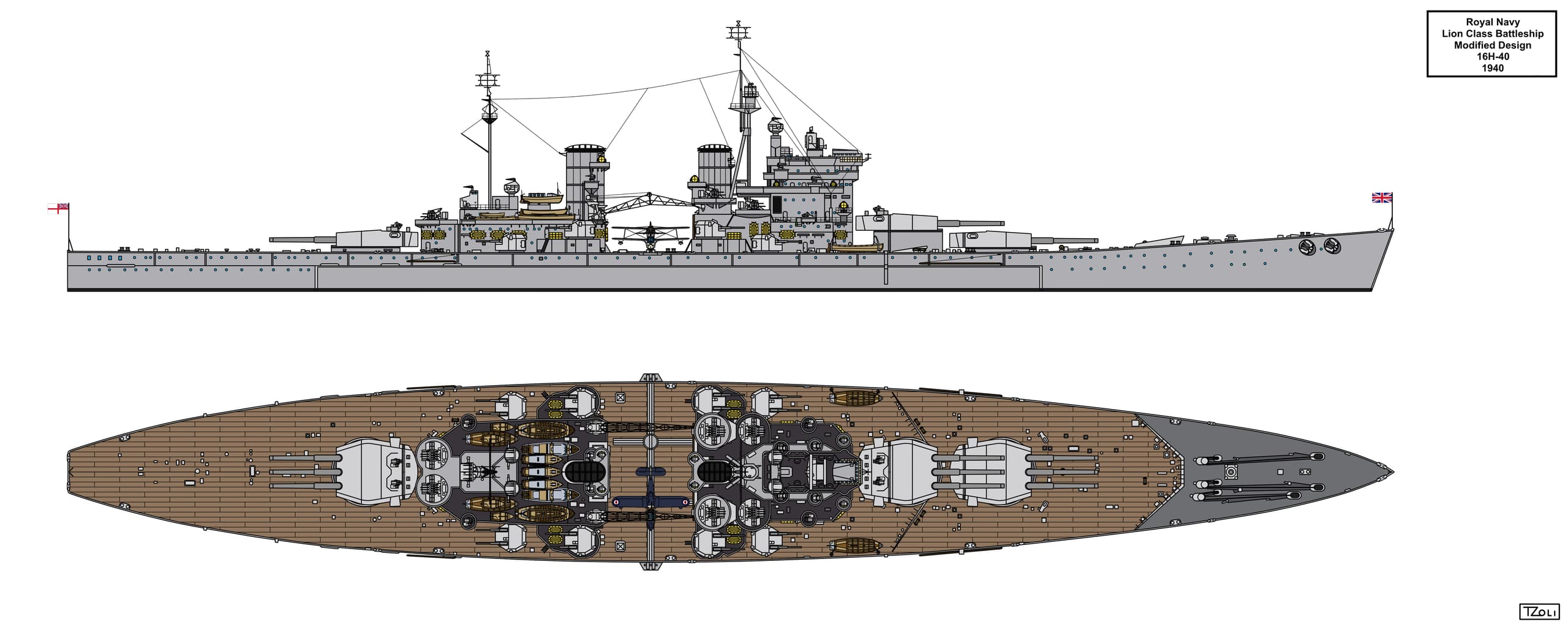
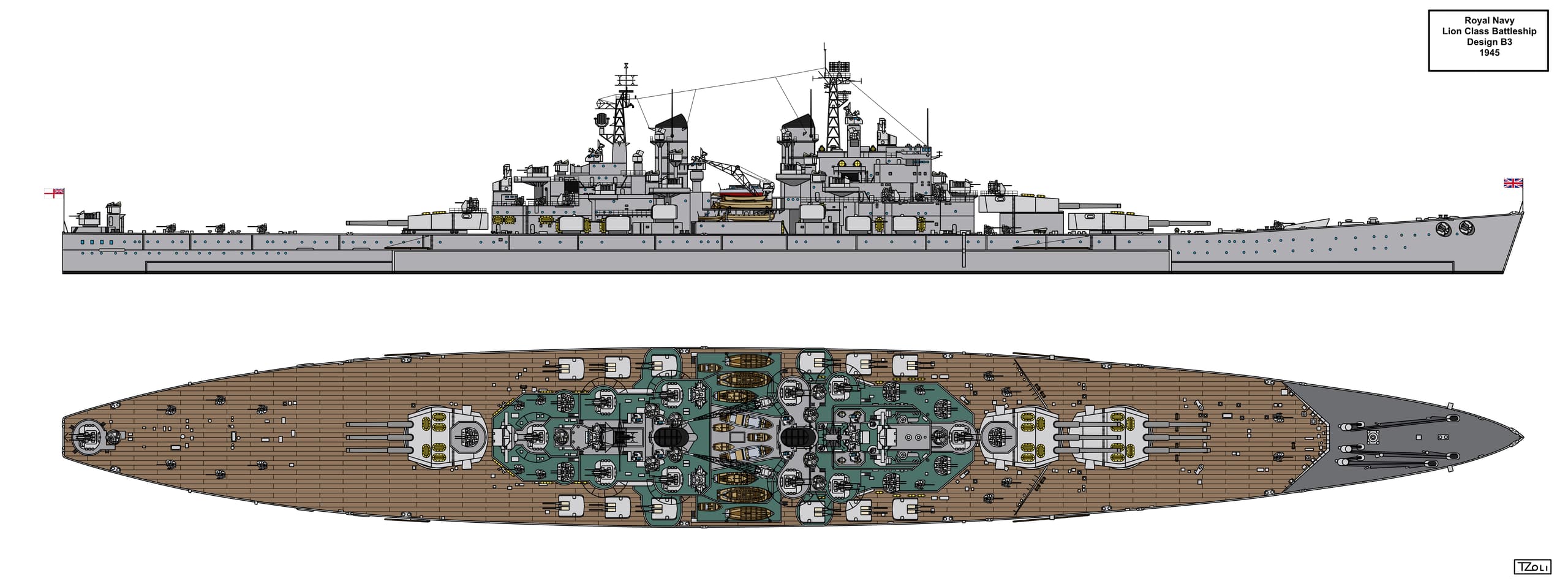
There are a few changes made to the original design. The most noticeable change is the ship’s bow—it has become wider, longer, and significantly higher. This change was crucial for the vessel, as it allows it to stay fully operational even during fierce North Atlantic storms and heavy seas, which wasn’t the case for the already commisioned KGV’s with their flat bow. This solution proved itself on the later commisioned HMS Vanguard, which remained completely battle-worthy while sailing the North Atlantic, whereas Allied vessels of the Iowa-class with their thin bows struggled in similar conditions.
Another change involved its AA protection and main guns. Multiple 20mm Oerlikon cannons were added in place of the .50 Vickers guns, which were lacking when facing more modern aircraft. BL 16-inch Mark II was to be replaced by Mark III variant.
The armoured belt abreast of the machinery spaces, along with the maximum barbette thickness, was reduced by 1 inch; to reduce weight. However, additional anti-splinter plates were incorporated within the citadel.
With the weight reduction it was also possible to increase her operational range by incomporating additional fuel compartments.
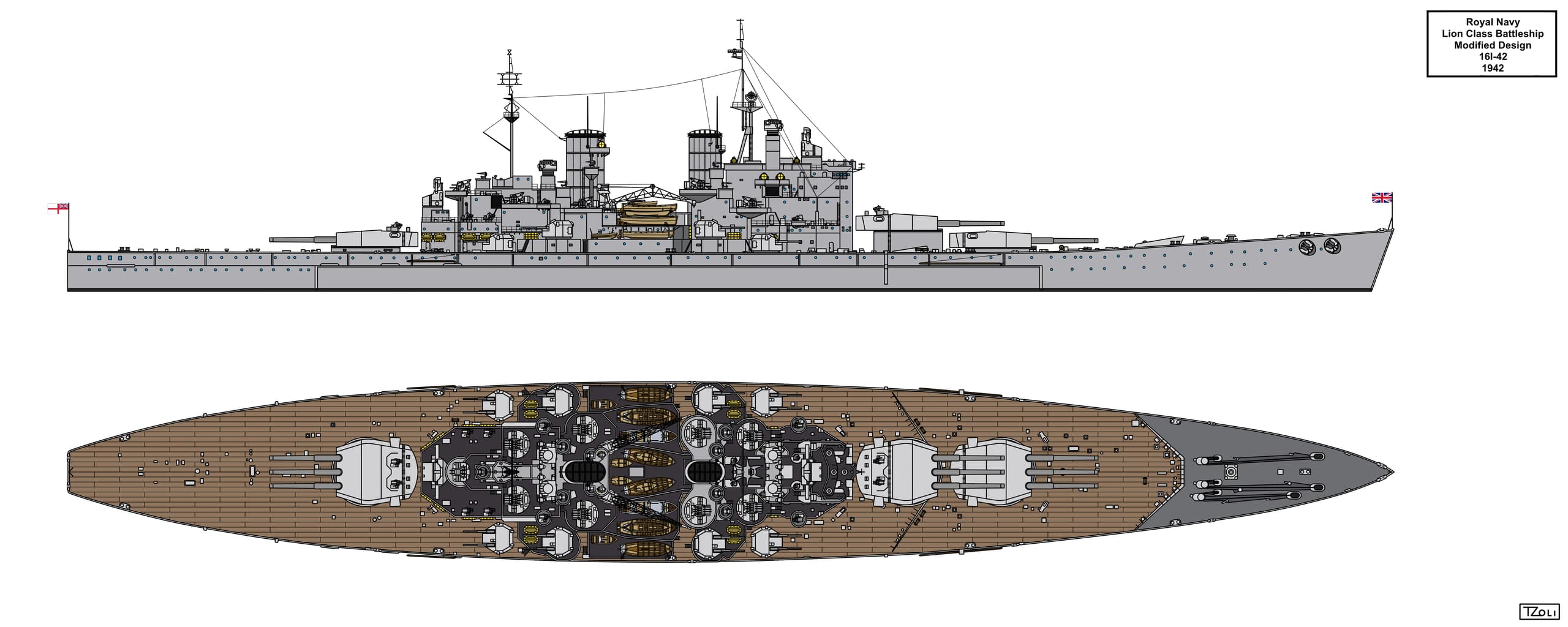
This version is very similar in terms of changes to the 1939/1940 re-design. Even more AA protection was added, including a pair of octuple-mounted “Pom-Poms” and more 20mm Oerlikons.
Armoured belt was further reduced by making it a bit shallower bellow the waterline, and again, adding more fuel and splinter protection in citadels.
One major visual change is the superstructure. With the incorporation of more advanced RADAR and fire control systems onboard plane has become obsolete. Therefore, the catapult island and hangar were entirely removed and replaced by crew compartments, including lengthened bastion.
Although unlikely, it is possible that this design could potentially mount BL 16-inch Mark IV as its main armament. However, none of the Mark IVs were ever made and tested, so it’s more likely for her to carry Mark III guns.
Author’s note
Some of you might be wondering why later designs weren’t included in this suggestion. Here is my reasoning.The construction work on both HMS Lion and HMS Temeraire started in mid 1939—on the 4th of July and 1st of June, respectively. Work on the original hulls had been ongoing until the suspension of both later in October of 1939; and after resuming, again in May 1940, which lasted until the project was canceled altogether and first parts began to be scrapped in April 1943. Designs beyond that point in time were not made specifically for the existing hulls, and were made purely for the potential resurrection of the idea and envisioned the entirely new Lion class for the post-war Royal Navy. Therefore, designs and proposals made after 1943 are not considered in this suggestion.
I know they’re cool, but we’ve got to be realistic, as this is very close to being a paper warship, and I would love to see Lion added at all. However, depending on the decision-making of Gaijin, in the future this specific design phase might be added, not as HMS Lion, but as HMS Temeraire, HMS Thunderer or perhaps HMS Conqueror.
PS: Some of the later designs are truly schizophrenic.

- Yes
- No
- As ordered in February of 1939
- Early wartime expierience revision of 1939-1940
- Major revision of 1942
- I answered ‘No’ in the first poll
Sources:
- Royal Museums Greenwich - Lion (1938) collection
- NavWeaps - United Kingdom / Britain 16"/45 (40.6 cm) Marks II, III and IV - NavWeaps
- Wikipedia - Lion-class battleship
- Wikipedia - BL 16-inch Mark I
- Navy General Board - The slow death of the Lion class
- Warship Projects 1900-1950 - Lion - Part I
- Warship Projects 1900-1950 - Lion - Part II
- Warship Projects 1900-1950 - Lion - Part III
- Warship Projects 1900-1950 - Lion - Part IV
- Naval Encyclopedia - King Georges V Class (1939)
- Lion Class Battleships - Destination’s Journey
- loc.gov.com
Art:
- Frederick W. Bumford - Art UK
- @Tzoli - DeviantArt