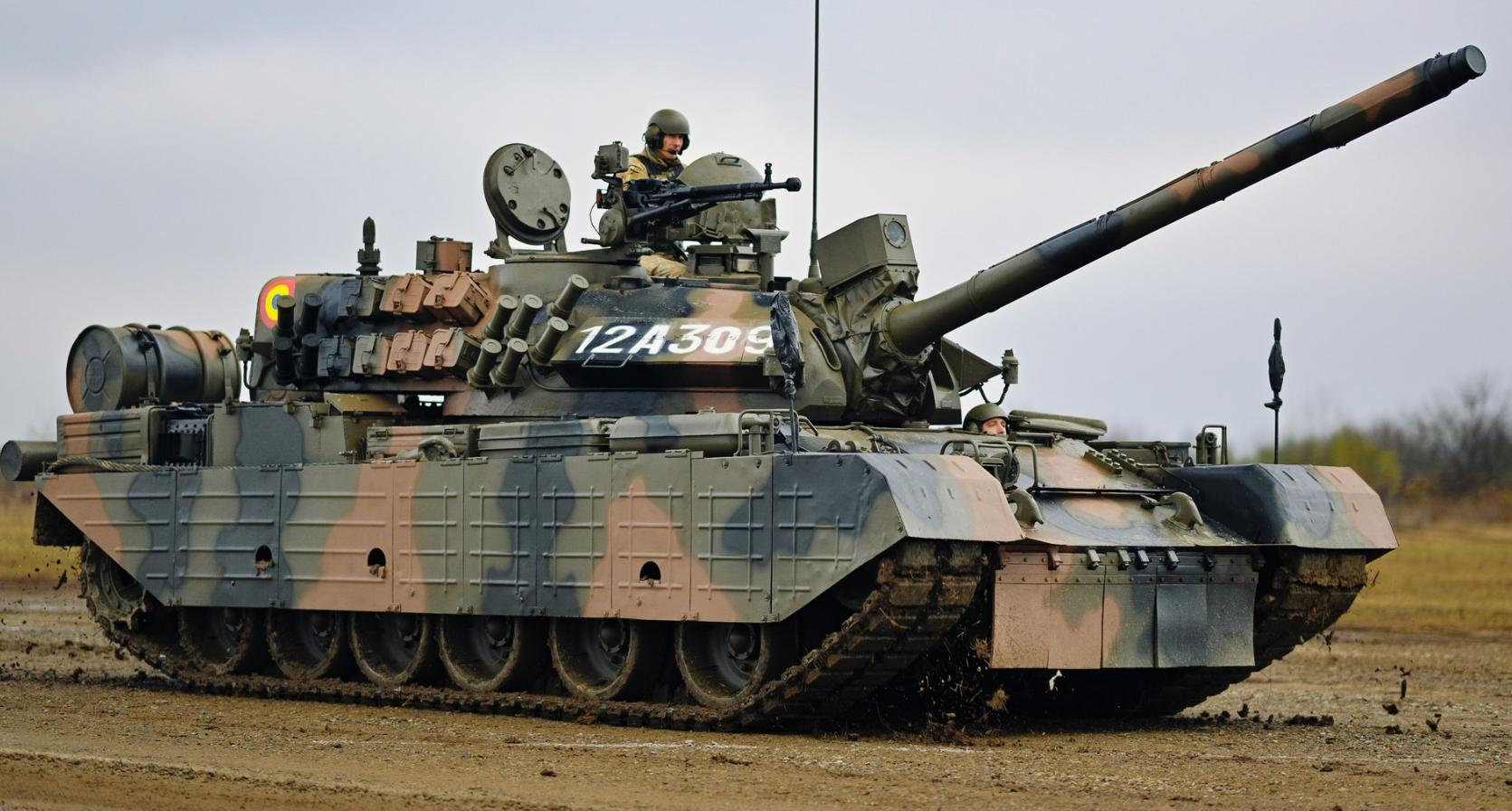
1. Historical Context & The 100 mm Rifled Main Armament Question
Often brought up in discussions regarding high-tier additions for the Romanian sub-tree within the Italian Ground Forces tree, the TR-85M1 “Bizonul” (The Bison) represents the culmination of Romania’s domestic main battle tank (MBT) engineering—bridging Cold War Warsaw Pact hull architecture with 1990s Western fire-control, survivability, and NATO interoperability standards.
Contrary to popular misconception, the TR-85M1 is not merely a T-55 fitted with add-on composite blocks. Its lineage traces back to the 1970s TR-77-580 and the 1980s TR-85, which featured a domestically lengthened hull with six roadwheels per side, a larger turret ring, and a license-built V-8 diesel engine derived from the Leopard 1’s MTU MB 838. Following the end of the Cold War and Romania’s strategic pivot toward NATO membership (Partnership for Peace in 1994), the Romanian Ministry of National Defense initiated a comprehensive modernization program in March 1994 (formally adopted in 1997) alongside Western defense contractors—most notably French firm SAGEM (now Safran) and Israeli firms Elbit Systems and IMI—to bring the fleet up to third-generation operational standards.
- Note on Official Archival & Military Designation (“TR-85M1 / Model 1985 Modernizat 1”): In official Romanian Land Forces (Forțele Terestre Române) inventory records and Uzina Mecanică București (UMB) factory documentation, the vehicle is designated TR-85M1 (Tanc Românesc Model 1985 Modernizat 1), informally nicknamed “Bizonul” by crews. Between 1997 and 2009, 54 to 56 existing TR-85 tanks were rebuilt to the TR-85M1 standard to equip the 282nd Mechanized Brigade (Brigada 282 Blindată “Unirea Principatelor”).
Addressing the 100 mm A308 Rifled Gun & BM-412Sg APFSDS (Historical Status & In-Game Ballistics)
Because Romania retained the domestic 100 mm A308 rifled tank gun (a locally produced, thermally sleeved derivative of the Soviet D-10T2S) rather than re-arming with a 120 mm or 125 mm smoothbore cannon, the combat viability of the TR-85M1 hinges directly on its Western-assisted kinetic ammunition—specifically the BM-412Sg APFSDS-T (Armor-Piercing Fin-Stabilized Discarding Sabot – Tracer) developed jointly by Romarm and Israel Military Industries (IMI):
- Real-World Testing Status: Unlike speculative paper projectiles, the BM-412Sg APFSDS was fully homologated, mass-produced in Romania, and deployed operationally by Romanian TR-85M1 battalions, including during multinational NATO exercises and KFOR/peacekeeping readiness deployments.
- Verified Ammunition & Ballistic Data (100 mm A308 / BM-412Sg):
- Armor-Piercing Fin-Stabilized (BM-412Sg APFSDS-T): Tungsten-alloy long-rod penetrator | ~1,440–1,480 m/s muzzle velocity | Fin-stabilized with slipping obturator band for rifled barrel compatibility.
- Secondary & Chemical Munitions: BK-412R HEAT-FS (shaped-charge fin-stabilized, ~380–400 mm RHA penetration) and OF-412 HE-Frag (high-explosive fragmentation).
- Loading & Rate of Fire: Manual loading by a dedicated loader (4-man crew) with an upgraded electro-hydraulic two-axis stabilization system (EADS / SAGEM), achieving 4.0 to 7.0 rounds/min (approx. 8.5–15 seconds depending on ready-rack stowage vs. hull stowage).
- Verified Armor Penetration Benchmarks (BM-412Sg APFSDS, 0° Obliquity RHA):
- 1,000 m: ~440 – 450 mm
- 2,000 m: ~400 – 415 mm (Note: Penetration figures reflect Romanian Ministry of National Defense / Romarm export catalog specifications and IMI 100 mm tungsten penetrator benchmarks, positioning the A308’s lethality alongside early 105 mm DM33/M833 and 125 mm 3BM42 rounds at typical combat ranges.)
2. Design Specifications & The Modernization Trade-Offs (TR-85 vs. TR-85M1)
When evaluating the TR-85M1 from an armored engineering standpoint, it is necessary to distinguish between the Cold War baseline TR-85, the transitional TR-85M1A prototype (which lacked thermal imaging), and the production TR-85M1:
| Parameter | TR-85 (1986 Baseline) | TR-85M1 “Bizonul” (1997 Production) | TR-85M2 Prototype (2002 Experimental) |
|---|---|---|---|
| Combat Weight | 42.2 metric t | 50.0 metric t | ~50.5 metric t |
| Crew | 4 (Commander, Gunner, Loader, Driver) | 4 (Commander, Gunner, Loader, Driver) | 4 (Commander, Gunner, Loader, Driver) |
| Hull Length / Width | 6.95 m (hull) / 3.43 m | 6.95 m (hull) / 3.43 m | 6.95 m (hull) / 3.43 m |
| Powerplant | 8VS-A2T2 V-8 Diesel | 8VS-A2T2M V-8 Turbo-Diesel | IVECO V-12 Turbo-Diesel |
| Engine Output | 830 hp | 860 hp (641 kW) | 1,200 hp (895 kW) |
| Power-to-Weight Ratio | 19.7 hp/t | 17.2 hp/t | ~23.8 – 24.0 hp/t |
| Transmission | THM-5800 hydromechanical (6F / 2R) | Upgraded THM-5800 (RENK license) | Upgraded heavy-duty hydromechanical |
| Max Speed (Road / Reverse) | 60 km/h / ~20 km/h | 60 km/h / ~20–24 km/h | ~65+ km/h / ~24 km/h |
| Operational Range | ~400 km (internal) | ~310 – 400 km (with external drums) | ~400+ km |
| Main Armament | 100 mm A308 rifled gun | 100 mm A308 rifled gun (stabilized) | 100 mm A308 rifled gun |
| Fire Control System (FCS) | Ciclop ballistic computer (day/IR) | Ciclop-M digital FCS + MATIS thermal | Ciclop-M digital FCS + MATIS thermal |
| Secondary Armament | 1 × 7.62 mm PKT coaxial 1 × 12.7 mm DShKM AA |
1 × 7.62 mm PKT coaxial 1 × 12.7 mm DShKM AA |
1 × 7.62 mm PKT coaxial 1 × 12.7 mm DShKM AA |
| Turret Front Armor | 200 mm cast steel | 200 mm cast + ~120–150 mm composite modules | Same composite turret array |
| Hull Glacis Armor | 100 mm RHA (60°) | 100 mm RHA + add-on composite/spaced plate | Same hull composite appliqué |
| Countermeasures | Engine smoke generator (TDA) | SAILR Laser Warning System + 16 × 81 mm smoke | SAILR LWS + 16 × 81 mm smoke |
Analysis of the Protection-to-Mobility Ratio
A defining engineering characteristic of the TR-85M1 is how Romanian engineers balanced substantial armor and electronics upgrades onto a chassis originally sized for 42 tons:
- The Weight Escalation (+7.8 Tons): Adding frontal passive composite cheek modules, a heavy rear turret bustle (which houses electronic units, ammunition/stowage, and acts as a counterweight for the barrel), a layered upper glacis appliqué plate, reinforced rubber side skirts, and a redesigned torsion-bar/hydraulic suspension pushed combat weight to 50.0 metric tons.
- Mobility & Transmission Advantage: While the uprated 8VS-A2T2M engine (860 hp) yielded a modest power-to-weight ratio of 17.2 hp/t, the German-derived THM-5800 hydromechanical transmission (featuring regenerative steering and a torque converter) gave the TR-85M1 far superior agility, neutral-style pivot turning, and reverse speed compared to contemporary T-55/T-72 variants.
- Internal Survivability Constraints: Retaining the narrow T-55-derived hull meant internal ammunition stowage remained concentrated in the forward right hull rack next to the driver, mitigated partially by upgraded fire-suppression systems (Deugra automatic halon system) and relocation of auxiliary gear to the rear turret bustle.
3. Real-World Tested Subsystems & Sensor Suite
Unlike paper modernization proposals, every subsystem on the TR-85M1 was serially integrated and field-tested by the Romanian Land Forces:
- Fire Control & Thermal Optics (Ciclop-M / SAGEM):
- Gunner’s Sight: SAGEM MATIS second-generation thermal imaging camera integrated into the Ciclop-M digital fire-control system, paired with an eye-safe laser rangefinder, crosswind/cant/temperature sensors, and automatic lead calculation against moving targets.
- Commander’s Station: SFIM EC2-55R stabilized panoramic day/night sight with hunter-killer target handoff capability to the gunner.
- Passive Composite Armor & Countermeasures:
- Turret & Hull Appliqué: Modular passive composite arrays bolted onto the cast turret cheeks and upper glacis, designed to defeat 100–105 mm kinetic penetrators and shaped-charge warheads (RPGs/ATGMs).
- Laser Warning & Screening: SAILR (or Polish-derived Bobrawa) laser warning receivers mounted around the turret roof, providing 360° threat detection and automated triggering of 16 × 81 mm Wegmann-type smoke grenade launchers (arranged in two clusters of 8 on either side of the turret) plus multispectral aerosol grenades.
- Suspension & Running Gear:
- Six dual rubber-tired roadwheels per side (spaced unevenly with a distinct gap between the first and second roadwheel to accommodate the front-mounted transmission/engine balance), reinforced torsion bars, and hydraulic shock absorbers rated for the 50-ton load.
4. The TR-85M2 Prototype: Solving the Power-to-Weight Bottleneck
By the early 2000s, Romanian defense engineers at Uzina Mecanică București (UMB) and the Military Equipment and Technologies Research Agency (ACTTM) recognized that the TR-85M1’s primary tactical limitation was its 17.2 hp/t power-to-weight ratio, which lagged behind modern NATO MBTs (typically 22–26 hp/t). To resolve this, a dedicated mobility demonstrator—widely designated in defense literature as the TR-85M2—was built and tested around 2002:
- Powerpack Replacement (IVECO 1,200 hp): Engineers replaced the domestic 860 hp V-8 engine with a compact, high-output IVECO V-12 turbo-diesel engine rated at 1,200 hp, paired with a reinforced cooling and transmission assembly.
- Performance Gain: With combat weight remaining near 50.0–50.5 metric tons, the power-to-weight ratio jumped from 17.2 hp/t to ~24.0 hp/t—matching the acceleration and cross-country responsiveness of contemporary Western MBTs such as the Leopard 2A4 and Ariete.
- Armor & Armament Continuity: The TR-85M2 retained the complete TR-85M1 turret, composite armor package, Ciclop-M/MATIS thermal FCS, SAILR laser warning system, and 100 mm A308 gun firing BM-412Sg APFSDS.
- Why It Was Never Mass-Produced: Despite successful mobility trials confirming the chassis could handle the 1,200 hp output, budget constraints in the mid-2000s and Romania’s shift toward expeditionary light/wheeled forces (Piranha III/V) halted fleet-wide conversion. Romania later opted to procure M1A2 SEPv3 Abrams tanks in the 2020s rather than invest in a third overhaul of the TR-85 platform.
5. Armor, Ballistics & Gaijin Penetration Models (100 mm A308 / BM-412Sg)
Armor & Development Feasibility Notes (Hull, Turret & In-Game Assets)
- Front Hull / Glacis (~200 mm Layered/Composite Configuration): Official Romarm technical specifications indicate a layered front hull protection reaching around 200 mm (combining the base steel glacis with add-on composite/layered elements). In broad engineering terms—as a compact, multi-layered add-on protection concept rather than a heavy modern third-generation composite array—it is closer in spirit to layered/composite upgrade philosophies seen on vehicles like the ZTZ88A or the T-55AM-1, while remaining built on Romania’s lengthened six-roadwheel chassis rather than a Chinese or Soviet T-72/ZTZ hull.
- Turret Armor Concept (Closer to T-55AM-1 Than T-55AMD-1): The TR-85M1’s turret modernization is conceptually much closer to the T-55AM-1 than to the T-55AMD-1. Unlike the T-55AMD-1, which relies on the Drozd active protection system on the turret cheeks, the TR-85M1 features cheek-mounted composite/add-on armor modules (with Romarm data citing 320 + 20 mm and high nominal RHAe figures under favorable angles) paired with a Laser Warning System (LWS) and 16 × 81 mm smoke grenade launchers.
- Leveraging Existing War Thunder Mechanics & Assets: Because Gaijin already models multi-layered/add-on composite armor, thermal optics, laser rangefinders, laser warning systems, and multi-tube smoke launchers across existing vehicles (such as the T-55AM-1 and ZTZ88A), the core damage and sensor mechanics are already proven in-game. Implementing the TR-85M1—and by extension the TR-85M2 prototype—would still require a dedicated six-roadwheel hull, custom turret bustle and cheek geometry, and specific Ciclop-M / MATIS and 8VS-A2T2M / THM-5800 (or IVECO 1,200 hp on the M2) parameters, rather than a simple copy-paste of another tank.
Ballistics & Gaijin Penetration Models (100 mm A308 / BM-412Sg APFSDS-T)
In War Thunder, Gaijin calculates armor penetration using standardized physical/empirical formulas rather than relying solely on arbitrary or fragmented test claims:
- Lanz–Odermatt Equation (Sub-Caliber Kinetic Penetrators / APFSDS): Used by Gaijin for modern APFSDS rounds. It models long-rod penetration into homogeneous armor as a function of penetrator length-to-diameter ratio (
L/d), penetrator density, target density/hardness (BHN), and impact velocity (v), accounting for hydrodynamic/transition regimes and obliquity effects. Because exact unclassified dimensions of the BM-412Sg tungsten core are not publicly disclosed, an in-game Lanz–Odermatt implementation would rely on Gaijin’s standard sub-caliber rod parameterization calibrated around the documented ~1,450–1,480 m/s muzzle velocity and ~440–450 mm RHA at 1,000 m benchmark. - Jacob de Marre Formula & Chemical Models: While full-caliber AP rounds follow the Jacob de Marre equation, the 100 mm A308’s secondary munitions—such as the BK-412R HEAT-FS and OF-412 HE-Frag —follow War Thunder’s shaped-charge jet penetration (~380–400 mm RHA) and explosive-mass fragmentation models respectively.
Estimated Penetration at Standard War Thunder Stat-Card Ranges (BM-412Sg APFSDS-T)
Because War Thunder’s Lanz–Odermatt model places heavy emphasis on angled performance against sloped glacis plates (such as T-72 and T-80 hulls), the table below includes both vertical (0° ) and sloped (60° ) RHA estimates aligned with comparable first-generation Western 105 mm tungsten long-rod penetrators (e.g., DM33 / M833):
|Distance|0° Obliquity (Flat RHA)|60° Obliquity (Sloped RHA)|
| Distance | 0° | 30° | 60° |
|---|---|---|---|
| 10 m | 460 mm | 398 mm | 260 mm |
| 100 m | 456 mm | 395 mm | 258 mm |
| 500 m | 448 mm | 388 mm | 252 mm |
| 1000 m | 442 mm | 382 mm | 246 mm |
| 1500 m | 428 mm | 370 mm | 237 mm |
| 2000 m | 412 mm | 356 mm | 226 mm |
2. BK-412R (HEAT-FS)
- Projectile Type: High-Explosive Anti-Tank Fin-Stabilized
- Muzzle Velocity: ~900 m/s
- Explosive Mass: ~1.45 kg (A-IX-1 / RDX equivalent)
- Fuse Sensitivity: 0.05 mm | Fuse Delay: 0.0 m
- Ricochet Angles: 0% at 62° | 50% at 63° | 100% at 65°
| Distance | 0° | 30° | 60° |
|---|---|---|---|
| 10 m | 390 mm | 337 mm | 195 mm |
| 100 m | 390 mm | 337 mm | 195 mm |
| 500 m | 390 mm | 337 mm | 195 mm |
| 1000 m | 390 mm | 337 mm | 195 mm |
| 1500 m | 390 mm | 337 mm | 195 mm |
| 2000 m | 390 mm | 337 mm | 195 mm |
3. OF-412 (HE-Frag)
- Projectile Type: High-Explosive Fragmentation
- Muzzle Velocity: ~900 m/s
- Explosive Mass: ~1.46 kg (TNT equivalent)
- Fuse Sensitivity: 0.1 mm | Fuse Delay: 0.0 m
| Distance | 0° | 30° | 60° |
|---|---|---|---|
| 10 m – 2000 m | 25 mm | 24 mm | 21 mm |
(Note: Because the 100 mm A308 is a rifled gun, the BM-412Sg uses a slipping obturator band to decouple barrel spin from the fin-stabilized tungsten penetrator; exact in-game stat-card values would be finalized by Gaijin once core length, diameter, and mass parameters are assigned.)
(Note: Because the 100 mm A308 is a rifled gun, its BM-412Sg round uses a slipping obturator band to decouple projectile spin from the fin-stabilized tungsten penetrator; exact in-game stat-card values would be finalized by Gaijin once core length, diameter, and mass parameters are assigned.)
6. In-Game Implementation Feasibility & Proposed Configuration (War Thunder Context)
From a game-development and tech-tree balance perspective, both the TR-85M1 and TR-85M2 represent high-value, historically authentic additions for the Romanian sub-tree within the Italian Ground Forces tree:
- Filling the 9.3 – 10.0 Italian Lineup Gap: Italy’s 9.3–9.7 bracket relies heavily on wheeled/light vehicles (VBC (PT2), Centauro I 105) and legacy Leopard 1A5 / OF-40 Mk.2A platforms that lack composite turret protection and laser warning systems. The TR-85M1 provides a true armored brawler/sniper hybrid at BR 9.3, while the TR-85M2 can serve either as a foldered/researchable BR 9.7 follow-up or a squadron/event vehicle.
- Distinctive Playstyle (Soviet Silhouette, Western Electronics):
- Strengths: High-resolution gunner thermal sight (MATIS), laser rangefinder, 360° Laser Warning System (LWS) with 16 smoke grenades, competitive ~450 mm APFSDS penetration, composite turret cheeks capable of stopping autocannons and early APFSDS/HEAT rounds, and a genuine Western-style reverse gear (~20–24 km/h).
- Weaknesses & Balance: Manual reload (~8.5–10 s aced) with a 4-man crew, cramped T-55-style hull ammo stowage behind the right glacis, and average acceleration on the M1 (17.2 hp/t)—a weakness directly remedied if the player unlocks the TR-85M2 (24.0 hp/t).
7. Sources & Attribution Notes
To maintain strict historical and technical transparency for forum and developer review, the specifications above are compiled from official defense catalogs, Romanian military historiography, and ballistic references:
- Romanian Ministry of National Defense (Ministerul Apărării Naționale – MApN) & Forțele Terestre Române Technical Fact Sheets:
- Scope: Official operational specifications for the TR-85M1 “Bizonul”, combat weight (50.0 t), 8VS-A2T2M engine output (860 hp), THM-5800 transmission, Ciclop-M fire-control integration, and brigade deployment records (282nd Mechanized Brigade).
- Romarm & Uzina Mecanică București (UMB) Defense Export Catalogs (2000–2010):
- Scope: Factory technical data for the 100 mm A308 rifled gun, BM-412Sg APFSDS-T and BK-412R HEAT-FS ammunition dimensions, muzzle velocities, RHA penetration benchmarks, and the IVECO 1,200 hp powerpack trials on the TR-85M2 prototype.
- Jane’s Armour and Artillery (Christopher F. Foss, IHS Jane’s, 2001–2012 Editions):
- Scope: Independent third-party verification of the SAGEM MATIS thermal imaging system, SFIM EC2-55R commander sight, SAILR laser warning system, composite armor layout, and the chronological progression from TR-85 to TR-85M1A, TR-85M1, and TR-85M2.