Harriers should be able to defeat ir missiles simply by turning, but in game they burn brighter than the sun. It’s pretty silly that the main advantage of the harrier isn’t modelled, even R-60Ms will even ignore flares against it sometimes. I play the AV-8B a lot, and it’s really annoying when your aim 9ls eat a random flare but enemy missiles fly straight at you no matter what. Are there any existing bug reports for this, since it been a problem for a while.
I think there are reports around, discussing exactly that, but not sure about the details.
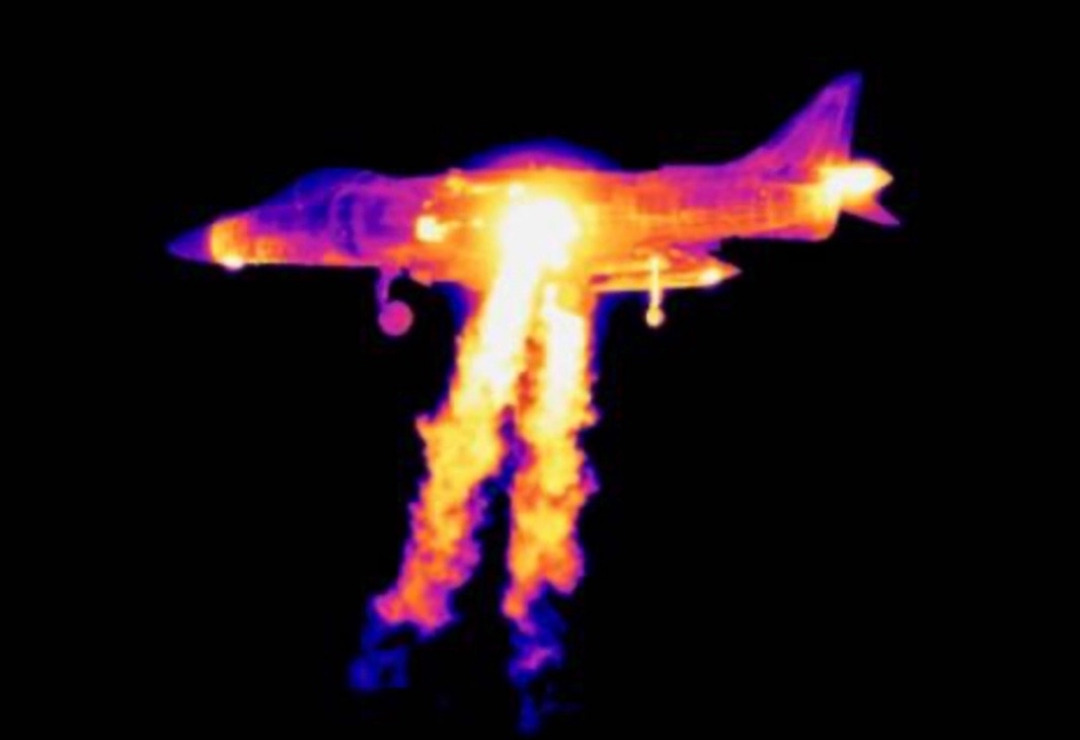
What one would expect however is that the IR-signature of the Harrier should indeed be comparatively lower than other aircraft with similar thrust:
The Pegasus engine has four adjustable nozzles, of which only the rear ones actually expel hot air from after the combustion section of the engine. The forward nozzles get their air from the fan stage, and this air is cold.
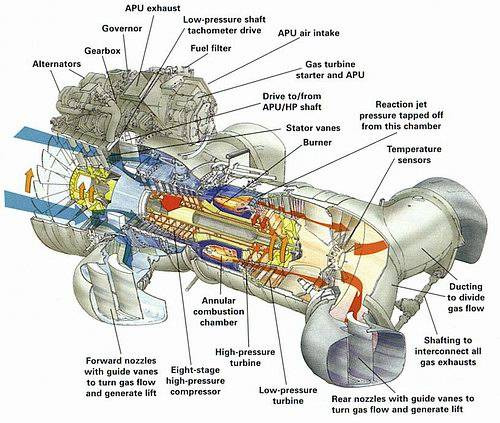
While in most jets the engine exhaust is at the rear of the aircraft, and thus visible from a very large arc, the Harrier’s exhausts are shielded by the shoulder-mounted wings form many directions. Also the cold air from the forward nozzles should shield the hot air from the rear nozzles, making their heat signature less observable.
Plus, there is no afterburner.
So at least intuitively, Harriers should indeed have much lower heat signatures than other comparable aircraft - but still that would need to be supported with real-world references. Also, I don’t know how detailed the heat signature modelling in WT is, and of it for example takes into account LOS shielding of heat signatures etc…
2 Likes
Warthunder does take into account aspect dependency, but iirc it’s not configured adequately on the harriers to match real life performance at the moment.
The common complaint of the harrier being modeled as having 4 engines, and thus “4x the heat” is just blatantly false, due to the heat modeling being thrust dependent. So even though it has 4x engines its still only roughly the same heat as if it was one engine.
The main issues currently are yeah, from the front nozzles. While the rear ones have fine base thermal properties, the front ones are also modeled as being relatively hot, which is the cause of a lot of the issues.
Thermal mixing of the air is something that could be better handled through thermal modifiers, but as far as im aware theres already pending bug reports on it.
3 Likes
its modelled with IR sig of 4 engines instead of 1 divided into 4 outlets.
cant both those things be true at once?
The issue with the base heat of the engine is more due to the effective bypass ratio of the engine then it actually being 4 engines. Warthunder’s heat calculation as a baseline doesn’t really account for engine bypass ratios. Due to it being more built around older engines which were low or no bypass. So for engines with high bypass ratios they produce much more heat then should be expected in most cases, at a per thrust level.
This isn’t all cases, theres stuff that goes into it about the base thrust figures, but is generally the issue,
i meant in the sense that when we look at the model (3d model), it must have 4 emitters for the IR sig locations on the fuselage (from the outlets), and i suspect that instead of coding an unrealistic but still fair 1/4 IR sig for each emitter they just applied the same value for all 4.
realistic would be something as schindibee said above, prolly 10-10-40-40 IR sig division between the nozzles
reminds me of some not so pleasant memes
Not always the case, just look at the f5e engines runnig for no reason much colder than the g91YS while having more thrust, f5c on full AF are harder to lock than an alpha jet with also less thrust
That is actually thrust dependent, and why its fairly provable that the F-5’s engines are colder.
The F-5 does actually just have a lower base thrust then the the G91YS. However it then gets a multiplier on the thrust figure which can exceed 1, leading to the engine effectively being colder then on the G91YS, where the figure caps out at around 1.
It going above or not going above 1 isn’t that weird by itself, there are plenty of engines with either implementation (Most harrier variants cap at 1~, part of why they’re so hot). But it is weird that the same engine on different aircrafts has a different multiplier for this.
I’ve tried bug reporting it, but uh. Yada yada bug report staff wanted proof of the engines temps installed due to channel loss to prove they should be more similar. Which like, how they are right now is physically impossible, but i’ll just assume they meant to figure out which one actually deserves to be changed.
Not the E, it gets nearly 300 kgf more, the f5c it has less ir signature than the f117, even with the reduce ir multiplier.
I dunno about the E, the A deffinitly does though and it uses the same engine as the YS.
The F-5A has a base max thrust of 960, while the G91YS has a base maximum thrust of 1230.
The heat is calculated by a base thrust figure then adjusted for RPM and such. However there are thrust multipliers for the final thrust figure based on flight conditions, which is where the multiplier comes from. The G.91YS has this figure cap out at 1.01, while the F-5A has it cap out at 1.4.
Bringing this back to the main topic though. Yeah the Harriers generally have their multiplier cap out around 1. Which while not an issue when viewed as a standalone thing. Does lead to them running fairly hot.
The base thrust is 1480 kgf and 2220kgf on reheat
Do you know is general thermodynamic considered as well, concretely fuel flow?
If we think about it, fuel has a specific caloric value, so higher fuel flow literally means more energy transformed into heat. How that is translated into thrust is then of course a matter of the efficiency of an engine, but the total energy (and thus heat) output should be more or less correlated with how much fuel is burned per second.
Of course that would not be the whole story, but could be highly relevant, no?
If it was it would be part of body/engine heat, which I do not know how the game handles. The game does have stuff for fuel flow and mixture ratios, but from what I know it’s more of a thing that’s back calculated to get proper fuel consumption rates and such dynamically then something done for heat.
Body heat is it’s own thing, I’m fairly certain that its a non-issue on the harriers due to how their engine is configured, although i’m not entirely sure. And if it’s not taken care of then it could also be a contributing factor.
1 Like
The F-5E’s base thrust is 1480, the F-117’s is 4100. The F-117’s rear aspect IR mult is only 0.5. So yeah the F-5E will be more detectable from rear aspect.
I was comparing the f117 with the f5c
It should be noted though, that heat bands are not additive across types. So even if body heat is too high, it generally would not be an issue due to the current sensitivity of seekers to other bands such as it’s exhuast.
E and C use the same engine, no?
nevermind just checked and it uses the same as the A
the E has higher thrust as far as i am aware off