History
The F9F-8T was developed as the final version of the Cougar family. It took a single-seat F9F-8 and turned it into a tandem-seat trainer model; hence, the “T” suffix denoted that it was designed as a trainer. As the F9F Panther and Cougar aircraft entered service with the US Navy, the Navy needed a jet trainer to train pilots in jet operations as well as carrier operations.
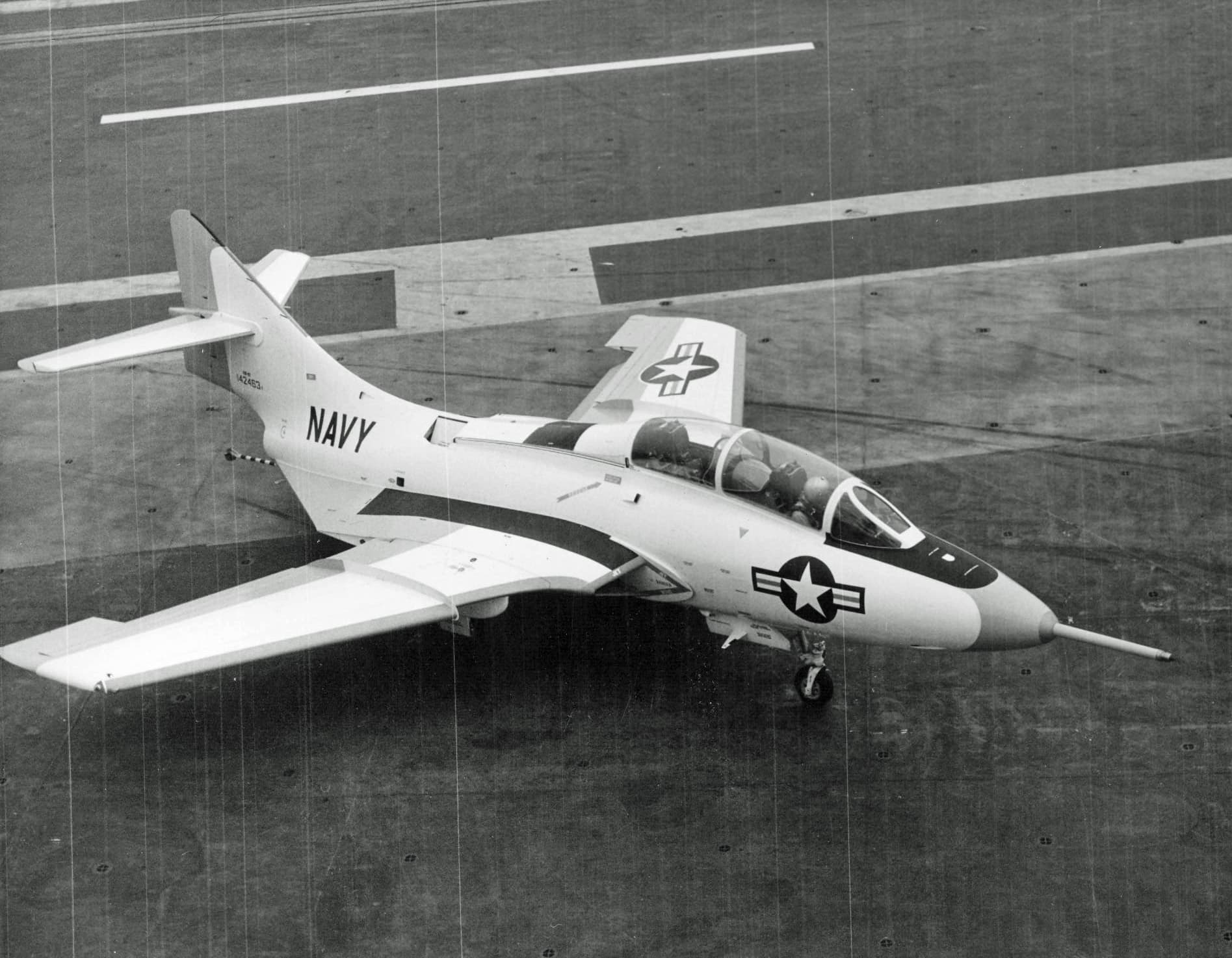
Grumman managed to convince the Navy that the excellent flying qualities of the Cougar made it an obvious choice for such a new swept-wing jet trainer, so a prototype F9F-8T was authorized and flew for the first time on February 29, 1956.
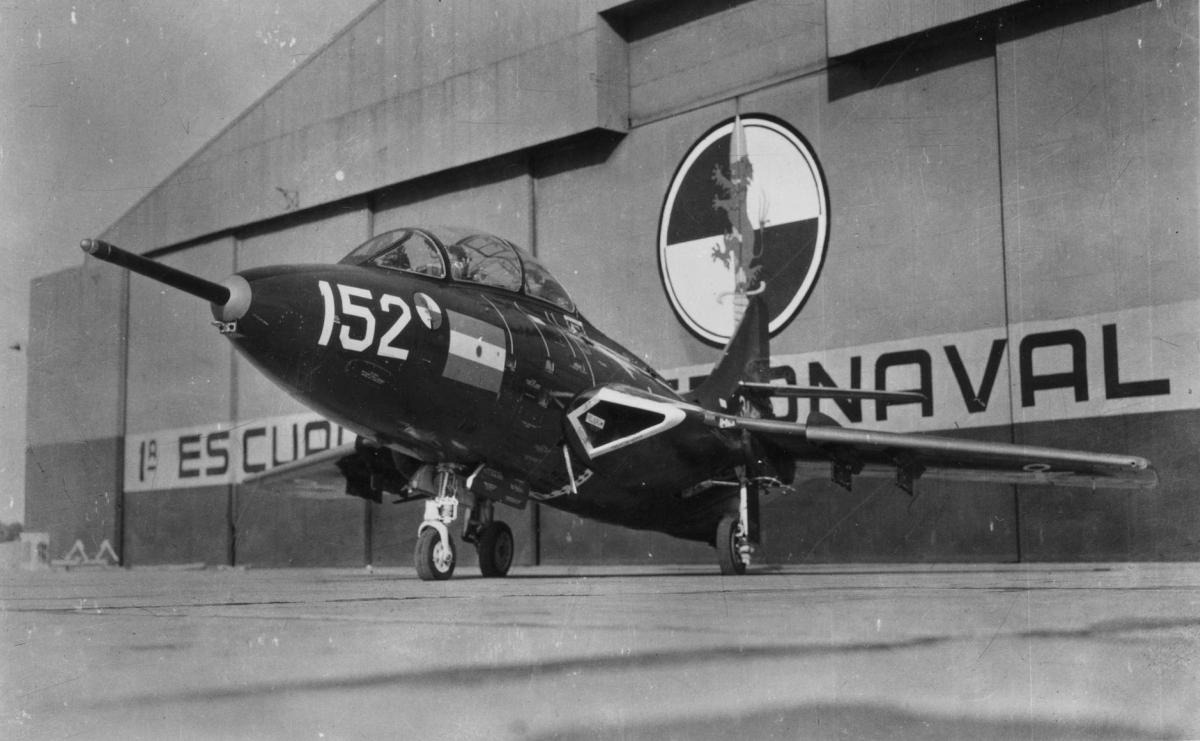
The F9F-8T received structural changes that differed from the standard F9F-8. This involved incorporating a second cockpit, extending the aircraft’s length by 34 inches. This used up some of the space occupied by the forward fuselage fuel tank, so the tank was reduced in size, and the total fuel capacity of the two fuselage tanks dropped from 847 gallons in the F9F-8 to 730 gallons in the F9F-8T. The internal gun armament was reduced from four 20 mm cannons to two for gunnery training and combat purposes. All bombs and rocket pods, as well as Sidewinder missiles, certified for use on the F9F-8 fighter were also certified for use on the trainer. The in-flight refueling capability was retained in the F9F-8T.
In addition, a single, long canopy covered both cockpits and slid aft on external rails to open. Because some carrier launches and recoveries were flown with the canopy open, a second windscreen was installed between the cockpits to provide protection for the instructor or observer in the rear seat, making it possible to fly the aircraft with the canopy open. This feature also allowed the instructor to remain in the rear cockpit in the event the canopy was lost in flight.
In addition to the prototype, 399 F9F-8Ts were produced in four production blocks. Navy and Marine training squadrons used the majority of the F9F-8Ts, but one or more were sometimes assigned to fleet units that flew the other versions of the Cougar and, on occasion, even different types of aircraft. Examples of the two-seat Cougars could be found in fighter, attack, photographic reconnaissance, and even heavy attack squadrons. The Blue Angels used an F9F-8T as their utility aircraft during the years they flew F11F-1 Tigers as their show aircraft.
In September 1962, F9F-8Ts were redesignated TF-9Js, and they continued to serve with the Navy and Marines for the following years.
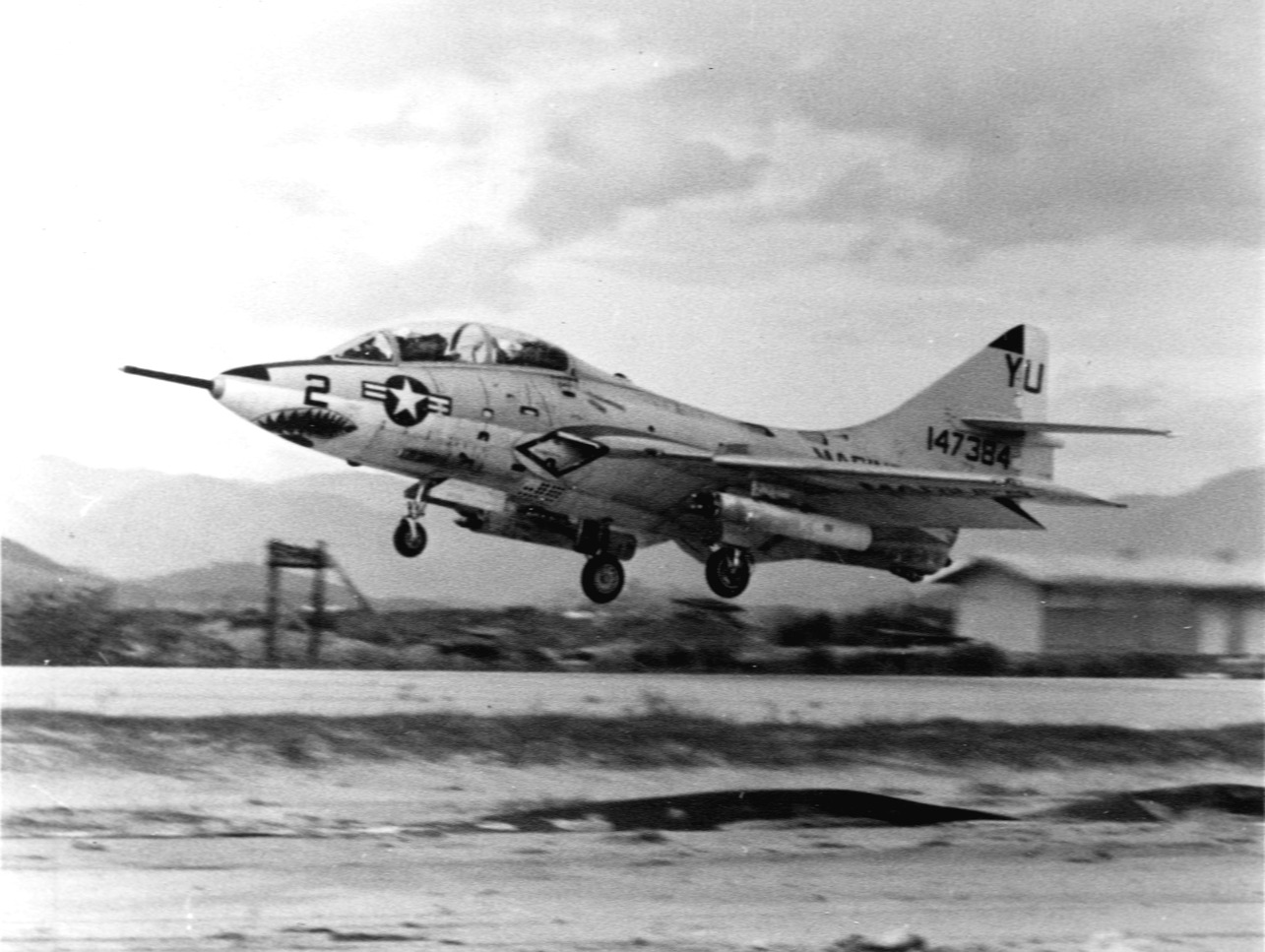
During the early years of the Vietnam War, two Marine Headquarters and Maintenance Squadrons (H&MS) used the armed TF-9Js as fast forward air control aircraft. This meant that while the pilot flew to the designated hostile areas, the observer in the rear cockpit communicated with forces on the ground as well as other aircraft to facilitate close air support and artillery support operations. It was the observer’s responsibility to spot enemy positions and activity and then provide command and control for friendly ground forces and supporting aircraft as they made their attacks. Along with the two 20 mm cannons, these FAC TF-9Js were usually armed with two rocket pods, each carrying four 5-inch Zuni rockets. These could be used to mark targets for other aircraft or helicopters.
Between 1966 and 1968, H&MS-11 used the TM tail code while flying out of Da Nang Air Base, while H&MS-13 marked its Cougars with the YU tail code and operated out of Chu Lai. Each squadron flew four aircraft in this role. Ironically, this marked the TF-9J, the trainer jet, as the only Cougar version to have fired in anger and the only version to be used in combat.
The final TF-9J was not retired until 1974, when VT-4 flew the last Cougar training mission. TF-9Js were replaced as the Navy’s advanced jet trainer by the TA-4F and TA-4J versions of the Douglas Skyhawk, making the TF-9J the longest-serving Cougar variant in the US Navy.