History
In late 1939 and early 1940, the French Naval Aviation sought a new type of carrier-based fighter to equip its carrier-based squadrons aboard the carrier Bearn and two new aircraft carriers, Joffre and Painlevé, which were under construction.
The French Naval Aviation sent its delegates to the United States to seek companies willing to export aircraft that met their requirements. They approached Grumman to discuss purchasing an export variant of the F4F Wildcat. They became interested in Grumman’s G-36 design, which had been given the American designation F4F-3. An order was placed for a similar aircraft with certain changes specified by the French. The new export design was assigned the model number G-36A by Grumman for the French order, with several major changes.
The G-36A was to be powered by the Wright GF-1820-G205A-2, a civil version of the Wright R-1820 radial engine. It was equipped with a single-stage, two-speed supercharger. This engine did not require the longer cowling seen on the American F4F-3, so the cowling was shorter, and the cooling flaps were omitted. The engine provided 1,200 horsepower for takeoff, driving a Hamilton Standard unchuffed propeller. The civil version of the engine was installed and tested in the third and fourth production F4F-3s, which were redesignated XF4F-5s.
Inside the cockpit, everything on the instrument panel was of French design. It was to be installed with French radio equipment and a gunsight. Additionally, it was equipped with a French throttle assembly that was reversed from standard American installations to correspond with the French system of throttle operation; pulling the throttle aft increased power. A minor change was that the antenna mast was thinner and mounted at a 90-degree angle to the aircraft centerline, unlike the mast on the F4F-3s, which was canted forward. The wings were a non-folding version.
The armament was specified as four 7.5 mm Darne machine guns: two Darne machine guns mounted in the wings and two mounted in the cowling of the upper fuselage, firing through the propeller arc. These guns were to be installed after delivery directly in France.
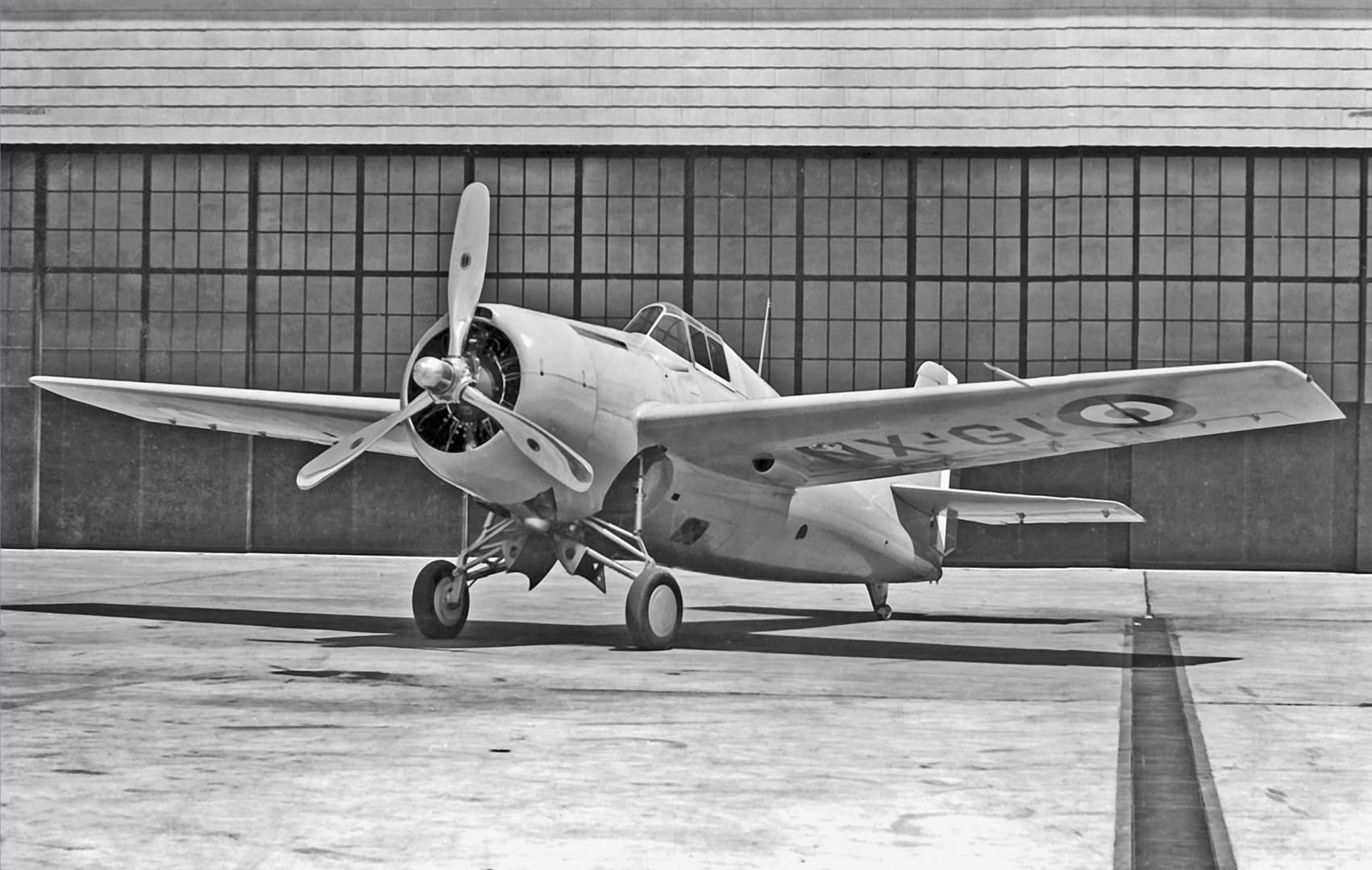
On May 11, 1940, the first G-36A, under U.S. civil registration NX-G1, completed its maiden flight from the Bethpage runway. This aircraft was painted in an overall Light Gray scheme with French Navy markings that included French national insignias in all four wing positions, along with red, white, and blue stripes on the rudders and elevators. Around the same time, Germany had already launched its invasion of France and the Low Countries.
The order specified 81 G-36As and an additional 10 aircraft’s worth of spare parts. However, by the time France capitulated on June 22, 1940, only six additional G-36As were completed. The completed aircraft and the remainder of the French order were taken over by the British to bolster their number of fighters in operational service. Consequently, these aircraft, with the codes NX-G1 through NX-G7, were flown to Canada. From there, they were refurbished to British standards and shipped to England. They were given the British serials AX753, AX754, and AL231 through AL235.
The rest of the order was built from the start to British specifications, and all of these aircraft went to the Fleet Air Arm, designated as Martlet Mk Is. Thus, NX-G1 was the only aircraft built with French internal equipment and painted with French markings, standing by for delivery to France before the Armistice occurred in June 1940.