History
The FG-1A was the designation for Corsairs that were license-built by Goodyear to the same specifications as Vought’s F4U-1A Corsairs. The first Goodyear-built FG-1 flew in February 1943, and deliveries of FG-1 Corsairs began in April 1943.
Early Corsairs employed the iconic birdcage canopy, a heavily framed structure composed of numerous plexiglass panels. Although the canopy was considered structurally strong, it heavily hindered the pilot’s visibility, especially during carrier approaches and other critical situations.
Further improvements were attempted to improve the canopy design, introducing a new, taller, wider canopy that closely resembled the Malcolm Hood fitted to some British fighter aircraft. This canopy was applied to the F4U-1A, F4U-1D, and subsequent variants, and it was a successful design that greatly enhanced the pilot’s visibility. A similar development occurred later when the US Army Air Forces adopted full bubble canopies for their P-51D Mustang and P-47D Thunderbolt, greatly improving all-around visibility and situational awareness.
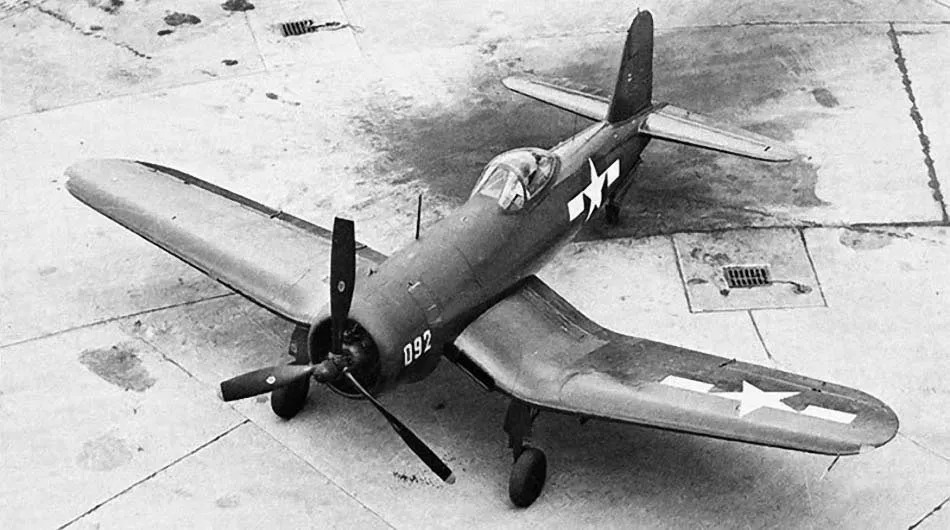
An even more radical proposal to offer a much-improved canopy over those fitted to later F4U models was initiated by Goodyear. Goodyear took two FG-1A Corsairs from the production line and converted them for experimental purposes. These aircraft bore BuNos. 14091 and 14092, respectively. Goodyear described them as possessing a “360-degree teardrop canopy,” a term that would later become universally known as the bubble-top canopy.
These FG-1As retained the Hamilton Standard three-bladed propeller and standard Pratt & Whitney R-2800 engines. According to the Pilot’s Handbook for the F4U Corsairs, the water injection system was provided beginning with FG-1 serial number 13992 and subsequent aircraft. With their BuNos. being 14091 and 14092, these FG-1As were fitted with R-2800-8W engines, with the “W” denoting the water injection system, which increased boost during war emergency power.
Their cockpits were revised with extensive modifications, with the upper rear fuselage behind the cockpit removed and the dorsal decking lowered to allow the installation of a streamlined bubble canopy. Secondary sources claim the canopy was more or less derived from the British Hawker Typhoon. However, the Typhoon canopy geometry did not align evenly with the special canopy fitted to these FG-1As, and no surviving NACA reports or official Goodyear documents confirm this claim.
After being fitted with the new canopy, these FG-1As were tested thoroughly by the National Advisory Committee for Aeronautics (NACA). Reports indicated that the canopy design improved cockpit visibility, pilot positioning, and airflow management around the canopy and fuselage. The standard F4U-1A configuration, with its raised cockpit and simplified canopy design, was used for comparison in this report.
Due to the limited number of surviving documents describing the experiments with these FG-1As and their radical canopy, there is not much more to say. However, the design contributed valuable lessons that led to the creation of the F2G Super Corsair with its newer bubble canopy design. In retrospect, the FG-1As with BuNos. 14091 and 14092 can be considered experimental ancestors of the Super Corsair variant.