
1 Like
The name is badass as well, “Dragonfire”
2 Likes

Oh look, it’s the same issue plaguing FCAS as well lmao
Spoiler

1 Like
From my understanding at least reading what they are talking about it seems U.K might be unwilling to share some specific technologies? I wonder why though considering Italy and Japan are basically sharing everything.
Time to revive this thread lol
Seems like the FCAS fighter is going to be killed soon
2 Likes
Sorry for the very late response I am not that up to date right now.
I might have to recheck but as far as I’m aware Italy is interested in bringing Germany into the program, so well see how that plays out I guess.
This might also be late news but I might as well bring it up.
anything that combines germany and france in one project always fails
1 Like
Would probably be Germanys best choice, even if we only get some privileges to modify it ourselves in exchange for money, but afaik Tempest and FCAS are designed for very different doctrines, so not sure if our military would be happy with that solution. Doing it ourselves (or maybe just with spain and maybe Sweden, dunno if they already have a project going tbh) would probably take too long or be too expensive.
Also, according to Reuters the meeting is currently scheduled for the 11. December
I mean, the Tiger heli was pretty successful I’d say (even if outdated nowadays), but that is very much the exception
I knew from the start something similar to this would happen with them.
It would. Even if Germany wouldn’t want to join, there isn’t much else they can do as far as I’m aware. Unless for reason they decide to join whatever’s concept Sweden is on to right now, at this point I’ll just have my fingers crossed waiting for their meeting.
1 Like
Most likely scenario here is GCAP goes ahead, maybe collects a few more nations to sell to, FCAS falls apart with France and Germany both perusing their own designs with the way they’re both talking atm.
If GCAP ever exist, Japan and Italy are still waiting UK for their DIP (it keep being pushed to later) and so to be able to sign any contract…
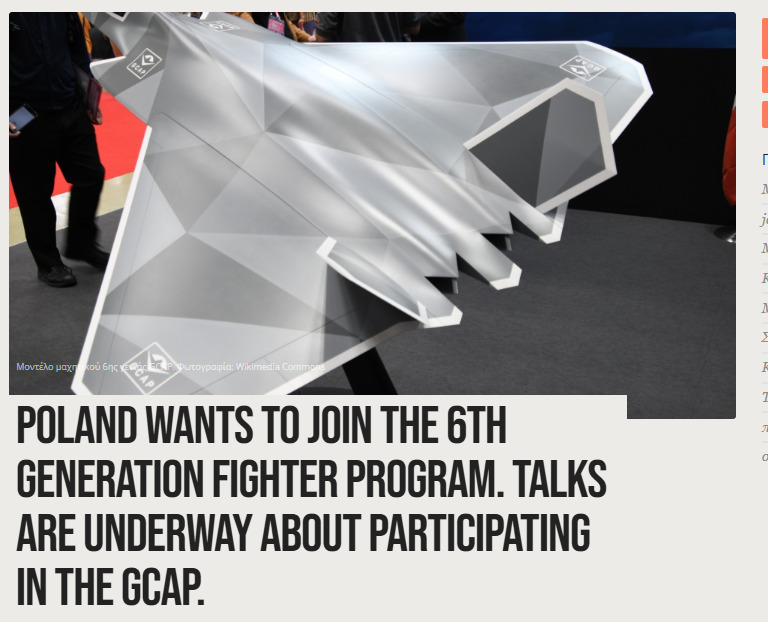
I never really thought much about polands views on gcap from the beginning but good for them i guess, india seems to step up their interests too that i’ve heard somewhere
1 Like
India is especially interested in FCAS since they are buying french planes and funding a french 6th gen engine.
Otherwise GCAP can’t be navalized so it’s another reason that it is not happening.
And Japan like the other members would not want to give workshares to India which is the thing that they would for sure ask.
I think india is also particularly interested in technology-transfer. And I severely doubt France hands it over (maybe if Germany and Spain leave there’s a deal to be struck), and its never going to happen with GCAP.
Now the only partners that can join are tier 1 partners who get no tech insight, but rather just manufacturing shares and customisation rights when it comes to GCAP.


Seems GCAP may indeed suit Poland then as long as they’re comfortable in not having a design input but gaining limited tech-transfer and manufacture rights.
1 Like
Can’t wait to see the first prototype
1 Like
Well, GCAP is not without it’s drama too.
Japan sounds alarm over UK delays to combat aircraft project
Spoiler
Japan is growing increasingly doubtful about the UK’s commitment to their joint fighter development programme with Italy, with crucial development work stalled by British budgetary foot-dragging.
The Global Combat Air Programme (GCAP), which aims to put next-generation fighters in the skies by 2035, is a landmark effort by Japan, the UK and Italy to challenge US dominance in military technology.
But a series of delays to the UK’s defence investment plan is preventing the signing of a vital contract for design and development work with Edgewing, the commercial joint venture between the three nations’ leading defence contractors.
“Frankly speaking, it’s a terrible situation,” said one person involved in GCAP, referring to the hold-up of project work caused by the UK.
A second person involved acknowledged there was a sense of “growing frustration” on the part of Japan.
In addition to funding questions, two people familiar with the matter also suggested the two capitals had different priorities for the programme.
Tokyo’s main aim is to produce a new fighter by the mid-2030s, whereas London and Rome are more interested in GCAP producing a cutting-edge “system of systems” — a jet that operates in concert with a swarm of drones — over a less rigid timetable, one of the people said.
One of them added that this could leave the UK “tempted” to try to slow the timetable to make it more affordable in the short term.
The friction between the governments comes at a time when anxieties are rising about global security because of the war in the Middle East and an unpredictable US under the Trump administration that has urged its Nato allies to do more to defend themselves. Keir Starmer and Sanae Takaichi shake hands and smile at a press event, with UK and Japanese flags behind them.
GCAP was intended to create a successor to the current generation of jets flown by the three nations, helping to reduce reliance on more advanced F-35 fighters supplied by the US, which are a mainstay for Nato air forces.
The UK had initially planned to publish the 10-year defence investment plan in autumn 2025, but this has been repeatedly postponed because of fiscal constraints with a funding gap identified of up to £28bn over a decade, according to officials.
At the start of this year, Italy estimated that its share of the design and development phase would cost €18.6bn, triple its previous forecast. Last month, Rome approved a budget that included an €8.8bn tranche of funding for the programme.
Japan’s deepening worries over the delays to the UK’s defence spending plans and whether GCAP’s funding requirements will be ringfenced have been expressed at ministerial levels, the people said.
UK Prime Minister Sir Keir Starmer tried to reassure Japanese counterpart Sanae Takaichi of Britain’s commitment during his visit this year, but in the absence of any funding his reassurances did not hold much sway, said two people familiar with the visit.
The programme’s industry partners had expected the international contract to be signed last September. The contract would have released the next tranche of funding — expected to be in the billions of pounds — to the Edgewing consortium. The signing, however, was repeatedly pushed back amid delays to the publication of the UK’s defence investment plan.
The main companies involved — BAE Systems, Italy’s Leonardo and Japan’s Mitsubishi Heavy Industries — have continued engineering and design work under existing national funding streams, but fear the UK money will run out in the coming weeks, according to two people familiar with the programme.
Tokyo has shifted its stance to become more open to signing deals with potential customers for the fighter jet to reduce the funding requirements on the UK, with Canada a leading potential customer, according to two of the people.
Japanese officials stressed that Tokyo is reluctant to allow the entry of any new design and development partner, however, given the complexities. Japan resisted a push last year by the UK and Italy to get Saudi Arabia involved in the development. Saudi Arabia was still in talks to join in some form, according to two people familiar with the situation.
UK defence secretary John Healey told MPs this year he was “determined that the momentum of the [GCAP] programme is maintained”. On Monday he told parliament the government was “working flat out to settle the defence investment plan”, but gave no sign it was due to be published imminently.
A UK Ministry of Defence spokesperson said: “The depth of collaboration between all three nations is clear — in the last year alone we’ve seen the trilateral GCAP headquarters open in Reading and the launch of the joint venture made up of industry organisations from all three nations to deliver the programme.
“Our immediate priority is working with all parties on signing the first major international contract for GCAP as soon as possible.”
Japan’s Ministry of Defence said Edgewing contract negotiations were in the final stages and “we do not believe this will lead to delays in the programme”. It added that “if there are countries expressing their interest, we will, together with the UK and Italy, take their interest and perspectives into account and respond in a way that helps improve the programme”.
An Edgewing spokesperson said GCAP is “proceeding on schedule, with engineering work . . . moving briskly forward”. The “GCAP Agency and Edgewing are continuing to ramp up and operate in line with our planning,” they added.
In simple Japan urgently want a plane as fast as possible while UK and Italy not so much with more capabilities but less restrictive timeline.
And there is no money for UK to do every big projects they launched so they are trying to cancel / slow down as much stuff as possible.