Weapons suggestion should be checked on report system, not on forum
https://community.gaijin.net/issues/p/warthunder/i/ZjEek192j08h
1 Like
This image is a comparison chart of the AAM-4 and other missiles, taken from a presentation document on the development of the AAM-4B. When compared to the AIM-120B, the stand-off ranges are listed as 1.0 and 0.9-, respectively, indicating that the AAM-4 has a better than the AIM-120B.
The “stand-off range” referred to in this document does not refer to the missile’s flight distance, but rather to the distance between the launcher and the target when the missile has locked onto the target with its seeker.
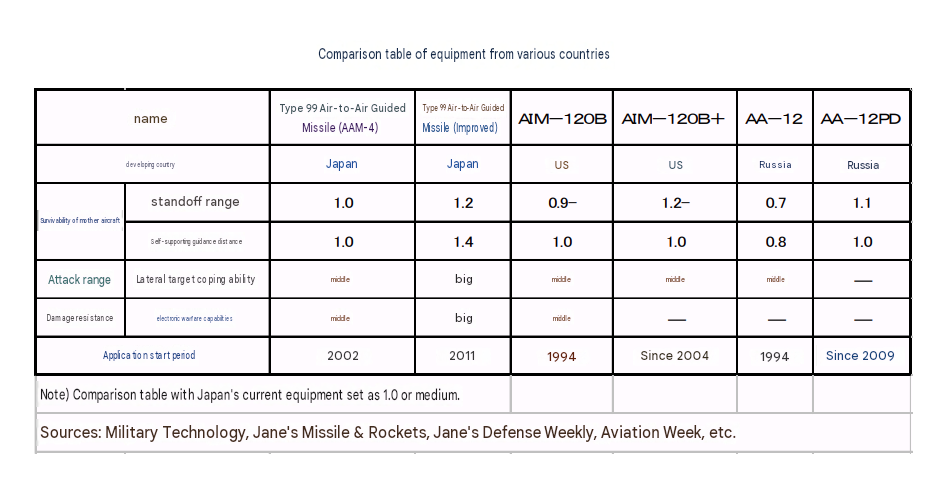
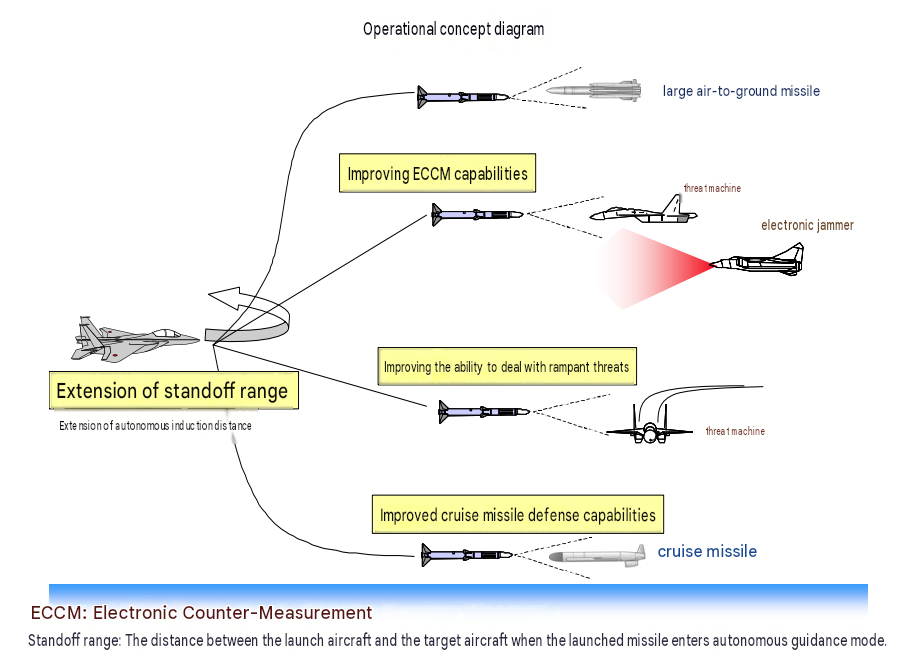
This is where it gets important. The reference materials in this list include military magazines. Japan conducted an evaluation from June to August 2001 and compiled this document. However, prior to that, in March 2001, Japan acquired the AIM-120B and conducted compatibility tests with the host aircraft. This timeline matches the period listed in SIPRI.
In other words, Japan knows more about the performance of the AIM-120B than military magazines do—even without relying on them.
Since we’re comparing missiles, the conditions are the same: altitude, distance from the target at launch, speed, weather, etc. — everything. Based on these factors, the difference in stand-off range figures shows that the AAM-4 has a higher speed than the AIM-120B.
1 Like