History
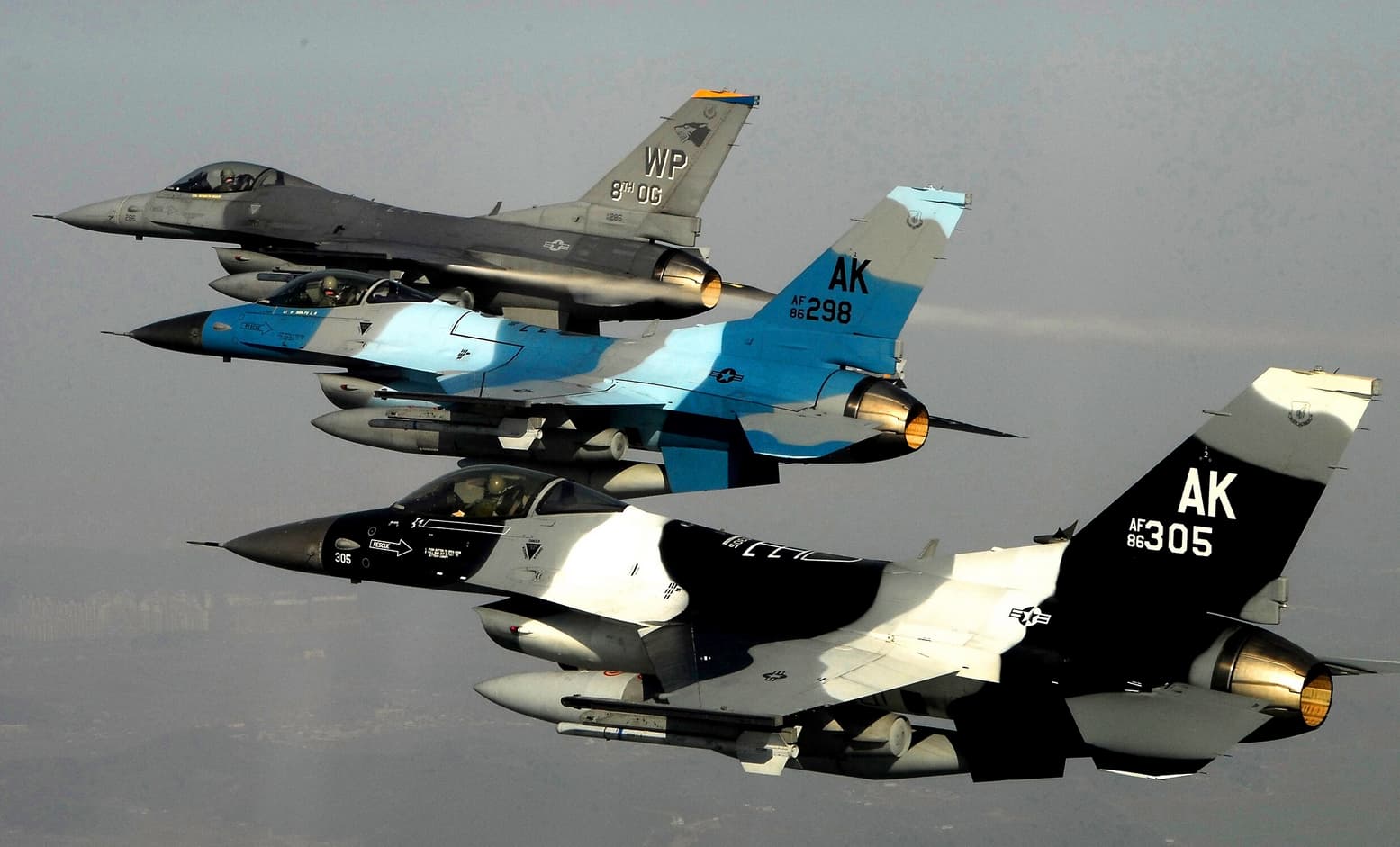
The General Dynamics F-16 Fighting Falcon is arguably the most iconic American single-engine supersonic multirole fighter. It originated from the Lightweight Fighter (LWF) program, initiated as early as 1965 to replace the USAF’s F-105 Thunderchief, A-7 Corsair II, and F-4 Phantom II. Production began in late 1975, and the first examples of the F-16A rolled out in 1976.
These aircraft became operational with the USAF in the autumn of 1980. Over the production run of the F-16A, multiple blocks were introduced: Block 1, 5, 10, 15, and 20, each progressively enhanced through programs such as the Operational Capabilities Upgrade, Multinational Staged Improvement Program (MSIP), and the Air Defense Fighter modification program. These upgrades allowed early-model Falcons to integrate next-generation weapons to remain competitive against evolving threats, including the AIM-7 Sparrow and AIM-120 AMRAAM. However, the USAF ultimately required a deeper redesign and new-build variants for long-term combat effectiveness.
This transition led to the development of the F-16C/D series, beginning with Block 25. As part of MSIP Stage II, the F-16C first flew on June 19, 1984, and deliveries to the USAF began the following month. Block 25 introduced several major upgrades. These included new software enabling the use of AIM-120 AMRAAM and improved night/precision attack capabilities. It also featured updated avionics, such as an enhanced fire-control computer, stores management system, inertial navigation system, two multifunction displays, and provisions for future electronic warfare suites. A new radar, the Westinghouse (now Northrop-Grumman) AN/APG-68, offered increased range, better resolution, and expanded operating modes. Physically, the F-16C/D gained a larger HUD, new upfront controls, and an expanded tail root fairing housing components of the ALQ-165 Airborne Self-Protection Jammer (ASPJ). Structural enhancements allowed a higher 37,500 lb maximum takeoff weight while still retaining the F-16’s hallmark 9-G capability at full internal fuel with a basic A2A load. Block 25s remained originally powered by the Pratt & Whitney F100-PW-200 engine.
A major leap came with the introduction of the F-16C Block 30 in mid-1986. This block was built with a universal engine bay capable of mounting either a Pratt & Whitney F100 or a General Electric F110. However, the F110 required significantly greater airflow, necessitating a larger Modular Common Inlet Duct (MCID), often called the “Big Mouth.” Falcons equipped with the F100-PW-220 became Block 32; those with the F110-GE-100 became Block 30.
The F110-GE-100 was transformative. Though larger and heavier than the F100, it delivered roughly 5,000 lbf (22.2 kN) more thrust and produced full thrust at lower airspeeds thanks to the enlarged inlet. Regarded as one of the world’s premier fighter engines, the F110 introduced major improvements in operability, reliability, durability, and lifecycle cost. Other than the propulsion system, Blocks 30 and 32 were identical in avionics.
Block 30 also introduced seal-bonded fuselage fuel tanks to reduce leakage, increased onboard computer memory, and replaced the earlier AN/ALE-40 chaff-flare launchers with the more capable AN/ALE-47 system. Early Block 30s carried two dispensers; later sub-blocks (starting with Block 30D) standardized four. During this change, the RWR antennas previously located on the nose were relocated to the leading-edge flaps for improved sensor coverage. Block 30s incorporated the ALR-56M advanced radar warning receiver and gained software enabling carriage and launch of the AGM-45 Shrike and AGM-88 HARM, as well as the AGM-65 Maverick.
Production of the Block 30/32 series began in January 1986, with the first deliveries in July 1987. A total of 733 aircraft were produced before the block closed out in 1989. Block 30/32s were operated by the USAF, US Navy (as the F-16N), Turkey, Israel, Greece, Egypt, and South Korea.
USAF Block 30s saw extensive combat service in Operation Desert Storm as frontline fighters, and later in Operation Iraqi Freedom under Air National Guard units. They served as the backbone of multiple air campaigns until gradually replaced by the more advanced and slightly heavier Block 50s. In the 2000s and beyond, many Block 30s received modern avionics upgrades, approaching the similar level of Block 50 capability, though these enhancements added more weight and equipment compared to their lighter Desert Storm-era configuration.