TLDR; This Suggestion is for the final model of Striker, equipped with the Barr & Stroud Combined Sight, dieselised via the CVR(T) Life Extension Program, and upgraded with the Swingfire Improved Guidance (SWIG) ACLOS guidance system. This is the generation of Striker that the British Army deployed from 2003-2005 during the Iraq War.
- Yes
- No
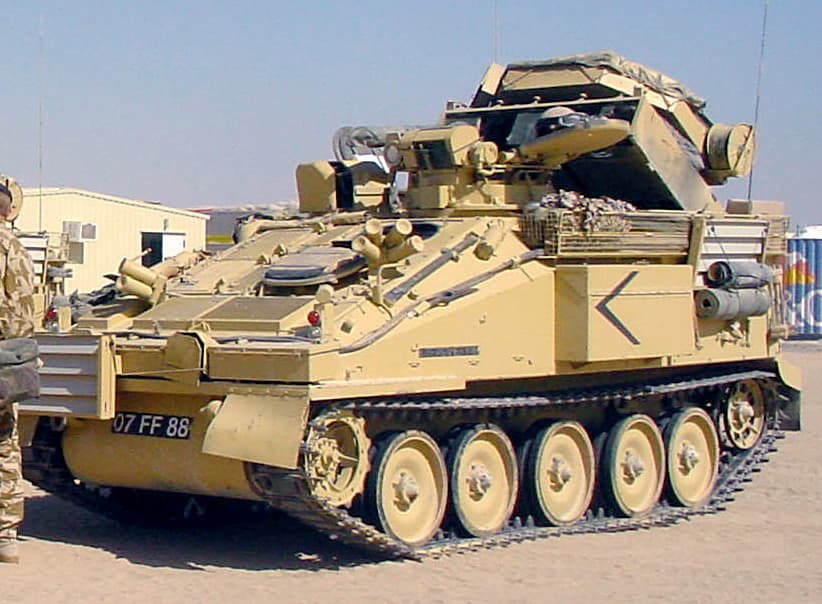
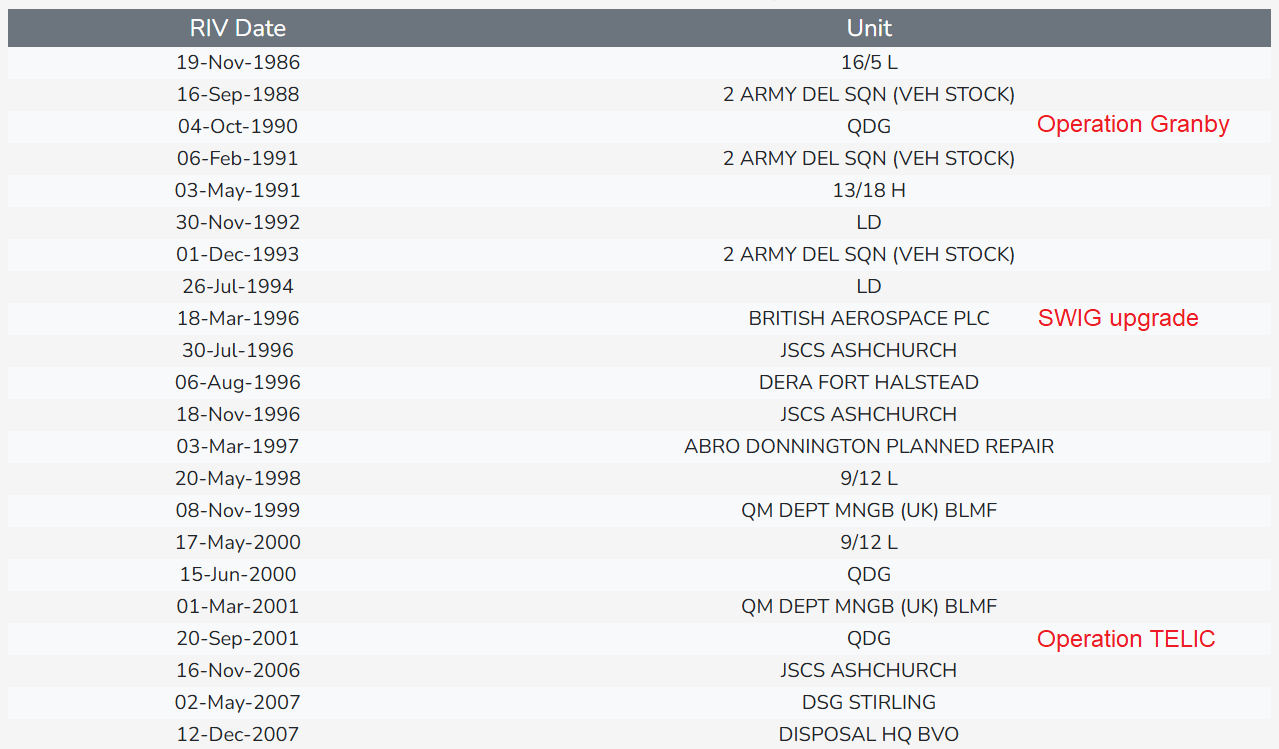
Fig.1 An FV102 Striker SWIG of C Sqn, 1st The Queen’s Dragoon Guards pictured prior to the invasion of Iraq in Camp New Jersey, Kuwait on 14 March 2003. 07FF88 was in British Army service from September 1977 to December 2007, deploying to Iraq in 1991 and 2003, both times with the QDG. SWIG installation was performed on this vehicle by British Aerospace PLC in March 1996. A brief vehicle history can be found on the Merlin Archive.
Overview
FV102 Striker SWIG is an upgraded version of the original FV102 Striker anti-tank guided missile carrier. Striker SWIG is based on the highly successful Combat Vehicle Reconnaissance (Tracked) platform, and is armed with the powerful and long-ranged Swingfire ATGM.
SWIG
Spoiler
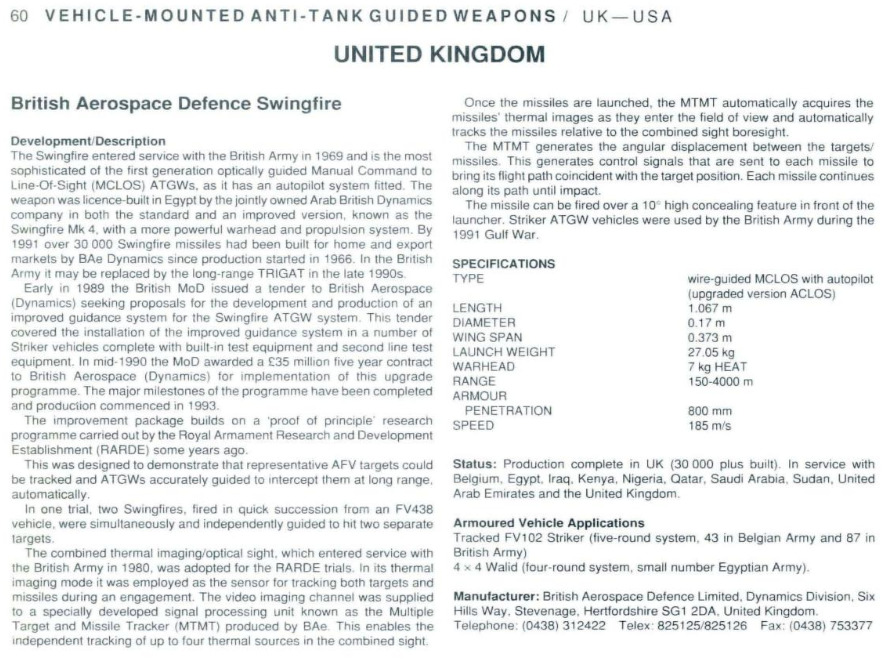
The Swingfire Improved Guidance or SWIG system originates in the experiments in automatic target tracking conducted by the Royal Armament Research & Development Establishment (RARDE) and Fairey Engineering Ltd in the late 1980s, in which fully automatic digital guidance or Automatic Command Line-of-Sight (ACLOS) was developed.
In May 1988 during several trials, two Swingfire missiles were ripple-fired from a pair of FV438 GW carriers and were simultaneously, automatically and independently guided to hit two separate targets using a system developed by RARDE engineers. The experimental system used standard Swingfire dismounted targeting equipment, modified to employ the thermal channel of the Barr & Stroud Combined Sight (CS) via a signal processing unit, the Multiple Target & Missile Tracker (MTMT).
The MTMT acquires the thermal signature of the outgoing missile and automatically generates control signals to bring to zero the angular displacement between missile and target without input from the missile controller. It can manage four thermal sources at once; two missiles and two targets. Based upon this research, in 1989 the Ministry of Defence issued a tender to British Aerospace Dynamics Ltd (BADL) to submit proposals for upgrading the Swingfire guidance system.
In June 1990, BADL was awarded a £35 million, five-year contract to upgrade the Swingfire guidance system using the principles developed by RARDE and Fairey. The main subcontractor would be British Aerospace (Systems & Equipment) Ltd (or BASE), a BADL subsidiary headquartered in Plymouth, who would produce the auto-tracker and scan converter modules. Rebuild of the Swingfire guidance modules took place at the BASE site at Stevenage, installing a Dowty Weapon Systems high-pressure pure air generator (HiPPAG) and replacing the thermal sight gas cooling system of the CS thermal sight with a pressurised cryogenic system.
Operational Service
Spoiler
Striker was first deployed operationally during the 1991 Gulf War, while SWIG was still in development. Equipped with CVR(T)s including 16 Strikers, the 16th/5th The Queen’s Royal Lancers provided the divisional reconnaissance group to 1st Armoured Division, alongside FV101 Scorpions from A Sqn, 1st The Queen’s Dragoon Guards, and 1 Sqn RAF Regiment.
From 1990 to 1995, all 89 of the British Army’s remaining FV102 Strikers were gradually upgraded with SWIG. Following peacekeeping service in Bosnia & Herzegovina in the Implementation Force (IFOR), Striker’s final combat deployment would be in Operation TELIC, the UK’s contribution to the 2003 coalition invasion of Iraq. 1st The Queen’s Dragoon Guards would again deploy Striker to the Gulf, alongside D Sqn, the Household Cavalry Regiment.
Striker would score its final Swingfire kill on 24 March 2003, destroying an Iraqi T-55 in support of 3 Commando Bde during the four-day Battle of the Al-Faw Peninsula. In a famed incident from Al-Faw a QDG Scimitar (C/S 22) threw track while reversing under fire from rocket-propelled grenades. Under cover from C/S 20 commanded by the now LtCol Simon Farebrother MC, C/S 22’s crew dismounted, repaired the track, and recovered their vehicle while still under heavy enemy fire.
Operation TELIC proved the last hurrah for both Striker and the Swingfire missile system, with Swingfire being replaced by Javelin and Striker, now disarmed, was retired in mid 2005.
Specifications
Spoiler
Length: 4.89 m
Width: 2.21 m
Height: 2.28 m
Combat Weight: 8,346 kg
Crew: 3
Engine: Cummins 6BTA 5.9-litre diesel, producing 190 bhp (192.64 ps) @ 2,600 rpm
Transmission: David Brown TN15D
Armament:
- 10x Swingfire anti-tank guided missile (5 loaded, 5 reloads)
- 1x L37A1 7.62mm general purpose machine gun in No. 16 Cupola
Gallery
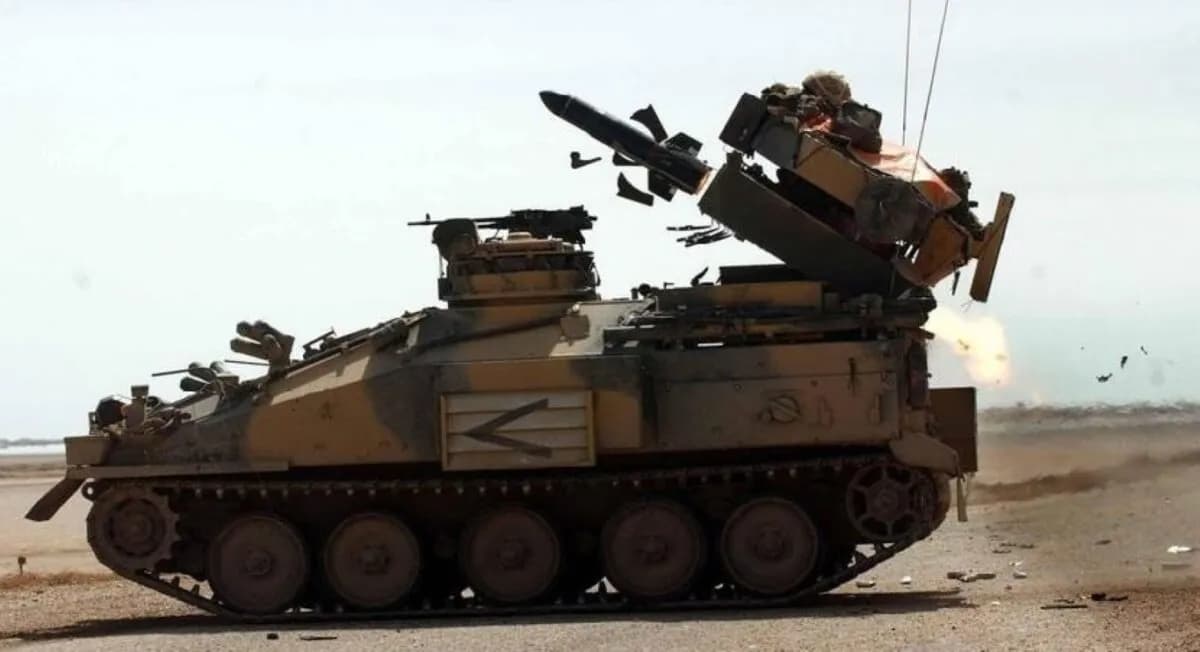
Fig.2 An FV102 Striker of C Sqn, 1st The Queen’s Dragoon Guards fires a Swingfire ATGM during the 2003 invasion of Iraq.
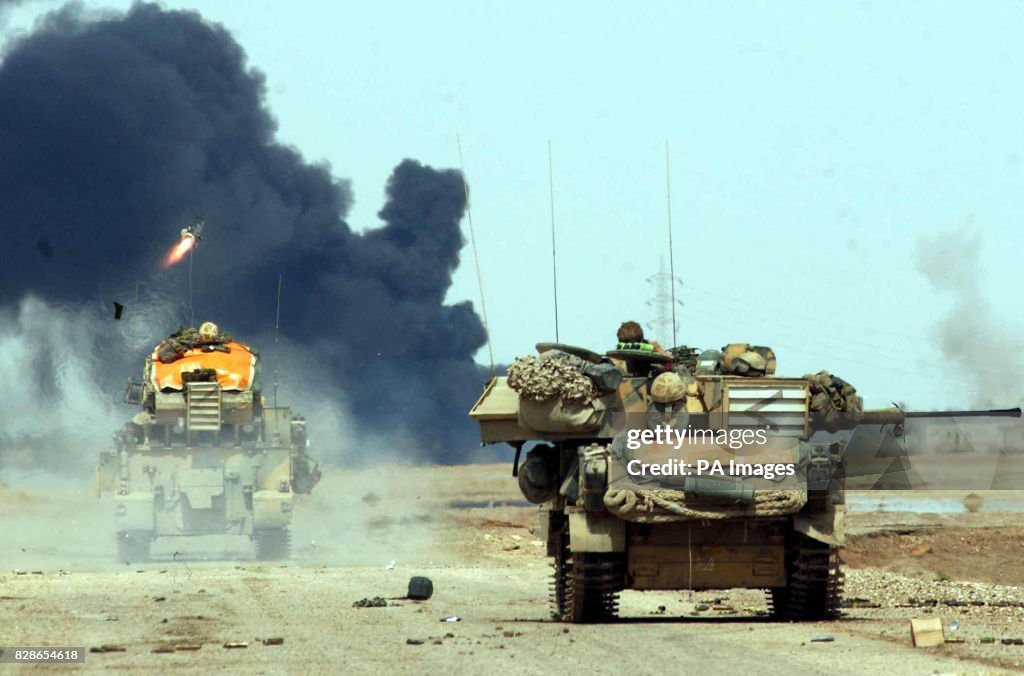
Fig.3 An FV102 Striker of C Sqn, 1st The Queen’s Dragoon Guards fires a Swingfire ATGM during the 2003 invasion of Iraq.
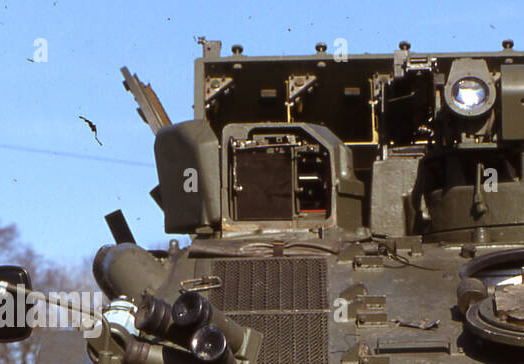
Fig.4 A close-up of the Barr & Stroud Combined Sight, showing the new sight housing.
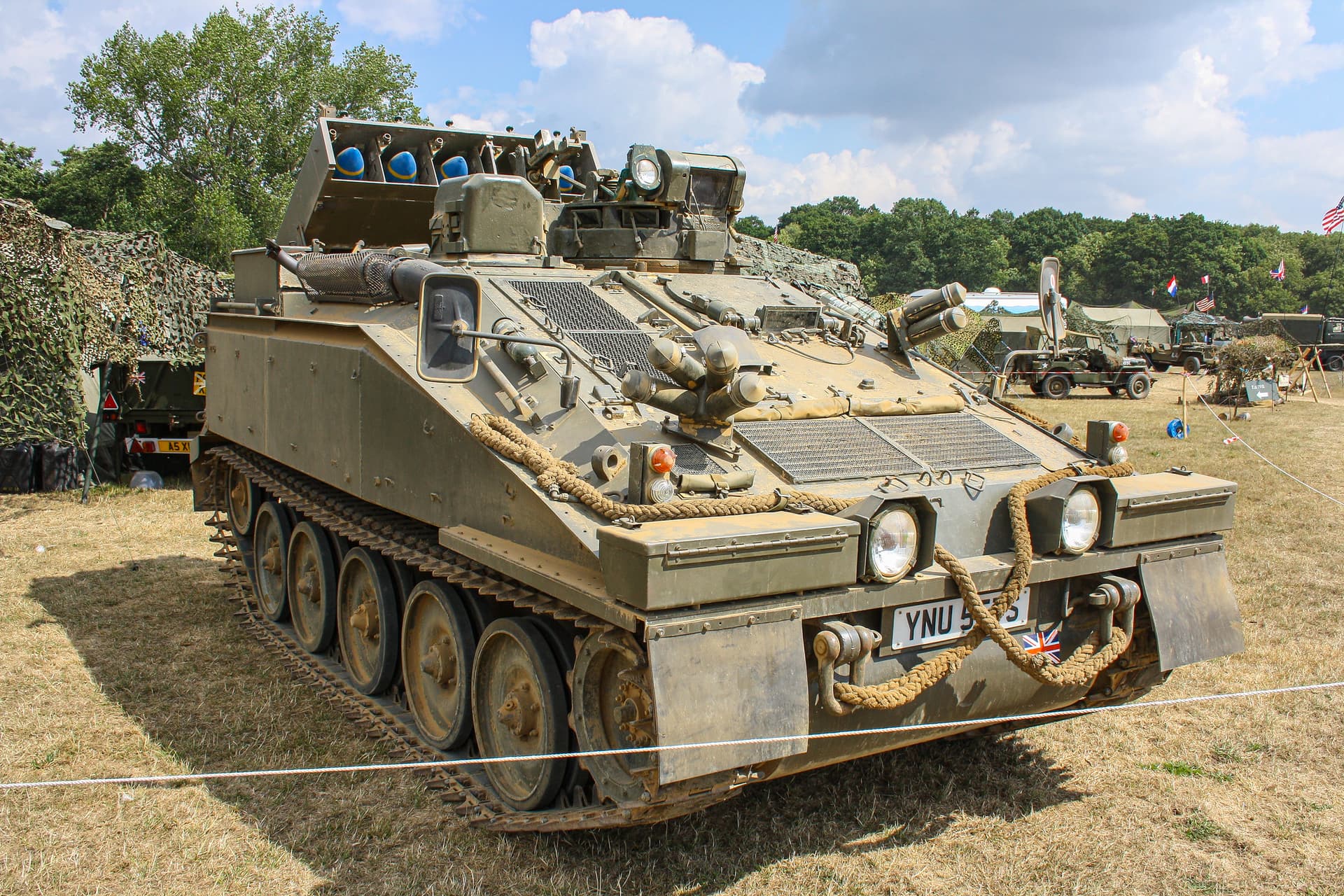
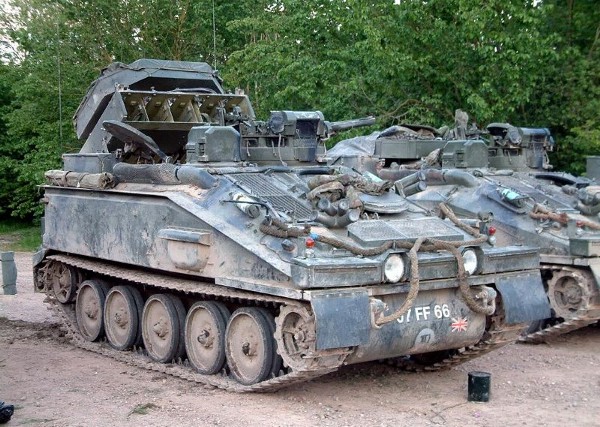
Fig.5 An FV102 Striker in private ownership, showing two of three front stowage bins, and the sight housing of the Barr & Stroud Combined Sight in the closed position.
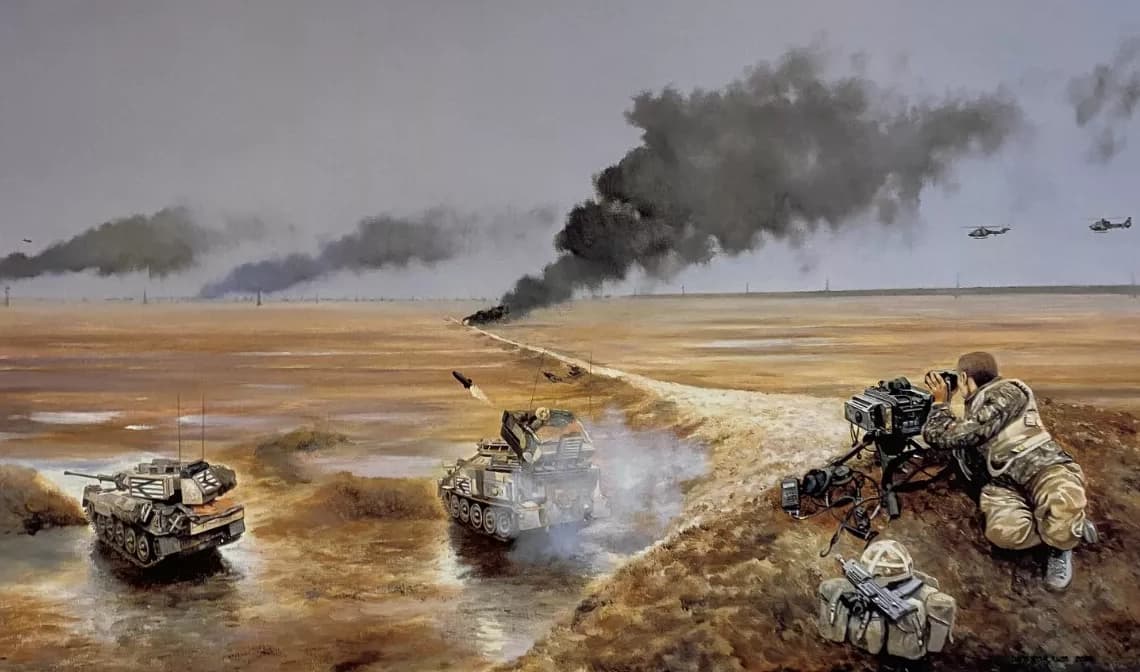
Fig.5 An FV102 Striker of C Sqn, 1st The Queen’s Dragoon Guards fires a Swingfire in a depiction of the combat on the Al-Faw peninsula, from “1st The Queen’s Dragoon Guards: C Squadron, Al Faw” by David Rowlands.
Sources
- Forecast International, Missile Forecast - Swingfire
- Think Defence - Swingfire ATGW
- Tank Encyclopedia - FV102 Striker (1974)
- IWM - R.A.R.D.E. (18.00 to 19.35)
- Jane’s Armoured Fighting Vehicle Retrofit Systems 1993-94, page 60
- Armies of the Gulf War, Gordon L. Rottman, 1993
- Target Basra, Mike Rossiter, 2008
- https://merlinarchive.uk/vehicle/07FF88