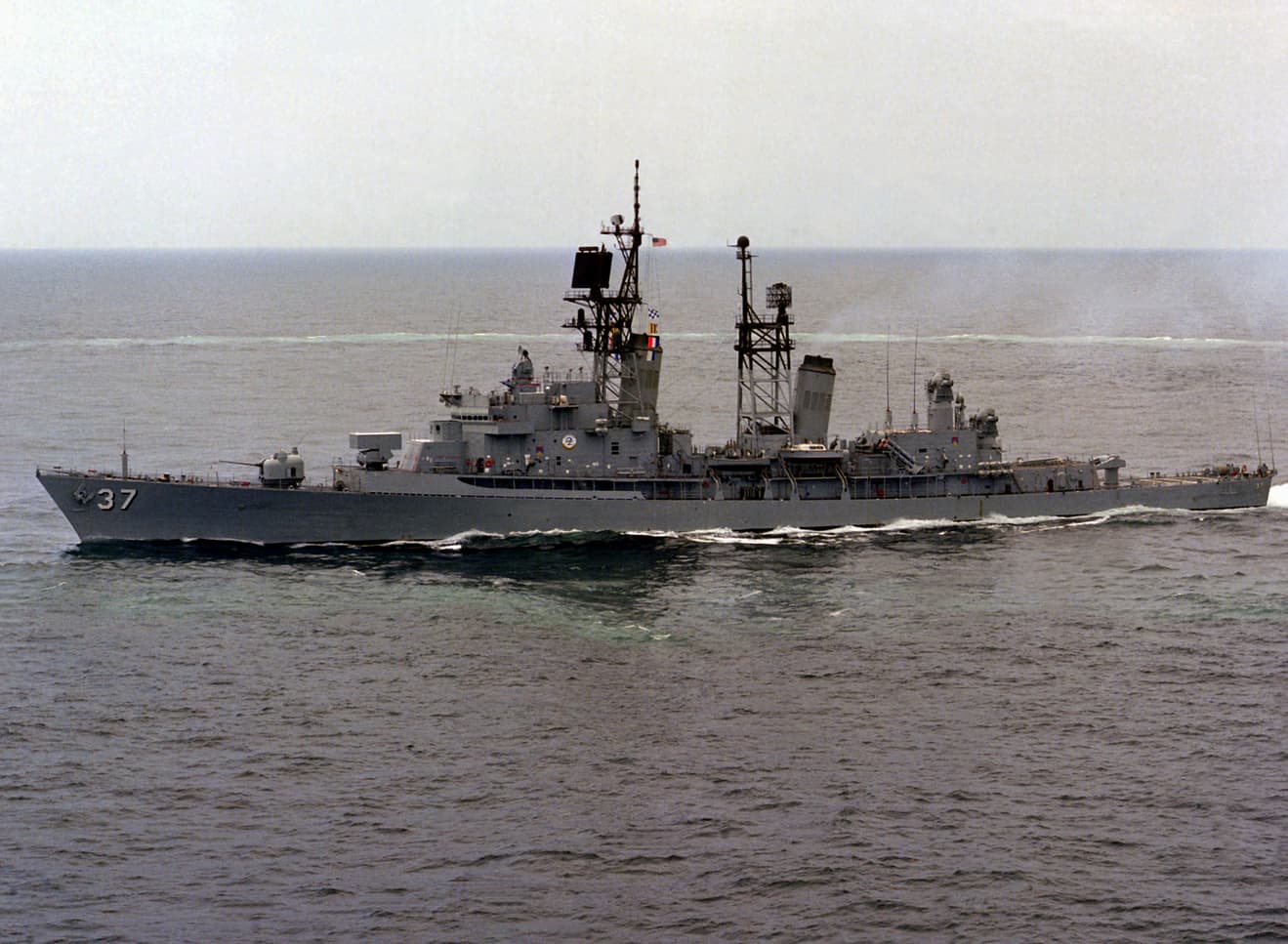
Description
Background
Artist’s Impression of the Farragut class in 1958
In the late 1950s, the US Navy ordered a new class of ten destroyers. Originally, the first three ships were intended to be all-gun vessels and classified as DL (Destroyer Leaders), while the next three were planned as gun-and-missile ships classified as DLG (Guided Missile Frigates).
During construction, however, the Navy decided to complete all six ships to the guided-missile configuration. USS Coontz was the first of the originally planned missile ships and was laid down on March 1, 1957, making her the first ship specifically designed from the outset as a guided-missile warship. Because of this, the class was often informally referred to as the Coontz class. Although USS Farragut carried the lowest hull number, she was originally intended as an all-gun design and was later redesigned during construction as a guided-missile ship. To conform to US Navy naming conventions, the class was more correctly designated the Farragut class. It also became the first class of missile-armed destroyers built from the keel up for the US Navy.
Table of Ships of the Farragut destroyer class (Wikipedia)
All ten ships entered service during the early 1960s as guided-missile frigates (DLGs). Their primary mission was to escort carrier battle groups, providing area air defense with the RIM-2 Terrier surface-to-air missile system.
In 1975, the US Navy implemented its ship reclassification program, which revised the terminology and hull classification system for cruisers, frigates, and ocean escorts. As part of this reorganization, the Farragut-class ships were redesignated from DLGs to DDGs (Guided-Missile Destroyers). They were also the only redesignated ships to receive entirely new hull numbers, with USS Farragut changing from DLG-6 to DDG-37, followed by the remaining ships as DDG-38 through DDG-46.
Throughout their service lives, the ships underwent several modernization programs. The twin 3-inch (76 mm) anti-aircraft gun mounts were removed and replaced with two quadruple AGM-84 Harpoon anti-ship missile launchers. Their radar and fire-control systems were also upgraded during the late 1970s and early 1980s to support the more capable RIM-67 Standard Missile (SM-1ER).
USS Mahan (DDG-42) was the most unique member of the class. She was the only ship selected to receive the New Threat Upgrade (NTU) beginning in 1980-1981 at the Philadelphia Naval Shipyard. She served as the primary test platform for the RIM-67B Standard Missile-2 Extended Range (SM-2ER). Testing continued from October 1981 through March 1985. The NTU transformed USS Mahan into arguably the most capable anti-air warfare ship in the US Navy at the time. Although similar upgrades were considered for the rest of the class, the program was ultimately cancelled because the remaining service life of the ships did not justify the cost, especially given their limited growth potential.
Most ships of the class participated extensively in operations off Vietnam, providing naval gunfire support throughout the Vietnam War. During their final years of service, several also participated in Operation Desert Storm, conducting escort and naval operations in the Persian Gulf between September 1991 and April 1992. USS Coontz became the first ship of the class to be decommissioned in October 1989, while USS Mahan was the last, leaving service in June 1993.
Armament
The ship’s primary armament was the Mk 10 Mod 7 twin-arm guided missile launcher, supplied by a 40-round rear-loading magazine. Initially, it employed the Convair RIM-2 Terrier, one of the earliest operational US Navy surface-to-air missiles. Early Terrier variants used beam-riding guidance with wing control surfaces and reached speeds of approximately Mach 1.8. Later variants introduced semi-active radar homing, tail control, and speeds approaching Mach 3. Eventually, the Terrier was replaced by the more capable RIM-67 Standard Missile, commonly known as the SM-1ER Block I. Besides engaging aircraft, the missile could also be employed against surface targets. Missile guidance was provided by the AN/SPG-55 tracking and target-illumination radar.
USS Mahan (DDG-42) was the only member of the class upgraded to employ the RIM-67B Standard Missile-2 Extended Range (SM-2ER) under the NTU program. This included installation of the AN/SPS-48E and AN/SPS-49(V)5. Unlike the SM-1ER, the SM-2ER incorporated inertial mid-course guidance before changing to semi-active radar homing during terminal guidance.
The primary gun armament consisted of a single 5-inch (127 mm)/54 caliber Mark 42 gun mounted forward, identical to that carried by the Forrest Sherman class. Fire control was provided by the AN/SPG-53 radar. Each ship carried approximately 560 rounds of ammunition for the Mark 42.
The ships were originally fitted with two twin 3-inch (76 mm) anti-aircraft gun mounts aft of the bridge. These weapons were considered obsolete and were removed during modernization refits completed by 1977. In their place, two quadruple AGM-84 Harpoon launchers were installed amidships during the early 1980s.
For anti-submarine warfare, every ship carried an octuple ASROC launcher positioned immediately behind the 5-inch gun. The ASROC (Anti-Submarine Rocket) was an all-weather anti-submarine weapon capable of delivering a Mk 46 acoustic homing torpedo or a nuclear depth bomb. After launch, the missile followed a ballistic trajectory before releasing its payload under parachute, allowing it to enter the water gently with minimal acoustic disturbance. Once submerged, the torpedo activated its homing system using active or passive sonar. The launcher carried enough reloads for two complete additional salvos.
Additional anti-submarine capability was provided by two triple 324 mm Mark 32 torpedo tube mounts installed amidships, firing the standard Mk 44 or later Mk 46 lightweight acoustic torpedoes.