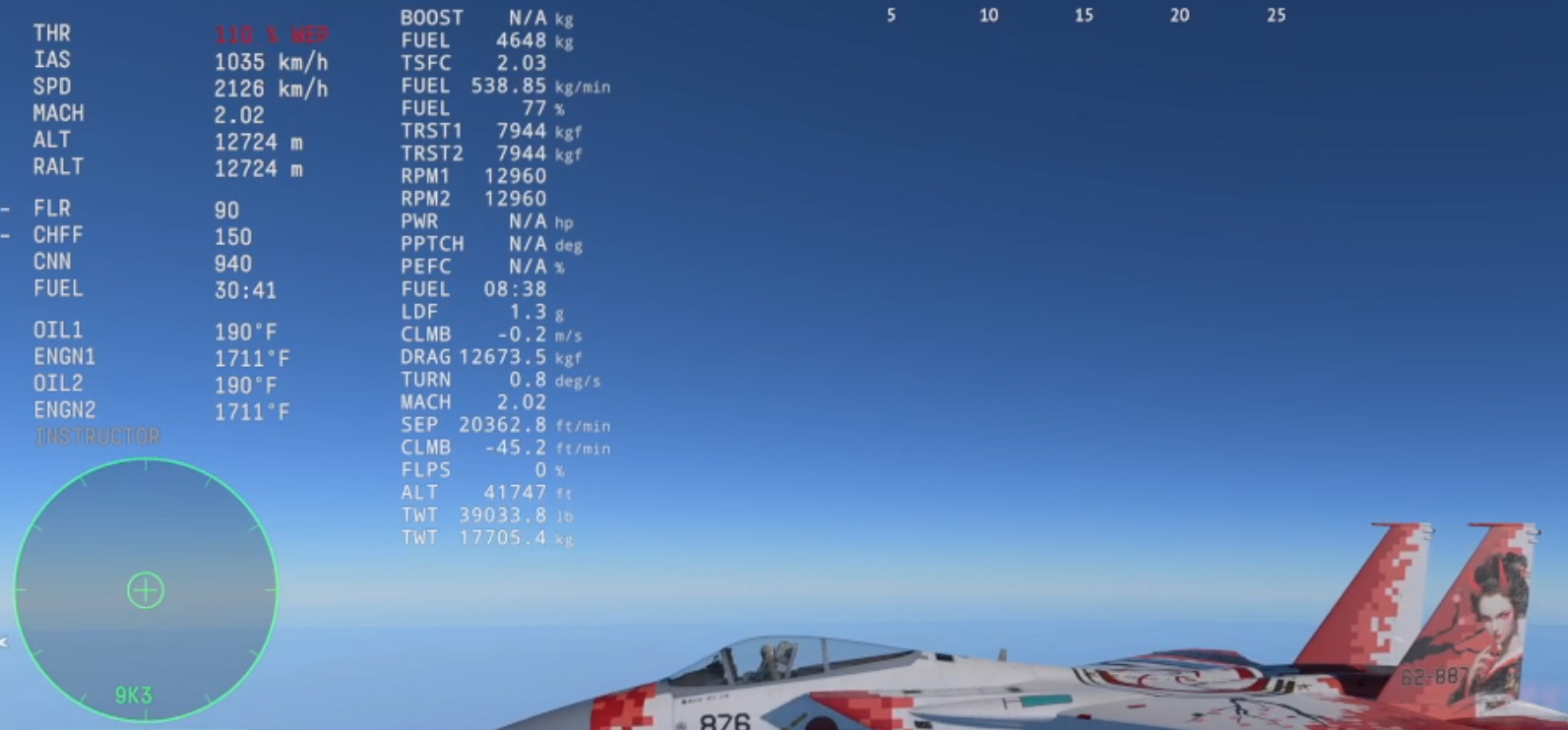
Cause there are more channel losses on the F-15’s engine.
That’s it.
The F-15’s channels are designed to slow down air that has an intake speed up to & exceeding mach 2.5.
Whereas F-16’s channel is designed to slow down air that has an intake speed up to mach 2/2.1.
F-18’s drag is too high if that’s the case, cause F-18 is performing exactly as it should in-game.
1 Like
You mean the F-18C and not F-18E, no?
In what regard?
I know the F-18C’s flight performance is correct in-game. Speed, climb rate, sustained turn rate, acceleration, etc all correct currently.
F-18E’s… I can’t remember my assessment & would have to re-do the tests.
So if F-18C’s engines are producing too much thrust, then its drag is too high as well.
well someone doesnt know how variable intakes and intake ramps work
Well, there are plenty of resources for you to learn.
I can help you as well.
Variable intakes allow for improved supersonic control of air making supersonic flight more efficient.
However, they are not relevant to static thrust, which relies on a short open path to the engine, for which the F-15’s intake is not short, nor is it as open as the F-16’s channel.
This is why the F-16 will always have more static thrust.
What thrust value statcard even shows? For what conditions? Are they even showing thrust values in same conditions for different aircrafts?
Statcard thrust is static thrust, always, without exception.
It’s the most useless thing cause it’s only useful for takeoff of an already spooled engine.
Spool time matters more than static thrust.
& at-speed thrusts matter more than both.
1 Like
this is the conclusion i came to as well, but i wasn’t sure if it was same conditions for every aircraft.
1 Like
maybe you should take yourself up on that offer
because your entire argument that I replied to is negated by the existence of variable intakes and bypass systems such as those found on the F-15
I never made any arguments of which you claim.
I only stated static-thrust, which is dictated by channel length & overall amount of air able to go in.
Variable intakes help make the mouth smaller to adjust air speed, it however does not make the intakes larger than the already maximum size.
Variable intakes also don’t make the intake length shorter.
If you have issues, go speak with physicists on the matter & they’ll tell you the same thing; cause their research is where I got this information to begin with.
did you forget how to read or something?
if not you might want to re read what I replied to
because this statement is only true if you outright ignore the existence of variable intakes so you probably should take yourself up on that offer
@Alpharius11348
Those statements are true because of the variable intakes existing.*
Fixed it for you.
In order to have lower channel losses, your intake needs to be larger & the distance from intake to engine needs to be shorter.
For example: A-10 & Harrier.
A variable intake cannot increase the opening, only constrain it at higher speeds.
Variable intake is why the F-15 has more thrust at mach 2 onward than the F-16 does; variable intake is partly why the F-15 has lower static thrust than the F-16, because the mechanism takes up space in the inlet, & causes more drag for the air coming in.
The intakes of the F-15 aren’t open enough or short enough to allow for an as-high static thrust.
This isn’t a hill to die on, the explanation was given, & static thrust is a useless stat anyway.
F-15 has higher at-speed thrust because of the variable wing sweep, which matters more than the F-16’s higher static thrust.
Not sure why you’re trying to out-beat physics.
Second generation MiG-29 airframe and Eurofighter would disagree.
No, they very much align with that.
The intake maximum on both vehicles are static.
The intake minimum can change, but not the maximum.
The Typhoon however has movable surfaces in front to brute force air into the fixed size inlet at speed.
most advanced air intakes ingame some how they also have some of the highest channel loss same with tomcat by logic the channel loss should the least on these to planes, because channel loss is caused by changing or moving the direction of air SU30SM1 for example with its TVC has no little thrust
straight channel air intakes like flankers and F14s and F15s should have lowest channel loss ingame yet things with S ducts have lower channel loss it makes zero sense
Holy moly… Here I go again.
Your post is incorrect.
First off, zero air movement toward the aircraft, static. S-channel doesn’t matter as much as opening size & distance to engine, because on ground & static, the engine is pulling vacuum.
At speed, the straighter the intake the lower channel losses it gets, which is modeled in-game.
F-15 also isn’t a straight shot either [it’s a bit straighter than F-16], it’s still a curve, and even then the F-15 has lower channel losses at speed than the F-16 because the F-16 isn’t designed for the speeds F-15 gets to.
Variable intake only matters in-flight, on the ground it’s doing nothing because there’s no fast wind moving into the intake, the engine is pulling vacuum instead.
& TVC does reduce thrust of the engines by measurable amounts.
The purpose of variable intakes is not to give the engines more thrust on the ground [because that’s pointless], the purpose of them is to improve high-speed thrust efficiency.
Edit:
Arguing over static-thrust channel loss is silly when it doesn’t even impact us.
Notice how there’s no topic that talks about the channel losses that matter: At-speed channel losses.
For which F-16 has a rather high channel loss, losing 1000kgf over F-15’s PW-220s at higher speeds.
Same does second gen MiG-29 airframes. Lower part of the intake is movable and moves down to increase airflow at low speeds. But at high speed intakes indeed work to reduce airflow and not to increase it.
First time seeing F-16 go over Mach 2, it usually caps around mach 1.9 for me. Is that F-16CM PoBIT?
No, it’s the F-16AJ cause I wanted a quick PW-220 test.
Just ran clean and knew a safe mach 2 altitude from testing years back.
Ultimately I’m annoyed that static thrust is still talked about over a year into air spawns.
Even when we were ground spawns, static thrust only really mattered for bombers that needed to take off faster than everyone else.
F-16 has higher static thrust it’ll never use.
F-15 has higher high speed thrust it always uses.
1 Like
except the varible intake prevents compressor stalls on take off just like the F14A had problems with and at high AOA