-
Yes
-
No
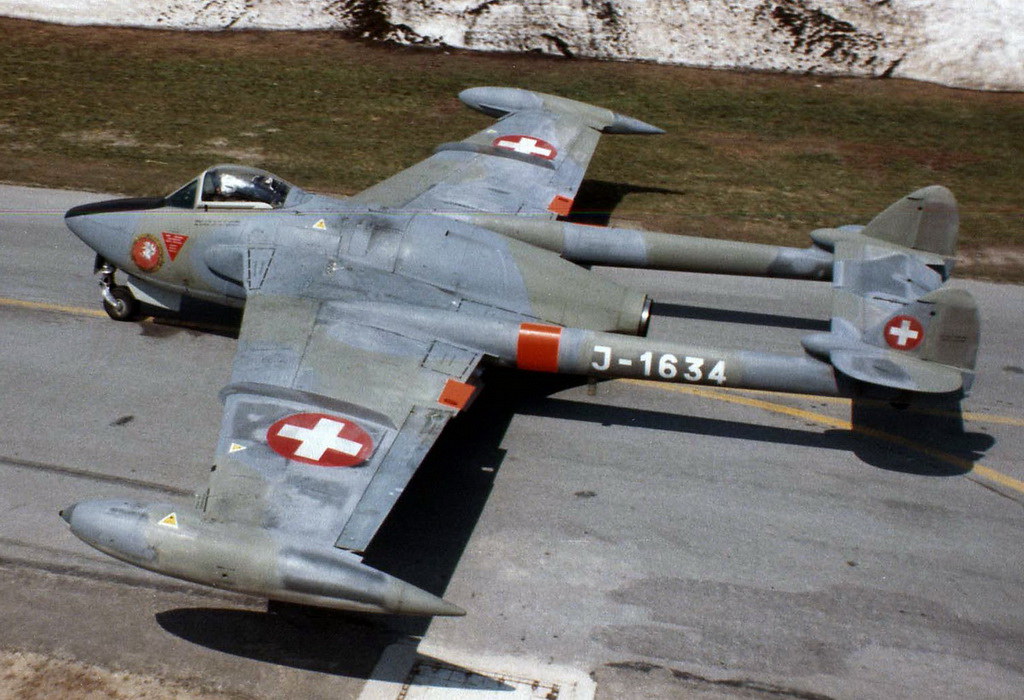
The Venom FB.54 (late) is a Swiss-manufactured, upgraded, long-nosed variant of the Venom FB.4 that features a ballistic computer with CCRP functionality and an expanded selection of air-to-ground armaments.
The De Havilland Venom was a British fighter jet that emerged after World War II, developed as an evolution of the earlier Vampire aircraft. Although it looked similar to the Vampire, the Venom was effectively a brand-new airframe. Designed to meet the UK Air Ministry’s F.15/49 requirement, the Venom was powered by the significantly stronger De Havilland Ghost turbojet instead of the older Goblin engine. It also introduced a new wing with a swept-back leading edge and a reduced thickness-to-chord ratio.
The Venom FB.1 first joined the Royal Air Force in 1952, and the final RAF version, the upgraded FB.4, entered service one year later in 1953. Both variants were intended as single-seat fighter-bombers. The FB.1 and early production FB.4 in RAF service used the Ghost Mk.103 engine (4850 lbf thrust), but the later production FB.4s incorporated the more powerful Ghost Mk.105 engine (5,300 lbf thrust). The FB.4 also incorporated larger vertical stabilizers to improve directional stability and to compensate for the more powerful engine.
RAF Venoms saw action in several conflicts during the 1950s including the Suez Crisis and Malayan Emergency. NATO operators valued it as an important close air support platform. While its light weight and lower speed made it unsuitable for carrying nuclear weapons, its agility and range made it highly effective for conventional strike missions.
An avid user of the earlier Vampire, Switzerland also became the main foreign operator of the Venom. In 1954, the Venom began to replace the Vampire in the Swiss air defense role. Switzerland ultimately acquired and produced more than 250 Venoms in both fighter-bomber and reconnaissance configurations. In Swiss service, the FB.1 was known as the FB.50, and the FB.4 was dubbed the FB.54. Notably, Switzerland was the only country to build single-seat Venoms under license. A consortium led by Eidgenössische Flugzeugwerke (F+W Emmen) manufactured and delivered 100 FB.54s through 1956.
The agile Swiss Venoms were well-suited to operations in mountain valleys and earned high praise from pilots of the Swiss Air Force. Over time, modifications were incorporated to strengthen their airframes and and extend their service lives beyond what was typical for British aircraft. In the early 1970s, Swiss Venoms received new, longer noses to accommodate a UHF radio, an IFF transponder, and a ballistic computer for improved ground attack accuracy. More than 100 Swiss FB.50 and FB.54 aircraft were upgraded to the FB.54 (late) standard. At its operational peak, the Venom was flown by 14 Swiss squadrons. The Venom remained in Swiss service until 1984, long after other air forces had retired the type.
Notable upgrades performed over the course of its service included:
-
Integration of modernized avionics, including a ballistics computer, enhanced instruments, encrypted radios, and an IFF transponder.
-
Installation of an extended nose to house this new and improved avionics equipment.
-
Wing spar strengthening
-
Capability to carry an expanded array of ordnance options compared to RAF Venoms, including BL755 cluster bombs, napalm, and domestic Swiss rocket pods. Notably, the FB.54 was able to carry two 1000-pound bombs and eight 80mm rockets simultaneously, whereas the British FB.4 couldn’t mount both 1000-pound bombs and rockets at the same time.
Armament, Ordnance, and Avionics:
-
4× FM-45 HS (Hispano Mk.V) 20mm cannons, with 125 rounds/gun (total: 600 rounds)
-
Up to 2000 pounds of bombs on 2 outer wing pylons, including 1000-pound Mk.83 equivalents, napalm canisters, or BL755 cluster munitions
-
8× rockets (such as 80mm SURA-D or 8cm Flz.-Rakete Oerlikon rockets) on inner wing/fuselage pylons
-
Notable ability to carry 2x 1000-pound bombs together with 8x 80mm rockets due to airframe reinforcements. The UK Venom FB.4 lacked this capability.
-
Ballistic computer – The Venom FB.54’s ballistic computer displayed a calculated impact point on its mechanical bombsight. Details on the ballistic computer model used in the Venom FB.54 are hard to come by. Some sources report a SAAB BT series computer was featured, but finding information about this computer is a dead end. However, the ballistic computers in the Swiss Hunter F.58s were reportedly repurposed from their Venom FB.54s. As such, the Venom FB.54 should have identical CCRP & SPI functionality to the Hunter F.58.
-
External fuel tanks – 2x 295-liter (78 gal) wingtip tanks + 2x 303-liter (80 gal) underwing drop tanks
Measurements & Performance Details:
-
Length: 10.1 m (33 ft) with extended nose (0.4 m over base Venom FB.4)
-
Wingspan: 12.7 m (41.7 ft)
-
Empty Weight: 4,244 kg (9,357 lbs), estimated 70 kg (155 lbs) above the short-nosed FB.4, accounting for weight of nose extension & avionics
-
Maximum Takeoff Weight: 6,945 kg (15,311 lbs)
-
Wing Loading: 267.1 kg/m2 (54.7 lb/sq ft)
-
Engine: De Havilland Ghost Mk.105, providing 2,404 kgf (5,300 lbf / 23.6 kN) (This would provide about 10% more thrust than the Ghost Mk.103 on the UK Venom FB.4 that is currently in game, improving acceleration and climb rate.)
-
Top speed: 1030 km/h (640 mph) at sea level
-
Rate of climb: 45.7 m/s (150 ft/s)clean, about 10 m/s more than the stock FB.4
-
Service ceiling: 12,192 m (40,000 ft)
-
Maximum Range: 1,738 km (1080 mi.) with 2x underwing drop tanks
The late-service Venom FB.54 includes several unique aesthetic and functional features compared to the UK Venom FB.4. Its ballistic computer and improved air-to-ground loadouts enhance its effectiveness as a CAS platform over the British Venom. As one of the only modernized Venom variants, it adds further diversity to the Swiss subtree while showcasing Swiss innovation in aircraft modernization. Additionally, there are a variety of striking camouflage schemes for this aircraft to display in game (see below).
Proposed placement:
-
BR: 8.7 in Air RB, with a potential +0.3 BR in Ground battles due to CCRP capabilities
-
Tree: Swiss subtree (within German tree)
-
Role: Fighter-bomber, especially effective for CAS in Ground RB
Spoiler


-
Venom F.B.4 Pilot’s Notes, 2nd edition. (A.P.4335D-P.N., April 1958)
-
De Havilland Venom FB Mk. 4 Aircraft General and Technical Information Manual, Volume I. (A.P. 4335D, April 1957)
-
Aces Flying High - Swiss Air Force Centre: de Havilland DH.112 Venom
-
Warbird Alley – de Havilland DH-112 Venom - source for length of extended nose; other stats on page N/A as the aircraft described is an FB.50 variant