- Yes
- No
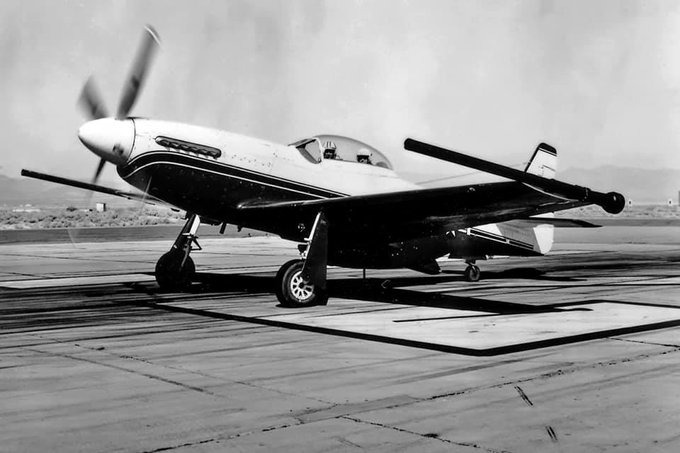
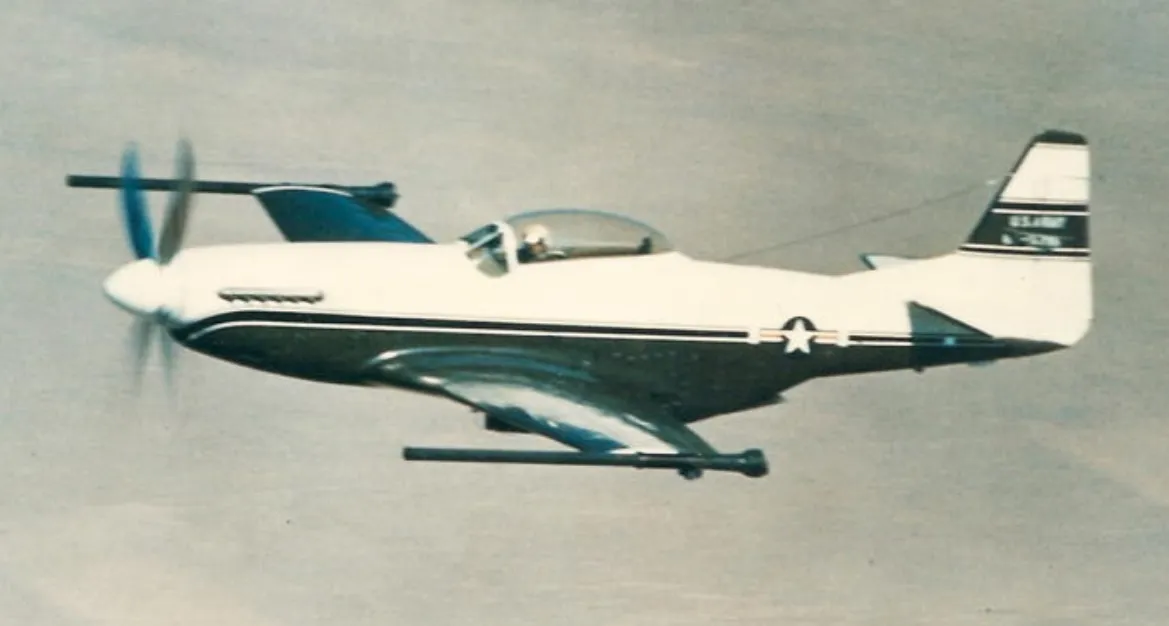
 F-51D (44-73264) - Experimental P-51D with Recoilless Rifles
History
In the early 1960s, the U.S. Army Aviation Limited Warfare Laboratory at Fort Rucker, Alabama, began testing cheap, heavy-hitting weapon systems for light counter-insurgency (COIN) aircraft. One of their most unusual experiments involved fitting a surplus World War II North American P-51D Mustang (USAF serial number 44-73264) with two ground-service single shot 106mm M40 recoilless rifles mounted directly to the wingtips.
Although the 1948 Key West Agreement generally restricted the Army from operating fixed-wing combat fighters, the service retained a small fleet of P-51Ds through the 1950s and 60s for research, radar calibration, high-speed chase duties, and weapon evaluations.
The Concept: Army engineers wanted a way to deliver massive anti-armor firepower from a light aircraft without the destructive recoil forces of a conventional artillery piece or heavy cannon. Standard high-caliber guns of that size would have torn a Mustang’s light aluminum wing structure apart upon firing.
The M40 recoilless rifle solved the structural issue by venting high-energy propellant gas out a rear venturi nozzle, equalizing the force of the shell leaving the barrel. Placing the rifles on the extreme ends of the wingtips allowed the hot backblast to vent harmlessly behind the aircraft, clear of the tail surfaces, radiator scoop, and fuselage.
Flight Testing and Drawbacks: During live-fire testing, the physics concept proved sound. Firing the massive 106mm High-Explosive Anti-Tank (HEAT) shells in flight produced virtually no structural stress on the Mustang’s airframe, and the recoil mitigation worked as designed.
the large wingtip pods created significant aerodynamic drag, degrading the Mustang’s airspeed, acceleration, and roll rate.
Thermal exhaust and acoustic shock from repeated firings caused localized skin stress on adjacent wing surfaces.
Ammunition capacity was severely restricted compared to standard internal machine guns or external rocket pylons.
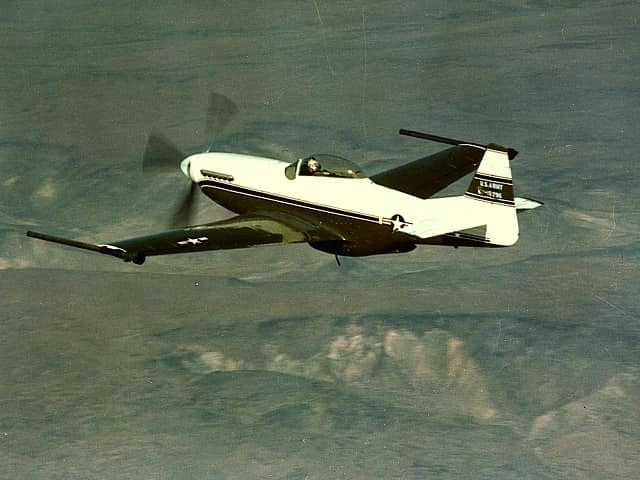
Following the conclusion of the recoilless rifle tests, serial number 44-73264 was stripped of the experimental wingtip pods and reassigned to standard U.S. Army test-support and chase duties at installations including Edwards Air Force Base and Fort Rucker. Upon retirement from government service, the airframe entered the civilian registry as a warbird, where it was restored to classic civilian/military flying status.
Specifications
General Characteristics
- Crew: 1
- Length: 34 ft 2 in (10.40 m)
- Wingspan: ~41 ft 4 in (12.60 m) with wingtip pods attached
- Height: 13 ft 1 in (4.00 m) (features the taller Cavalier vertical tailfin)
- Wing Area: 408 sq ft (37.9 m²)
- Empty Weight: ~7,500 lb (3,400 kg)
- Max Takeoff Weight: ~12,000 lb (5,443 kg)
- Powerplant: Packard Merlin V-1650-7/Rolls-Royce Merlin 724 liquid-cooled V-12 engine, producing 1,720 hp
Performance
- Maximum Speed: 440 mph (708 km/h) clean; reduced to ~380–400 mph with wingtip gun pods
- Service Ceiling: 41,000 ft (12,500 m)
- Rate of Climb: 3,000 ft/min (15.2 m/s)
- Ferry/Operational Range: ~1,000 to 2,000 miles (depending on internal tank routing)
Experimental Armament
- Primary Test Weapon: 2x 106mm M40 recoilless rifles mounted in custom wingtip pods
- Ammunition: 105x607mmR (HEAT, HEP, Flechette Canister)
- Muzzle Velocity: 1,650 ft/s (503 m/s)
- Armor Penetration: ~400 mm (15.7 inches) of rolled homogeneous armor with M344 HEAT rounds
- Capacity: 2 rounds total (1 single shot per wing pod, unreloadable in flight)
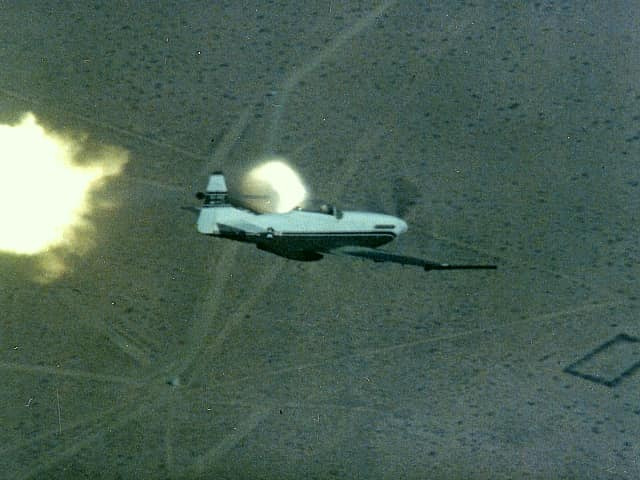
“This P-51 pilot (a marine) practiced for weeks against two trucks on the range at White Sands and had all of his altitudes, speeds, and aim points marked in the sand. When the Congressional delegation arrived to see if there was something to this (they were looking at a new P-51 airframe carrying wing cannons) he hit both trucks with one-shot from each cannon. Subsequent evaluations showed it really was not a practical system and the guns were single-shot.”