F-35A Lightning II
A closer look at the Lightning II and how it could fit War Thunder
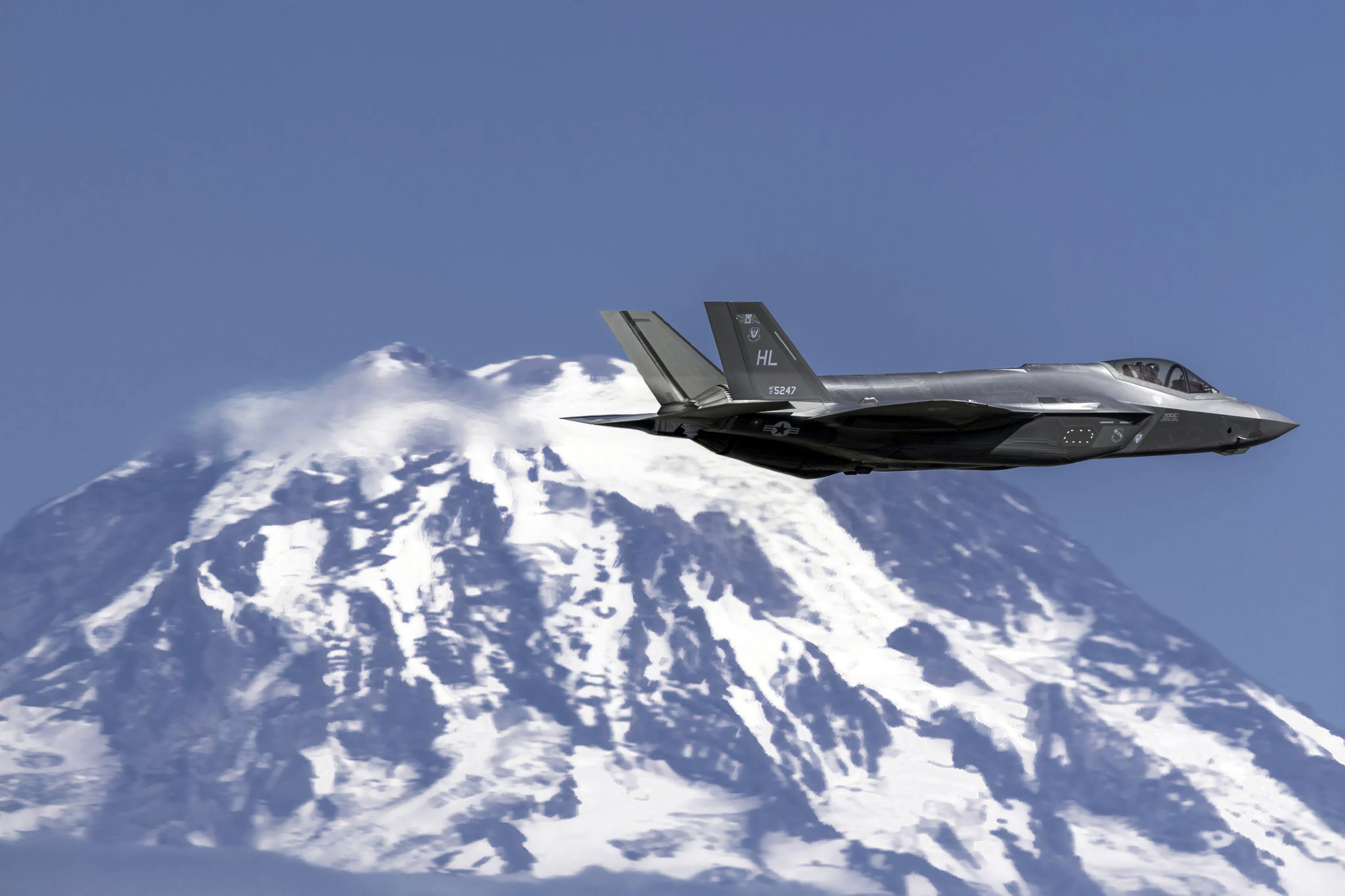
A U.S. Air Force F-35A Lightning II during a demonstration flight. Public-domain U.S. Air Force image.
This is a Machinery of War discussion and technical overview, not a request for immediate implementation. The goal is to look at what makes the F-35A interesting and how a fair in-game configuration could represent it without turning it into an invisible, all-knowing jet.
A quick question for the community
If the F-35A ever comes to War Thunder, what should define it in-game: stealth, sensor fusion, internal weapons, or its overall survivability? I would rather see a carefully modelled F-35A with clear limits than an overloaded “everything at once” version.
Hello everyone!
The F-35A is often reduced to one word: stealth. In reality, it combines a low-observable airframe, AESA radar, infrared sensors, electronic warfare, internal weapons and a helmet-mounted display into one combat system.
If it ever arrives in War Thunder, the challenge is representing that information advantage without making the aircraft invisible or all-knowing.
For that reason, I would focus on a documented F-35A configuration first, while treating Block 3F and Block 4 as historical upgrade milestones rather than combining every capability into one overloaded aircraft.
Configuration scope
Aircraft: F-35A Lightning II, conventional take-off and landing variant.
Article focus: One F-35A profile; Block 3F and Block 4 are upgrade context only.
Evidence rule: Confirmed facts, tests, plans and unavailable details are separated.
Evidence labels
To keep the discussion honest, each claim in this post follows a simple evidence scale:
Confirmed — stated in an official fact sheet, programme document or manufacturer publication.
Tested — demonstrated in an official flight, weapons or integration test.
Planned — announced as part of a future upgrade path.
Estimated — a cautious public estimate, not an official performance figure.
Not publicly disclosed — information that should not be filled with invented numbers or internet rumours.
Quick profile
| Feature | F-35A baseline data |
|---|---|
| Role | Single-seat, single-engine stealth multirole fighter |
| Take-off configuration | Conventional take-off and landing (CTOL) |
| Engine | Pratt & Whitney F135-PW-100 |
| Maximum thrust | Approximately 40,000 lbf with afterburner |
| Maximum speed | Mach 1.6 with a full internal weapons load |
| Maximum load factor | 9 g |
| Length | 15.7 m |
| Wingspan | 10.7 m |
| Empty weight | Approximately 13,290 kg |
| Internal fuel | Approximately 8,278 kg |
| Maximum take-off weight | 70,000 lb class |
| Internal weapon bays | Two bays with four internal stations |
| Internal gun | GAU-22/A four-barrel 25 mm cannon, 181 rounds |
| Primary radar | AN/APG-81 AESA on the Block 3F baseline |
The figures above are public programme data. They should not be interpreted as a complete in-game stat card; classified details such as exact radar performance and radar-cross-section values are not publicly available.
Airframe and visual references

Three-view drawing of the F-35A. Public-domain reference derived from U.S. government material.

F-35A weapons-bay-door pass during F-35 Demonstration Team practice. Public-domain U.S. Air Force image.
The F-35A is the CTOL member of the family. It avoids the F-35B’s lift fan and the F-35C’s carrier structure, giving it a useful balance of fuel, weight and aerodynamic efficiency.
Its internal fuel and low-observable shaping support long missions, but the airframe is heavy and should still require careful energy management in a dogfight.
A short development history
The F-35 grew from the Joint Strike Fighter programme. Lockheed Martin’s X-35 won the 2001 competition, while the F-35A became the conventional runway variant.
Software and weapons capability arrived in stages: early 2B/3i, Block 3F, then the larger Block 4 modernization path.
The sensor suite — the real reason the aircraft is interesting
AN/APG-81 AESA radar
The Block 3F baseline uses the Northrop Grumman AN/APG-81 multifunction AESA radar. It supports air-to-air and air-to-ground modes and was designed to work together with the F-35’s electronic-warfare and infrared systems.
For a game implementation, the radar should not be given fictional “infinite range” values. A more believable approach would be a strong, low-probability-of-intercept-style sensor model with excellent track quality, but with normal limits caused by geometry, terrain, weather and target aspect.
AN/AAQ-37 Distributed Aperture System
The DAS/EODAS uses six infrared cameras distributed around the airframe. The system provides spherical situational awareness, missile-warning functions and infrared imagery to the pilot’s helmet-mounted display.
In War Thunder, this should not mean that every enemy is permanently marked through the airframe. A fair interpretation would be passive IR detection and warning with limited identification quality, range and line-of-sight rules.
AN/AAQ-40 EOTS
The flush-mounted Electro-Optical Targeting System combines forward-looking infrared and infrared search-and-track functions. It can support air-to-air detection, ground-target recognition, laser designation and precision-guided weapons without hanging a large external targeting pod under the aircraft.
This is especially relevant for a future CAS loadout: the F-35A could use an internal sensor for targeting instead of relying on a conventional pod that increases drag and radar signature.
AN/ASQ-239 electronic warfare suite
The AN/ASQ-239 Barracuda provides integrated electronic support, warning and countermeasure functions with 360-degree coverage. Public descriptions confirm the system’s role, but they do not provide a reliable public number for every detection range, jamming mode or threat-library parameter.
Therefore, I would avoid inventing exact classified jamming statistics. In-game, the suite could be represented through improved threat warning, better identification of radar emitters and carefully limited defensive electronic effects rather than an automatic “jam everything” button.
Visual sensor reference

F-35 weapons-bay mock-up showing the internal carriage concept. CC BY-SA 2.5 NL; credit: Dammit/Wikimedia Commons.
The important point is sensor fusion. Radar, infrared, electronic support and datalink information are combined before reaching the pilot. In a game, the advantage should be faster and cleaner information, not an omniscient wallhack-style display.
Sensor architecture at a glance
| System | Publicly documented role | Conservative in-game interpretation |
|---|---|---|
| AN/APG-81 | AESA fire-control radar with air-to-air, air-to-ground and SAR modes | Strong track quality, but geometry, terrain and target aspect still matter |
| DAS/EODAS | Distributed infrared warning and spherical situational awareness | Passive warning and detection with limited identification |
| EOTS | Infrared/optical search, targeting and laser designation | Passive target support without a large external targeting pod |
| AN/ASQ-239 | Electronic support, threat warning, countermeasures and jamming functions | Better emitter awareness and limited defensive effects |
| HMDS/CNI | Helmet display and secure information exchange | Faster information presentation, not omniscient target marking |
Stealth without the usual myths
Stealth reduces detection and lock quality; it does not make the F-35A invisible. Aspect, range, sensor type, altitude, emissions, infrared signature and external stores still matter. I would avoid assigning a precise RCS number because most public figures are estimates or context-free comparisons.
Weapons and upgrade context

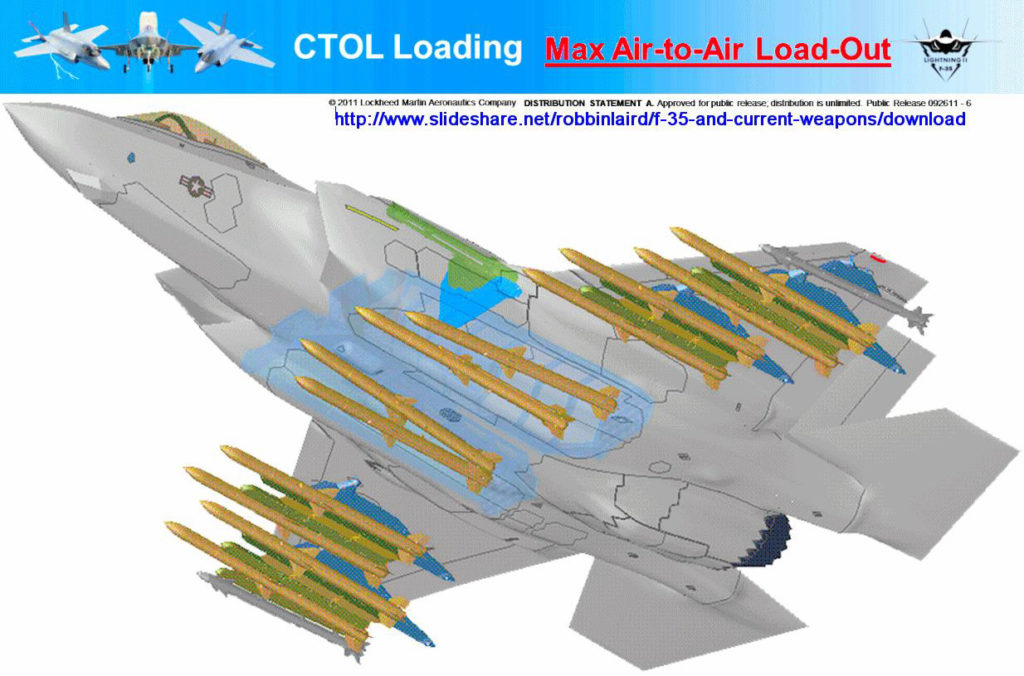
Public-domain F-35 weapons-carriage arrangement reference.
Suggested initial F-35A configuration
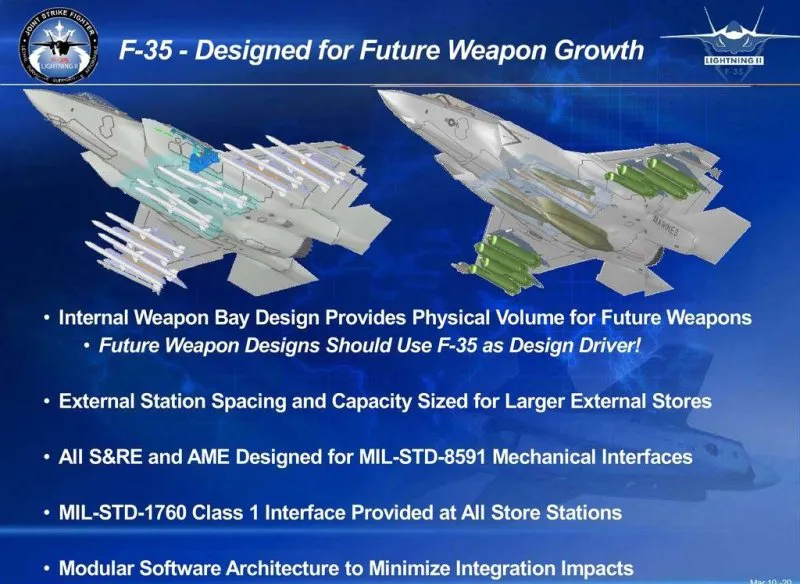
Public baseline data lists two AIM-120C/D missiles and two GBU-31 JDAM bombs; Block 3F-era programme material also documents a four-AMRAAM internal configuration.
For War Thunder, I would use the conservative, clearly defined package below rather than mixing every weapon ever tested on an F-35:
| Proposed loadout | Stores | Gameplay purpose |
|---|---|---|
| Stealth fighter | 4 × AIM-120C internally | Beyond-visual-range air combat with no external drag |
| Stealth multirole | 2 × AIM-120C + 2 × GBU-31 internally | Air-to-air cover plus precision strike |
| Visual-range option | 2 × AIM-9X on external wingtip stations | Short-range defence; external stores reduce stealth |
| Training / clean | Internal gun and countermeasures only | Lowest observable configuration |
The F-35A’s internal GAU-22/A 25 mm cannon carries 181 rounds and is hidden behind a door in the left wing until firing. It is not a high-ammunition spray gun; short controlled bursts would be important.
The 2017 Block 3F weapons testing programme publicly confirmed integration work with AIM-120, AIM-9X, GBU-12, GBU-31, GBU-39, Paveway IV and AGM-154-class weapons. That does not mean every one of these stores should appear on the first in-game version.
Later upgrade context
Block 4 adds new computing, sensors, weapons and a planned Sidekick increase to six internal AMRAAM-sized missiles on applicable configurations. APG-85 and Advanced EOTS belong to this modernization path, but the exact fielded standard varies.
Weapons evidence matrix
| Weapon | Role | Likely carriage in a first F-35A implementation | Evidence level |
|---|---|---|---|
| AIM-120C/D AMRAAM | Beyond-visual-range air-to-air | Internal bay | Operational/tested |
| AIM-9X Sidewinder | Short-range air-to-air | External station in a conservative first loadout | Tested/integrated |
| GBU-31 JDAM | Precision strike | Internal bay | Operational |
| GBU-39 SDB | Small precision bomb | Internal bay | Tested/integrated |
| GBU-12 / Paveway IV | Laser-guided strike | Documented test or external loadout | Tested |
| AGM-154 JSOW | Stand-off strike | External station | Tested |
| GAU-22/A | Internal 25 mm cannon | Internal gun installation | Operational |
This matrix separates documented integration from a proposed in-game loadout. Not every weapon ever tested should automatically appear on the first version.
Public data limits
Exact radar detection ranges, low-probability-of-intercept waveforms, threat-library parameters, electronic-warfare power levels, sensor-fusion algorithms and reliable aspect-specific radar-cross-section values are not publicly available.
The responsible approach is to describe their confirmed function without inventing exact classified numbers. A relative, configuration-dependent stealth model would be more credible than a fixed “RCS value” copied from an unsourced chart.
How could it work in War Thunder?
Suggested in-game loadouts
| Preset | Stores | Intended gameplay |
|---|---|---|
| Low-observable air combat | 4 × AIM-120C internally plus the internal gun | BVR engagement and repositioning |
| Multirole | 2 × AIM-120C plus 2 × GBU-31 internally | Air cover with a limited strike option |
| Precision strike | Internal air-to-air missiles with GBU-39 or GBU-31 | Controlled ground attack |
| External heavy load | AIM-9X and bombs on external stations | More payload, but a clear stealth penalty |
| Clean training configuration | Gun and countermeasures only | Lowest-observable practice setup |
These are gameplay proposals, not claims that every configuration was simultaneously fielded in one universal F-35A standard.
Strengths
- Very low observability in an internal-only configuration.
- Excellent passive awareness from DAS, EOTS and electronic support sensors.
- Strong internal fuel capacity and long mission endurance.
- High-quality BVR engagement potential with internal AMRAAM carriage.
- Internal 25 mm cannon, unlike the F-35B and F-35C.
- Useful precision-strike capability without a large external targeting pod.
Weaknesses and balancing levers
- Only a small internal missile magazine for the initial configuration.
- Heavy airframe and high wing loading compared with lighter fourth-generation fighters.
- Mach 1.6 top speed and no need to pretend that it is an F-22-style air-superiority aircraft.
- External AIM-9X, bombs or fuel tanks should visibly reduce the stealth advantage.
- Sensor fusion must have realistic line-of-sight, identification and datalink limits.
- No publicly supportable reason to assign a magical fixed RCS or universal radar immunity.
The F-35A would be strongest when it chooses the engagement: detect passively, launch from a low-observable configuration, then use its fuel and sensors to reposition. It should be much less comfortable if forced into a prolonged rate fight after losing its energy.
Possible progression and implementation philosophy
I would place the F-35A at the end of the U.S. fighter line, after the late F-16 family, as a researchable aircraft rather than a premium or event vehicle. I would avoid fixing an exact BR before a test server because the result would depend heavily on how stealth, radar detection and missile guidance are actually modelled.
The most important balance rule would be simple:
Block 4 upgrades could remain historical context for a later progression step instead of being combined with every capability on the first F-35A implementation.
Common misconceptions
Stealth does not mean invisibility. Detection should depend on aspect, range, sensor type, emissions, altitude and external stores.
Sensor fusion should not be a wallhack. The advantage should be cleaner information and faster identification, with line-of-sight and confidence limits.
The F-35A is not an F-22 replacement. It is a multirole aircraft designed around survivability, sensors and precision weapons, not unlimited close-range dominance.
A tested weapon is not automatically a standard loadout. The post keeps operational, tested and planned capabilities separate.
A precise public RCS number is not reliable by default. Configuration, aspect, frequency and source quality matter too much for one magic number.
My take
The F-35A would be a fascinating addition only if it is treated as a sensor-and-survivability aircraft, not as a normal fighter with a tiny radar signature multiplier. A documented early configuration already has enough capability to be interesting, while still leaving a clear limit in missile capacity and kinematic performance.
Personally, I would rather see a carefully modelled F-35A with an honest, documented loadout than an exaggerated package that carries every future weapon and turns top tier into a guessing game.
What do you think? How should a future F-35A be represented in War Thunder, and how would you model stealth and sensor fusion without making it feel unfair?
Visual sources and usage notes
Official U.S. Air Force/DVIDS photographs are preferred for aircraft and test imagery. Wikimedia files are used with file-page credit and licence information. No classified diagrams, leaked material or unattributed “RCS comparison” graphics are used.
References and image credits
- U.S. Air Force — F-35A Lightning II fact sheet
- Lockheed Martin — F-35 Fast Facts
- Northrop Grumman — AN/APG-81 AESA radar
- Lockheed Martin — F-35 EOTS
- BAE Systems — AN/ASQ-239 electronic-warfare suite
- U.S. Air Force — Block 3F weapons delivery accuracy testing
- U.S. Air Force — F-35A GAU-22/A airborne gun testing
- Wikimedia Commons — weapons-bay mock-up, CC BY-SA 2.5 NL
- DVIDS — F-35A flight photograph, public domain