Marconi’s description for the F-16C HUD says it had a CRT on the conventional HUD as well.
Albeit when in raster mode using the CRT, it is projecting any symbology from video raster as well and doesn’t combine cursive/stroke symbology over the raster display. So there are bound to be limitations when flying with it https://rochesteravionicarchives.co.uk/items/f-16c-d-hud-pilot-s-display-unit-1
Quote
The F-16C (single seat) and F-16D (two seat) variants entered production in 1984. The first C/D version was the Block 25 with improved cockpit avionics and radar which added all-weather capability with Beyond Visual Range (BVR) AIM-7 and AIM-120 air-air missiles. Blocks 30/32, 40/42 and 50/52 were later C/D versions. The LANTIRN Diffractive optics HUD was designed for the new aircraft but development was delayed by the complexity of the manufacturing problems. As an interim the Company offered a wide angle conventional optic design.
The initial order was placed in 1984 and was valued at nearly $50 million (then about £30 million) to cover both development and production. Over 2300 HUD’s were delivered for the F-16 and the system has been the basis of equipment supplied for other programmes such as for the A-7D/K and F-5 adding another 1500 units to the family. In 1985 the F-16C/D design won the Queen’s Award for Technology Improvements to aircraft Head Up Display systems for the Company.
The HUD Pilot’s Display Unit (PDU)
The HUD PDU has both a raster and a cursive capability with the first application of ‘cursive in flyback’ in which the same amount of symbology as in the daytime high brightness mode can be drawn on the CRT using the raster flyback period of the Night mode. A good grey scale was provided for sensor video and the system could operate in 525, 625, or 875-line standards. The system accuracy was enhanced by the ability to apply corrections for the windshield. The F-16 windshield in particular acts as a lens which modifies the focus of the system and this is compensated for in the optical module design but in addition there are linear distortions away from the centre of the field of view caused by the curvature of the one-piece canopy and manufacturing variations. It is possible to provide both a generic and a specific correction for the particular aircraft. The optics provides a 25 degree Total Field of View and a 20 degree by 13.5 degree Instantaneous Field of View which was the maximum that could be achieved within the limitations of the 6.7-inch exit lens design and the large distance between the pilot and the HUD occasioned by the reclined high ‘G’ seat. The exit lens is truncated, and the size is limited by the ability of the glass to withstand thermal shock. The field of view is about the maximum that can be achieved with a conventional refractive optics.
The Cathode Ray Tube is circular but with a blank area at the bottom; the beam is deflected into this area so that raster and cursive display luminance calibration tests can be carried out without illuminating the phosphor. As usual the deflection is magnetic and the focus electro-static. The deflection coils and the matching card are now all constructed by Rank Electronic Tubes and the item is delivered as a Tube Unit Assembly. The venerable P1 phosphor is still used but the final Anode voltage is now a nominal 18kV and the tube operates with a Focus voltage of 2.96kV to 4.76kV.
The Camera was left forward of the Combiner to retain commonality with the LANTIRN design. In a refractive optic design, the outside world and symbology can be captured from aft of the Combiner but with the reflective design this is not possible, and the symbology is added to the outside world view by video mixing after scan conversion in the Electronics Unit.
The Head Up Display castings were all made by Kent Alloys who worked for Medway Investment Castings.
The HUD Electronics Unit (EU)
The F-16 C/D Electronics Unit contains twenty circuit boards. The Processor/Symbol Generator uses the MIL-STD 1553B (Standardised Electronic Data Highway) databus architecture, the MIL-STD-1750 (Standardised Computer architecture) processor and the MIL-STD-1589A (Standardised Jovial J73 Computer language) software. This was the first time that all three Standards had been used together and the Company was way ahead of its US rivals in this respect. The foundations for the implementation of these Standards was laid down by FARL from 1978 and led to a highly successful LSI chipset for the 1553 Databus. The HUD EU has comprehensive video mixing and scan conversion and self-contained weapon aiming capability.
The more modern Elbit version of the HUD is capable of cursive/stroke on raster.
It goes without saying that a laser-based collimator that solely projects calligraphic symbols cannot produce an image in the same way a rasterized projection can.
Only the WAR HUD could project rasterized video footage.
The Marconi HUD of the 25 + 30/32 is a calligraphic collimator. It’s physically incapable of rasterized imagery, as it isn’t a “raster” HUD. There is no such thing as a “conventional raster” HUD, as “conventional” and “rasterized” are two separate HUD technologies named such to differentiate each other. They’re mutually exclusive, unless there is some hybrid HUD out there that makes use of a combined laser + imager output. The WAR isn’t such. The lantirn HUD’s symbology projection is either scanned normally in common use or projective as cursive in flyback, which is its way of projecting symbology over an image both brighter and clearer.
No, they most definitely aren’t. The conventional HUDs are Wide Angle Conventional HUDs, hence the whole “conventional” thing. They lack a rasterized image, also hence the “calligraphic” title in its name.
There were calligraphic HUDs that had rasterized cursive, but it was incapable of producing any image to the HUD. It was strictly for MLU iterations of export Block 10, 15, and 20 aircraft by BAE. I believe the ROCAF’s Viper suite gives it a graphics controller.
They were not. K0656 was the one and only projector used in the HUD with the exact same chassis since its introduction in MSIP-III.
Why’s that? Not to self-plug, but there’s a premiere F-16CG squadron that runs PoBITs. It honestly would be better than a Swamp Fox baseline if it weren’t for the whole ARM wave. Maybe it can be a mod similar to the Su-24M, maybe a separate block 42 can be added.
Not really. Everything that the nav pod had done is inbuilt to Viper standard F-16s and the likes of LITENING G4 / Sniper.
That’s a WAR HUD. I haven’t touched BMS since 4.33 so I can’t say what they’re doing now, but IRL the CG is the only F-16 that can project nav pod terrain imagery or TGP overlays to the HUD.
Interface issues? Not quite sure of what you mean.
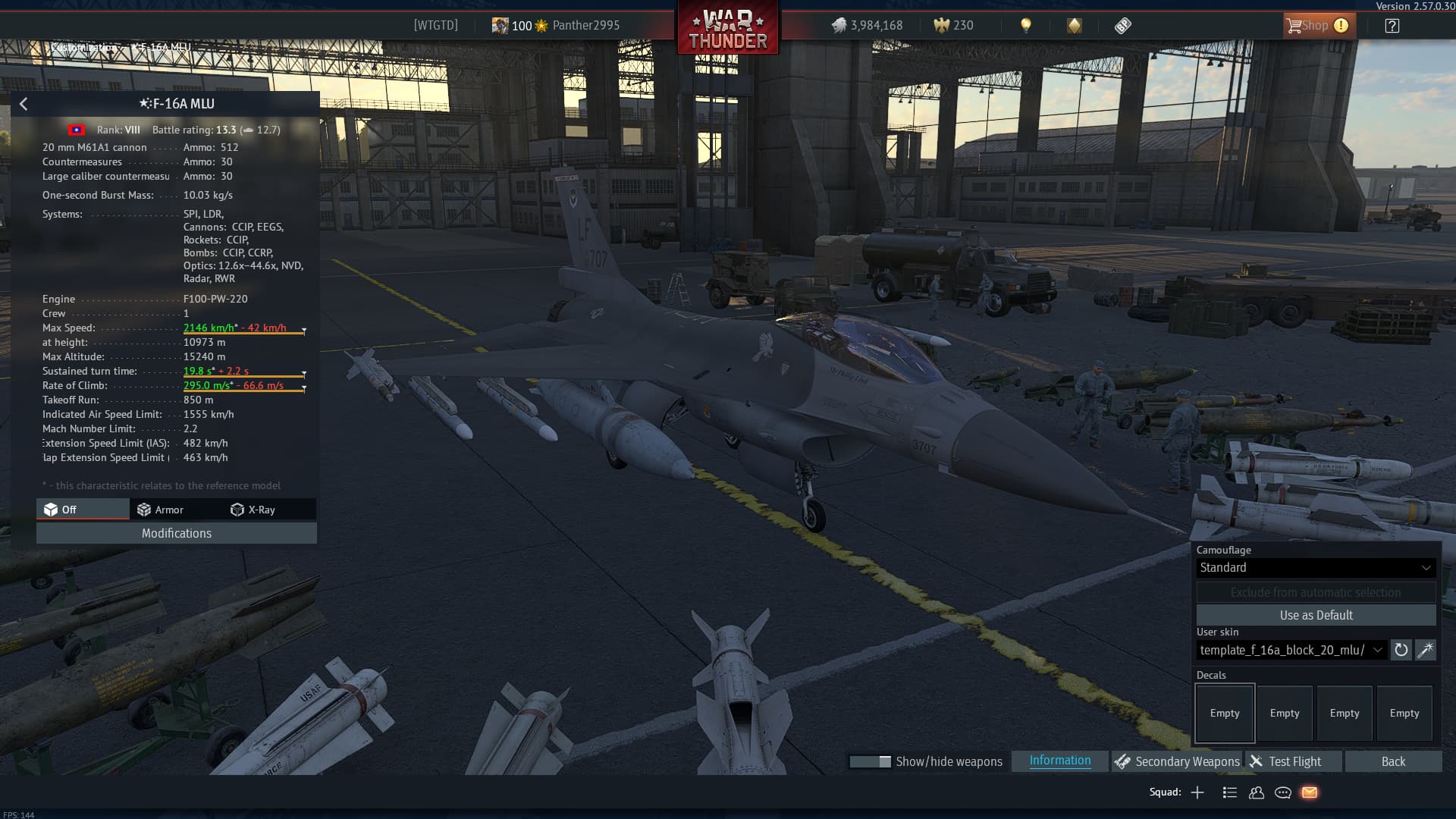
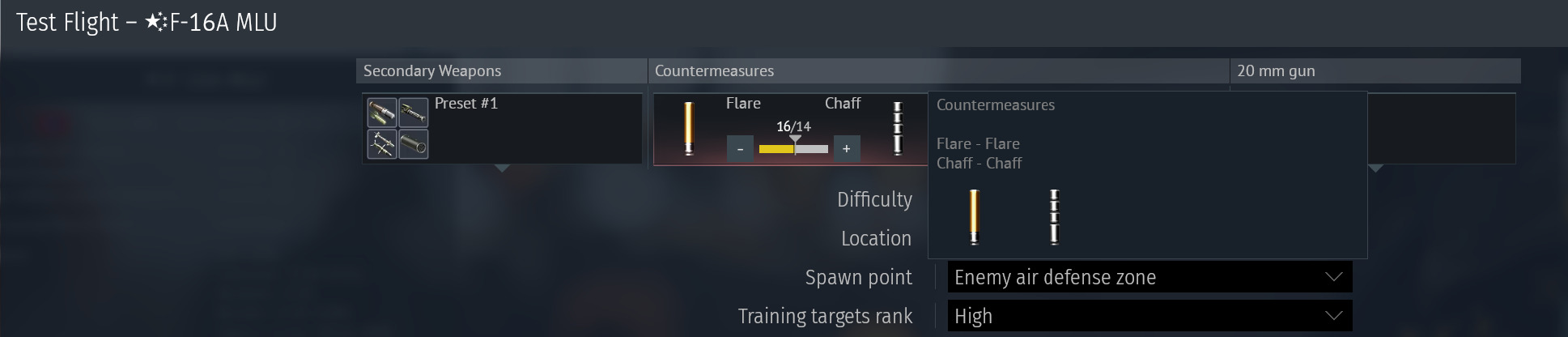
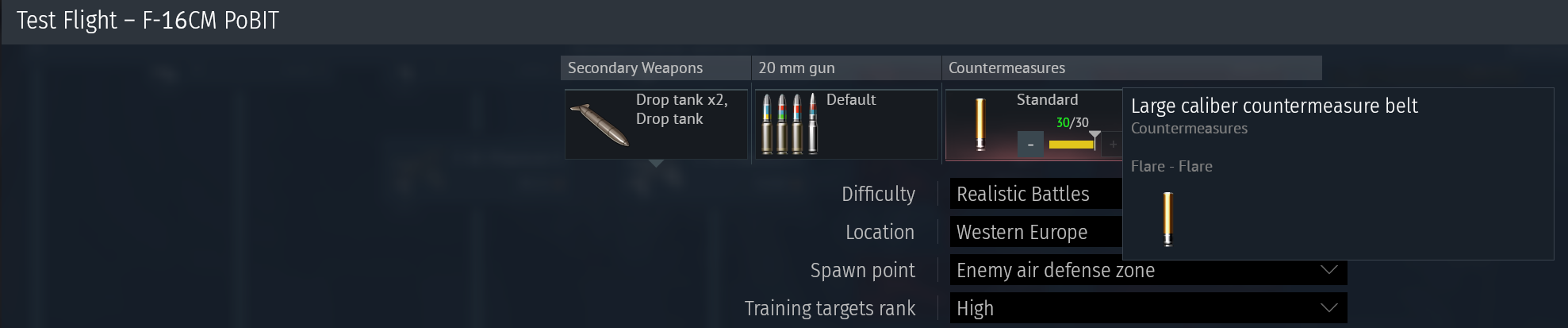
Ignore the stat card, it can be incredibly dubious at times and occasionally straight up misleading. When selecting weapons loadout, fuel, and countermeasures, the countermeasures section shows both 30/30 countermeasure groupings as standard instead of either large or small (it should be 30 large and 30 standard).
This doesn’t affect aircraft that are properly modelled, such as the Dutch F-16AM and F-16CM PoBIT, but the same can’t be said for the F-16A MLU.
This isn’t always true, iirc. There are a plethora of vehicles with their countermeasures split even when they’re all the same calibre. Additionally, most recent additions have their countermeasures labelled, so determining whether the F-16A MLU was properly implemented would likely require us to look into the game’s files.
I wasn’t entirely sure about this, so I clearly started the message with ‘I think’. You might’ve missed that.
This would lead into another issue of knowing which countermeasures are large and which are standard regardless, so there’s an issue regarding implementation on Gaijin’s end nonetheless
I was writing another reply specifically to you, but Marconi’s later iterations of HUDs that came with MLU orders granted it rasterized symbols and cursive.
That does not give it the ability to overlay an image though, as the aircraft these were given to (block 10s, 15s, 20s) lacked a graphics controller that would manage that projection.
It’s possible that Taiwan’s F-16s can though, theirs are Viper standard and they have a decent supply of LANTIRNs.
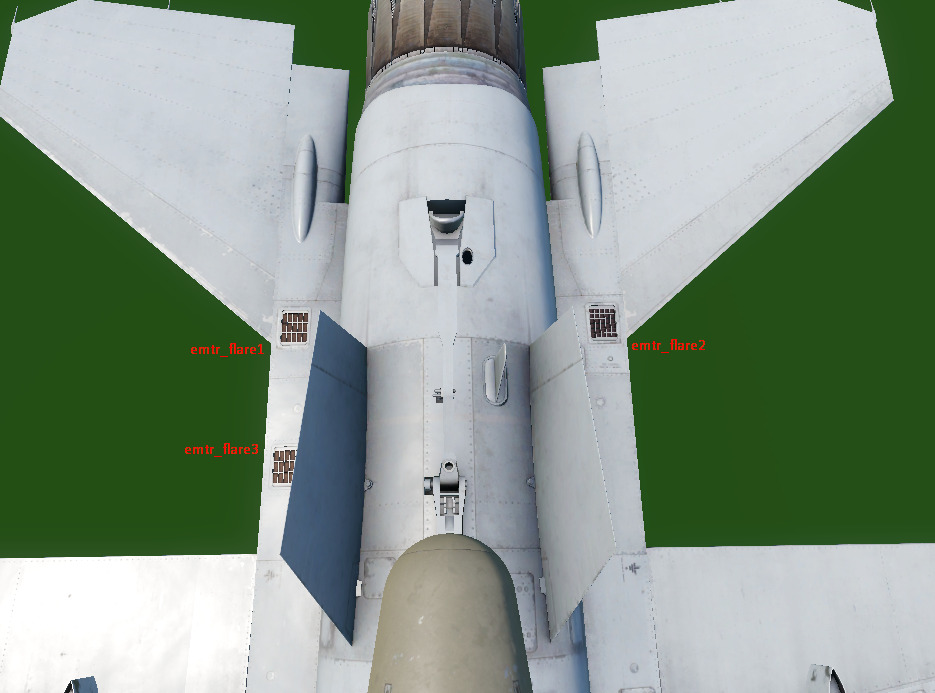
I was thinking the same thing, as I’d expect Gaijin to label the countermeasures as either large calibre or standard, but clearly they didn’t (even though the change was very recent). I ended up checking the data mines anyway, and the F-16A MLU does indeed have large calibre countermeasures. The issue now primarily rests on determining which group of 30 countermeasures is large and which is standard.
Everything comes back to Gaijin needing to standardise the game, whether that be inaccurate designations (the F-16A MLU’s official designation is the ‘F-16A Block 20’; ‘MLU’ was fictional slop Gaijin slapped on) or not properly labelling countermeasures, creating confusion over their use and identification.
You physically won’t know which countermeasures are large and which are standard unless you test them thoroughly to determine which is which lmao
MLU is very much an official designation, the ROCAF F-16 MLU we have in-game is a Peace Phoenix RisingPeace Fenghuang (don’t write off of memory, kids) model.
The term “MLU” was created on May 3 of 1991 by the EPAF. By 1995 every nation of the EPAF had tested integration of the MLU package and officially designated the receiving aircraft "F-16[AM/BM].
It in itself was founded on the OCU program.
Ah, sort of forgot that was this thread. Some pods simply won’t project an image to the HUD. Not much of an issue with CG squadrons, as the 112th has a decent supply of LITENING while legacy squadrons like the 309th or the 314th have LANTIRN in storage if the need arises.
Given that they’re slowly bringing in Scorpion to replace JHMCS and get NVD functions alongside the HMD, I doubt they would ever have a need to mount LANTIRN in favor of Sniper.
The F-16A operated by the Republic of China doesn’t officially use ‘MLU’ in its designation. That term was applied to help distinguish between the three different stages of Taiwan’s F-16As: aircraft prior to the software updates that made them compatible with the AIM-120 (Stage 1), those that later received those updates (Stage 2), and those that received upgrade packages for Viper standardisation (Stage 3). The F-16A we have in-game would be Stage 2, since it has access to AIM-120s (even though it never operated the initial variant of the AIM-120) and smart ground munitions such as the AGM-65G and LGBUs.
While it’s true, iirc, that the F-16A Block 20 has its origins in the OCU programme, it also received upgrades that made it unique from those aircraft, such as the AN/APG-66(V)3 radar, a specialised evolution of the original (V)2 for the RoC.
Additionally, a descriptive page, even when primary, doesn’t mean it’s authoritative. Lockheed Martin themselves refer to upgrades on the F-16A Block 20 as the ‘Taiwan Retrofit Program’, not ‘MLU’.
If anything, it would be more accurate to refer to it as the F-16A Block 20 ‘SLEP’, as service life extension packages for the RoC are directly referred to as such.
Lying requires deliberate intent, and I’ve never had that intent. Everything I’ve said is based on research and my understanding of the subject, including staff working on behalf of Gaijin confirming that the ‘MLU’ designation for the F-16A Block 20 is used in a similar way to terms like ‘Early’ or ‘Late’ (their statement, not mine), such as applied to the IRIAF F-14A Early. I quite literally gain nothing from lying about that.
I don’t want to join your little kerfuffle on who is right, but how is the naming of the operator country not relevant, when in WT it’s under that country’s flag and not under Lockheed Martin? We don’t call the Phantom F.G.R. Mk. 2 the F-4M, or the J-11 the Su-27SK, so why the exception?
Uh oh, fence sitter alert! Everybody stand by and listen to their reasonable and objective opinions and viewpoints!!
<3
It very much is. I’d rather it be called an F-16AM as it would differentiate it from a block 10, and prior to the huge F-16 swaparound it would differentiate it from the block 15.
To say that it isn’t an MLU airframe is quite simply incorrect though. It’s the best of neither world. Not only do we not have the ROCAF’s designation of the aircraft, now people think we shouldn’t have Locksneed Shartin’s designation of the aircraft.
What exception is there? We call the J-35 an F-35, the Cent mk.10 an S101, and so on.
Why scrutinize me for refuting his nonsense position that it isn’t an MLU instead of scrutinizing him for not wanting it to be called an F-16AM? Hell, why scrutinize at all if you aren’t “joining the little kerfuffle”?
So you value distinction over accuracy, like Gaijin? A subjective opinion I disagree with. :P
I never said it’s not technically an MLU airframe.
So it should have both names, manufacturer name and then operator name underneath, but sadly that’s only available in lang mods.
Both your examples and mine are using operator name over the manufacturer name. The F-16 using MLU, which is not in the operator name, only in the manufacturer name, would be an exception to Gaijin’s names. But because Gaijin is consistently inconsistent when it comes to names, that’s par for the course, of course.