Has this been reported? Since it’s absolutely how it currently works in game with unsupported STT launches going active, in the predicted terminal phase thus erroneous.
Considering it as firing in ACM (Direct Active) mode, the implementation in the game isn’t entirely unreasonable.
F-14A/AWG-9/AIM-54A Weapon System
The Phoenix missile (AIM-54A) can operate in either active or semi active modes. The missile and AWG-9 radar system also have the unique ability to communicate during missile flight via missile messages. These coded missile messages enable the AWG-9 to command the inflight, semi active missile to an active mode. The AWG-9 also has the capability of updating the missile and in so doing, may control several inflight missiles simultaneously. Basically, the missile may be launched in one of three AWG-9 launch modes; Single Target Track (STT), Track While Scan (TWS) or Air Combat Maneuvering (ACM) Active.
The AWG-9 can maintain track on several targets simultaneously and in so doing facilitates rapid reattack capabilities. When more than one target is maintained on a track file, the aircrew may launch AIM-54 missiles in the ACM active mode by first selecting a target then launching the missile. At Launch To Eject (LTE) the mislile is given guidance data and an Active Transfer Command (ATC). This then allows the missile to actively guide on the target, releasing the AWG-9 of the responsibility to maintain track on the target. Since the AWG-9 radar system has the ability to maintain track files on up to six targets, six AIM-54A missiles may be launched at six different targets in a matter of seconds.
In STT mode, the F-14A/AWG-9/AIM-54A weapon system maintains track on one target and may launch a Semi Active (SA) PHOENIX missile at the target illuminated. The AIM-54A when launched in this mode, receives regular missile messages from the AWG-9 which provide tracking data updates and steering commands. The passive AIM-54A then guides Semi Actively to target intercept. In this mode, the target must remain illuminated during the entire missile flight time as the AIM-54A would not have the capability to guide actively.
When the AIM-54A is launched in TWS, preset instructions allow the missile to obtain an optimum aerodynamic flight geometry for each particular launch. During the first phase of missile flight, the AIM-54A guides via sample data (this missile mode is called Sample Data Active, SD/A.) The missile receives tracking data with each missile message, eventually receiving an ATC (in a missile message). At this time, the missile attempts to go active. If a successful active transfer occurs, the missile then guides actively to intercept. If for some unforeseen reason the missile should lose track during active flight, it may receive and process the next missile message sent for sample data. At LTE, each missile is assigned a code so that during missile flight, only those missile messages postscripted with the proper missile code will be processed. Because each missile message is coded, up to six missiles may be launched in TWS and simultaneously controlled by the AWG-9 during missile flight.
But If it only needs a Track file for an ACM launch, can’t it be launched with the Radar in non-TWS search modes? (or at a data linked target via the flight’s LINK-4C / Link-16) since if TWS was required it would effectively duplicate a TWS launch profile at shorter ranges.
But Active is only referenced with Pulse-STT (or IRT) mode(s), It’s not listed in any other mode.
As an aside does the source you have have anything similar to the above tables? Because it’s not obvious what set of capabilities are described by the use of “Normal Launch” as a qualifier.
Sort of, it would be that in STT modes it should cease to update prior launched missiles over the datalink so can’t support a simultaneous multiple targets attack, it can support more than one missile against the tracked target.
You’d probably need a tactics manual, or a RIO to be absolutely certain of proscribed methods and workarounds.
And how it interfaces with later missile variants and radar revisions (Latest I’ve seen mentioned is the AWG-15H (FCS) on the F-14B(U)).
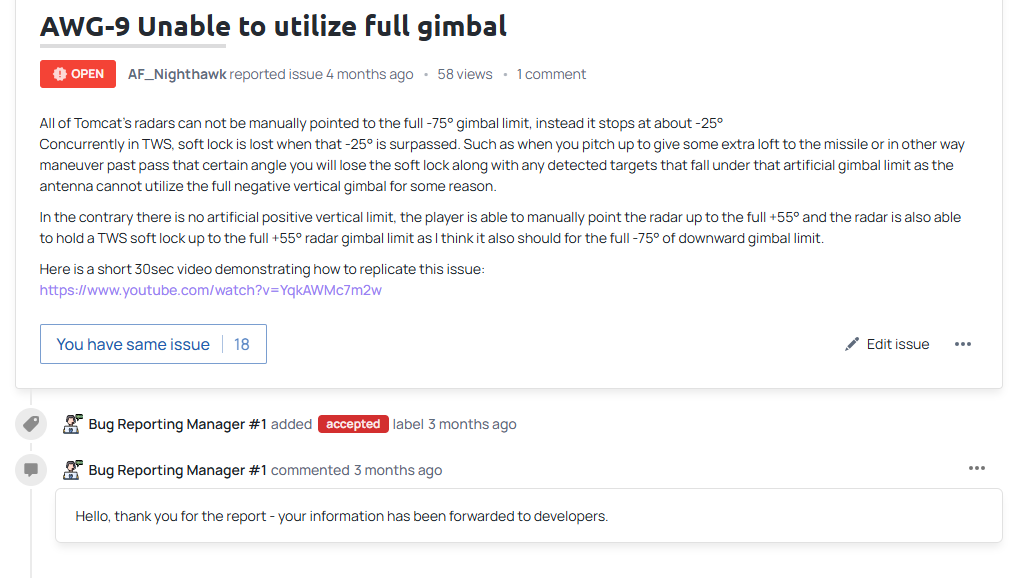
The negative gimbal limit bug of the awg-9 has been accepted for a few months now, hoping it goes through.
Would help the usability of the radar since because of it you normally loose soft lock when you roll away (to say put the target at the edge of the radar) or pitch up to add some loft