ok thats fair, but MICA is almost used only by french planes, reading “current” mraam i would think about something more spread like the 120s, but, could be could be
1 Like
This is what I think too, since russians did make ramjet r-77, didn’t further develop it due to cost reasons.
Probably massive missiles with solid motors make more sense logistically than ramjet missiles
Looking at the speed, if what the other guys are saying is true and it does cruise around Mach 4, the “current MRAAM” seems to have a higher top speed than the AMRAAM. which also happens to line up with what the MICA can do
Kindly read my initial point.
They can reach the SAME RESULTS THAT THEY NEED.
1 Like
I’m going off of their own claim, and other claims on its cruise speed. Even at 100km the speeds work out so that it would have stopped burning before the 100km mark
The only numbers that matter are what the manufacturers and various users report. The point of something like Meteor is that it can throttle down or throttle up.
You’re thinking of it like an on-off solid booster. Which it isn’t. Subject to the same constants. Which it isn’t.
From MBDA.
“This ‘ramjet’ motor provides the missile with thrust all the way to target intercept, providing the largest No Escape Zone of any air-to-air missile system, several times greater than current MRAAMs. The fragmentation warhead ensures maximum lethality.”
Thrust all the way. Not some of the way.
Stop coping.
Like 100km in 90 seconds?
Exaggerated, from what they are saying after, this is for a shot within NEZ
That’s your reading comprehension, not what it says.
You cannot seriously believe this thing burns forever as long as there is a target. Even the 100km in 90 seconds figure is probably using low throttle already
Why?
Let’s say you fire the thing. It accelerates up to speed and lofts into the thinner air. It can throttle back to sustain more efficiently in those better conditions and then accelerate again when within a certain range of the target.
A rocket motor is just on or off. At it’s core it cannot back off thrust to take advantage of thinner air - it just goes at it’s rate thrust until it runs out.
If you want an aircraft example - just look at Concorde. It used it’s afterburners to get up to Mach 2. Then it got most of it’s thrust from the intakes (different to ramjet but the principle of a fuel efficient high speed cruise is similar) while supercruising and was remarkably efficient in that flight regime.
2 Likes
there are no real sources saying the meteor cruises at mach 4, the only values given for speed are “mach 4+” but nothing specifying cruise speed
there are indicatives that it can loft as high as traditional mraams even though it’s a ramjet:
Spoiler
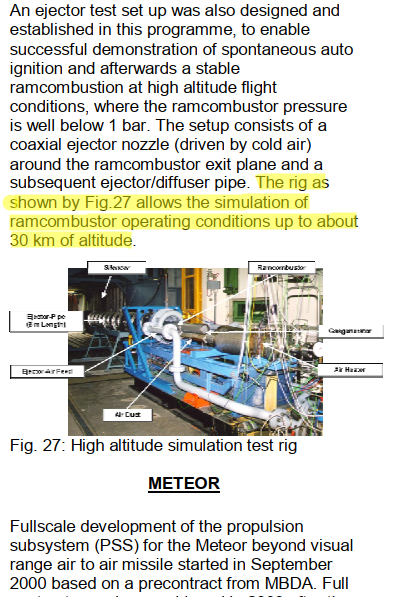
image regarding the a3m which was the experimental hardware that the meteor derived of later on
the image you replied to comes from a british focused paper, that is still MBDA but it wouldn’t make sense for them to compare the meteor to a missile they don’t even use
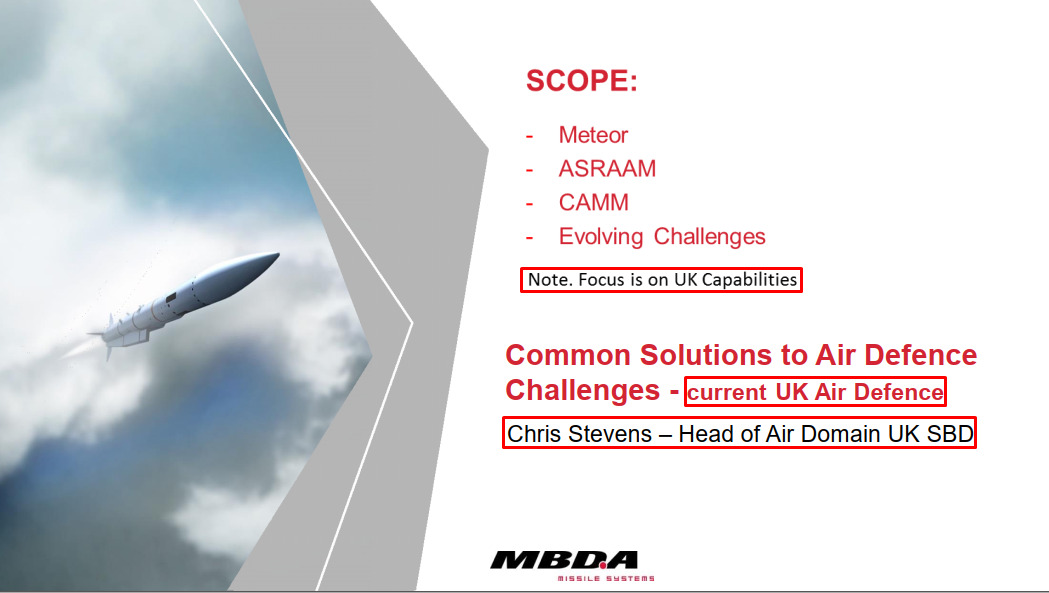
besides that, the meteor was made primarly by 6 different nations, only one of those use the mica
5 Likes
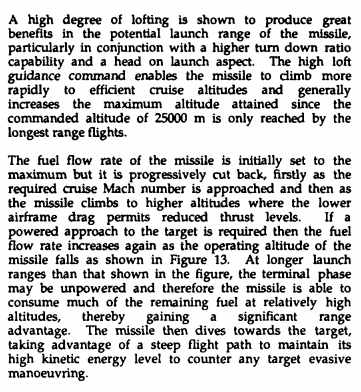
the only paper i’ve seen that would describe the way a missile like the meteor operates throttle wise is this one: ADA257018.pdf (pages 33 - 43), these pages has the focus on a missile very similar in design and proportion to the meteor, with the same objective too, some of the info can probably be passed on to the meteor as the concept is generally the same.
Spoiler
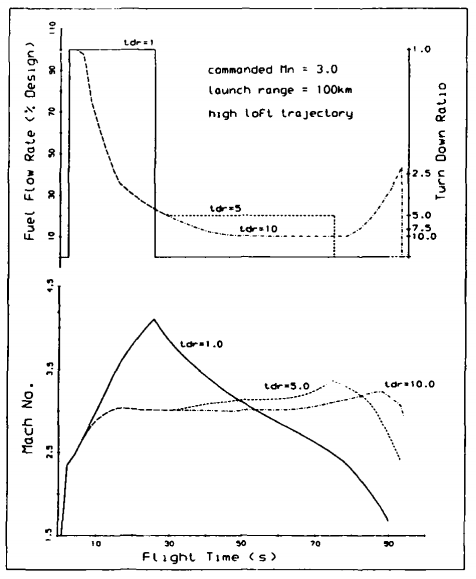
this is a graph for a 100km headon shot, both planes flying at 6000m and mach 0.9, the “tdr = 1.0” line represents the missile flying without throttling at all (100% throttle, so 4.3% of the sustainer mass per second).
the “tdr = 5.0” line represents the missile having a minimum throttle of 0.86% of the sustainer fuel mass per second, “tdr = 10.0” means a minimum throttle of 0.43%
on the top graph you can see how the missile stays on full throttle for a very short period of time and then throttles down gradually, on the bottom graph you can see the effect that has on time to target and terminal speed
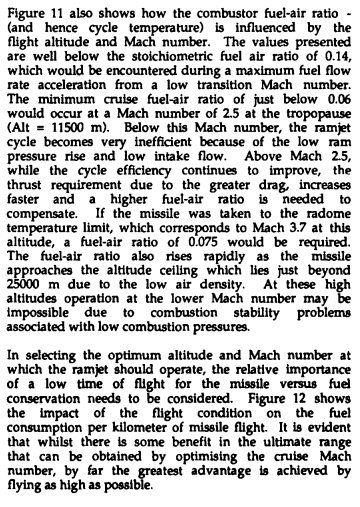
another thing worth talking about imo is the increase in efficiency in high altitudes compared to low altitudes, it’s also talked about in the same paper:
Spoiler

6 Likes
That just says they are able to test it that high not if it works well or works at all
Of course it would, they should have more easily accessible accurate data for MICA and it makes the meteor look comparatively better
Okay I’m out.
You’ve plainly got your worldview. We might as well be trying to explain Physics to my Labrador…
8 Likes
Good boy/girl?
2 Likes
Good boy. He’s jolly clever you know.
2 Likes
Don’t think meteor is has 300000 second burn time = biased worldview
for me “allows the simulation of ramcombustor operating conditions up to about 30 km of altitude.” means it can operate at these conditions, my english isn’t the best so i probably can’t judge that too well
the missile was made specifically with the amraam dimensions in mind, even during development the diameter from experimental articles were reduced from 180mm to 178mm to have an easier compatibility with amraam carriers, the whole point of the missile is to be a superior choice in kinetics compared to the amraam, not the mica
6 Likes
This post was flagged by the community and is temporarily hidden.
9 Likes