They also use the MICA on their mirage and rafales. There’s a probability they considered the MICA sufficient for long range, while the IRIS-T short range performance and cost effectiveness on their other airframes does not warrant the use of the ASRAAM
again, dont speak greece, that what we have been told
You can hear him say it. You can compare what he says to when he says IRIS later.
Also it lines up with the topic, of him talking about the Viper, That they use IRIS-T and AMRAAM on.
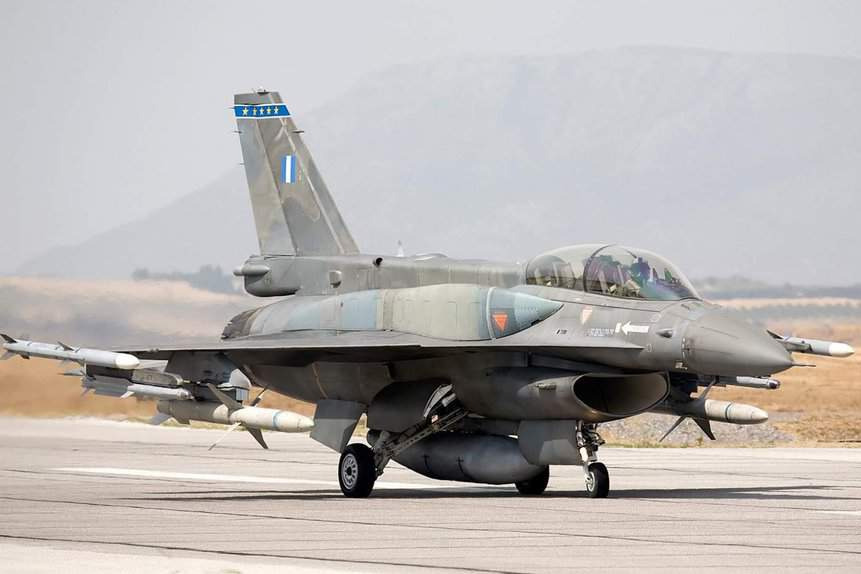
Greece never got ASRAAM (afaik), so it would be weird if he was talking about it.
ok wait i am an idiot, i checked again, yeah amraam not asraam, i confuised the context
2 Likes
I still have yet to find something that backs the statement that a 2D focal plane array is better than a line scan device. AFAIK they decided against a 2D focal plane array because it had not enough flare resistancy in their opinion (overblending of neighboring lines, suspectible to LDIRCM because of the continous exposure to the source, etc.). The optical part should be idenpendent from the used CCD type (except for the needed actuated micro-mirror for line scan devices) so lock-on/view range (magnification) can be identical.
The only disadvantages a line-scan device as a seeker CCD has, is the more complex mechanics (actuated mirror) and the limited refresh rate, caused by the actuation and minimum duration charge-discharge cycle of the CCD pixels, which causes the IRIS-T to have a refresh rate of 80 Hertz → 80 times per second 64 lines are scanned, so 5120 mirror (or prisma, whatever was used) movements and charge-discharge cycles per second for the CCD.
Neat part: The two lines of the 128x2 CCD are shifted, so targets can’t fall between the pixels during the scan, especially small targets at great distance.
Thing is, you can also easily simulate a 1D array using a 2D array, so I struggle to understand how you could argue that it’s worse when it comes to flare resistancy, by just using certain parts of the seeker in the compute. The more « sensor » you have, the more complex the compute you can have in general imo.
I think where the IRIS-T might actually have better flare resistance than the ASRAAM is due to using 2 arrays of different wavelengths, while the ASRAAM only has a singular array (correct me if I’m wrong I’m not 100% certain actually of this) and thus is limited in that aspect.
The MICA has 2 2D arrays for example, and some French papers do discuss the advantages of looking through several wavelengths to discriminate countermeasures. This would combine both seekers advantages, but also come at a steeper cost
The problem is, that it’s virtual with no mechanical component. Yeah you can scan line per line with a focal plane array, but the optics are made so that the incoming light always hits the whole array and not a small line. So you will always have the overblending even if scanning line per line which is not the case of the IRIS-T as the optics move there and shift the focus. It’s a mechanical limitation of the optics and not the seeker CCD itself in this case (different types of CCDs need different optics).
That the IRIS-T uses two wavelengths would be news to me. AFAIK it only uses Indium antimonide as the CCD material with 1000 nm to 5500 nm sensitivity (near infrared).
Even a mechanical scan would still see some bleeding when not totally in focus tho, meaning that it would still see similar abherations as fixed 2D array in the « vertical » scan, and it would see identical abherations on the horizontal axis by virtue of being 2D (so, why didn’t they go with a single point scan then ?)
This is more a case of the optic itself creating abherations, not the sensor.
The argument that a 1D array can be better than a 2D array, all other things equal seems a bit silly to me. Kinda like arguing that a mechanical radar is better than an electronically scanned array radar (wink)
I think, like the radar argument, it’s mostly a question of how economical it is compared to the advantages this brings to the missiles (ie, for a missile of the cartegory of the IRIS-T, either tech would basically be identical, so it end up making more sense going for the 1D tech, which was most likely way cheaper despite using mechanical parts for late 90s tech)
Of course you will have some bleed but it would only affect one line + its neighboring two lines, not more or even the whole seeker as the focus is moved.
Single Point scan would be unfeasably slow so you compromise to a line scan and are able to ignore or shut off a few lines instead of the whole seeker. Of course ignoring just a single point would be better but it also would be slower by a magintude (Instead of 5120 scans per second with 128x2 it would have to do 327680 scans wit 2x2 pixel and four times that with only a single pixel) and uncomparably more complex to implement technically.
Apples and Oranges. This comparison would be valid if we would talk about LIDARs which today are only line scan with a single laser source or a future developement where every LIDAR pixel has its own laser source, but we’re currently talking about completely passive receivers without active components ^^
Technically both are 2D, just one is stepped while the other is all at once. A 2D line scan also has other advantages as the much smaller array (1/64 the size of a focal plane array with the same resolution) is much better coolable. Other stuff like the exposure time to LDIRCM of only a few microseconds per scan instead of being exposed constantly is also advantageous.
Yup ASRAAM is a MWIR seeker, atleast it was, we cant be sure because Block 6 changed the seeker.
Surely refresh rate is inverse to exposure time, which would mean that by scanning and therefore only exposing the sensors in each line for a short period, you automatically limit the sensitivity the sensor can achieve? This would reduce range no?
Yep, but it also means you its much less likely to be permanently blinded by laser systems
Range also isn’t much of an issue for IRIS-T seeing as it is still a dedicated short ranged IRAAM, unlike ASRAAM/MICA with their much larger rocket motors. Saab states the seeker is capable of all-aspect target acquisition throughout the missiles full kinematic range, which fundamentally is all the missile seeker needs.

interesting wording, could mean its suitable for the full kinematic range… i.e within the first few seconds it attains lock.
In practice that should be minimal because targets are CW (continous waves or continous unmodulated emitters) and the energy reaching the missile seeker is the same. Only the integration time is shorter so the overall energy transfer is less but that can be compesated by adjusting the scanning speed (should be also a reason the scan speed is just 80 Hertz and not >100 Hertz to have a balance between sensitivity and scan-speed). Line scan is also less susceptible to thermal noise because there are fewer pixels and they can be better cooled.
But the most important part I think which is also the reason why a line scan for the IRIS-T was used is, that line scan can handle movements (of the seeker and the target) much better. Line scan cameras are for example used for imaging and analyzing moving things like stuff on a conveyor belt. Interestingly you get problems with motion blur on fast moving targets in a focal plane array, but they can use pixel binning to enhance the sensitivity while simultaneously sacrificing resolution.
It’s also valid to assume that the moment a target is detected with a line scan device, the seeker could only scan the lines with the target and a few above and below instead of the full height → higher scanning speed because of less lines scanned or better sensitivity at same scan speed (additionally less distraction from outside and background heat sources which enter and leave the smaller FoV faster).
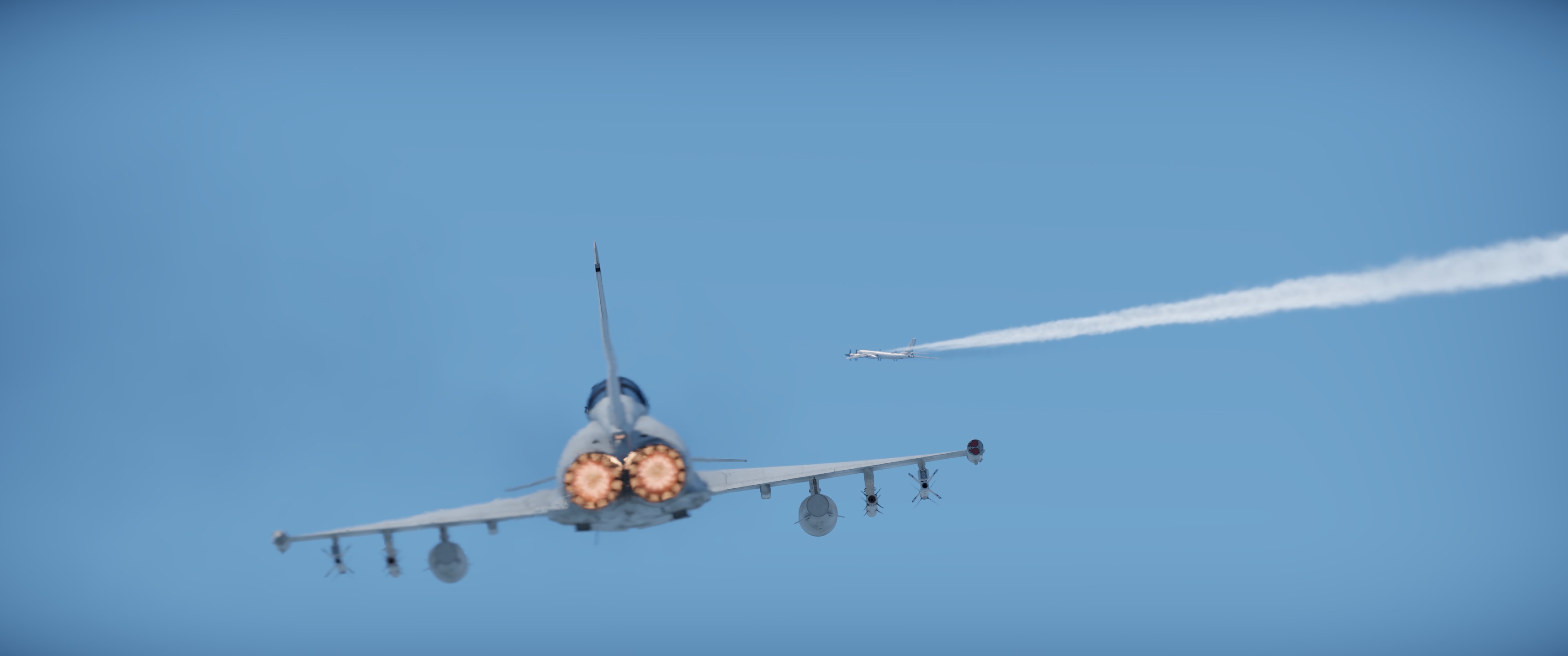


Yoink.
15 Likes
Only minor shame is it seems to be outer most pylon, which means giving up extra AMRAAM/Meteor/ASRAAM in-game.
Would’ve been more peak if there was a su-27 escorting the bear in the shot as well, usually they’re escorted by a su-35 irl.
Still peak tho