Its probably pretty close :D
Ive not touched that BR, but ive heard that 9Ls are working semi-well I think
Its probably pretty close :D
Ive not touched that BR, but ive heard that 9Ls are working semi-well I think
That’s not something I can have any control over.
I’m just pointing that the flankers have large calibre flares, those work better than normal ones and they burn for longer, they are also fired upwards which is more useful to flare Aim9M in side aspect while turning into the missile.
Chaff is probably the same between bol-normal-large from my experience.
It usually doesn’t swap to a flare unless the missile seeker just loses the initial target after the shut off phase. When the seeker re-engages it will point to where the aircraft would be with its IOG tracking prediction, if the target isn’t exactly there but there are still flares where he looks, the missile probably will just lock into the flare, else it would go dumb eitherway.
If the missile re-engages where the aircraft is, but there are still flares in the seeker fov, it will go again into shut-off phase.
I don’t know if the implementation should be any different, I’m just saying what I think is happening from my understanding of game mechanics.
A good way to understand how the tracking suspension seeker behaves is to just lock into a target without lanching the missile, what the seeker does while still under your wing would be the same as if the missile was flying.
Yeah, but as I said earlier. They’ve been pro-actively swapping to flares, the moment a flare is dropped, which shouldnt be happening. Though regardless of that bug, There is a debate to be had that even in the absence of seeker shutoff, whether they should be going for flares over an afterburning target at all. More than likely, they shouldnt.
An Su-30, sat on full reheat, can spam all the large calibre flares he wants, but an Aim-9L would more than likely still kill without throttling down IRL.
In my recent experience, they work just fine, or just like they always did. If you really encounter such a bug in most of the launches, maybe it might be some weird desync issue?
Yeah that is the single advantage of 9L in top tier, if your target flares thinking it is a 9M in rear aspect but doesn’t lower engine temperature, the 9L will follow the engine, but that is very plane dependent. A gripen will be fine sitting on afterburner and flaring.
My experience, the only things not fine is the Harriers and they dont even have Afterburner
I think I have to update the report with what I observed and described in this post:
TL:DR; I suspect a “ghost-lock” onto a non-existent target with a random movement vector. Happens if the active seeker is moved onto a flare (not when it’s activated on a flare) as far as I can tell. Would be helpful if somebody else could test this case too, because I could also be imagining things…
Harrier, an aircraft known for its low thermal signature.
What IR seekers in WT see when looking at an harrier:
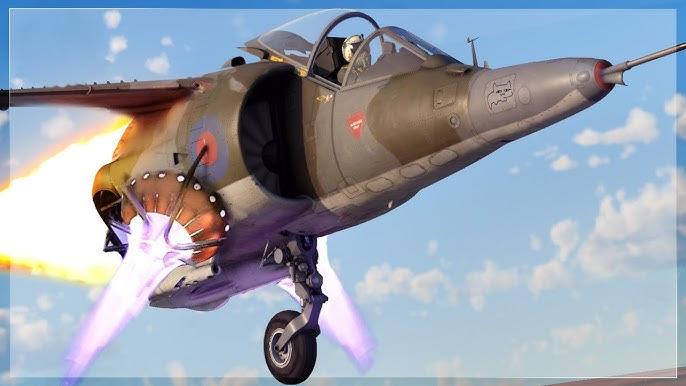
Sombeody care to make a rising teletubby sun GIF with the harrier instead of the babyface? xD
Yep, definetly a fitting image… At least flame’s report got accepted, so there is an extremely dim light at the end of the tunnel
Regardless of the exaggerated harrier IR signature in WT, people fail to flare in harriers because they are 110% throttling the engine while it is activelly melting according to WT.
It doesn’t have an afterburner, but you still need to lower the throttle to like 90% or less while flaring. Same thing with the F-14, cutting afterburner might not be enough.
Another case is the mig-19 variants that takes ages to drop or regain engine thrust. So if you are flying an A-5C or similar, you need to wait a second after dropping your throttle for the engine to cool enough for flares to be effective
Nah. I’ve been at 70-80% throttle and failed to flare missiles with multiple flares before. The key is airspeed not throttle setting most of the time as the Harrier is hotter at lower airspeeds
That is because in warthunder thrust and temperature go hand in hand, so at slow speeds with the harrier you build A LOT more thrust and temperature and by consequence you need to adjust your throttle even more.
What you could flare while going mach 0.9 at 100% throttle, might not be flared while going 80% at slow dogfight speeds.
The inverse with supersonic jets also happens but its a very rare occurrence. Going very fast with the engine buiding a lot of thrust at medium-low altitudes and cutting afterburner won’t be enough because your engine will take a second or two to lower the thrust/temperature enough for flares to be more aptizing to the IR seeker
Yes, I know and exactly my point
Why aren’t the devs giving the EFT radars variable scan rates depending on the volume (full ESA, hybrid MECA ESA) just like the Russian radars have ?
I think it went center mass and fused on the ground behind it
Cuz they said no.
My understanding is that the mechanical part can only effectively point in a circle - 40 degrees from the boresight, and rotates around this sector continuously, or can stop and scan in any sector continuously.
This means the dish only rotates around a fixed point.
The ESA scans a 60 degree cone wherever the radar is pointed and can update the entire field in less than a second.
This means the radar scan area is actually a 200 degree CONE and should be able to update the entire field in less than the time it takes for the dish to perform a full rotation.
However, this means that it should be impossible to provide a track update when the esa cone of influence is not pointed at a target. However, in game, the radar is able to provide tracking updates outside the esa scan area of the radar every 0.1s.
This is actually a massive oversight and artificial buff to the radar.
That is how all ESA updates work for all ESA radars in game, if they pulled that the radars that would fair the worst are PESA’s, SU-30SM radar only has a +/-45° FoV for the E-Scan area.
So the wider your FoV the more you benefit, but inversely if it was fixed the smaller your FoV of your E-Scan area the impact is bigger.
Woah, didnt expect that eletronic scan being so narrow and azimuth so wide, EF with this big azimuth would be capable of ~300º of FoR
