- Yes
- No

USS Erie underway in May 1940 (source: File:USS Erie (PG-50) Underway starboard bow view, May 1940..jpg - Wikimedia Commons)
TL;DR: small and slow gunboat that is surprisingly well armed and armoured, even carrying a floatplane.
USS Erie (PG-50) was the lead ship of the Erie-class gunboats from the 1930s and 40s. Built under a special provision of the London Naval Treaty, they were intended to perform an unusually wide range of tasks, including fleet screening, convoy escort, support of destroyer attacks, tactical control of fleet submarines, plane guard duty, high-speed minelaying, amphibious fire support, and even diplomacy! Accordingly, USS Erie had a short but eventful career, from her commissioning in 1936 to her sinking in 1942, during which she saw action in both the Spanish Civil War and World War II.
Although technically classified as a gunboat, given her size the Erie could either be placed as a coastal or bluewater ship in War Thunder. If placed in the coastal tree, she will end up being one of the heaviest coastal ships in-game, thanks to her full load displacement of 2,875 t, outweighed only by the Köln-class frigates. She would also have one of the heaviest armaments, with four 6-inch (152 mm) main guns and a plethora of autocannons. More surprisingly, she has some decent armor, with a 89 mm side belt (though only covering vital areas), 25 mm gun shields, a 32 mm deck, and 100 mm armor for the conning tower; she is better armored than many destroyers. To top it off, she also carries a floatplane, something that you wouldn’t expect to see on anything smaller than a cruiser (although the US Navy—yes, them again—did try mounting floatplanes on three Fletcher-class destroyers).
Of course, all these amazing features come at a price. With just 6,200 shp, she lumbers around at a max speed of 37 km/h. While not the slowest ship in-game, moving around even the smallest maps is going to take some time, and she’ll be a sitting duck if caught out in the open or jumped on by torpedo boats at close range. Nevertheless, in favourable combat conditions, she can easily club coastal vessels and even give destroyers a run for their money.
History
At the 1930 London Naval Conference, Chief of Naval Operations Admiral William V. Pratt successfully lobbied for a special provision in the Treaty. Article VIII (b) stated that vessels that do not exceed 2000 long tons of displacement, have a speed less than 20 knots, mount no guns exceeding 6.1-inch caliber, and no more than four guns exceeding 3.1-inch caliber, and do not have any torpedo tubes would not have any limits on the number constructed. Pratt and his staff envisioned that such ships (sometimes considered sloops) could perform a wide range of duties (as mentioned in the introduction).
However, the downturn of the economy and President Hoover’s pacifist stance meant that getting funding for any new ships would be near impossible. This changed when Roosevelt was elected president in 1932. As part of his New Deal program, the National Industrial Recovery Act would provide funds for naval construction. The same day the NIRA was passed, Roosevelt signed an executive order providing $238 million to construct 32 ships, two of which would be the sloops championed by Pratt. These two ships were the Erie-class gunboats.
USS Erie was laid down on 17 December 1934, launched on 29 February 1936, and commissioned on 1 July 1936, although at the time of commissioning, she was only 98% complete and still lacked her 6-inch guns. Her construction was considered complete in August, and in October, she finally received her guns and mountings. She then participated in two festivities in New York, the Navy Day celebrations from 25 to 27 October and the fiftieth anniversary of the dedication of the Statue of Liberty on 28 October, before heading out on her shakedown cruise on the last day of the month.
During her two-month shakedown cruise, she was active in Spanish waters, protecting American interests and evacuating US citizens and other nationals in the Spanish Civil War. An incident happened on 17 December when she arrived in Port Musel, Gijon at 08:00. At 08:30, the Spanish battleship España controlled by the Nationalist faction arrived and fired three rounds into the port, one landing less than 300 yards from Erie. General Quarters were called as she prepared to manoeuvre to avoid gunfire, but she did not return fire and España steamed away almost immediately. While newspapers back in the US claimed it was an attack on Erie, her captain, Commander (later Vice Admiral) Edward Hanson, believed that the battleship was merely trying to target Republican forces in Gijon. The State Department accepted his report and decided that no retaliation was necessary. She returned to the New York Navy Yard on 30 December, concluding her shakedown cruise. Her performance was considered satisfactory, although several hull plates were damaged in the high winds and rough seas of the Atlantic on her return journey.
1937 was an uneventful year for Erie, during which she served as a training ship at the Naval Academy. She rammed the dock while returning from a drill on 11 May, requiring repairs to her bow. On 29 May, the Naval Academy hosted Japanese officials at a re-enactment pageant in celebration of Commodore Matthew Perry’s friendship visit to Japan in 1853. Erie and two other destroyers illuminated the event with their searchlights and paraded around the Dewey Basin after the fireworks display.
After finishing her overhaul on 24 January 1938, she was transferred to serve around the Panama Canal, changing her homeport to Balboa, the canal’s Pacific terminus. On 21 February, her SOC-2 Seagull floatplanes were removed due to being difficult to handle and were later replaced by OS2U Kingfishers. On 27 April, her captain, Commander Hanson, left to take up office as the governor of American Samoa, and command of Erie was taken up by Commander Andrew Mack. After that, she left on a three month goodwill tour of ten ports in eight Central and South American countries. On 21 January 1939, she participated in the search-and-rescue efforts for the ditched and sunken flying boat Cavalier, providing a doctor to treat the survivors.
After the outbreak of World War II, Erie was transferred to Cristóbal on the Atlantic end of the canal to participate in the Battle of the Caribbean. Her duties consisted of protecting convoys against German U-boat attacks and rescuing survivors from sunken ships. On 10 November 1942, Erie led the convoy TAG-20 out of Port-of-Spain, Trinidad, en route to Guantanamo Bay. She was accompanied by the destroyer Biddle, corvette Spry, and three PC-461-class submarine chasers.
Two days later, on 12 November, some ships from Willemstad, Curaçao, joined the main convoy at 16:35. At 17:02, Captain Mack ordered “right standard rudder” to investigate spray on her starboard side. At that moment, the ship’s navigator, Lt. Commander David L. Roscoe, spotted a torpedo 2,000 yards out. “Hard left” was ordered in an attempt to evade, but two more torpedoes were spotted to her starboard. These torpedoes were fired by German submarine U-163. A torpedo struck one of Erie’s starboard oil bunkers, abreast of the #4 gun, which immediately caught fire as the engines cut out and power was lost. The avgas tanks for her floatplane also ruptured and caught fire, causing a second explosion. Nevertheless, the engine room crew bravely stayed on station to restart the engines and restore power. By 17:40, she was listing to starboard, although partial power was restored and the starboard engine was back online. At 17:44, the starboard engine stopped again, and one minute later, two severe explosions in the #4 gun shelter rocked the ship, followed by two more explosions in the same place five minutes later.
“All stop” was ordered at 17:55 in order to lower motor boats for transferring casualties and searching for crew who jumped overboard. At 18:00, her port engine came back to life, and Erie started moving forward at 8 knots. A local vessel advised that there was a shelf just off the shore of Piscadera Bay where the Erie could safely beach herself to avoid sinking. At 18:12, crew members began hauling gunpowder from the #3 ready room to prevent another explosion. The ship’s Executive Officer, Lt. Commander Daniel J. Sweeney, who was taking a shower at the time of the attack, managed to make his way to the afterdeck, where he and four injured crew members made sure the depth charges were set to “safe” before jumping overboard with life rings, joining the two depth charge watchers who were knocked overboard earlier when the torpedo hit. All seven were quickly picked up by a Dutch motor torpedo boat. Six minutes later, “all stop” was ordered again, and the main deck was underwater by 18:20. Finally, she managed to beach herself, and amidst growing fires, “all hands abandon ship” was ordered at 18:26. The crew jumped over the port bow, and Captain Mack was the last to leave the ship. Six officers were missing and presumed dead, and a crew member died from his injuries the next day, bringing the total death toll to seven. Other escorts of the convoy dropped depth charges and searched the area, but U-163 managed to escape.
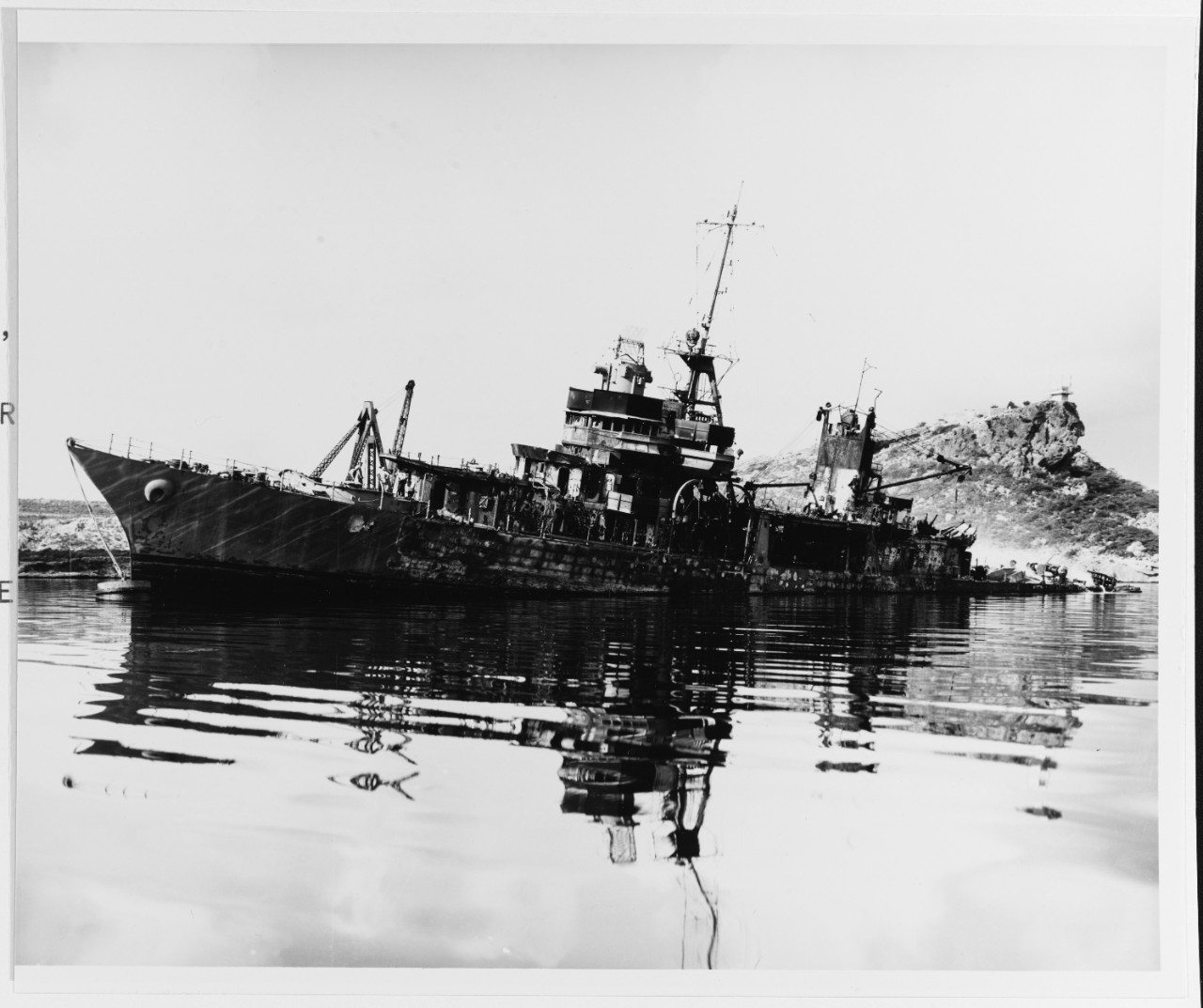
By 14 November, the fires aboard Erie had either burned out or had been put out by firefighters. She was deemed salvageable, so a small group of Erie’s survivors and several local ships began work on 19 November. She was raised on 28 November and towed to Willemstad, but on 5 December, a failure in a watertight door caused her to list, and attempts to correct the list by counter-flooding instead caused the ship to sink. Salvage was deemed impractical, and on 28 July 1943, USS Erie was struck from the naval register. In 1952, she was partially raised and towed out to sea, where she was finally sunk in deep water.
Specifications
Compliment: 243
Displacement: standard 2,032 t, full load 2,875 t
Length: 100.13 m
Beam: 12.57 m
Draft: 4.52 m (full load)
Max speed: 20 kt (37 km/h)
Propulsion: 2x Babcock & Wilcox boilers, 2x turbines, 2x shafts; 6,200 shp (4,600 kW)
Armour:
- 89 mm side belt (only covering vital places)
- 25 mm gun shields
- 32 mm deck
- 100 mm conning tower
Armament:
- 4x 6-inch/47 Mark 17 guns
- Elevation: -10˚/+20˚
- Ammunition: Common Mark 28, 2.6 kg Explosive D, m.v. 853 m/s
- Rate of fire: 5-8 rounds per minute
- 4x quadruple 1.1-inch/75-caliber guns
- 4x Oerlikon 20 mm cannons (possibly added later)
- 2x depth charge racks (15 each)
Electronics:
- Mark 35 battery director
- Mark 3 radar
- ASDIC sonar
Float plane: 1x SOC-2 Seagull (pre-1938), 1x OS2U Kingfisher (post-1938)
More pictures
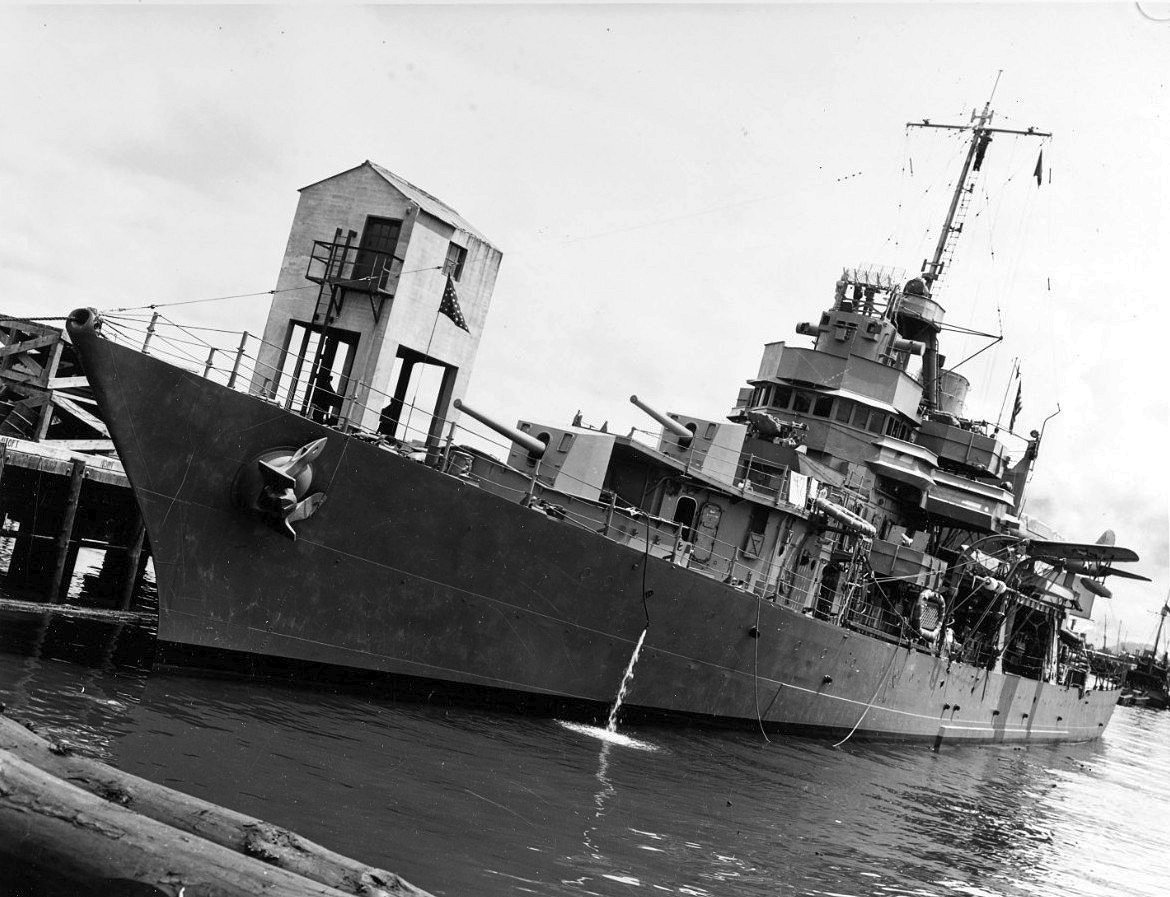
USS Erie moored at Balboa, Canal Zone, in early November 1942, probably just days before her final voyage. Visible are two 6-inch guns, two quaduple 1.1-inch guns (one forward the bridge, one to the side), and what is probably an Oerlikon with gun shield on the side below the higher 1.1-inch mount (source: File:USS Erie (PG-50) Balboa November 1942.jpg - Wikimedia Commons)
_Underway_starboard_bow_view,_May_1940..jpg)
_Balboa_November_1942.jpg)
USS Erie on 2 December 1942, at Willemstad, where she had been towed. Note extensive burn/fire damage; guns have been removed. (source: File:USS Erie (PG-50) salvage 2 December 1942 2.jpg - Wikimedia Commons)
_salvage_2_December_1942_2.jpg)