Unfortunately the protection analysis function is flawed in and of itself, there is so much in-game footage of rounds penetrating where the analysis says they shouldn’t, and vice versa. All hail the mechanic that is “volumetric” armour!
4 Likes
Protection analysis may not have true values but from all of my experience playing with ERA (I have almost every tank I listed in the post above except the lecerc AZUR) as well as against it, the values in the protection analysis seem pretty much spot-on
yes i agree,generally era is unerperforming a lot
Currently in War Thunder, there is a noticeable imbalance in how Explosive Reactive Armor (ERA) is modeled across different nations.
Russian Relikt ERA consistently provides very high protection against both chemical and kinetic threats, while ERA on NATO and other modern MBTs appears significantly less effective—especially against APFSDS.
This raises a core question:
Why does Relikt outperform all other ERA types by such a large margin, particularly against kinetic rounds?
4 Likes
It’s not that russian ERA outperforms everything, it’s that 1) nato in general doesn’t rely much on era and 2) nato era is built with a different doctrine in mind.
Russian/ukrainian era provides heavy heat protection despite its size because 1) russia/ukraine has more experience making it and 2) it focusses on raw stopping power without taking safety precausions for nearby infantry.
Nato tanks are built for mostly long engagement, which is why they have much thicker composites that provide a lot of protection forwards (rather than sideways like turret armour on soviet designs) thus for the most part they don’t require era, so much so germany and sweden prefer external composite plates over era (leopard 2 pso, strv 122). And for the same reason they don’t bother to develop era with kinetic protection. Other nato countries rely on it more than those two, but baseline tank models are still without era (like abrams, leclerc, etc.), whereas russia and ukraine implement it as baseline protection (aka you would see abrams, etc. without era, but not so much for t90m’s, oplots, etc.)
Perfect example to illustrate the different philosophies is to compare contact 5 and the dorchester armour package for challengers: both have about equivalent chemical protection, however the era on the challenger 2 is much thicker and heavier because it has a ‘containment’ area which catches spall going away from the tank, thus it’s much safer to be around. Also, the challenger 2 used extra composites for places like the gigantic lowerplate, whereas Russian/ukrainians put era there.
In summary, era protection values are based on real values, It’s just that the expectations for era are vastly different in russian/ukraine and nato: russia and ukraine rely on it a lot more, thus they spend a lot more of their budget developing better era, like relikt, contact 5, nizh (ukrainian), etc.
1 Like
As a Counterpoint, the performance of APFSDS is not based directly on observed performance as one could come to expect from Gaijin. But is estimated in game based on the physical characteristics of the round.
The problem is that Gaijin uses an arbitrarily modified Lanz-Odermatt formula. which is known to degrade performance to a degree. and with doing similar massaging for armor (for the most part) APFSDS suffer unduly poor performance.
A similar way to approximate ERA performance should be implemented. Where it is based of known kinetic energy of the flyer plate(e.g. adjusted by some factors such as; angle of incidence and angle of arrival) and the ratio of mass to the projectile as to assert momentum transferred and work backward to figure out the effective quantity of lost mm of penetration of the shell.
4 Likes
The spaghetti code will make an even bigger mess then what we have now
The argument mixes some correct points with conclusions that don’t really hold up.
First, ERA wasn’t originally a Soviet/Russian concept. The first operational use was by Israel (Blazer ERA in the early 1980s), with the Soviets introducing Kontakt-1 shortly after. So it’s not accurate to say Russia/Ukraine simply has more experience—both sides have decades of development.
The doctrine difference is real, but often overstated. Soviet/Russian tanks rely more on ERA as part of their base protection due to weight and design constraints. NATO tanks rely more on heavy composite armor (Chobham/Dorchester) and use ERA as an add-on. But that doesn’t mean NATO ERA is “worse” or that it isn’t designed to counter kinetic threats—those capabilities exist, they’re just less visible or differently implemented.
Kontakt-5 and Relikt are effective because they can disrupt APFSDS rods through moving plates, but this effect is situational and modern penetrators are designed to counter it. They are not universally superior solutions. They also come with trade-offs like higher explosive force, safety risks for nearby infantry, and dependence on coverage.
The key mistake is comparing ERA-heavy Russian designs directly with composite-heavy NATO designs. That’s not ERA vs ERA—it’s two different protection philosophies. NATO compensates with stronger base armor, while Russia compensates with more aggressive ERA use.
The perception that Relikt is far superior mostly comes from how it’s modeled. In-game, Russian ERA often provides strong protection against both HEAT and kinetic rounds, while NATO composite armor and ERA effects are likely underrepresented. So the imbalance players see is less about real-world superiority and more about inconsistent implementation.
1 Like
no just no
I recommend you the book ‘Terminal Ballistic’ written by Zvi Rosenberg and Erez Dekel. The idea of ERA is talked in chapter 7, part 2.
And there’s a well-known bragging article published by NII Stali here:
All parameter for calculation is transparent: plate - 20mm. Flying speed - 370mps. Yawing angel -15degs. See whether there’s any over/underestimation of things.
The existing KE equivalence - 200-250mm includes the sideskirt, within a <30deg angle.
mb for all the inconsistencies i provided, i’m not incredibly well versed abt ERA irl, but my main point is that russia/ukraine has consistenly used more resources to develop better era as compared to other nations.
Israel being the first to invent it has mostly replaced it with composites or APS, the US has only used ERA on some upgrade packages for the m60’s and abrams’es (like SEPv1/2/3), etc.;
Russian/Ukraine on the other hand have implemented it as a ‘basic’ protection measure and have created countless designs and improvements.
On the count of in game:
i don’t have much to add, you’re right. ERA and composite modelling is horrible, i’ve noticed not so long ago that CM11 has half as much heat protection as magach6C and m60a3TTS even though they share the same ERA.
I’ll be sure to give it a look, thx
I do see your point, though from all my experience of playing tanks with and against ERA i can’t say apfsds has poor performance against ERA with kinetic protection. I’m not denying your point, it may have worse performance than it should, it’s just that most ERA in game evidently has much much less protection than it should (both against kinetic and chemical penetrators) since ERA only starts having effective protection at high angles even though it should still be effective at a flat angle.
Can I get a TLDR ?
Im guessing you mean a short summary(?)
If so,
Almost all ERA in game (only expections being era on m60a3tts, magach6c and french tanks) underperforms since it provides 10-60% less protection than listed on the statcard.
Basically meaning that the implementation of era is both shit and inconsistent (same era on different tanks behaves differently sometimes).
Note: i was unable to test the ERA on the abrams so i cannot speak about the abrams.
1 Like
Ok ok I see. Well I suppose the speed of the projectile does make quite a huge difference in how ERA would react so I’d be curious to know that’s why there’s a discrepancy.
I’ve just been testing different calibres and on the protection analysis it always shows the same amount of armour but the chance of penetration changes. It starts becoming noticeable on 90mm apfsds. I haven’t seen any difference between slow/fast shells.
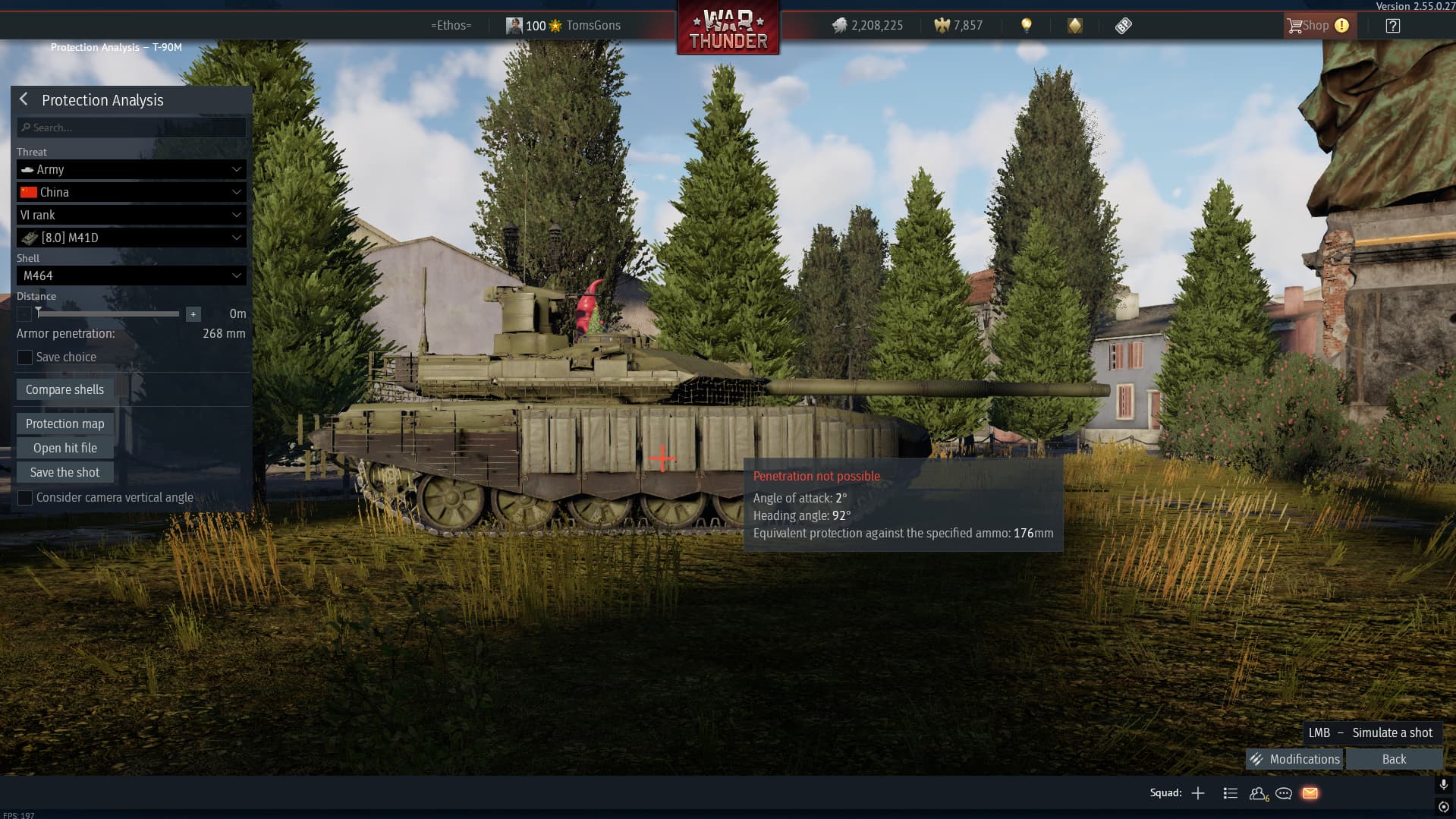
I wouldn’t totally trust hangar armor analysis, I’ve made my share of contributions for bug reports showing it clearly has discrepancies with the in-match model.
I think it’d be a lot more relevant with custom battle testing (or custom map) to make sure it’s not just the hangar analysis showing bullshit.
I cannot (or at least don’t know how to) test it in a custom battle but i know that some issues with era modelling persist in games, like double layered era barely adds protection compared to a single layer or how some era has much less protection than it should
Yeah it would require some SDK knowledge or finding a map with most vehicles available to shoot, which might be possible.
I noticed double layer doesn’t work unless it’s the weird slanted ERA blocks on the side of the BMPT and such and suddenly it eats 500mm pen APFSDS for lunch.