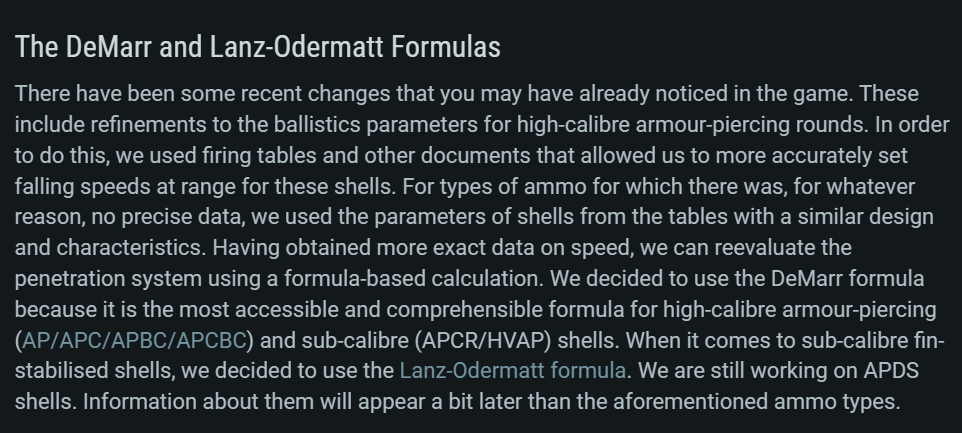
You cite one source, dismiss every flaw in it, refuse to apply the same test to LO let alone look at it and call others biased? Your lack of self-awareness should be measured and charted for future generations.
Has to be an official credible source. Even Gajin has enough self respect with all their flaws. No third party, old guy got bored and made a website nonsense.
You’re genuinely a lost cause. I have not seen a person like you in ages. Your case should be preserved for future generations so that they can avoid becoming like you.
It was a statement they made on the news back when they where buying the M1A1s… something like 22 years ago, I’ll have a look and see if I can find anything about it, but I would not hold my breath on it.
It’s also possible that they where over selling it to justify the cost of the tanks, had been over sold on it by either the army or the USA or just straight up had no idea what they where actually talking about, our government is not exactly filled with smart people.
What I do have on hand is a pen simulation comparing the Tungsten alloy to DU
as you can see they are basically identical, now these are blocks of a single type of metal, so it doesn’t really show how they would interact as part of a NERA array, as that is dependent on a “sandwich” of materials with different shockwave propagation speeds which causes them to warp when hit, increasing the amount of material the penetrator has to pass through, as well as causing darts to yaw and also break off mass. However due to the highly classified nature of Abrams armour, we have no idea what is in the NERA arrays or how those materials interact.
Then we get:
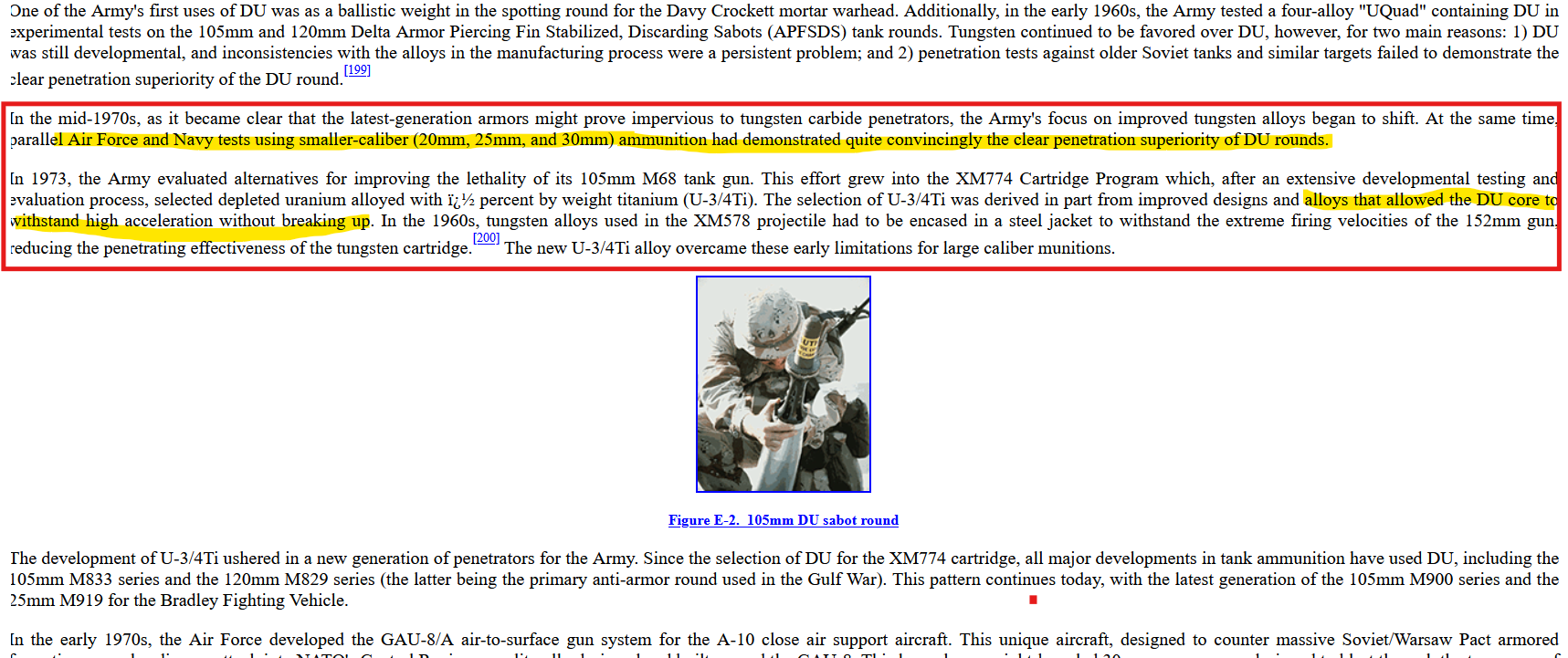
Wow improvements to their thesis hopefully DU governments don’t discover this improvement to make the DU round even BETTER from years ago my goodness that would be awful.
Therefore, NO REAL application of DU rounds especially classified U.S. DU ammunition. Makes sense since DU behaves completely different than Tungsten who would of thought?
I just read a whole lot of garbage to prove the DU rounds are still superior and they can’t even be tested in a this this glorified excel calculator.
It’s official I’ve been told to look at LOs just to prove a point its grade A clown show.
Lastly, not only is the Abrams from Sweden but it’s ammo is also wrong WT uses the same general APFSDS calculation framework for DU and tungsten rounds
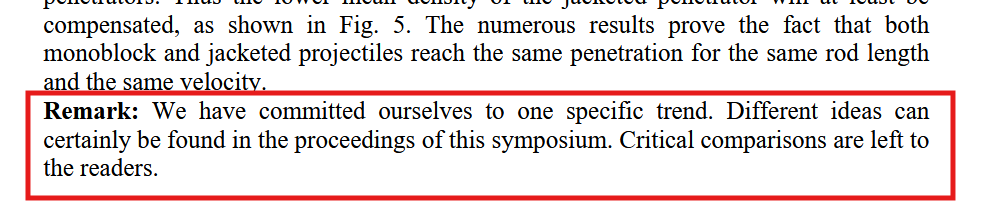
You quoted the closing Remark of the paper, a one-line disclaimer about the authors future predictions for jacketed penetrators, then “answered” with “longer, jacketed heavy-metal rods” while that’s literally what the authors predict. Your entire “debunk” of the document is regarding a segment on the current trend and potential future while ignoring anything it says about the downsides of DU in current penetrators. You are making a statment showing a clear missunderstanding of the topic at hand (assuming jacket = sabot?), this potential future is talking about darts nobody currently services with only few experimental APFSDS made which align to this predicition (XH45 with an inner LD of ~80).
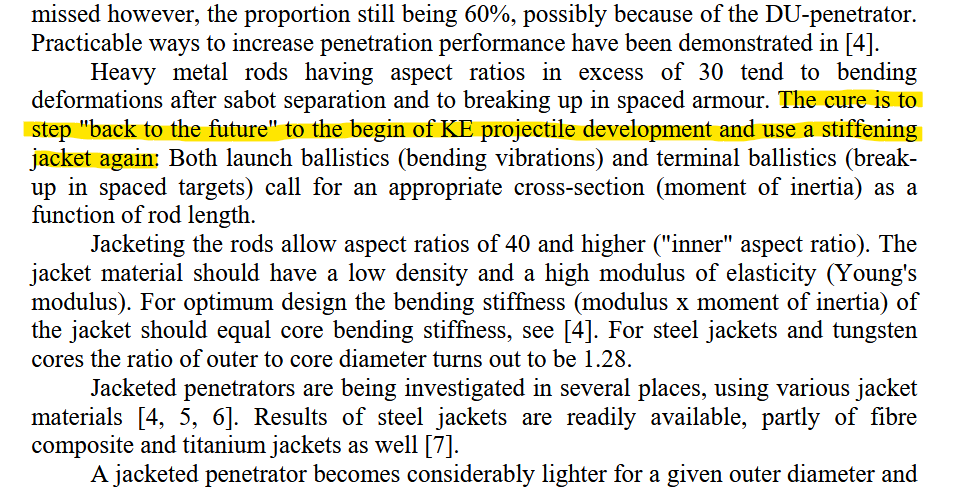
You completely failed to answer any of the actual material characteristics and downsides MENTIONED in the paper regarding DU, and you’re “debunking” it based on future predictions that have since been partly proven right via projects like XH45. You have failed to talk about: 1) the material downsides of DU in a direct 1-to-1 comparison to WHA, like how WHA already surpasses DU by 3x in Young’s modulus (360 vs 120 GPa), or 2) the downsides this difference causes in DU APFSDS design, specifically the need for stronger, heavier sabots to support DU during acceleration even with the 0.75% titanium alloy the US uses. Notably, the paper’s own future-trend section explicitly requires high Young’s modulus materials for both the jacket and the core to handle the forces involved. But I did not talk about potential future penetrators in my argument.
Can you not read? You managed to ignore the entire point of the paper and skipped to the part about “TRENDS” and future rounds which aren’t even in service. They’re referring to jacketed penetrators, aka penetrators with a steel/alloy jacket around a dense core, à la 3BM42 or experimental XH45, as can be clearly seen when you read the green and underlined part. The entire POINT of jacketed penetrators was to increase the L/D while retaining strength for the penetrator. A DU core will still have the same issues as a monoblock DU projectile. If you hadn’t noticed, jacket ≠ sabot, a jacket for APFSDS is a steel / alloy sleeve around the core, it does not fly away like sabot.
They can, I’ve shown you, but you refused to look at it I guess? I don’t understand what you did wrong, so you’re blaming the tool instead of trying to fix it or asking for help.
You mean an alloy like 0.75% titanium that still needs stiffer and heavier sabots? Wonder where that was said…
You’re also ignoring that these tests refer to the tests already posted above, which are 15 years older than the document in question, and as I’ve already said, they don’t disagree with the data. They expand on it in more detail. Specifically, they show that trying to use data for lightweight, low-velocity rounds isn’t applicable to large, high-L/D penetrators with significantly higher mass and impact energy. Almost exactly what we’ve been saying for the past 3 hours. And again, WHA has come a long way since then, as already shown in the paper where it has equal or better tensile strength with 3x larger Young’s modulus.
Graph Demonstrating Velocity changes
If you actually take the time to look at it, you will see that at LOWER VELOCITIES, DU outperforms WHA in fixed impact energy scenarios with an L/D ratio of 30. Why is this different from the test data you’re talking about? Because the data in question specifically talks about low-velocity, low-mass penetrators using a much older WHA. It might have been true in the late 1980s and mid-1990s that DU was potentially better in all aspects, but that simply hasn’t been the case for decades now. Espesially with large penetrators.
note it seems you have deleted this for some reason, wonder why
The paper’s goal was not to show whether WHA or DU is better. It shows the history and development of APFSDS penetrators over the past decades while making an educated guess for the future given trends of the time, as clearly stated at the very top. It was authored by 3 people, all funded by European institutes who work directly in this field. One of them is from the Swiss Defence Procurement Agency, a government-funded and operated department. This is the combined work of the Swiss government, Swiss industry (RUAG, Mowag, etc.), and a French-German defence research institute (ISL) funded by both the German and French MoDs.
This paper describes the main development steps of KE projectiles
from the basic full calibre antitank steel round to today’s heavy metal
sub-calibre penetrators having an aspect ratio of 30, along with the
corresponding penetration performance increase. A plausible
development trend will be jacketed heavy metal rods having aspect
ratios of 40 plus. Penetration results of big calibre firing tests with
monoblock and jacketed penetrators are presented. The conclusion is
that both projectile types yield the same penetration for the same rod
length and the same velocity.
Two nations. According to the UN report, it’s the Brits (who are switching away) and the Americans. Neither the Russians, French (who make WHA rounds like Shard), Chinese, Germans, Italians, nor Israelis have claimed DU to be universally superior, even though many have plenty of access to fissile material.
Russia does not service large amounts of DU ammounition, their most commonly produced round (3BM42) is WHA, the only exception is 3BM46 which is rather rare in itself and 59 which is a unicorn, espesially compared to its WHA counterpart. France literally uses a DU version of DM43 which would have lower performance than its WHA counterpart due to being heavier and, well DU. The UK is buying german WHA rounds for their challanger 3, specificially Ke2020neo (eKE / DM83).
These only corroborate the data already posted. If you had actually read the graph, you would have seen that at lower velocities (under 1600 m/s) DU penetrates more armour at constant impact energy than WHA. This remains true for smaller calibre and slower rounds.
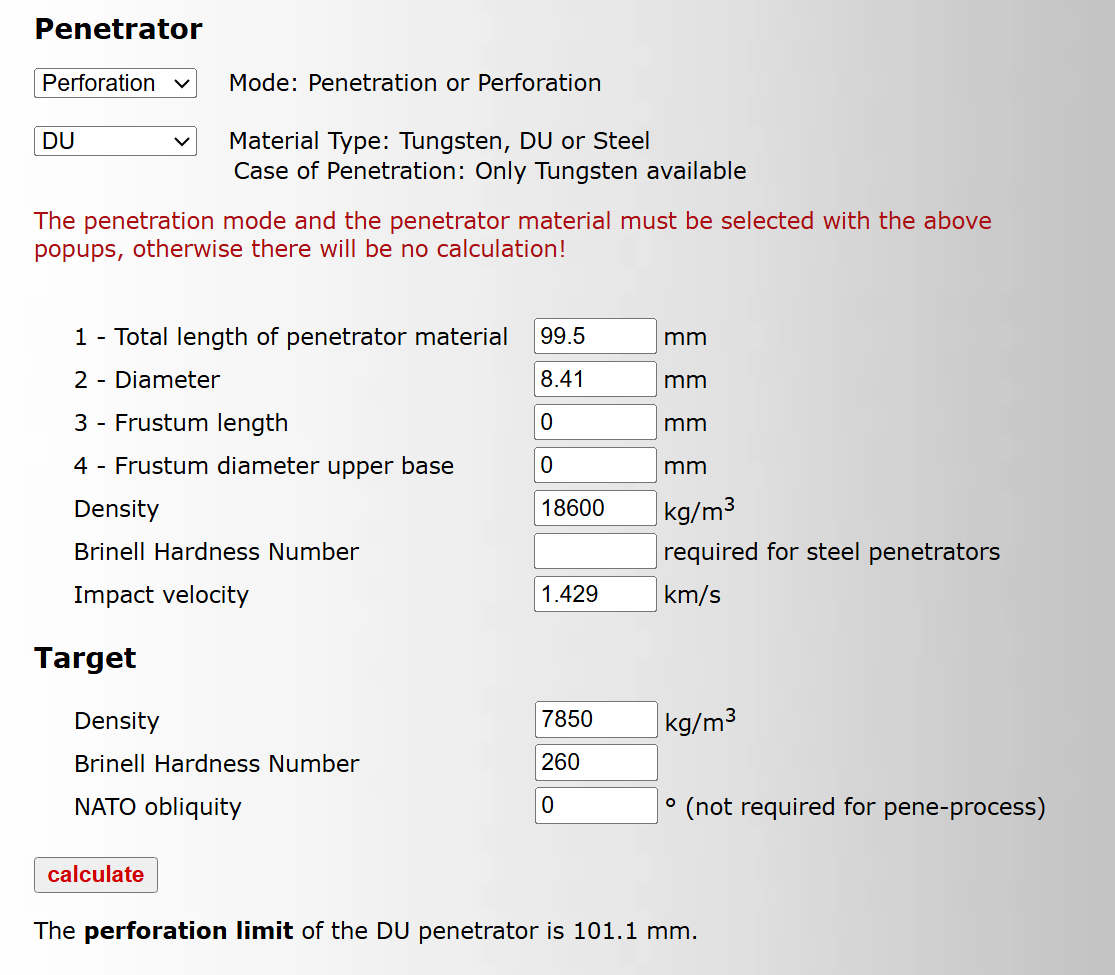
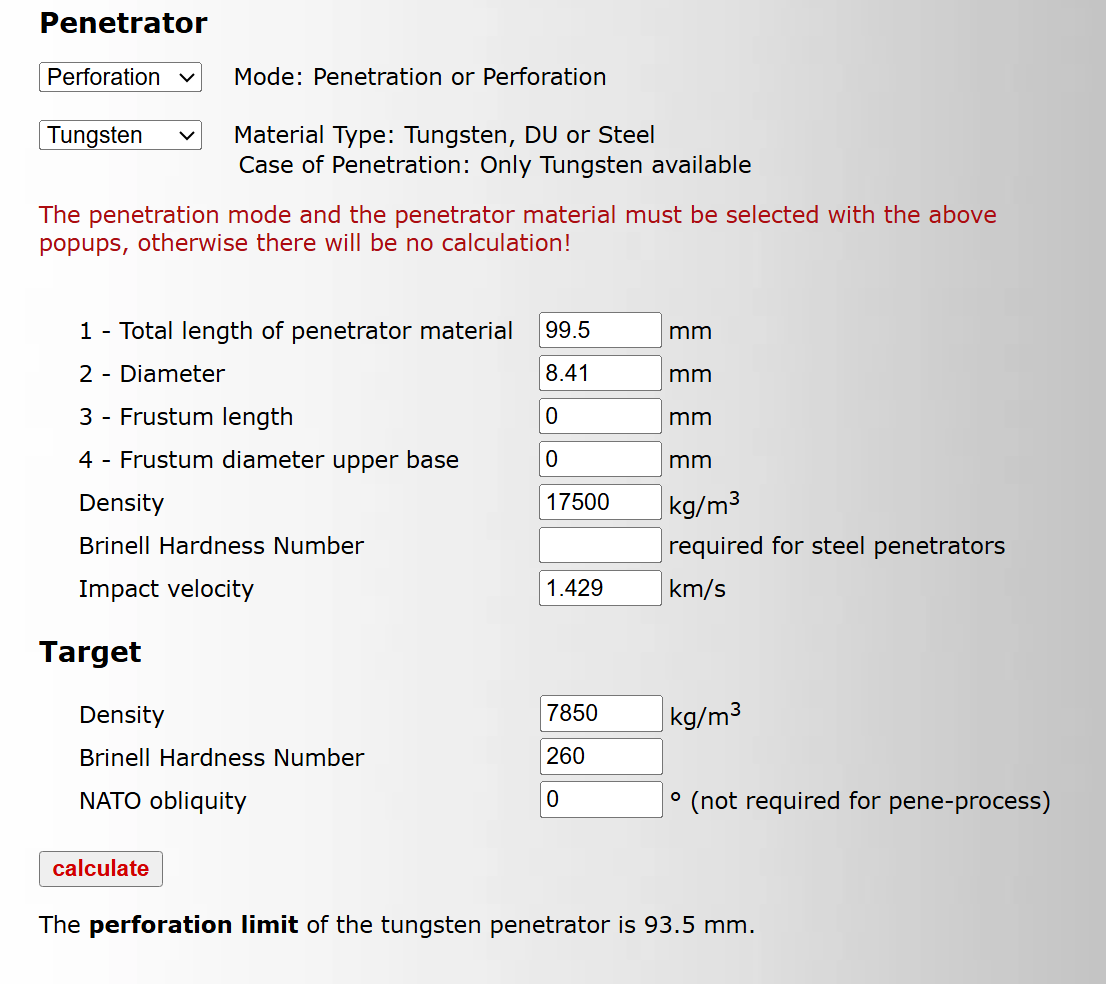
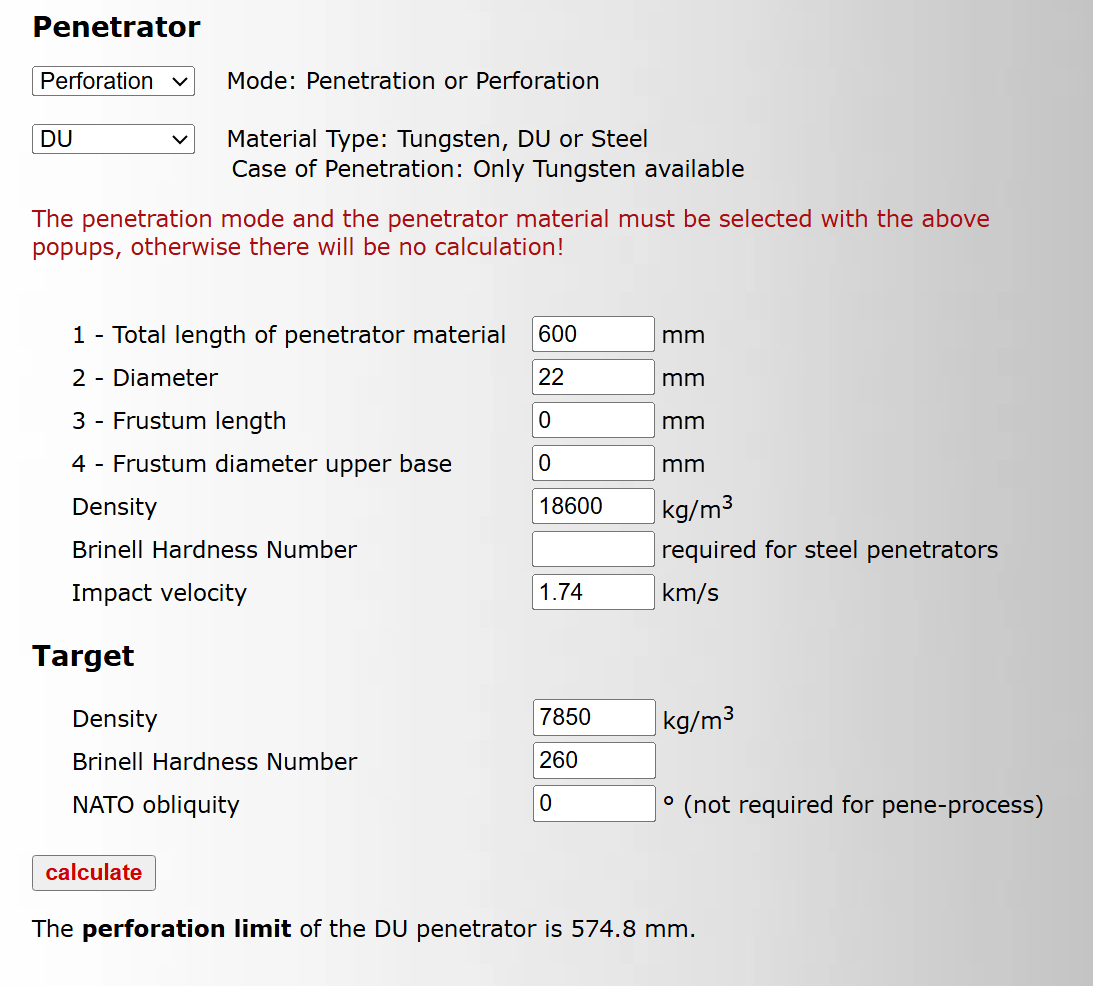
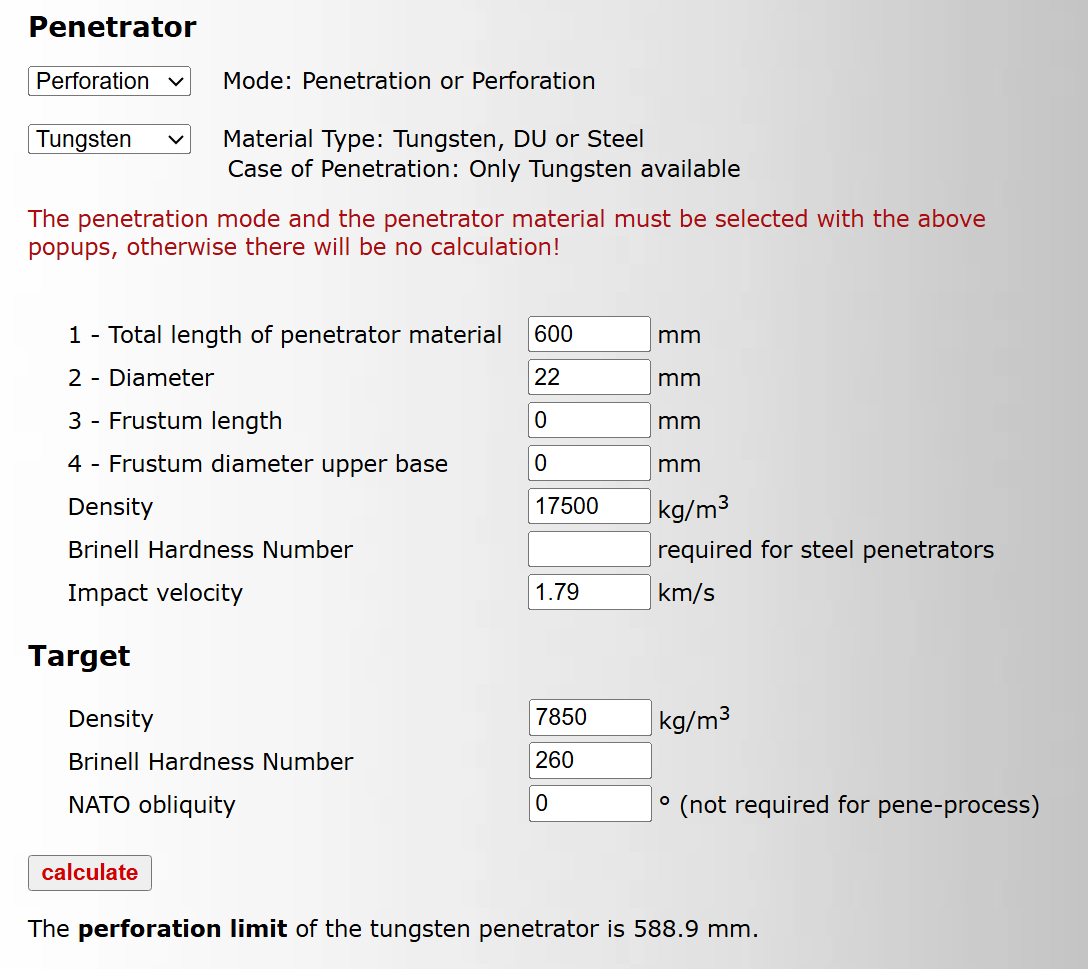
Here, I’ll give you an example. Below is my calculation for M919 using LO, once with DU and once with Gaijin’s WHA. M919 is a 25mm Bushmaster round, well below tank-gun energies and within the data from the tirals you are talking about. As you can see, it is in fact TRUE that lower-calibre, slower rounds perform better with DU than WHA. BUT (and it’s a big “but”) this changes once we increase the energy. At the energies that actually matter for MBT engagements, DU starts to perform worse than WHA, as the F1 vs F2 comparison shows.
Change in velocity is likeley due to the increased weight of the pentrator and reinforced sabot. Sourced from Nexter.
They don’t use identical data. They have distinct values for DU shells, using 18.6 g/cm³ density. The general formula is the same, yes, but it’s applied with different material inputs (18.6 g/cm³ for DU vs 17.5 g/cm³ for WHA in WT’s case). Once again, your lack of knowledge on the topic at hand exposes the misinformation you’re spreading.
This entire fiasco has shown that you can’t actually engage with the topics at hand. You failed to address any of the points both Jecka and I brought up, while managing to confuse basic terminology and being unable to read the paper in the correct order. You went from the ending up and completely missed any of the data I actually used in my argument. You likely also managed to confuse perforation with penetration, and instead of thinking critically and reading, you yell, and yell, and yell without end. You neither take the time to read nor to construct clear, coherent, and factually correct arguments.
I’m happy to discuss these topics when coherent sources and clearly structured arguments are involved, not dishonest interpretations of the data being discussed. But I doubt anything I, or anyone else has to say will change your mind. But seeing that you decided to not complain about the data I quoted, I guess it must be true.
TL;DR
You have no data backing your claim. The only source cited discusses much older tests using outdated WHA on low calibre, low velocity autocannon APFSDS, not modern high energy long rod penetrators. You then tried applying those results to MBT rounds while completely missing the actual argument Jecka and I made. You also confused basic terms like perforation vs penetration, then blamed the tool instead of addressing the data itself. All the while deleting arguments & msgs you knew didnt make any sense.
P.S. You edited and deleted a lot of your msgs, so im going to be responding to them as I first saw them. If you dont like me responding to your original points I will remove them.