Yes and no. They would have only listed the Turret change not the Hull change. Therefor Something was clearly done to the Hull Package as well. On the left side it clearly states “Improvements over Previous Model Armor” If there was no improvement to the hull why list it and why list the Hull and Turret together with the same Term? I’m seeing a lot of holes in the counter argument to all of this. Sure it can be interpreted serveral ways but at the end of the day there WAS Changes to the hull and turret protection Thus AIM A2, and onward should see an increase to the Hull armor reguardless if its actually DU or not and with that the A2 and A2 SEP should see further increases in the turret armor because of the generational change in DU armor.
Gaijin could easily just go oh okay A2 gets a 5% Better turret protection and A2 SEP gets a further 2.5% increase aswell for being Gen 3 DU. Reguardless AIM and newer should see a buff to the Hull armor.
You are correct. The column header is “Improvements Over Previous Model.”
If the hull armor was identical to the IPM1, listing it there would be incorrect. The specific improvement listed is “Heavy armor added to hull and turret.”
The Federal Register defines the Heavy Armor System as the radioactive package. It is an upgrade. It is DU. The current model ignores this.
I think the 5 Experimental Hulls listed were infact Gen 1 which led to the Gen 2 and Gen 3 Before the aim was even done to Current A1 Versions. But that doesnt rule out the fact that DU is clearly in the Turret and the hull had an improvement but it still makes zero sense to list “Heavy Armor” for both Hull and Turret if it does not mean they got the same upgrade material. With AU Stating that the DU was removed from AIM to meet the Restrictions in place for thier country that would explicity state that DU was Infact in the Heavy Armor.
This even stats Heavy Armor System is DU. So why would they specifically mention applying Heavy Armor to both the turret and hull if DU was only added to the turret? This further points to The “HAS” being DU meaning In order for the HAS to be applied to the Turret and Hull it would mean DU is in the Hull Composition aswell. If HAS was DU Turret and Improved Composite Hull then it would just simply be stated as Heavy Armor System Applied.
The TACOM license application you keep citing is dated February 22, 2006.
The Congressional Budget Office report is dated August 2006.
Congress audited the program six months after that letter was written. The CBO reviewed the active program status and confirmed the M1A1 AIM fleet features Heavy Armor added to hull and turret. The August report supersedes the February application.
But you do not need to guess why the numbers do not match. The NRC explained it themselves six years later.
In the 2012 Integrated Materials Performance Evaluation (Page 38), the NRC explicitly stated that the specific possession limits (the 5 tank limit) were removed from the license because the number of tanks and parts changes frequently and the specific quantity is classified information.
The Army did not lie. They listed a snapshot in February 2006. By August, Congress reported the fleet upgrade. By 2012, the NRC confirmed the inventory was too large and dynamic to list publicly and classified the count. The regulatory trail is clear.
“The licenses issued to General Dynamics Land Systems and the Department of the Army authorize Depleted Uranium (DU) for use in M1 Abrams tanks and tank parts. Based on discussions with the licensees, it was determined that the number of M1 tanks and tank parts in their possession at one time changes frequently and specific information on the quantity of DU in the tanks and tank parts was considered classified information.”
No. I am saying the M1A1 AIM entered service in 2000 . Look at the “Date of Introduction” row in Table A-1.
The CBO report describes the technical specifications of the M1A1 AIM fleet that had been in production for six years prior to that report.
You are conflating a specific NRC possession limit for a TACOM facility (the “5 hulls”) with the total inventory of the United States Army. The license covers radioactive materials held at specific domestic sites for testing and instruction. It does not list every combat vehicle deployed in active service.
The Army did not build the fleet in 6 months. They built it starting in 2000. The CBO confirmed that fleet features “Heavy Armor added to hull.” The NRC confirmed in 2012 that the actual inventory count is classified and changes frequently.
If what you are saying here is correct then the licence then cant be used to argue for all Abrams anyway then. You are now starting to contradict yourself.
They did not have a licence to have DU in the hulls in 2000.
Dude… you are focusing on the Worldwide text but missing the regulatory context provided by the NRC itself.
If there were only 5 static tanks in the entire world as you claim, why did the NRC explicitly state in the 2012 review that the inventory count changes frequently? Static museum pieces do not change frequently.
And why was the specific quantity deemed classified information in that same 2012 review? The number 5 is not a national security secret. The true size of an active battle fleet is.
Also, look at the 1998 Federal Register text again. Section 2C explicitly states that armor packages are shipped to LATP (Lima Army Tank Plant) for installation. Lima is the main mass production facility for the entire Abrams fleet. Do you honestly believe they were shipping armor packages to the main factory just to build 5 prototypes?
The CBO confirmed the fleet has it. The NRC confirmed the inventory is classified and dynamic. The 5 tank figure was a temporary placeholder that was later removed to accommodate the reality of the fleet.
You are inventing a distinction that does not exist in the text.
The 2012 NRC review explicitly states: “the number of M1 tanks and tank parts… changes frequently.”
It does not say “turrets.” It says “M1 tanks .”
A tank consists of a hull and a turret. If the number of complete M1 tanks possessing DU changes frequently, then the number of DU hulls must also change frequently.
If there were only 5 DU hulls in the entire world as you claim, the number of complete DU tanks would be strictly capped at 5. It would be a static number, not a fluctuating one, and it certainly would not be classified. The fact that the NRC cites the fluctuation of “M1 Tanks” proves the hull count is not fixed.
I don’t think either of you are going to convince the other. I’m pretty sure you can reach out to the CBO like I mentioned to get clarification. Regardless if there’s DU or not, one thing is clear. Improvements were made, with or without DU.
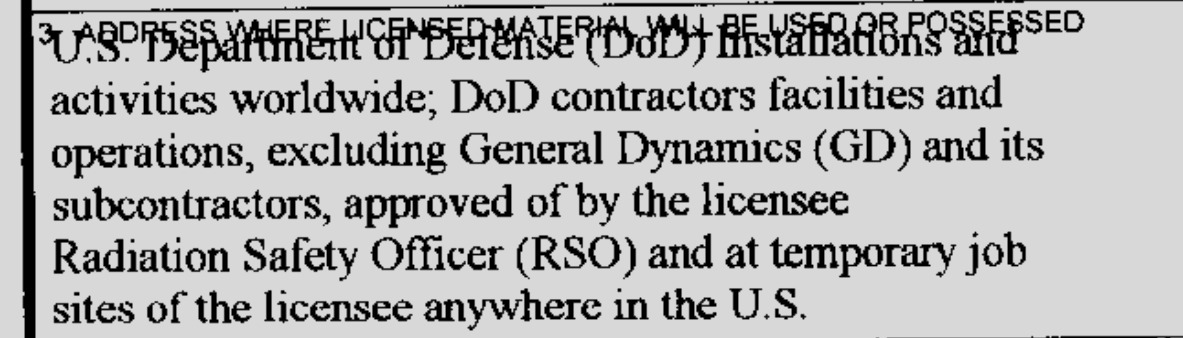
You are ignoring the structure of the license. Item 9 authorizes “Use… of tank turrets and hulls.” Item 8 sets the possession limit for both A and B materials as “As Needed.”
If the hull count was statically fixed at 5 while only the turret count fluctuated, the NRC would have split the possession limits. It would read: “Turrets: As Needed / Hulls: 5.”
It does not say that. It applies the “As Needed” classification to the entire category of “turrets and hulls.” The regulatory treatment is identical for both components because both are part of the active, fluctuating fleet inventory.
Calling the literal text of the license conjecture is a bold defense. The document explicitly groups turrets and hulls under a single possession limit. That is a fact, not a guess.
But if you want to talk about facts versus conjecture, look at the NRC’s own explanation again.
NRC Integrated Materials Performance Evaluation (2012), Page 38:
The number of M1 tanks and tank parts in their possession at one time changes frequently and specific information on the quantity of DU in the tanks and tank parts was considered classified information.
That is not my opinion. That is the regulators written statement.
It does not say the turret count changes. It says the number of M1 tanks changes.
It does not say the count is 5. It says the count is classified.
If the number of DU hulls was a static 5 for the last 20 years as you claim, the inventory would not change frequently, and the count would not be a matter of national security. You are calling the NRCs own rationale conjecture because it disproves your theory.
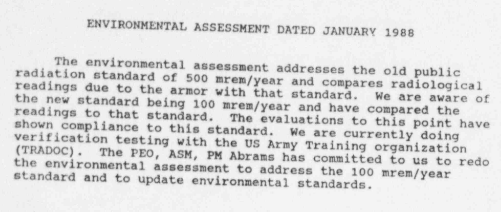
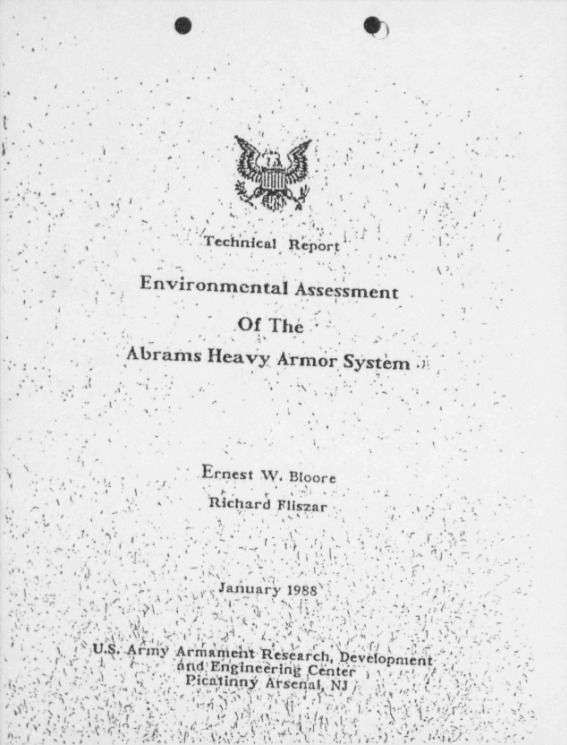
Going round and round about the same thing. Guys clearly not going to concede that and neither are you. So lets just move on and look specifically that a 1988 Assessment States Heavy Armor System as being Radioactive. Further statements of Heavy Armor in the Hull and Turret of the AIM Refit/Rebuild program states in both Hull and Turret. So why would a report from 1988 State the Heavy Armor is Radioactive to then have a later Document State “Heavy Armor in Turret and Hull” When The Hull never got DU atleast with the AIM Refit/Rebuild? If the Heavy Armor System was just DU Turret On the Same A1 hull it would just state Heavy Armor System applied instead of Specifically Listing both Hull and Turret? Its from 1988 which Post Dates A1 and Predates A2 and AIM So if the Heavy Armor System implies the addition of DU to the Turret since we already agree the IP and A1 have the same hull would that not also mean the Heavy Armor System refers to the DU Usage?