The only reason it would be “inconclusive” like you state is if the Military didn’t use plain and simple terms and language for descriptors and instead were using blanket terms and statements. When the Military uses distinct terms Like “Heavy Armor” they are directly referring to the use of Depleted Uranium as that in itself is what makes up the Heavy part of the Heavy armor.
Exactly as I thought. Why does anyone use this source and expect to be taken seriously?
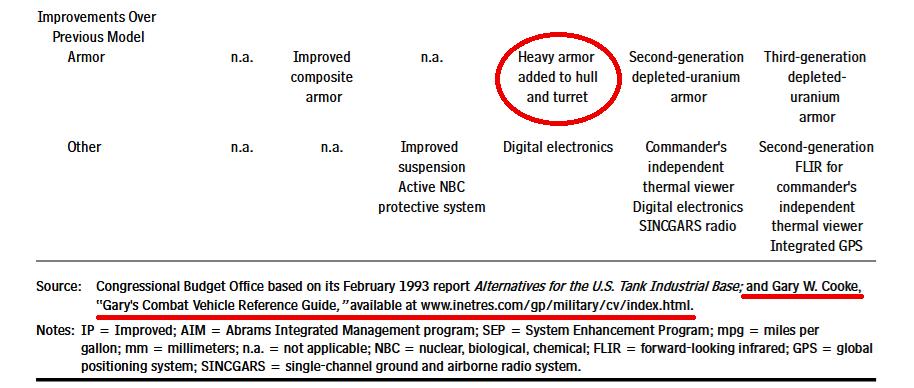
First problem: It’s based off of some random guy’s blog.
Second problem, feel free to visit the blog (which I’ve linked below) and try to find me any mention of the M1A1 AIM utilizing DU in it’s hull armour composition (spoilers: It doesn’t).
https://www.inetres.com/gp/military/cv/tank/M1.html
Third problem, even if this person’s blog did mention DU hull armour anywhere, what would be his source for this being the case?
Fourth problem, the first source that’s quoted in the CBO report dates to 1993 and it makes no reference to DU hull armour anywhere, it also makes it clear that the M1A1 AIM addition comes purely from the ‘Gary’s blog’ source.
3 Likes
The Congressional Budget Office (CBO) is the primary auditing agency for the US legislative branch. They have full access to Department of Defense budget requests and program data. They do not define multimillion-dollar defense procurement programs based on a fan blog.
The footnote references “Gary’s Guide” and the 1993 report as sources for the general unclassified specifications in the table (like vehicle dimensions, fuel capacity, and range).
The line item “Heavy Armor added to hull and turret” is there because that is the specific upgrade the Department of the Army requested funding for. The CBO tracks the taxpayer money. The Army asked for money to put Heavy Armor in the hull, and the CBO reported it. Suggesting that federal budget analysts had to check a website to find out what the Army was buying is ridiculous.
2 Likes
These sources are from 3 different instances. one is the army, one is a budget regulatory office and the third is the Nuclear regulatory commission. No where in any of them do they clarify explicitly that DU is in the hull.
The army states that DU packages are part of the Heavy Armor System, they do not say the the Heavy Armor System only consist of the DU packages and nothing else, in fact they do not even directly state what the Heavy Armor System even is. They in their application say that “Heavy Armor” has been added to many turrets and 5 hulls (they do not use the word “System” here, making the terms different)
The CBO Says that Heavy armor (Not Heavy Armor System or DU packages) was added to hull and turret. they do not specify what they mean by “Heavy armor” (they even use lower case " a " and earlier in the document talk about “a newer heavier armor”) or what that “Heavy armor” is.
Six years after the CBO claims that the Heavy armor was installed the NCR removes the DU limit for possession and simultaneously for number of hulls.
There is no source that states that DU packages were added to the rest of the Hulls after that.
This is why I don’t engage in discussion with you, because you just chose to ignore literal facts when they don’t suit your narrative.
Where did they state this?
Or are you assuming again?
1 Like
The blog does not contain the phrase “Heavy Armor added to hull and turret.”
Since the text does not exist in the blog, the CBO did not source it from there.
The Congressional Budget Office audits Department of Defense appropriations. The program specifics come from the Army budget requests being analyzed in the report itself. Claiming a federal audit copy-pasted nonexistent text from a fan site is illogical.
2 Likes
“They in their application say that “Heavy Armor” has been added to many turrets and 5 hulls (they do not use the word “System” here, making the terms different)”
But its the exact same Verbage used in the CBO report. “Heavy Armor added to hull and turret” that means the Heavy armor mentioned in the 1988 document is the same Heavy Armor added to the hull and turret of the A1s being Rebuilt to the AIM standard.
1 Like
Not capitalizing the " a " in armor does mean that it can be read as a different thing. As @senzawa has pointed out.
So another point against your claim, they aren’t even capitalized the same.

Look at the section for the M1A1 AIM on that same page. The blog text simply lists “Armor upgrade” with no further details.
The CBO report explicitly lists “Heavy armor added to hull and turret.”
Since the specific location and material details for the AIM are missing from the blog but present in the CBO report, the CBO obviously referenced internal program data to fill in the blank. The blog is generic but the audit is specific.
Still different capitalization so doesn’t automatically refer to the same thing :)
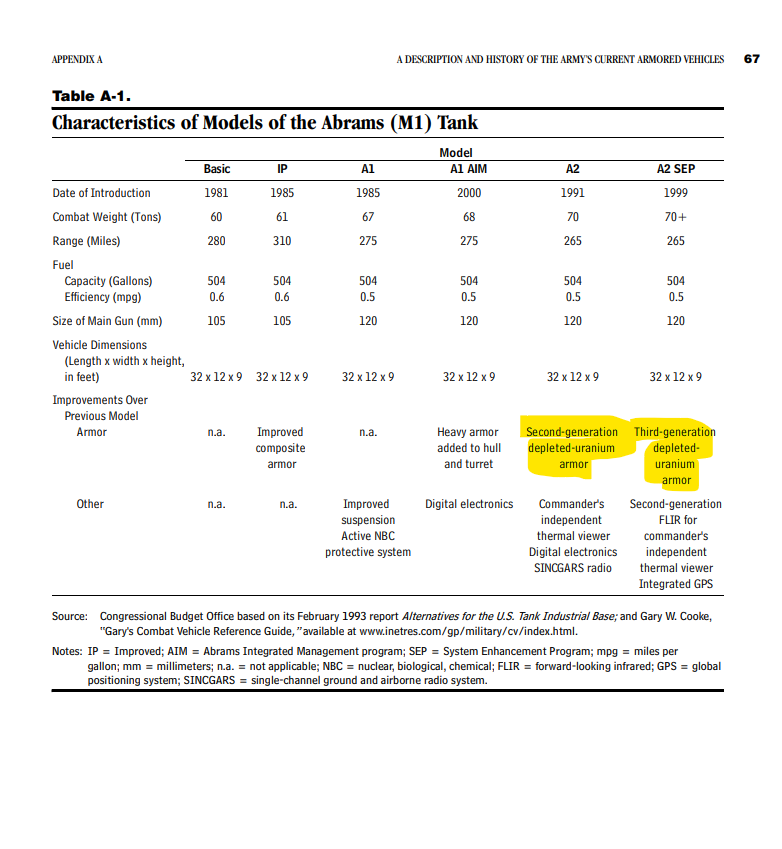
Look at the M1A2 column in that same CBO table.
It lists Second-generation depleted-uranium armor using lowercase letters.
If your argument is that capitalization invalidates the definition, then by your own logic the M1A2 has no DU either.
So if Heavy Armor in the Turret is referencing the 1988 DU System what could possibly be referenced later as Heavy armor? Please explain what logically could be Heavy armor thats added to the hull that isnt DU then? I want to see what you think Heavy armor could reference otherwise that would be acceptable as a “Heavy” substitue. Logically DU would make the most sense since it is 2.5x more dense than steel.
You have not shown that there is a defined “Second Generation” term that they skipped capitalization on so that argument has no base to stand on.
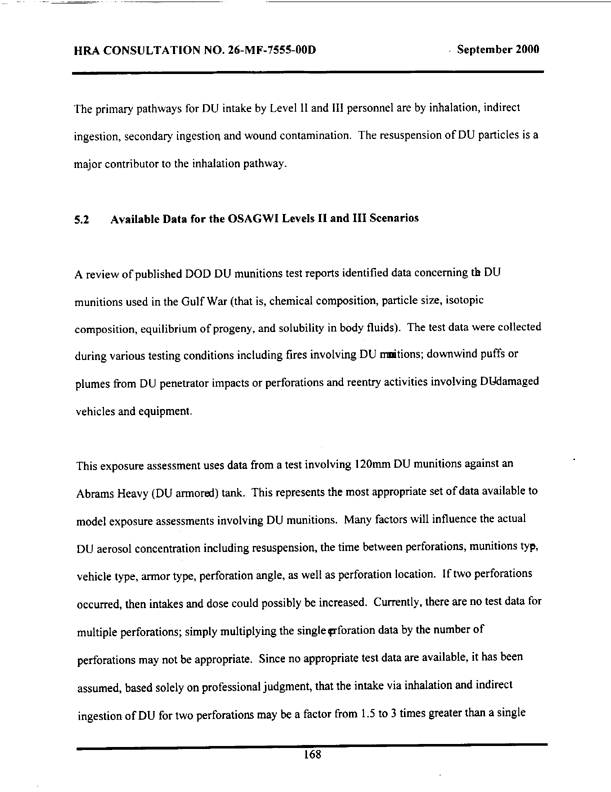
Just another thing to add to your “HEAVY ARMOR = DU” argument
This is a primary source documenting that verbiage
https://gulflink.fhpr.osd.mil/du_ii/du_ii_refs/n52en091/0335_003_0000208.htm
1 Like
The table uses standard sentence case for every single entry. Look at the IPM1 column. It lists “Improved composite armor” in lowercase. Look at the M1A2 columns. It lists “depleted-uranium armor” in lowercase.
Arguing that capitalization voids the technical definition is desperate. The report clearly distinguishes between Improved composite for the IPM1 and Heavy armor for the AIM. If the materials were the same, the CBO would have used the same text. Instead, they utilized the specific term for the radioactive package defined in the Federal Register. Capitalization is a formatting choice, not a material change.
Exactly that, heavy armor, armor that weighs more. They use the term that way 3 times in the document when referring to the Abrams. The Capitalization in the table is because it’s the start of a sentence.
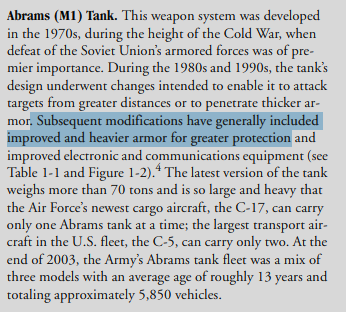
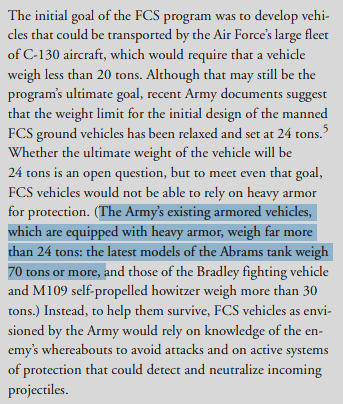
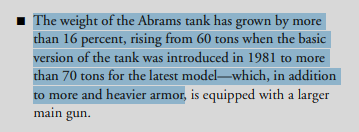
Yes, that is what he claims is previously defined and that they skipped capitalization on making that the standard for the table. I have not see a previous definition with that term capitalized.