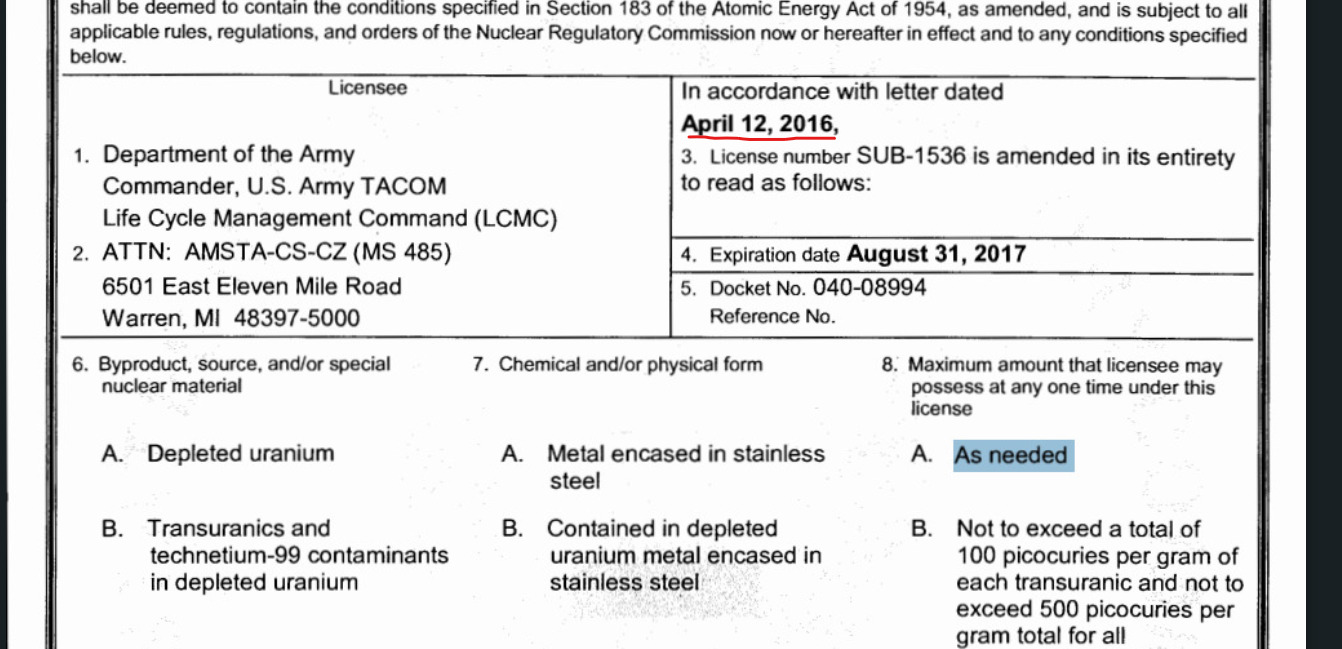
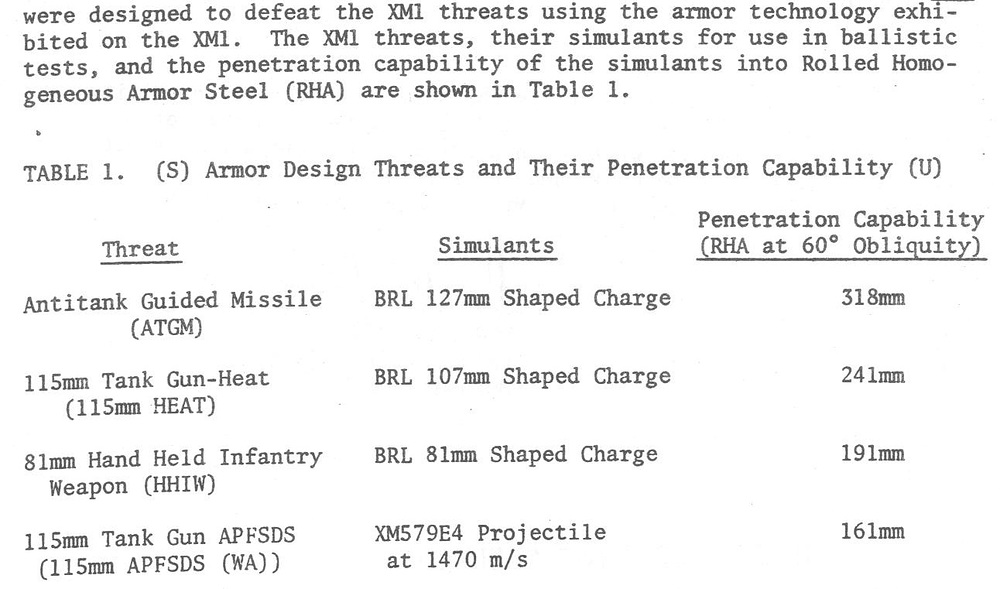
I actually looked closer at that parts database link and you are right, that was a mistake on my end. I missed that it was categorized under the M113 family, so I will drop that specific NSN point.
On the semantics of the word some, I understand your concern about speculation, but in the context of federal defense reports, it is usually used to group production blocks. Since the SEP v1 and v2 are the specific versions built or upgraded in large numbers after 1998, it is logical to see them as the intended group. It distinguishes the modernized fleet from the early 1990s models.
But even if we set the semantics of that one sentence aside, we still have the PNNL-14168 report from the National Laboratory. That study explicitly states that during Phase III testing, they fired directly into a DU-armor package of an Abrams Ballistic Hull and Turret. A BHT is a production-representative test unit. This isn’t a guess; it’s a technical description of the actual hardware used in a multi-million dollar scientific safety study.
When you combine that with the Federal Register confirming a production cut-in for the M1A2 in 1996 and the CBO explicitly telling Congress that heavy armor was added to the hull and turret, the picture becomes very consistent. The physics also back this up. The M1A2 is roughly 5 to 7 tons heavier than the M1A1. Adding that much mass without changing the physical dimensions of the tank can only be explained by a massive increase in material density in the frontal arc. If that weight isn’t the heavy armor package in the hull, there really isn’t another component in the tank that accounts for that much missing weight.
I’m just trying to follow the logical chain from the different federal agencies and scientific reports. It seems more likely that they are all describing a production reality rather than all of them being mistaken about the hull.
That chart actually illustrates the point quite well. If you look at the jump from the baseline M1A1 at 65.1 tons to the SEP v2 at 69.3 tons, you are looking at more than 4 metric tons of added mass. If you look at the SEP v3, that growth hits over 8 tons.
My argument is that this entire lineage of heavy armor tanks, starting from the M1A1 HC and AIM through the M1A2 series, represents a significant mass increase that aligns perfectly with the federal documents I provided.
The CBO report explicitly tells Congress that the heavy armor was added to the hull and the turret for the M1A1 AIM and M1A2 upgrades. The Federal Register notice confirms the production cut-in for this package happened in 1996. The weight growth you see on that chart between the M1A1 and the M1A2/SEP variants is the physical evidence of those documents being put into practice.
You mentioned the M1A1 HC doesn’t have it in the hull, but that is exactly what the new evidence is challenging. If the budget reports and environmental assessments are defining this heavy armor program as a depleted uranium package applied to the hull and turret, and the tank’s weight jumps by several tons during those exact production years, it’s a very consistent picture. We can’t really assume 8,000 to 10,000 pounds of extra material is all packed into just the turret cheeks when the official records specifically name the hull as part of the upgrade.
Fair enough on the short ton vs metric ton distinction, but that still leaves us with about 6,600 pounds for the M1A2 and over 8,000 pounds for the SEP v2. The M1A1 HC was already the “Heavy Common” version with the heavy turret armor, so that extra weight has to be accounted for somewhere.
If you tried to pack another 3 or 4 tons purely into the turret cheeks, the center of gravity would be shifted so far forward that the front suspension would be constantly bottomed out and the tank would be essentially undrivable. It only works if that mass is distributed across the frontal arc, which is exactly what the CBO report confirms when it explicitly tells Congress the heavy armor was added to the hull and turret.
The documents say it’s in the hull, and the physics of the weight increase require it to be in the hull to keep the vehicle balanced. It’s easier to believe the official record than to assume the Army built a tank that’s physically impossible to drive.
They didnt “pack” another 3-4 tons on the turret, the hole upgrade from the HC to the M1A2 is 3/4 of a ton, later on with the V3 which iirc there is pretty solid evidence of the upgraded hull they packed over 5 tons on the hull and turret armor, which did get an visually bigger array.
You are confusing the timeline. The SEPv3 (M1A2C) did not exist when these documents were written.
The DOI Document: Explicitly states “M1A2 Abrams tanks built after 1998.” The SEPv3 entered service around 2020. The “After 1998” production run refers to the M1A2 SEPv1 and subsequent SEPv2 refits.
The CBO Report was published in August 2006 . It explicitly lists “Heavy armor added to hull and turret” for the M1A1 AIM and M1A2 . The SEPv3 would not be designed for another decade.
To claim these sources apply only to the SEPv3 requires you to ignore the dates printed on the pages. These documents describe the fleet as it existed in the early 2000s.
That chart actually backs up the CBO report, it doesn’t disprove it. You need to look closer at the specific variants listed there.
First, look at the M1A1 SA column. That stands for Situational Awareness, which is the AIM refit program. Your chart shows it is nearly a full ton heavier than the M1A1 DU, which represents the older Gulf War standard. The CBO report I linked explicitly lists the M1A1 AIM having armor added to the hull and turret. A full ton of weight gain fits perfectly with a hull armor upgrade; electronics do not weigh that much.
Second, look at the SEPv2. It jumps up to over 71 tons. The CBO report was published in 2006, and the DOI document refers to tanks built after 1998. That covers the entire SEPv1 and SEPv2 production run.
So you have a 71 ton tank in 2006, and a Congressional report from 2006 stating that the government is paying for heavy armor in the hull. The chart just confirms that the mass exists to support what the documents say.
The documents were written after SEP2 was in service and when SEP3 was in development.
The documents you provided talking about DU hulls were not made in 1998.
You only ever provided one 1998 document which is talking about the DU in turrets.
The 2006 document also states no DU armor in hulls. Just improved armor and gives no numbers on the new protection the standard array gives.
The first ever one to talk about DU hulls is 2014, which is a student Thesis.
You are confusing the timeline. The SEPv3, or M1A2C, didn’t even enter Low Rate Initial Production until late 2017.
The DOI document explicitly refers to tanks built after 1998. That timeframe corresponds to the M1A2 SEPv1 and the later SEPv2.
The CBO Report was published in August 2006. It explicitly lists heavy armor added to hull and turret for the M1A1 AIM and M1A2. The SEPv3 wouldn’t exist for another decade. The CBO was auditing the fleet as it existed in 2006.
Regarding the license, the amendment is dated April 2016. That predates the production of the SEPv3. The NRC authorized the Army to possess hull armor for the fleet that existed at that time, which was the SEPv2 and M1A1 SA. You are trying to apply these documents to a tank that hadn’t been built yet to avoid the fact that they describe the tanks we already have.
Though I’d chime in here, but we do have primary values for the XM-1 / baseline M1 and inferred / prospective values for the M1A1 & M1IP so a case could be built if we have any documentation that uses said configurations as a reference.
KVT is not a tank.
KVT is a universal cosmetic kit designed to fit on all M1 variants [at the time M1 Abrams as that was the one in reserve when it was first designed], and by the time it was used M1s were rotated into storage out of reserve, and M1A1s were pushed in reserve.
You are treating these like design proposals or future requirements. They aren’t. They are compliance and audit records for things that had already physically happened.
Look at the verb tense in the 1998 Federal Register. It doesn’t say we plan to add this. It explicitly says that in 1996, a design change was made and cut-in to production effective with Job 1 M1A2 Phase II. Cut-in to production means it happened on the assembly line in 1996. It refers to a physical manufacturing event that took place 20 years before the SEPv3 even existed.
The 2006 CBO Report is a Budget Audit. The CBO audits what the military is currently buying to tell Congress where the money went. When they listed heavy armor added to hull and turret in 2006, they were auditing the M1A1 AIM and M1A2 SEP contracts that were active and paid for at that time. They do not audit budget for a tank like the SEPv3 that wouldn’t be funded for another decade.
As for the license, you don’t get a nuclear possession license 10 years before you build the item. You get it when you need to handle the material. The amendment to As Needed or unlimited quantity in 2016 was required because the existing fleet of M1A1 SAs and SEPv2s circulating through depots required it.
You are suggesting the Army installed DU hulls in 1996 per the Register, paid for them in 2006 per the CBO, but somehow they didn’t actually exist until the SEPv3 in 2020. That is chronologically impossible.
So go cut up a 2010 Abrams and prove your conjecture.
Cause the documents don’t prove your statements correct.
The documents aren’t saying what you want them to say, and the forum has already discussed the 2006 document last year and the year prior and the conclusion hasn’t changed.
The hull array of SEPv1 is changed over M1A1, we don’t know how, but we know it’s not depleted uranium.
Even if this is the case and a fair point, it sadly isn’t stated explicitly in the source so i doubt Gaijin is going to accept it in the way you are intending. You’re still making your own assumptions and coming to your own conclusions about the sources meaning and resulting consequence which isn’t something Gaijin generally accepts as far as i know.
They specify in the same document that the DU tested is only in the turret:
There is nowhere i have seen that specifies explicitly that the Heavy Armor Package contains DU for the hull.
Edit:
As a general guideline tip for doing research in this way, try to at the same time disprove your own theory, read through your sources first once to see if they support your theory and then once to see if they disprove it. This often eliminates selective reading and confirmation bias by making you look for the parts that you don’t want to find.
And the NERA Arrays are designed to be modular, permitting them to freely be refit between hulls as needed.
Also, as no further hulls have been produced since the end of M1A1 production everything since then has be remanufactured to produce a new configuration. So nothing would stop from Gaijin deciding to provide DU Hulls to any particular M1A1 configuration.