I don’t know the differences between those two in game. I know irl they’re absolutely differents, but in-game they look identical. They still uses radar scan sweeps.
AESA is significantly faster, and is able to update targets outside the scan area. mechanical radars are slower, less reliable and can’t update targets outside the scan area
MiGan Fox-3 touches on the benefits of AESA in his latest three videos on AESA planes
2 Likes
The AESA sees and keeps updated every enemy simply by being within the gimbal limit, whilst the TWS, or mechanical radar, only updates the enemies that are on its scan limit. Meaning that the AESA is way more powerfull than the conventional TWS mechanical radar, since the AESA can track planes even if they are out of it’s scan limit unlike the TWS.
1 Like
Then why is everyone complaining about the Su-30SM2 PESA radar when AESA is clearly more powerful?
Cause big ahh horizontal gimbal
You can guide what is the hardest missile to avoid in the game (R-27ER) while perfectly defending
3 Likes
Cause people are complaining about the radar angle lock, since it can be on a defensive position(the SU-30SM2) while maintaining lock on the enemy plane and notching at the same time, while the other planes at that Br and with AESA radar dont have the same angle of search. So imagine, i lock someone with the radar at 15km, i launch an R-27ER, then i change my position to a 90 degree angle or even higher while maintaining the lock on you, so im on a defensive position just in case you launch a missile at me so i can pre-notch. And thats the issue normally, that people dont notch properly the SU-30SM2.
1 Like
The description given is not exclusive to AESA. The TWS updates outside the search zone, faster overal scanrate etc over M-scan radars is the difference with ESA radars, which includes both AESA and PESA.
Irl AESA provides more flexibility in what you can do with the available resources (mostly power), but those advantages are not modelled. Things like gimbal limit and actual power (both of which the Su-30SM2’s radar just has a lot of) is a seperate thing.
PESA does not update outside the scan areas, you can test this in test drive
Works well with the R-77-1 too.
Doesn’t the Eurofighter AESA have bigger horizontal gimbal then the Su-30SM2?
no lol
1 Like
It appears that the N035 (and also N011) have a more limited zone in which TWS ESA is active.
Captor-E has full TWS ESA over 200x200° area:
Spoiler
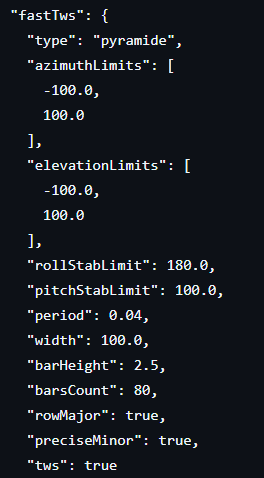
N035E only has a 120x80° zone
Spoiler
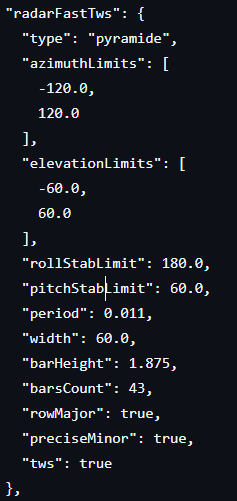
N011 has even less at 90x80°, and only the V001 has full coverage (albeit it’s still 120x120°). This is I think to reflect the actual PESA only has the regular usual limit of ±60°(idk why they have less in elevation, considering they are circular arrays). And the mechanical steering part is I guess not part of the scanning process unlike with Captor, which has a turntable rather, made to be constantly moving and aiding in continuous wider radar coverage.
For instance you can see in this video right at the start that TWS is being held for many targets outside the active search zone: https://www.youtube.com/watch?v=FwpqcpfieHY
Targets are otherwise only held for 4s (as also confirmed by your video)
So I think this is about the zone where TWS ESA works for this radar:
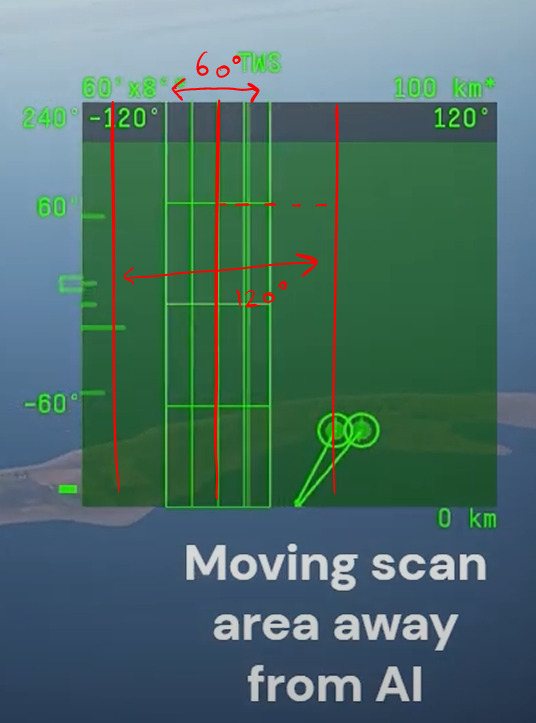
About this part is where also were both targets start fading on the radar screen (the right one started fading a bit earlier, but this alone can be explained by it also leaving the search zone earlier).
If you want, could you perhaps test this by setting the (smaller than 120° width) search zone next to the targets. Also I wonder what happens if you put the radar search zone (a small one, like the 30° one) right at the edge, because then I wonder if it covers for instance from -120 to -60° or only from -120° to 0° (what it realistically should be). Can confirm that if put at the edge, you still get the full TWS ESA width.
Yeah ok this on the dev server, I was too lazy to switch version. But it should still be the same as on live.
1 Like