- Yes, as a tech tree vehicle
- Yes, as a premium vehicle
- Yes, as an event vehicle
- Yes, as a squadron vehicle
- No, I would not like to see the Mosquito NF.36 in game.
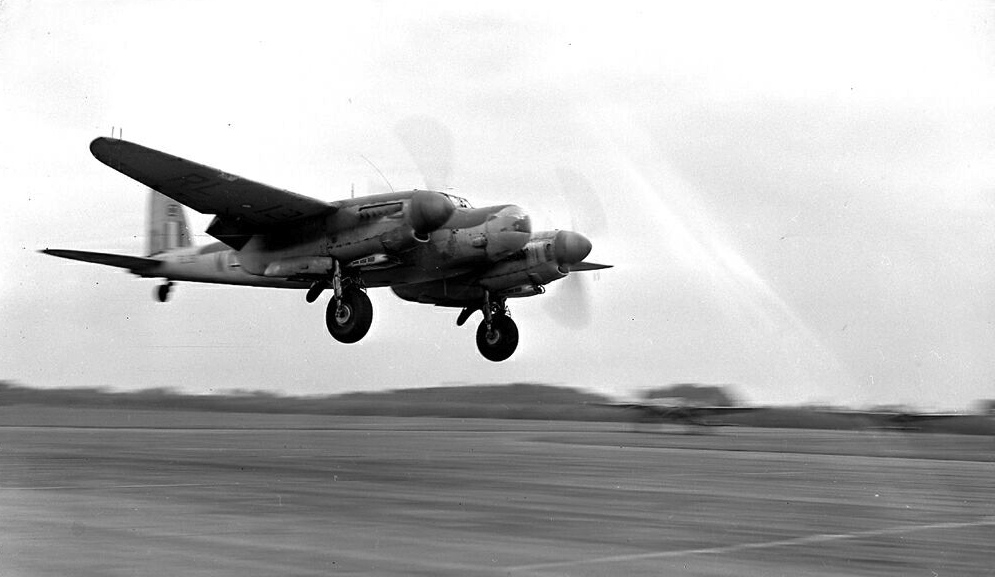
One of the RAF’s NF.36s touching down. In terms of telling the difference between this Mark and the previous NF.30, the enlarged intercooler air scoop (just below the propeller housing) and grilles on the carburetor air scoop are the only visible external differences you will find besides postwar paint schemes being used toward the end of the plane’s service life. It would seem this aircraft has a camera fairing installed for testing.
TL;DR
- Postwar night fighter variant of the Mosquito
- Carries four hard-hitting 20mm Hispano cannons
- Sacrifices machine guns for a more capable AI Mk.X radar set
- Merlin 113 engines take the Mosquito to its max potential
Why it should be in the game: The Mosquito NF Mk.II is a joy to fly and this is essentially that aircraft taken to its peak performance. It would be slightly heavier owing to new engines and a bigger radar set, but the raw power of the Merlin 100 series should be more than enough to make up for that. Its higher performance means that it would have its own niche in the strike fighter/heavy fighter tech line at a higher BR than the other Mosquitos. The NF.36 would go very well with the existing NF Mk.II in a new folder seeing as they fly completely differently to their cousins.
History
This Mosquito NF.30 was used to test the Merlin 113 installation on a night fighter Mosquito. The first production NF.36 would take flight in May 1945, the same month as this picture was taken. With the Merlin 113s installed the NF.30 was practically identical to its successor.

The legendary Mosquito does not really need any introduction. Suffice it to say de Havilland’s design was a huge success and the Air Ministry were extremely pleased with its performance and wanted to apply it to a variety of roles. At the same time, there were concerns that Gloster might not be able to fulfill an obligation to the Ministry’s OR.95 requirement for a turreted night fighter while they were hard at work on their jet aircraft. The Mosquito seemed like the perfect fit for a night fighter conversion. A day fighter version, the F Mk.II, had already been developed, so installing the AI Mk.IV radar was the only work that needed to be done to make it into an NF Mk.II night fighter. Progressive improvements to the night fighter type over the course of the war saw new radars introduced with new noses required to house them. Besides the experimental Mk.XV offshoot the night fighter marks were differentiated mainly by onboard equipment. They would all use Merlin 25s up until the NF.30 variant which used Merlin 76s. By the end of the war in Europe, the night fighter Mosquito’s nose would be radically different from how it started. The new nose was used to house the AI Mk.X, a successful radar of American make.
Around this time Rolls-Royce had finally gotten the Merlin 100 series engines to work in a reliable state. Naturally the Mosquito, being powered by Merlins, would be trialed with the new Merlin 113s. The results were satisfactory and production of the photo-reconnaissance PR.32 and bomber B.35 versions began. The NF.30 would receive the same treatment; after the new Merlins were cleared for installation, the NF.36 was born (though some NF.30s would have Merlin 113s installed too). The NF.30 was already quite speedy at high altitude with its Merlin 76s, but the Merlin 113s gave the Mosquito NF what it needed to be a high performance aircraft at all altitudes. Speed figures vary wildly from source to source, but based on test data from the NF.30 and PR.34, the NF.36 would have a sea level speed of around 330 mph - 335 mph (531 km/h - 539 km/h) with a top level speed of around 425 mph (684 km/h) which lines up with common figures given for the NF.30 (most likely with Merlin 113s installed.)
While not the greatest picture, it will have to do as this aircraft is rather camera-shy. This NF.36 (RL236) served as part of No. 39 Squadron stationed at Kabrit AFB in Egypt. The winged bomb emblem on the tail is a carry-over from when the squadron was a bomber squadron. It would later reform again as a recon unit.

Those speed figures might sound impressive (and they were certainly good enough for NF.30s catching V-1s) but the world was quickly advancing into the jet age and the NF.36 only entered service after the war in Europe was over in mid-1945, with 163 units being produced from 1945-1947. One might think that would spell the end for the Mosquito in service, but the NF.36 managed to endure until 1953. While bombers and fighters were enjoying the fruits of the jet revolution, night fighters were still sorely lacking. Therefore it fell to the Mosquito to be the backbone of all-weather interception duty at home and abroad. Six squadrons based in the British Isles fielded the NF.36 while one more fielded them in Egypt. The aircraft never saw combat and would finally be phased out by Meteor and Vampire night fighter versions in the early 1950’s, but until then they were Britain’s shield against nighttime intruders.
Specifications
Mosquito NF.36
Dimensions:
- Length: 41 ft 9 in (12.73 m)
- Span: 54 ft 2 in (16.51 m)
- Height: 15 ft 3 in (4.65 m)
Weight:
- 15,241 lb (6,913 kg) empty
- ~ 20,500 lb (~ 9,300 kg) loaded
Propulsion: 2 x Rolls-Royce Merlin 113/113A 12-cylinder inline engine
- Takeoff power: 1,690 hp each; 3,380 hp total
- Maximum power (@ 2,362 m [7,750 ft]): ~ 2,000 hp each; ~4,000 hp total
- High altitude power (@ 6,705 m [22,000 ft]): 1,690 hp each; 3,380 hp total
Maximum speed:
~335 mph (539 km/h) @ sea level
~425 mph (684 km/h) @ 31,700 ft (9,662 m)
Armament:
- Guns:
- 4 x 20 mm Hispano Mk.II autocannon (150 rounds/gun, 600 total)
- Drop tanks:
- Up to 2 x 50 imp. gal. drop tank
- Up to 2 x 100 imp. gal. drop tank
Crew: 2 (pilot, navigator/radar operator)
Additional equipment:
- AI Mk.X search radar
Sources
- The de Havilland Mosquito by M. J. Hardy (1977)
- Mosquito in Action Part 2 - Aircraft Number 139 by Jerry Scutts (1993)
- In Focus Late-War Mosquitoes
- PRESS RELEASE - Mosquito NF.36 restoration confirmed - The People's Mosquito
- https://www.wwiiaircraftperformance.org/Aircraft_Engines_of_the_World_Rolls-Royce_Merlin.pdf
- https://www.wwiiaircraftperformance.org/mosquito/mm748.pdf
- https://www.wwiiaircraftperformance.org/mosquito/mosquito-performance-aussie.pdf
- WRG - Allied Aviation Annex - British Aircraft Specs - de Havilland Mosquito