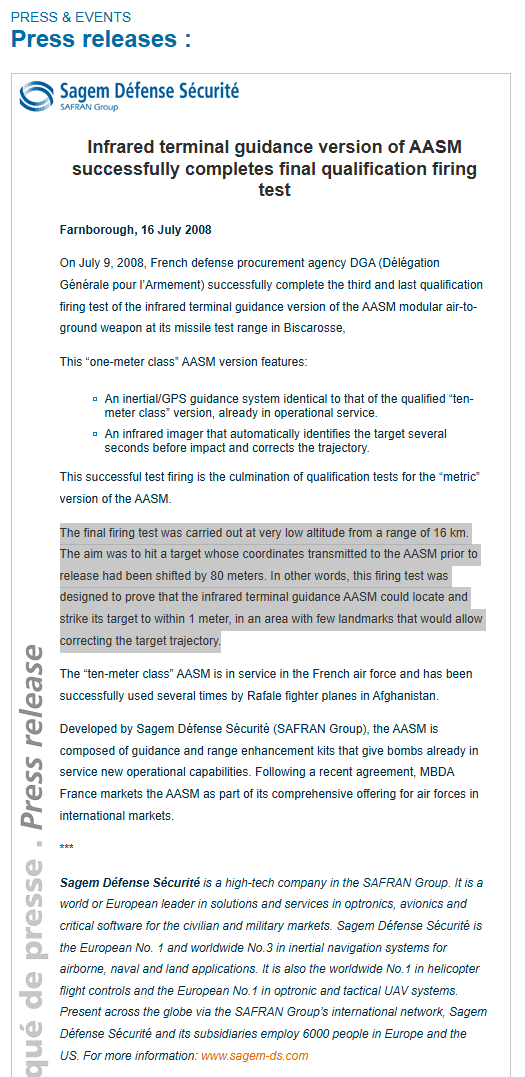
Primary source is explicit that the AASM IR is capable of re-finding its target even if the target had moved, in fact the primary source is a press release after testing had been done to see if the AASM IR would still have found the target after it had moved (which the press release confirmed it did).
Given that it is vehicles that move, and not buildings/roads that should answer your question.
Also primary sources assert recognition/identification capabilities.
From reviewing all the primary materials, the AASM-IR should be capable of being launched at any distance towards a target after the Rafale downloaded images from targeting pod to the AASM-IR, for it to travel until it is 1.5km above the given coordinates (total distance may be greater as the 1.5km is just the vertical distance).
From there, the AASM-IR is able to lock onto vehicles that have moved and even discriminate against vehicles. For instance if it was told to target a Russian tank but the original tank had its turret blown off, then it would no longer be recognizable as a tank and instead an intact tank (usually an operating one) should be targeted if in the same area.
Simce there have been cases now where sources have been misused and information has been deliberatly misused like the IR only starting to work from a 1.5km rannge.
Besides that about the databank in general and it avoiding blown off turrets i would fully understand. But thats likely spaghetti code issues where it would still go to intact wreckages. Since most kills in war thunder are over exagerated the image stuff cant realy be used
It should be stated again that the IR seeker will only turn on 1.5km ABOVE the target once it has reached the “basket”, likely meaning the seeker range is somewhere around 2.5km
What’s really going to matter is what is the FoV of the seeker head and thus, how far the missile can see?. After that, If the target is still within the FoV of the AGM, is it able to adjust onto the target fully, even at the out edges of its FoV?
If the target has moved too far from its previous position, then the seeker simply wont find it.
No, as long as the target has not moved more than 80m then it can land within 1 meter. The landing distance may be greater than 1 meter if the target has moved further than 80m.
I will be honest. It does not say it can target moving things per-se.
We do not know what was the size, and what even the target was.
Example of my point: You input a military hangar, and you shift its input coordinates by 80m. The hangar looks the same in the IR mapping as in the pre launch data, so the missile will correct onto it, even if the coordinates are not 100% in line with what was given to it.
I don’t think that is particularly conclusive. The brochure says the IR seeker is used in situations of “Poor
geopositioning or GNSS-denied environments”
Is seems to me that the press release is talking about a test to confirm performance of the weapon in those conditions. Basically they offset the co-ordinates they programmed the bomb with by 80 m from the target to simulate the bomb going slightly off course due to degraded / missing GPS, or alternatively the co-ordinates of the target not being precisely known at launch, and checked that the bomb was able to recognise the target and correct its course. Basically it was just a test that the weapon could correct its course when the target co-ordinates it was given do not match the exact location of the target it sees in front of it.
Nothing in that press release (or anything else that has been posted thus far) confirms that the IR AASM is capable of tracking small targets such as tanks, or capable of tracking moving targets. The information that has been posted so far all points towards it being a terrain matching system (I’m including buildings and roads, etc. in the word “terrain” for brevity) like what is used by Storm Shadow / SCALP.
The seeker information processing diagram appears to be showing a terrain matching system, rather than a target tracking system:
This brochure also confirms that a model of the area surrounding the target need to be created and uploaded to the weapon before use.
I agree with the motion that it is not able to accurately hit fast moving Mobile units. The sensor just does not have the fidelity, refresh rate, or gimbal tracking to actively achieve this.
It is however capable of hitting large objects that can relocate from previous known data, for example your satellite data indicates target is in location A, but by the time you get there, the target is a short distance away in location B.
For example:
Warships in a port that have moved a short distance.
Mobile installations, such as surface to air radars or Launchers that operate as static objects.
Portable buildings/structures
Parked aircraft that have been moved to a new location.