Description
Background
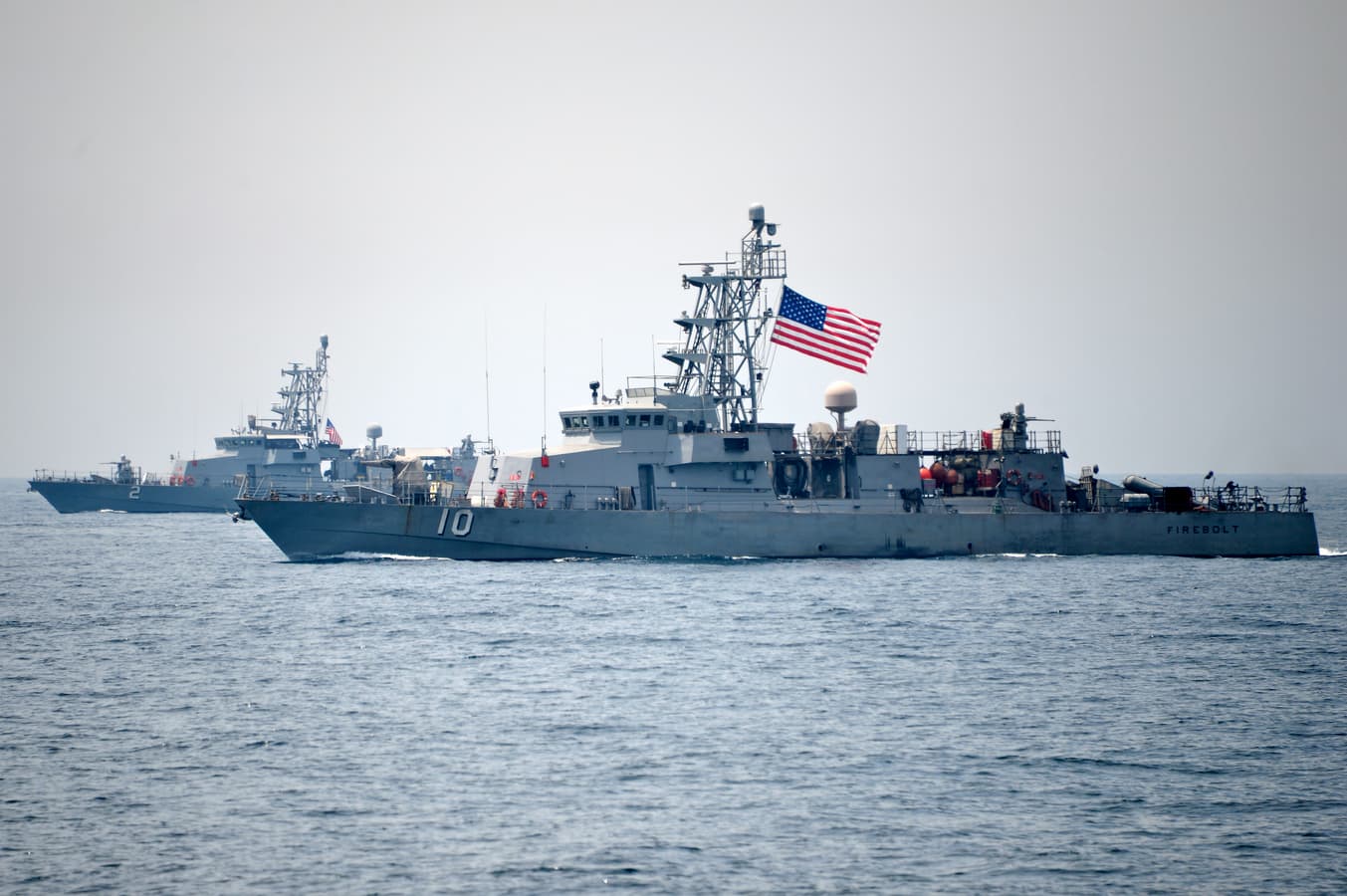
USS Firebolt (PC-10) was the 10th of 14 Cyclone-class patrol ship vessels of the U.S. Navy. It was laid down between September 17, 1993, and June 10, 1994, and commissioned on June 10, 1995. USS Firebolt and other vessels of the Cyclone class were designed primarily to perform coastal patrol and interdiction surveillance, with the capability to support US Navy SEALs and other special operations forces. Their homeport was designated as Manama, Bahrain, for future operations.
The initial armament consisted of two 25 mm Mk 38 chain guns, two 40 mm Mk 19 automatic grenade launchers, two .50-caliber (12.7 mm) Browning machine guns, and six FIM-92 Stinger missiles, which required shoulder-fired operation by personnel.
In February 2003, Firebolt was deployed to the Persian Gulf during Operation Enduring Freedom and Operation Iraqi Freedom. It later operated in the Gulf of Aden, where it conducted a rescue operation that saved 89 survivors after their small craft capsized off the coast of Somalia in April 2005. For the remainder of her service, she conducted patrol duties in the Persian Gulf.
In 2009, Firebolt underwent modernization to extend its service life by another 15 years, bringing the expected total to around 30 years (2023–2026). This initial modernization included significant alterations to the hull, mechanical, and electrical systems, as well as updates to the weapons systems and Command, Control, Communications, Computers, Intelligence, Surveillance, and Reconnaissance (C4ISR) suite. Cyclone-class vessels that received this modernization completed the process by 2017.
A subsequent Patrol Coastal Modernization Program replaced Firebolt’s and other vessels’ original, non-stabilized, hand-fired Mk 38 Mod 0 25 mm guns with the newer Mk 38 Mod 2 variant, which provided full stabilization and remote-control capability, along with electro-optical TV, a laser rangefinder, and an infrared sensor. This upgrade significantly improved effectiveness against swarming fast attack craft.
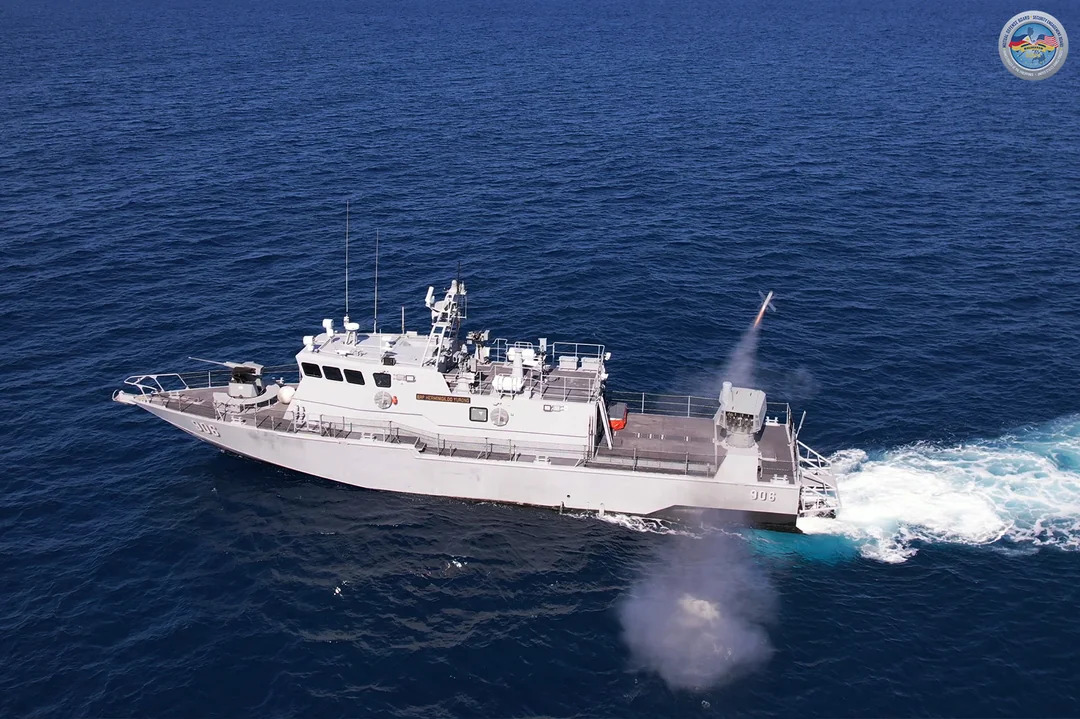
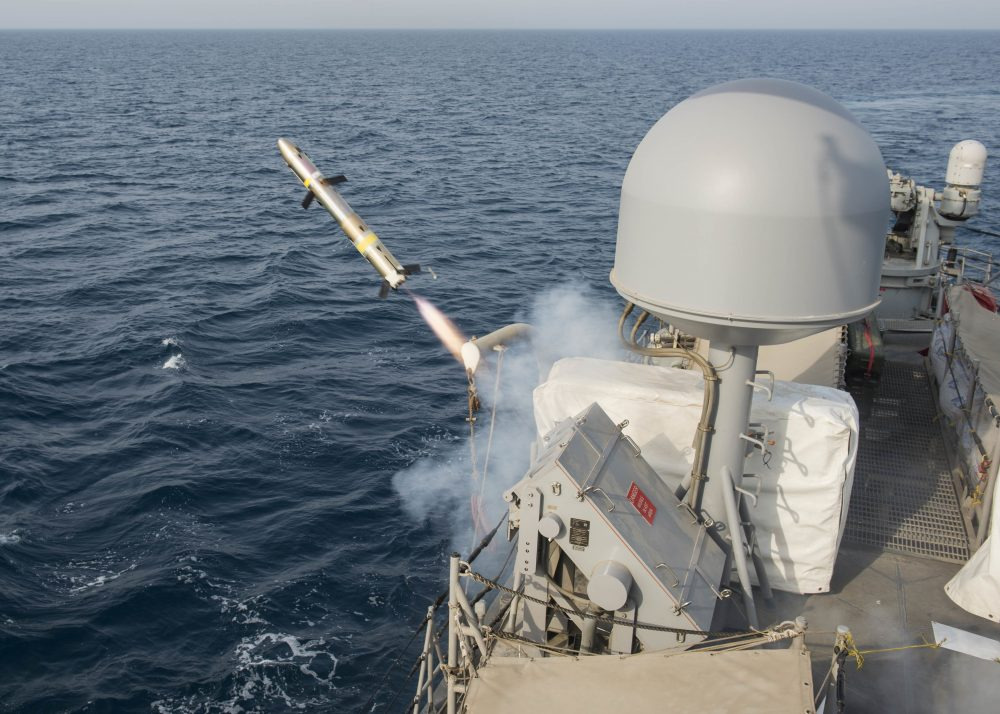
In October 2013, Firebolt and other active vessels underwent further modernization in Manama, Bahrain, to enhance their capabilities by installing Raytheon Griffin short-range surface-to-surface missiles. By 2016, ten Cyclone-class vessels had received this upgrade: USS Hurricane (PC-3), USS Monsoon (PC-4), USS Typhoon (PC-5), USS Sirocco (PC-6), USS Squall (PC-7), USS Chinook (PC-9), USS Firebolt (PC-10), USS Whirlwind (PC-11), and USS Thunderbolt (PC-12). Each received two quadruple Mk 60 Griffin Missile Systems, capable of firing missiles in multiple salvos using semi-active laser guidance. This system provided an additional layer of combat capability beyond the range of the 25 mm guns. On June 28, 2015, it was publicly revealed that Firebolt had successfully fired a BGM-176B Griffin missile during a test and proficiency exercise in the Persian Gulf.
On April 26, 2021, Firebolt and USCGC Baranof fired warning shots at several Iranian Islamic Revolutionary Guard Corps Navy fast inshore attack craft after the vessels closed to within 60 meters despite warnings via radio and loud-hailer in the Persian Gulf, without escalation into a direct engagement. This is considered one of the final notable incidents in Firebolt’s US Navy service. From that point, she continued routine maritime security patrols in the international waters of the northern Persian Gulf. She was decommissioned on February 23, 2022, in Manama, Bahrain, and subsequently transferred and recommissioned as RBNS Jenan (73) on March 30, 2022, with the Royal Bahraini Naval Force.
Armament, Sensors, and Countermeasures
The original Mk 38 armament consisted of a forward Mk 38 Mod 0 25 mm gun and an aft Mk 96 system, which combined a 25 mm chain gun and a 40 mm Mk 19 grenade launcher on a single stabilized platform. Because these systems were non-stabilized and manually operated, they proved insufficient against swarming fast attack craft. Modernization programs introduced the newer Mk 38 Mod 2 guns to address this limitation, replacing both the original Mk 38 and Mk 96 systems.
A 25mm Mk38 Mod 2 gun on Cyclone-class patrol boat
The Mk 38 Mod 2 is derived from the Typhoon Mk 25 Weapon System developed by Rafael. It features a stabilized sensor suite (Toplite) with electro-optical TV, a laser rangefinder, and an infrared sensor, along with a fully stabilized mount and remote firing capability from a console inside the ship. This allows accurate engagement while underway without requiring a gunner to be physically behind the weapon. Using its infrared sensor, the system is capable of operating effectively at night and in adverse weather conditions. The effective range is approximately 2.2 nautical miles (about 2.5 kilometers).
Twin M2HB heavy machine guns on USS Chinook (PC-9)
Firebolt and other Cyclone-class vessels had provisions for twin 12.7 mm M2HB machine guns across five designated mounts. Depending on mission requirements, these could be configured with combinations of twin or single M2HB machine guns, 7.62 mm M240B machine guns, or 40 mm Mk 19 Mod 3 automatic grenade launchers.
The canisters of a Griffin launcher
Firebolt was one of ten Cyclone-class ships outfitted with the Griffin missile system by 2017. Onboard, this system was designated the Mk 60 Griffin Missile System. Each ship carried two quadruple canister launchers mounted atop the deckhouse, positioned near the FIM-92 Stinger containers. This significantly improved defensive and offensive coverage, providing 360-degree engagement capability and extended range beyond the 25 mm guns. When deployed in canisters, the missile was designated BGM-176B Block II (Griffin B). It utilized thrust vectoring to engage maneuvering targets, including fast-moving boats, even when launched vertically, and could be fired in multiple salvos.
FLIR BRITE Star II
The Mk 60 system consists of several components: the Mk 4 Battle Management System (BMS), Mk 208 Griffin Launcher Module, AN/SSQ-133 BRITE Star II sensor/laser rangefinder and designator, and the BGM-176B missiles equipped with a 13-pound (5.9 kg) warhead. The system provides flexible targeting options through a user-friendly interface, allowing guidance via GPS, inertial navigation, infrared imaging, or laser designation. The BGM-176B Block II required semi-active laser guidance, meaning multiple missiles could only be guided simultaneously toward a single designated target.
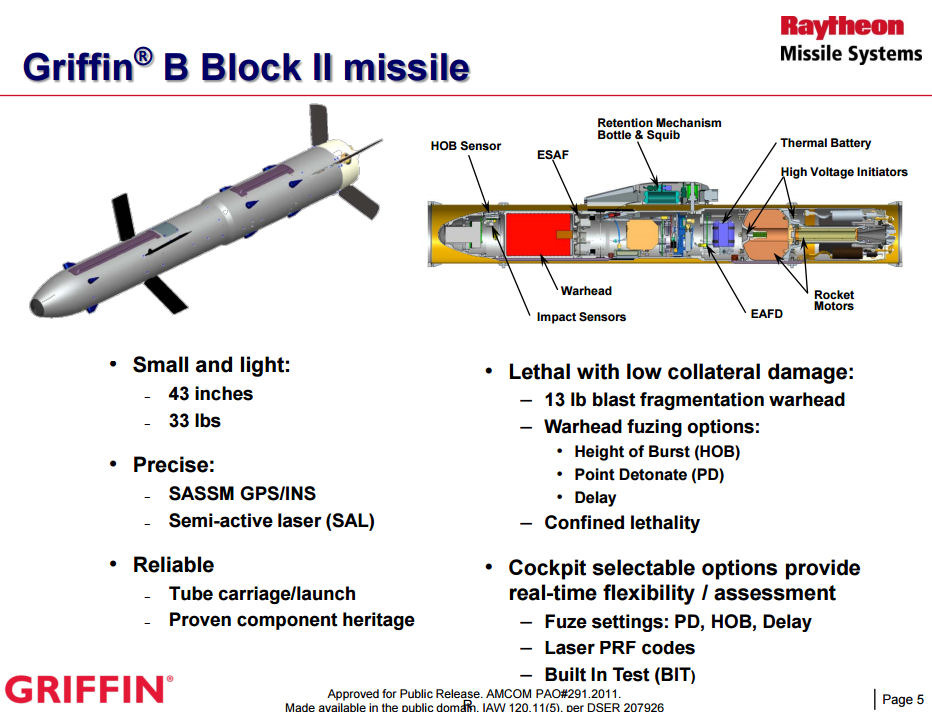
A later upgrade added to the BGM-176B Block II, becoming Griffin C, incorporating a dual-mode seeker with imaging infrared and semi-active laser guidance. This provided a fire-and-forget capability when using infrared guidance, along with datalink functionality for tracking multiple targets. The upgraded system also enabled real-time video transmission back to the operator for target verification. With In-Flight Target Update (IFTU), the missile could be redirected mid-flight, improving accuracy against swarming threats while reducing the risk of collateral damage. The original BGM-176B Block II had an effective range of approximately 3 nautical miles (5.6 kilometers), while the Block II variant extended this range significantly by about triple that original range.
Operator tracking a target aboard the coastal patrol ship USS Sirocco (PC-6) during a Griffin missile exercise, March 18, 2014
Firebolt and other vessels carried six FIM-92 Stinger surface-to-air missiles stored in two containers amidships. These had a range of less than 3.1 miles (5 kilometers) and a maximum speed of Mach 2.2, carrying a 6.6-pound (3 kg) warhead with an impact fuse and self-destruct timer. The system required manual, shoulder-fired operation by personnel.
The AN/SPS-73(V)12 served as the primary surface search radar. It is an X-band, short-range, 2D surface search and navigation radar that provides range and bearing data, automatic target detection, and tracking of surface and low-flying air contacts. In navigation mode, it assists with positional awareness relative to nearby vessels and hazards. The system is capable of tracking up to 200 contacts simultaneously.
For countermeasures, Firebolt and other vessels received an electronic warfare antenna mounted atop the main mast during modernization, although details remain unavailable due to classification. The vessels were also equipped with two six-tube Mk 52 Mod 0 chaff decoy launchers, providing protection against incoming anti-ship missiles since their original configuration.