Type: Infantry Fighting vehicle
ARMAMENT
Spoiler
-
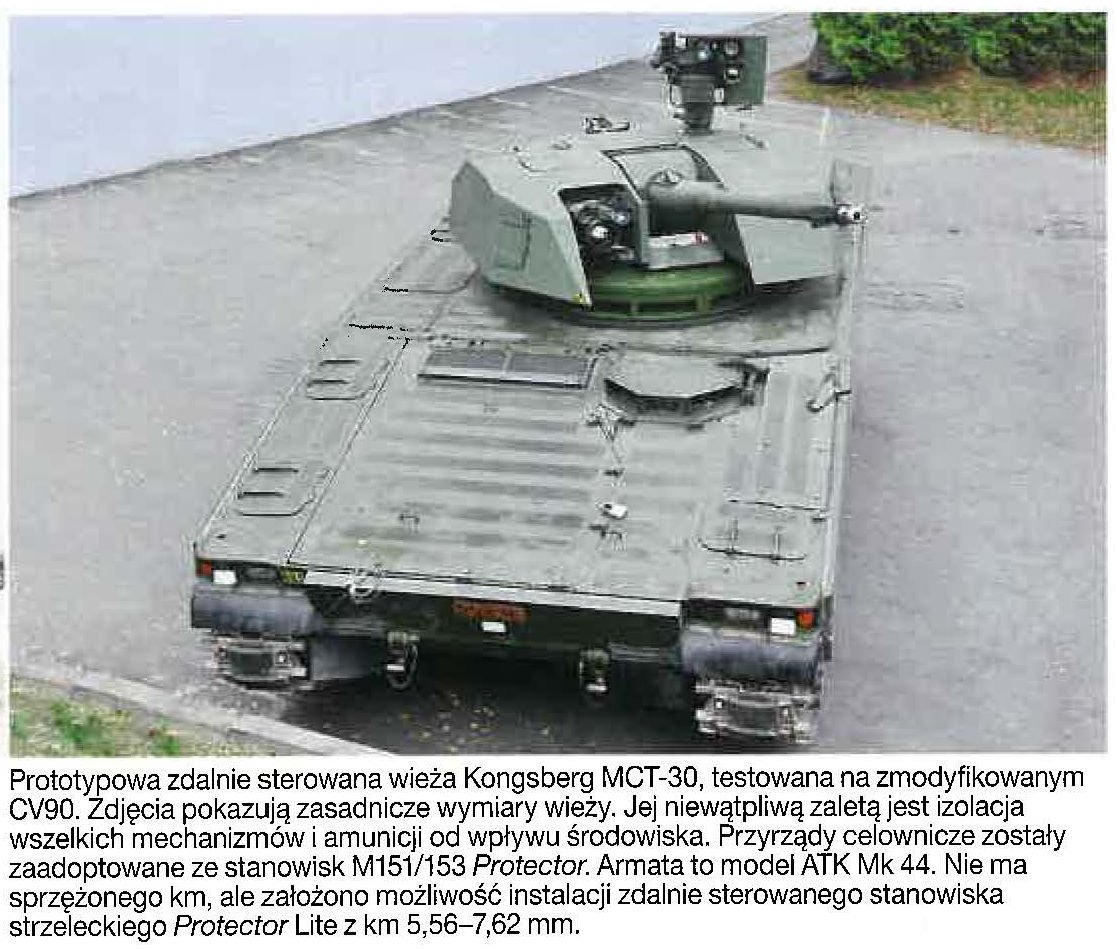
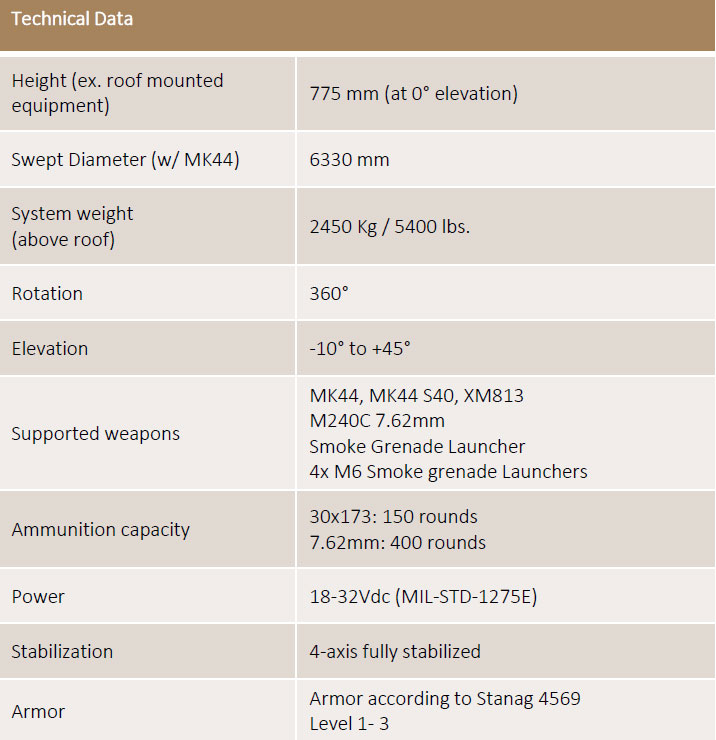
Remote Turret: 1x Kongsberg Remote Turret 40
-Weight: 2450 Kilogram
-Rotation and elevation: 360, -10 + 45 degrees
-Stabilization: 4 axis fully stabilized
-Armor: According to STANAG 45-69 Level 1-3
-Day camera
-Thermal Imager
-LaserRange Finder (LRF)
-Laser warning system
-Integrated Combat Solution (ICS)- Integrated main weapon: 1x 30x173mm Bushmaster Mk.44 cannon
-First round select
-Ammunition: 150 ready rounds
-Weight: Starting at 1250 kg
-Ammunition: All NATO ammunition
-Ammunition Handling: Linkless ammunition feeding 2x75 ready rounds
-Cameras/Sensors: Day camera, Thermal Imager and Laser Range Finder (LRF)
- Integrated main weapon: 1x 30x173mm Bushmaster Mk.44 cannon
-
Kongsberg Protector Lite remote station sight for situational awareness
- Placement: Rear left side of turret, on top
- For the commander, separate from the turret’s own sights, 360 degrees surveillance for increased situational awareness, has among other things NVD
TECHNICAL DATA
Eigne: Scania 14L DS 12 turbo diesel, 610 Hp
Top speed: 70 km/h
Length: 6.54 Meter
Width: 3.18 meter
Weight: 26 Metric Tons
Crew: 3+8 men
ARMOR
Most noticeable is the additional MEXAS on the front of the hull
Ballistic armour plating
HISTORY
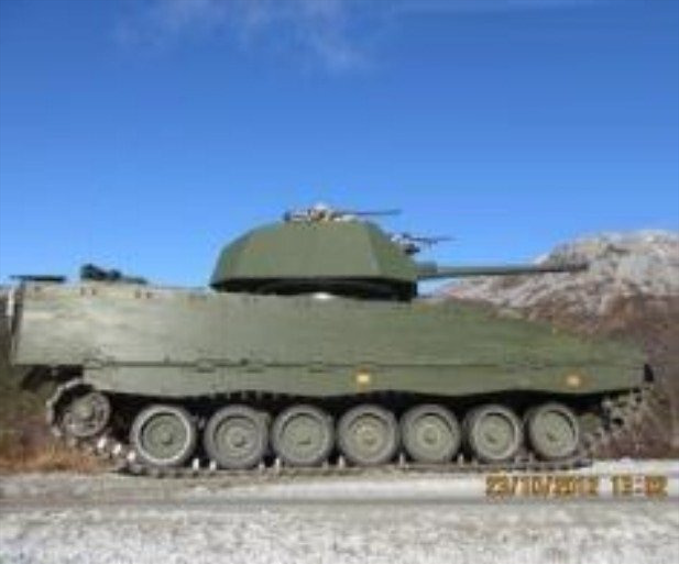
First of all, the image is horrible, this is likely due to it’s age and it being compressed after being screenshotted from one of the datasheets from Kongsberg. Kongsberg Defence & Aerospace is a leading Norwegian technology company wich is a part of Kongsberg Gruppen and is a direct continuation of Kongsberg Våpenfabrikk which was funded in 1814. When this company went through a composition and restructuring in 1987 due to it’s financial problems (including those related to the Toshiba case), the defense division was continued in a new company, Norsk Forsvarsteknologi (NFT), which then changed its name to Kongsberg Gruppen in 1995. Kongsberg Defence has since the 1990’s been developing remote weapon stations which has been sold to many different nations and been adopted on a number of vehicles trough the years. These weapon stations has been in continuous development, with new models being released every now and then and has underwent major changes.
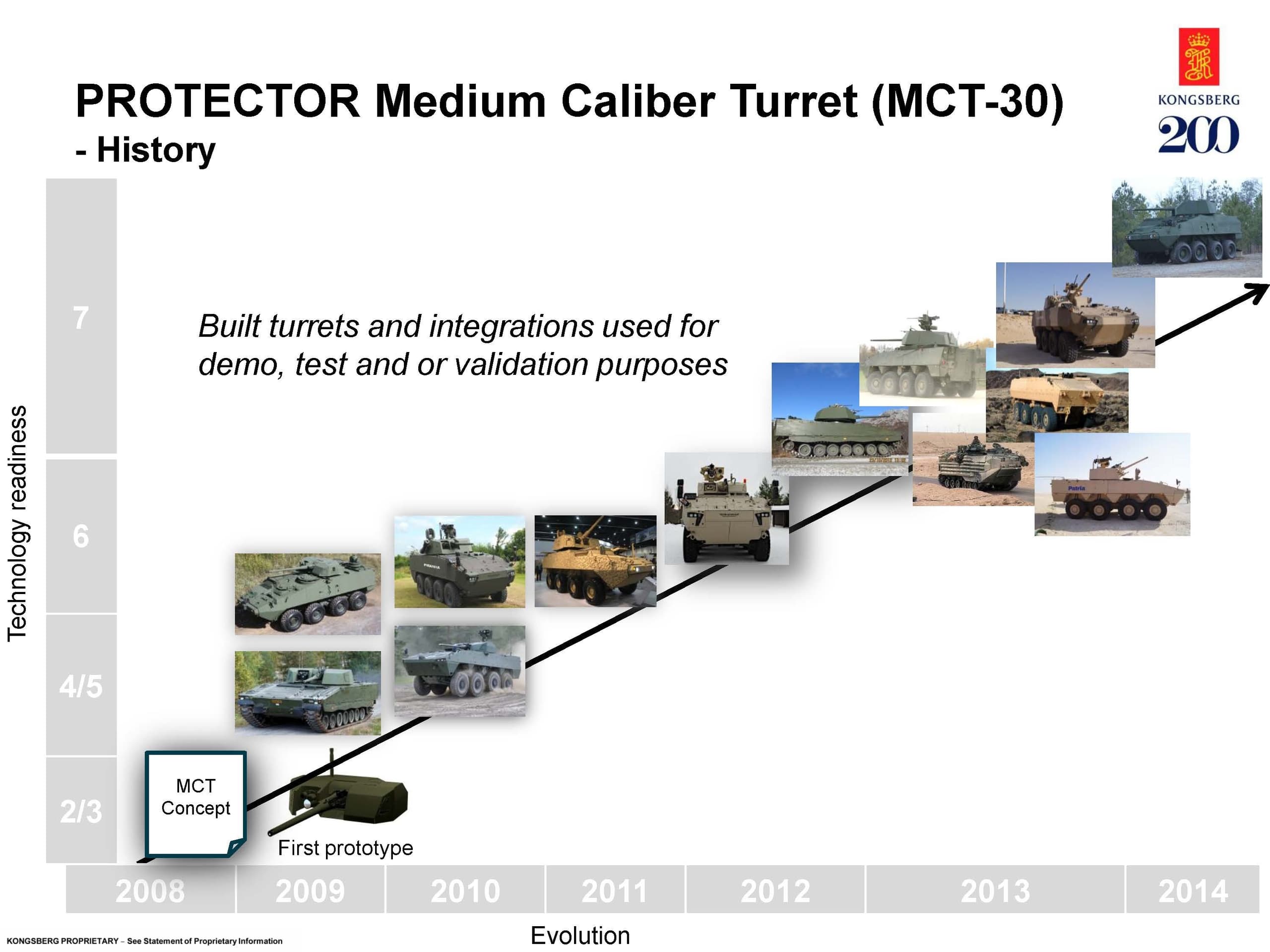
In 2009 Kongsberg Defence & Aerospace began working on developing a new series of product, remote turrets. These were called MCT-30 and featured a stabilized 30mm Bushmaster Mk.44 cannon, with the option for an coaxial machinegun of buyers choice, usually M240 in 5.56mm or the 7.62x51mm FN MAG. it features much of the same systems/optics and features as the older weapon stations, and is installed on the right side of the turret.
The first prototypes of the MCT-30 were built on a the hull of the Norwegian modified CV9030N Mk.I hull, the specific vehicle has license plate number 89436 and was the base for all the prototypes. This specific one is about the earliest one from around 2009. The first prototype has the turret mounted very low and close to the hull, giving it quite a low profile but sacrificing gun depression, as can be seen in the image, if it’s depressed enough the barrel will hit the driver’s hatch, and if depressed all the way down it can hit it’s own hull, this is something that has been improved on the later prototypes. I have been able to identify at least 3 different prototypes that Kongsberg Defence & Aerospace has made in the early development of this turret in Norway.
The second prototype which this suggestion is about, has been further improved by raising the turret higher, wich then improved it’s precious struggles with turned out to be crew ergonomics, protection, visibility, and system integration, this also gave it more mobility of the cannon, with it being able to depress much further, making it more versatile. The turret itself remains largely unchanged from the first prototype. The very high mounted turret also gives the vehicle disadvantages like increased vulnerability, with important components more exposed and giving the vehicle an increased profile.
The third prototype has received some changes to the turret itself, with storage boxes being welded to the rear of the turret for storing ammunition and other equipment for the crew and vehicle. This works as a double function as storage, as protection against high explosive rounds and missiles “spaced armor”. It also differ a little bit with it being prepped for installation of the 360-degree panoramic sight, a package of optics and sensors for the commander to increase the situational awareness.
The fourth prototype has the storage box in the rear of the turret removed, along with the 7,62mm FN MAG coaxial machinegun, has been repainted and has the Kongsberg Protector LITE installed in the previously prepped socket. This largely improved the situational awareness of the crew, with having 360 degrees surveillance.
The fifth prototype seems to be the final variant, here we can see the turret more or less in it’s final design, in late 2012 (The turret was released as an product the year thereafter) The rear of the turret has been made rounder (The shapes around where the breech goes during depression in the rear has been cased in), the sharp front cheeks has been improved, and have been mads shorter as well as the gap between the bottom of the turret that faces the hull has been sealed. It has an coaxial FN MAG in 7.62x51mm reinstalled on the upper left side of the cannon, and it has been updated with an beige Kongsberg Protector M151 weapon station with one 12.7x99mm machinegun integrated on it. This weapon station has the option to install 8x smoke grenades, 2x2 launchers on each side as well as an Javelin ATGM fire and forget launcher, however it’s uncertain if this was ever tested or is installed on it in the image.
IN GAME
This could be an unique addition to the game under Norway, either as a part of the Norwegian subtree under the Swedish techtree, or potentially in a future Norwegian/Danish independent techtree. The vehicle would be a capable light tank around 9.0 to 10.0. It features a much higher mounted turret than the first prototype, but in turn gives it more flexibility in uneven terrain with increased gun depression, it is also a little more vulnerable with the space between turret and hull being a weak spot, and any hit will easily damage important components even with smaller caliber munition. The addition of the Protector M151 with the .50 cal gives the vehicle increased protection against soft target, low flying aircrafts and drones.
AMMUNITION 30x173mm
Spoiler
-
HEI/HEI-T
-Caliber: 30 mm × 173
-High Explosive/Incendiary rounds suitable for anti-materiel/anti-personnel
-Projectile weight: Approx. 378 g
-Muzzle velocity: 1,100 m/s
-Max. dispersion Typical H&V deviation: < 0.5 mils
-Penetration: N/A
-Tracer: > 4 p
-Service temperature: -46°C to +63°C -
HEI/SD & HEI-T/SD
-Caliber: 30 mm × 173
-High Explosive/Incendiaryrounds suitable for anti-matériel/anti-personnel
-Projectile weight: Approx. 363 g
-Muzzle velocity: 1,100 m/s
-Max. dispersion Typical H&V deviation: < 0.5 mils
-Penetration: N/A
-Tracer/self-destruction: > 4 s/Between 4 s and 9 s
-Service temperature: -46°C to +63°C -
SAPHEI/SD & SAPHEI-T/SD
-Caliber: 30 mm × 173
-Armor Piercing/High Explosive/Incendiaryrounds with steel cartridge case for useagainst a variety of targets (light armorand matériel)
-Projectile weight: Approx. 363 g
-Muzzle velocity: 1,100 m/s
-Max. dispersion Typical H&V deviation: < 0.5 mils
-Penetration
30 mm NATO plate at 30° at 200 m
20 mm NATO plate at 60° at 200 m
-Tracer/self-destruction: > 3 s/Between 4 s and 9 s
-Service temperature: -46°C to +63°C -
NM 222 MP-T/SD
-(NM) Meaning: Norwegian Model
-Caliber: 30 mm × 173
-MP-T SD - Multi purpose tracer self destruction
-Projectile weight: 363 g
-Muzzle velocity: 1,070 m/s
-Max. dispersion: < 0.4 mils at 1,000 m
-Penetration
10 mm RHA 60° NATO at 1,000 m
Tracer/self-destruction: + 3,000 m
-Service temperature: -46°C to +63°C -
NM225 APFSDS-T
-(NM) Meaning: Norwegian Model
-Caliber: 30 mm × 173
-Armor Penetrating Fin Stabilised Discarding Sabot Tracer round
-Projectile weight: 230 g
-Muzzle velocity: 1,430 m/s
-Max. dispersion: < 0.3 mils at 1,000 m
-Penetration
100 mm RHA at 1,000 m
-Tracer/self-destruction: N/A
-Service temperature: -46°C to +63°C -
NM219 TP-T
-(NM) Meaning: Norwegian Model
-Caliber: 30 mm × 173
Projectile weight: 363 g
Muzzle velocity: 1,070 m/s
Max. dispersion: < 0.4 mils at 1,000 m
Penetration: N/A
Tracer/self-destruction: N/A
Service temperature: -46°C to +63°C -
NM245 TPDS-T/APDS-T
-(NM) Meaning: Norwegian Model
-Caliber: 30 mm × 173
-Projectile weight: 190 g
-Muzzle velocity: 1,480 m/s
-Max. dispersion: < 0.4 mils at 1,000 m
-Penetration:
70 mm RHA at 1,000 m
-Tracer/self-destruction: N/A
-Service temperature: -46°C to +63°C -
MK258 APFSDS-T This is a naval round, but it can be fired in this cannon
-Projectile weight: 230 g
-Muzzle velocity: 1,430 m/s
-Max. dispersion: < 0.4 mils at 1,000 m
-Penetration:
100 mm RHA at 1,000 m
-Service temperature: -46°C to +63°C -
MK264 MPLD-T
-Mature multipurpose technology in 30mm envelope
provides both armor piercing and high explosive
incendiary effects
-Available with or without self-destruct -
MK258 APFSDS-T
-Latest long rod tungsten penetrator design provides
unmatched armor penetration
-Already in service in NATO and fully interoperable with
MK44 Bushmaster cannon
-Swimmer version also available -
MK310 HEAB-T
-Airburst mode programmable in single shot, full auto,
or “String of Pearls” firing sequence
-Gunner selectable p
AMMUNTION 7.62x51mm
Spoiler
All ammunition classified of Norwegian definitions & exact used mixtures i am not sure of, but here is the ammuniton it CAN use
-
7.62 mm x 51 NATO BALL
Projectile weight 9.45 g (146 grain)
Muzzle velocity 810 m/s
Maximum dispersion SD ≤ 200 mm at 550 m
Penetration 3.5 mm NATO plate at 550 m
Service temperature -54°C to +52°C
Safety temperature -54°C to +71°C -
NM258 7.62 mm x 51 BALL 11 LONG RANGE
-NM258: Norwegian Model 258
Projectile weight 10.9 g (168 grain)
Muzzle velocity 780 m/s
Maximum dispersion ≤ 1 MOA
Penetration 3.5 mm NATO plate at 550 m
Powder Temperature stable
Service temperature -54°C to +52°C
Safety temperature -54°C to +71°C -
7.62 mm x 51AP 10
Projectile weight 9.85 g (152 grain)
Muzzle velocity 845 m/s
Maximum dispersion SD ≤ 200 mm at 550 m
Penetration 7 mm RHA at 300 m
Service temperature -54°C to +52°C
Safety temperature -54°C to +71°C -
7.62 mm x 51 BALL NON TOXIC 9 HP
Projectile weight 9 g (139 grain)
Muzzle velocity 860 m/s
Maximum dispersion SD ≤ 150 mm at 550 m
Penetration 3.5 mm NATO plate at 900 m
Service temperature -54°C to +52°C
Safety temperature -54°C to +71°C -
7.62 mm x 51 NATO TRACER
Projectile weight 9 g (139 grain)
Muzzle velocity 820 m/s
Maximum dispersion SD ≤ 300 mm at 550 m
Penetration 140 m – ≥ 775 m
Service temperature -54°C to +52°C
Safety temperature -54°C to +71°C -
7.62 mm x 51 TRACER NON TOXIC 9
Projectile weight 8.7 g (134 grain)
Muzzle velocity 850 m/s
Maximum dispersion SD ≤ 250 mm at 550 m
Tracer 140 m – ≥ 775 m
Service temperature -54°C to +52°C
Safety temperature -54°C to +71°C -
7.62 mm x 51 DIM TRACER (IR) 9
Projectile weight 9 g (139 grain)
Muzzle velocity 840 m/s
Maximum dispersion SD ≤ 300 mm at 550 m
Tracer 13–775 m (typically visible to 1 250 m)
Service temperature -54°C to +52°C
Safety temperature -54°C to +71°C
SOURCES
Spoiler
The Remote Weapon Station from KONGSBERG makes soldiers’ lives safer. - KONGSBERG - an international technology group
Redirecting...
Redirecting...
Army Guide
Book: Motoriserte Militærkjøretøy i Norge
Copyright 2005 by Forsvarsmuseet/HMK All rights reserved
Billedbehandling/Grafisk produksjon: Mikro Marketing, Asker
Press: Gan Grafisk, Oslo
Motoriserte Militærkjøretøy i Norge Bind 1
ISBN 82-91218-43-9
The book is printed in 3,000 copies, 100 of which are leatherbound
front cover/back cover: The wheel rider squadron at Trandum 1953
Defense publications No. 3 Oslo 2005
https://www.edrmagazine.eu/wp-content/uploads/2021/05/Kongsberg-RT40-data.jpg
Ammunition data and specs
https://www.nammo.com/wp-content/uploads/2020/08/nammo-handbook-2023.pdf
- Yes
- No
Special thanks to BSpiel8-live