CV9030 IFV

INTRODUCTION
HISTORY
Spoiler
As the NM135 infantry fighting vehicles from 1980 started to show it’s age, it was obvious that a replacement was needed, and upgrading the NM135 wouldn’t be adequate to be used against evolving weaponry and vehicles of other nations as it’s tactical mobility, protection and firepower simply weren’t good enough, thus, the Project 5033 Infantry Vehicle Programme began. Several vehicles of foreign nations were considered, both in tactical ways, economic and technical areas, the main priorities were; that the new ifv needed to have a level of mobility that was just as good as the Leopard 1, or preferably better, capacity for at least 8x crewmembers with full equipment in addition to the wagon crew, firepower with the ability to reliable fight all existing armored vehicles and helicopters/low flying aircrafts, and that it had sufficient protection from the era’s threats.
After Norway had sorted out an selection of contenders, those vehicles were prepared for a large Trial in Norway wich were to be held in two rounds, the first in 1991-1992 wich mostly were to train the Norwegian crew and testing at Trandum Camp in Norway, and the vehicles used here were the ASCOD Protoype No.1 (Only nation to trial the vehicle outside the development nations Austria and Spain), the German Schützenpanzer ACV Puma prototype, the British FV501 Warrior, the Swedish CV9040B, M2A2 Bradley and the Spanish ASCOD. This first part of the trial lasted a couple months.
The second and more important trial took place in 1993-1994, and the selection of this trial were now the modified CV9030 IFV, M2A2 Bradley and the Ascod Prototype No.1 or 3, and because the crew’s were trained on the vehicles, the proper trials could begin. This time at Hjerkinn shooting range. As Norway’s climate can be quite harsh at times, and with small roads and difficult and steep terrain, often with several meters of snow, the mobility of the vehicles, especially their ability to drive in and trough snow, most of the testing were done in the snowy terrain of Hjerkinn Shooting Range in mid-Norway. They also had to be able to handle the very cold temperatures they would face here. The criteria of the trials were as follow;
-Crossing 80 Meters of swamp
-Firing (Accuracy)
-Firing at -15,+15,+30,+45 degrees celsius
-Driving in Deep Snow round 1
-Driving in Deep snow round 2
-Slalom - This is a skiing style, basically means zigzag
-Circuit, 1.5 m snow, round 1
-Circuit, 1.5 m snow, round 2
-Circuit, 6-7 km long, medium terrain
-Circuit, 4 km long, rough terrain
-Slope, 1 m snow, round 1
-Slope, 1 m snow, round 2
-Slope, 1 m snow, round 3
-0.8 m Step
-15% Slope, ice
-17.5% Slope, ice
-Fording River, 1 m deep, 10m wide
-Fording River, 1.7 m deep, 10m wide
-Cold start, -20 degrees Celsius
-370 km drive
-Track change
The clear winner of this trial, were the Swedish cv90, as it was much lighter, and basically floated on top of the snow, with the German Schützenpanzer ACV Puma prototype in the 2nd place, those had the best performance overall, with the cv90 almost being supreme, as it could both handle cold temperatures really well and being light enough to have very good mobility. For example the cv90 could drive in circles around the M2A2 Bradley, wich were the heaviest of them all and consistently got stuck in the snow as you can see in the video i attached lower in the suggestion!
So, now i am going to tell you a bit about the CV9030 IFV of the 2nd stage of the trials! After the Norwegians had done thorough investigation and evaluation of the Swedish CV9040B with the first stage of the fist stage trials, they were pinpointing a lot of weak spots of the vehicle such as the most obvious one were that the 40mm cannon weren’t stabilized, and the vehicle could not fire on the move or right after stopping, which significantly reduced it’s firepower. Following this first stage of the trial, the Norwegians provided a list of modification requirements if they decided to buy it. The most important of these was as following;
-Stabilized cannon
-Observation cupola for the wagon commander for enhanced situational awareness and the ability for the commander to see trough the gunner’s sight
-Turret position indicator, which at the time was seen as a must on modern military vehicles, and for some reason, the Swedes were the only nation who hadn’t started using this on their vehicles.
-A 30mm cannon for increased ammunition capacity and ammunition availability and a much wider selection of ammunition.
-Improved suspension for maximum support for the crew
-Improved protection
-A more powerful engine
-Increased fuel tank capacity
As the modifications for the turret were so comprehensive, Hägglunds AB left it to Norway to build this tower! And Hägglunds would do the changes and improvements to the hull itself, which were simpler and less comprehensive. As these changes were so much different from the CV9040B, this prototype was given the designation CV9030 IFV. The CV9040B Tower were then rebuilt at Kværner Eureka in Norway, and had an Early development version of the 30x173mm Mk.44 Bushmaster II installed, the turret was also modified with a new and different Coaxial turret mounted FN MAG general purpose machinegun, chambered in 7.62x51mm. It also was given the new commander’s cupola along with many other changes. The Swedes modified the hull, and the CV9040B’s engine (Scania DS12 turbodiesel) was trimmed and increased hp from the original 550 hp to 610hp, and it’s weight ended up being 23.3 metric tons. The turret was based on the CV9025 turret that the Swedes had experimented with some years earlier.
Following the new modifications and after the final trial, the cv90 won and was selected. the 25th of January 1996, the first wagon’s were delivered and the first one was tamed “Tore”, named after the cavalry inspector Tore Eriksen. The last of the 104 wagons were delivered in 2001, and it was named “Helge” after Harald Sonde, which was a cavalry inspector at that time.
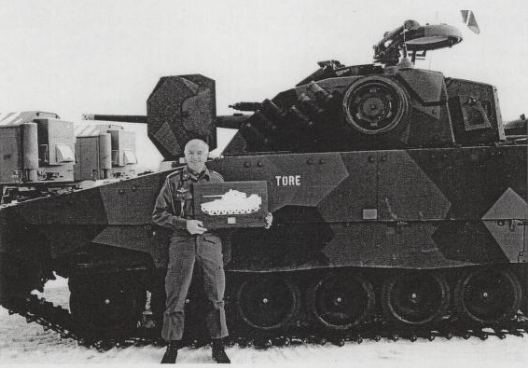
The first one delivered, seems like the CV9030 IFV was further modified and part of the delivery.
SOME DETAILS OF THE CV9030 IFV
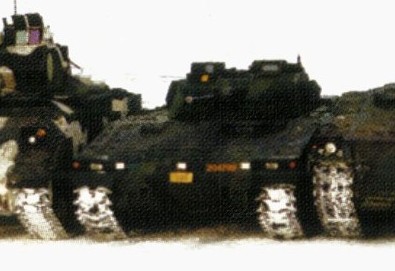
Norwegian Modifications done at Kværner Eureka in Norway
-Early development version of the 30x173mm Mk.44 Bushmaster II
-New coax mg, different placement, FN MAG 7.62x51mm
-Turret position indicator
-New Observation cupola for the wagon commander
Norwegian Requested modifications done by Hägglunds in Sweden
-Improved suspension for maximum support for the crew
-Improved protection (Don’t know exact details here)
-A more powerful engine, trimmed from 550hp to 610
-Increased fuel tank capacity
ARMAMENT
Spoiler
-
1x 30x173mm Early Development Mk.44 Bushmaster II
Shell: 30x173mm
Muzzle velocity 1,080 m/s
600 rounds per minute
Ammunition capacity: 400 rounds
The ammunition is banded, automatic loading from channels that run along the inside of the turret ring with a capacity of 2x200 rounds -
1x 7.62x51mm FN MAG general purpose machine-gun
Firing rate: 1150 rounds/min
Muzzle velocity 820 m/s
Belt fed ammuniton -
6x (2x3) Smoke grenade launchers
TECHNICAL DATA
Spoiler
Specifications
Eigne: Scania DS 12 turbo diesel
Horsepower 610 Hk
Volume: 14L
Top speed: 70km/h
Lenght: 6.54m
Widht: 3.18m
Weight: 26 tons
Crew: 3+8 men, Driver, Commander, Gunner, + 8x Infantry
Performance:
Max wading depth: 2600
Vertical obstacle: 2000 mm
Climbing slope: 50%
Side slope: 45%
Range: 950 km
Ground clearance: 200 mm
Max trench width 3100 mm
VIDEO
SOURCES
Spoiler
Kavaleriet i Norge 1200-1994 : utvikling og innsats gjennom 800 år
Link: Nasjonalbiblioteket
Søndenfjeldske dragonregiment 1987-2002
Link: Nasjonalbiblioteket
Den Sorte lue : medlemsblad for kameratforeningen Norske Dragoner hvori opptatt Hedmarks Dragonforening. november 2008 Vol. 5 Nr. 4
Link: Nasjonalbiblioteket
Norsk militært tidsskrift (trykt utg.). 1992 Vol. 162 Nr. 8/9
Link: Nasjonalbiblioteket
Forsvarets forum (Forsvarets rekrutterings- og opplysningstjeneste) : organ for alt personell i Forsvaret. 1993 Vol. 14 Nr. 4
Link: Nasjonalbiblioteket
POLL
- Yes
- No
