- Yes
- No
- (independent) BeNeLux tree
- France: BeNeLux subtree
- other
- no/negative
- 2 × 12.7 mm Browning M2 HMG
- 1 × 20 mm autocannon + 1 × 12.7 mm HMG
- other (please comment)
- no/negative
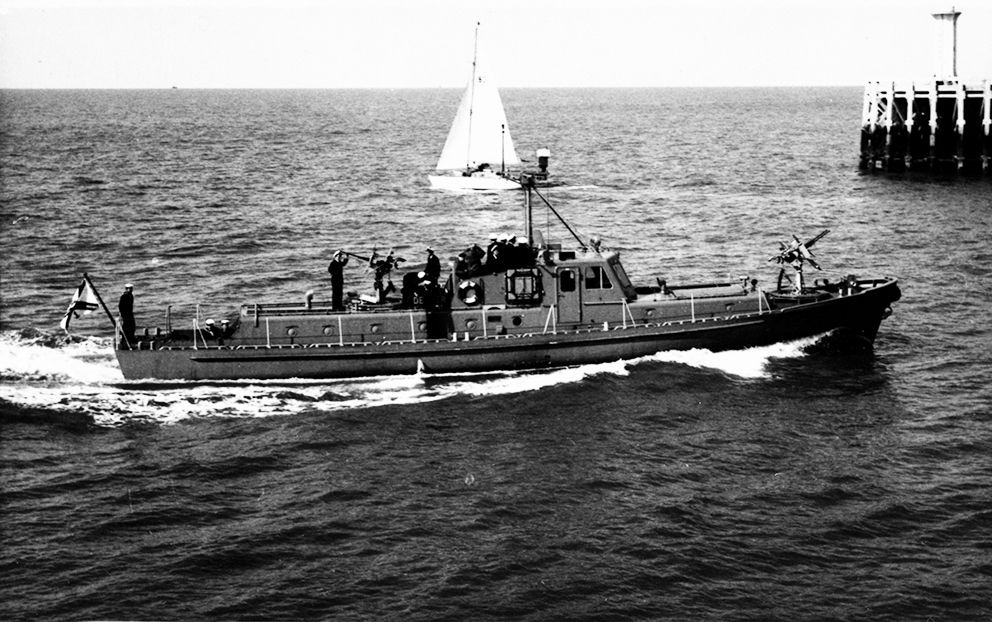
History
Service History of Dender
Initially, Dender served with the Belgian Force Navale from her commissioning in November 1954 until 1964. As part of the Congolais-class, she shared most features with her sisters Rupel and Ourthe, with minor design differences for tropical deployments: the deck had reduced camber, raising the stern 25 cm higher, wheelhouse windows were taller, and aft crew compartments used round portholes. Underwater hull dimensions remained identical to the Leie-class.
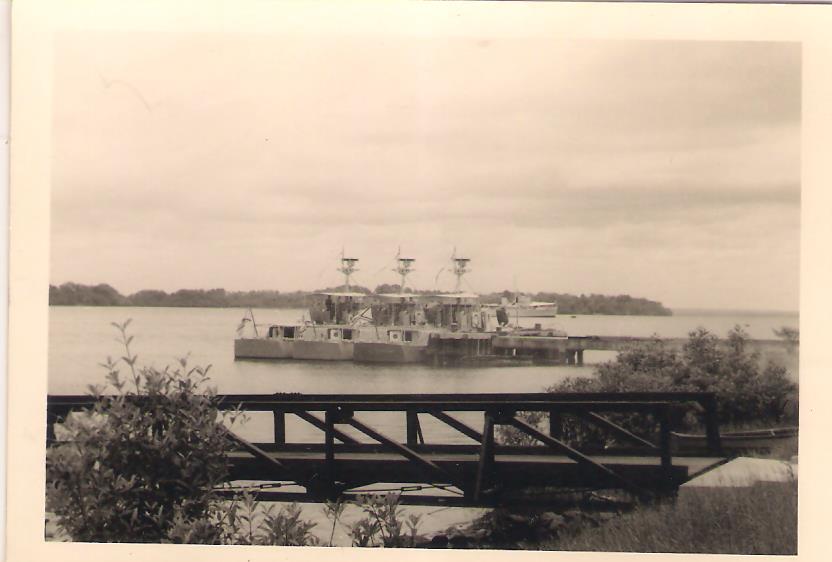
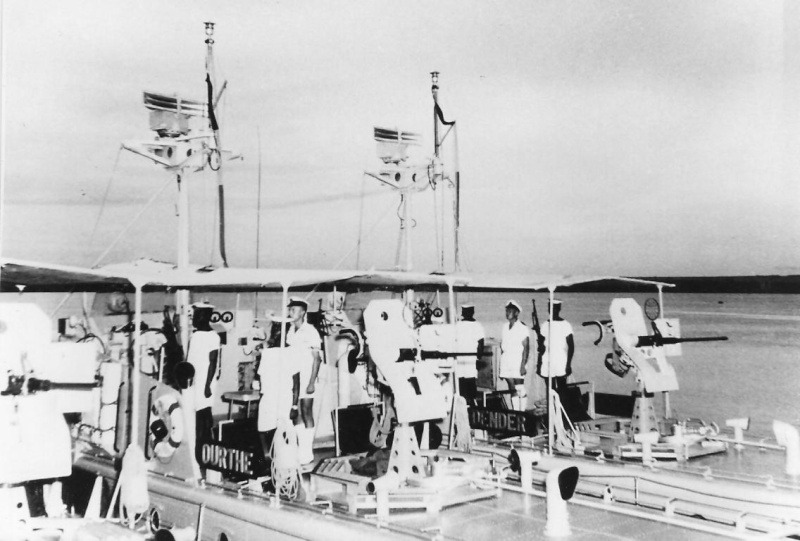
Dender and her two sister ships at Banana Naval Base in 1957From 1956, Dender was deployed to Congo, operating out of Marinebasis Banana. Alongside Ourthe and Rupel, she performed patrol duties, riverine transport, and sovereignty missions along the Congo River. Her shallow draught and agility allowed her to access smaller tributaries and perform troop landings when necessary.
In 1960, she participated in Operation CAMOENS, acting as a landing vessel for troops. During this mission, she operated without a hull number.
After returning to Belgium, the Dender was employed in civilian and commercial operations. From 1964 to 1970, she was used by INATRA, under A. Schreyen in St. Denijs Westrem. Between 1970 and 1972, she operated under Decross A. and Vollekindt A. in Ghent. These later roles highlighted the vessel’s continued versatility and robust construction.
The Dender remains notable as the last of the Congolais-class, combining riverine performance with flexible armament, representing both Cold War European and postcolonial African deployments.
Specifications
Displacement: 25 tons
Length overall: 24.25 m
Length between P/P: 23.0 m
Beam: 3.8 m
Draught: 0.9 m
Range: 2,300 nm at 10 knots
Speed: 19 knots
Propulsion: 2 × MWM RHS 418 A 8-cyl diesels (220 hp each), 2 shafts
Radar: DECCA 707
Crew: 1 petty officer + 6 sailors
Radio call sign: ORJLArmament Layouts
Variant Weapons Placement Notes Dual HMG 2 × 12.7 mm Browning M2 HMG Fore & aft Original configuration, suitable for general river patrols. Mixed Autocannon + HMG 1 × 20 mm autocannon + 1 × 12.7 mm HMG Aft (20 mm), fore (HMG) Congo short-timed configuration for stronger firepower.
Place in War Thunder
The Dender would integrate naturally into a BeNeLux naval tree or French subtree, offering historically accurate riverine patrol capabilities. Two playable variants could be implemented:
- Dual HMG version – a lighter patrol option, ideal for early-tier gameplay or reserve fleets.
- Mixed 20 mm + HMG version – a more heavily armed variant, effective for small engagements or troop transport scenarios.
These layouts reflect her historical service both in Belgium and in Congo, providing narrative depth for mission-based gameplay involving river patrol, troop landings, and Cold War European operations.
Sources
Sources
- Agentschap Onroerend Erfgoed — Inventaris Onroerend Erfgoed 2025: P902 Libération [online], P902 Libération | Inventaris Onroerend Erfgoed
- Coulier, F. (2008–2009). Het Belgisch maritiem Rijnsmaldeel I–IV, Neptunus
- Anrys H., De Decker de Brandeken J.-M., Eygenraam P. (1992). De Zeemacht
- Van Ginderen L. & Delgoffe C. Fotoboek Belgische Zeemacht 1946–1996
- MAS Antwerp archives (for Congolais-class patrol craft data)
- Jane’s Fighting Ships (1950s–1960s editions)