United States — Anderson-Walker / Tate-Alekseevskii Model
The U.S. Army Research Laboratory (ARL) primarily adopts the modified Bernoulli equation based on fluid dynamics, with the core being the Tate-Alekseevskii model:
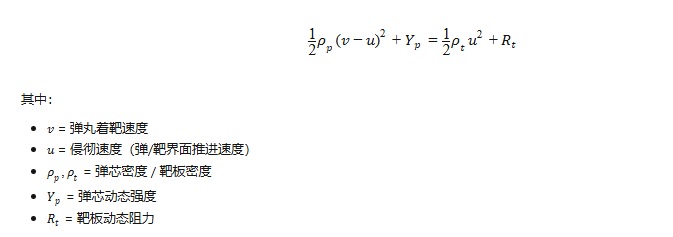
The penetration depth is obtained by integration:

Europe (Germany/France/United Kingdom/Switzerland) — Lanz-Odermatt Equation
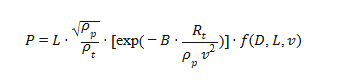

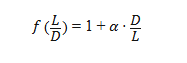
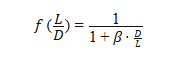
Odermatt presented two forms in 1999 and 2006:

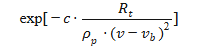
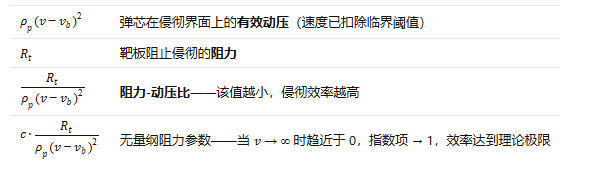
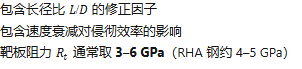
The Physical Meaning of the Exponential Term
Russia — Empirical/Semi-Empirical Method



China — Comprehensive Algorithm
Corrected Tate Model: Introducing the adiabatic shear sensitivity coefficient of the elastomer core material based on the classical hydrodynamic model


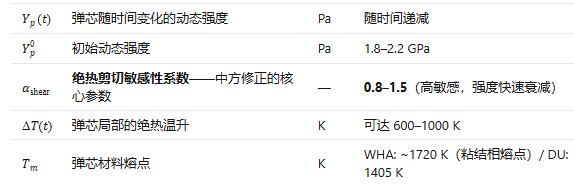
China’s Modification of the Tate Model — Adiabatic Shear Sensitivity Coefficient
The most important correction parameter introduced by China in the classical Tate equation:

The Chinese approach differs from the L-O equation, which uses a constant exponent to cover the entire velocity range; instead, it adopts a segmented method.

Layered Model of Target Plate Resistance in China
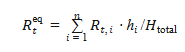

This is physically more reasonable than the L-O equation and is especially suitable for evaluating modern multilayer protective systems such as ceramic-steel-fiber composite armor.
Limitations of the Lanz-Odermatt Equation for Modern APFSDS
Although the Lanz-Odermatt equation (hereinafter referred to as the L-O equation) is elegant in form and clear in physical meaning, it reveals several systematic weaknesses when faced with the design evolution of modern long-rod penetrators:
Failure to Account for Adiabatic Shear Failure
This is the most fundamental defect. The L-O equation assumes that the penetrator core maintains ideal hydrodynamic flow during penetration. In reality, modern high length-to-diameter ratio tungsten alloy cores undergo adiabatic shear fracture at high impact velocities:
- During penetration, WHA (tungsten heavy alloy) experiences a rapid local temperature rise, causing material thermal softening → localized shear → periodic “spalling” at the penetrator tip.
- The L-O equation does not describe this non-steady penetration behavior and always assumes that the penetrator participates in penetration in a continuous jet form.
Crude Handling of Length-to-Diameter Ratio Effects
The L-O equation addresses the length-to-diameter ratio with a correction factor, which is purely empirical and lacks mechanistic support. The equation cannot describe the sudden drop in penetration depth caused by bending/deflection of the core at high L/D ratios. The penetrator does not always penetrate along the axis.
Assuming Constant Target Resistance, Ignoring Strain Rate and Pressure Effects
The L-O equation treats the dynamic resistance of the target plate as a material constant (RHA ~ 4–5 GPa).

Insufficient description of differences in penetrator core materials. The validity of the L-O equation is highly dependent on the velocity range:
- Too low a velocity (<1000 m/s): penetration transitions from the hydrodynamic to the rigid body penetration regime, and the equation’s predictions fail.
- Too high a velocity (>1800 m/s): the strength of the penetrator core can be neglected, approaching the pure hydrodynamic limit, but at this point, shock wave effects become significant, which are not reflected at all in the L-O equation.
Unable to handle lateral effects and edge effects.
Applicable to APFSDS longer than 500 mm.
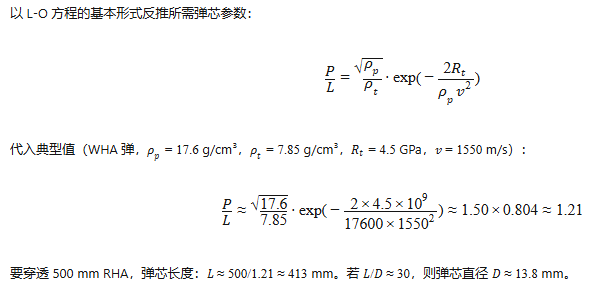
This means that the length of the projectile core in the 500 mm penetration depth range has exceeded 400 mm, and the assumed boundary of the L-O equation has begun to loosen significantly.

The long penetrator core does not participate along its entire length simultaneously during penetration. When the rear end (tail) of the penetrator enters the target plate, the front end of the core has undergone significant erosion and deformation. In reality:
- The longer the core, the lower the efficiency of the tail in transferring ‘thrust’ during the later stages of penetration.
- The timescale of stress wave propagation within the core is comparable to the penetration timescale, so the effects of stress wave reflection cannot be neglected.

The L-O equation takes a constant as input, ignoring the deceleration effect during the penetration process.
Back surface effects of the target plate:
The L-O equation assumes a semi-infinite target plate, completely ignoring the back surface. When the penetration depth approaches the actual thickness of the target plate, the final stage of penetration can be accelerated.
This means that it is completely impossible to perform proper calculations for DM43, DM53, M829A1, M829A2, 3BM46, 3BM60, DTC10-125, DTW-105, M900, and similar types.
For thicknesses above 500mm (i.e., modern APFSDS), it is more appropriate to use Chinese or American calculation methods.
The American Tate-Alekseevskii / Walker-Anderson model differential equation system establishes a system of differential equations in the time domain.
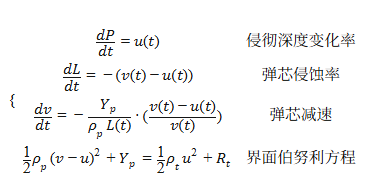
The American method captures the velocity-mass coupled attenuation during the penetration process—the projectile core becomes shorter and slower as it penetrates, and this deceleration, in turn, affects the instantaneous penetration efficiency. For a large penetration depth range greater than 500 mm, the absence of this mechanism directly leads to a 5–15% system deviation (as previously demonstrated).
China
Correction of the Tate model
Introduction of the adiabatic shear sensitivity coefficient α_shear
Introduction of a dynamic recrystallization softening factor for the projectile core material
Incorporation of temperature field corrections to Y_p
Dimensional analysis semi-empirical formula
Regression of key coefficients using a large experimental database
Establishment of coefficient sets separately for WHA / DU
Multivariable power-law model including L/D, v, and ρ
Finite element numerical simulation
Reproduction of adiabatic shear band formation and evolution
Simulation of projectile core fracture/yaw/back-surface effects
文献.zip (33.9 MB)