- Yes
- No
Hello everyone and welcome to this new suggestion
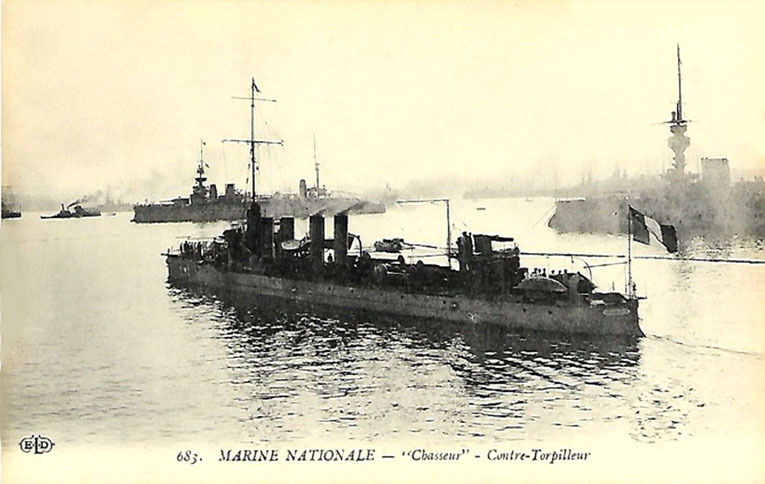
Today I present to you a new class of French destroyer, the Chasseur class, and to start here is the first ship of the class named the Chasseur.
The Chasseur class represents the ninth generation of French destroyers. While clearly inspired by earlier designs, it introduced a key improvement: a significantly higher maximum speed. These ships could regularly reach 31 knots, compared to around 28 knots for their predecessors. Aside from this performance boost, the class remained relatively conventional, retaining armament and equipment broadly similar to earlier French destroyers.
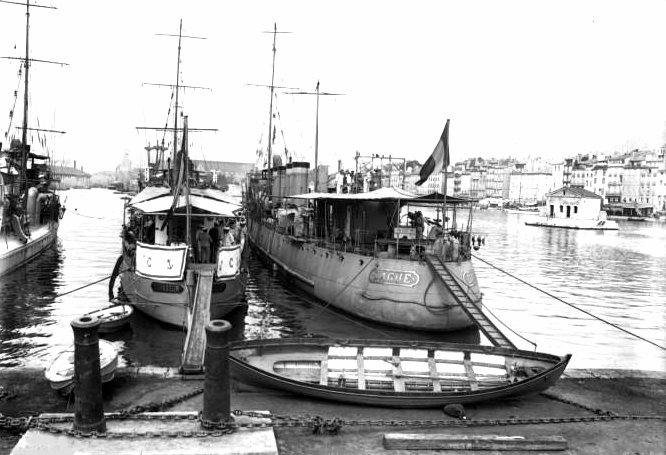
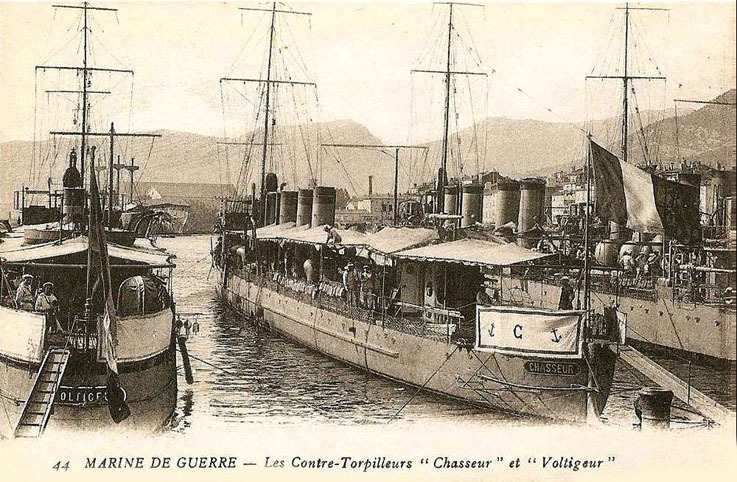
The Chasseur was laid down in Le Havre in 1909, built under the direction of the Augustin Normand shipyards, and launched later that same year. It entered service in 1910 with the 1st Naval Army, operating in the Mediterranean. In its early years, it primarily carried out patrol and surveillance missions. The ship could be easily identified by a painted “C” on its bow.
At the outbreak of the First World War, the Chasseur remained assigned to the Mediterranean Fleet. Like other destroyers in the region, it took on escort duties, protecting major French warships, particularly armored cruisers. As part of the 3rd Torpedo Boat Flotilla, the ship participated in the Battle of Antivari, where French destroyers were tasked with screening French and British battleships. However, due to the brief nature of the engagement and the limited resistance encountered, the Hunter did not see direct combat.
In the years that followed, the ship was reassigned, like many vessels of its type, to escort and protect transport and merchant ships. This strategic shift came after the torpedoing of the battleship Jean Bart, which highlighted the vulnerability of large warships and emphasized the value of smaller, faster, and more maneuverable vessels in countering German submarines.
The Chasseur passed through the war without any major incidents. However, due to his age and recurring engine problems, he was withdrawn from active service in 1919 and sold for scrap in Toulon the following year, bringing his career to a close.

Characteristics
Length : 64.20 m
Width : 6.60 m
Draught : 2.30 m
Mass : 490.00 tons
The ship is powered by three steam turbines fed by four Normand boilers, providing a total power output of 7,500 hp. Its advertised maximum speed was 29 knots (actual speed 30 knots).
The crew consists of 77 sailors.
Weapons
The ship’s armament is not particularly impressive, consisting only of medium-caliber guns; however, it is still sufficient to engage various types of targets. The following armaments are present :
- 6 x 65mm Mle 1891
- 3 x front guns
- 3 x back guns
- 3 x 450mm torpedo tube Mle 1906 (3 torpedo + 3 in hold)
- 1 x frontal fix tube
- 2 x tubes on turrets
This ship would be an interesting addition to the French tree, providing a ship with good combat capabilities and able to defend itself against various threats, thus complementing the French coastal tree.
Pictures
Sources
- https://www.servicehistorique.sga.defense.gouv.fr/ark/1023078
- CHASSEUR - Contre-torpilleur | Service historique de la Défense
- 16-2-12, Marseille, contre-torpilleur “chasseur” : [photographie de presse] / [Agence Rol] | Gallica
- The French Navy in 1914
- WW1 French Destroyers
- CLASSE Chasseur
- CHASSEUR - Contre-torpilleur - Page 2 - Forum PAGES 14-18